
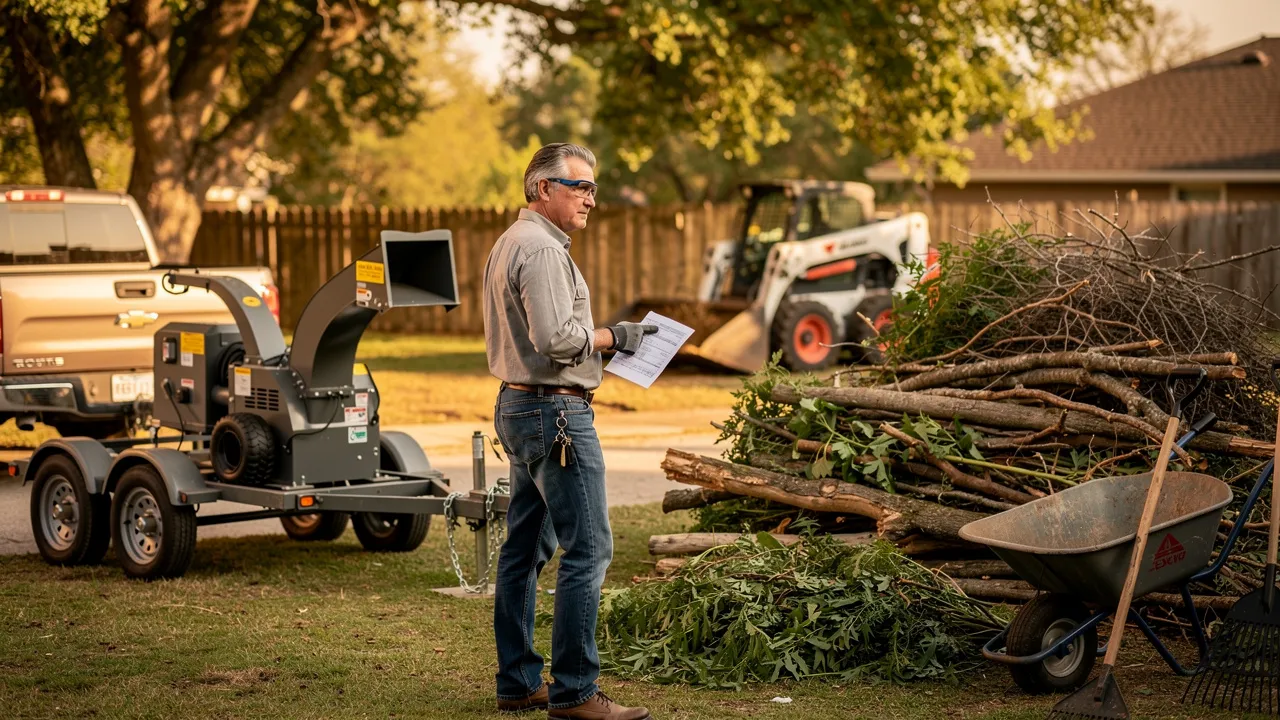
Start with the debris and the result you need
A brush chipper rental decision starts with the material you need to process and the result you want from the cleanup. In Irving and across Dallas–Fort Worth, your project might involve woody branches from pruning, a mixed pile of brush and leafy cuttings, or debris from tree clearing. Describe the actual job rather than assuming that a broad equipment label establishes what a specific machine can handle.
Your first description should cover three points: what the material is, roughly how much there is, and what you want the cleanup to accomplish. If the pile contains different kinds of debris, name them separately. Those details give a rental provider a starting point for checking fit; they do not confirm that a particular unit is suitable.
Your cleanup goal should be clear before you ask about equipment. For example, explain whether you are processing cut branches or handling a wider yard-clearing task, and describe what you want done with the material. Keep that goal separate from the machine question: a provider still needs to address whether an exact unit is appropriate for the work and debris you describe.
A rough estimate is useful if you label it as rough. Note whether the material is in one pile or several, whether it is mostly woody branches or a mix, and whether you know the largest branch size. If you are uncertain about any of those details, say so. Your goal is to make the project understandable, not to assign a machine capacity on your own.
Describe the material, not just the brush
Your debris inventory should distinguish the materials you expect to put through the equipment. “Brush” can leave important details unclear, so describe whether the pile includes woody branches, leafy cuttings, vines, or a mixture. These are ways to explain your job, not a promise that a particular machine accepts each material.
Estimate the amount in everyday terms you can explain: the number of piles, their approximate dimensions, or the area where you have gathered debris. If the material is divided into separate piles or includes noticeably different types, mention that too. A rough description is more useful than presenting a guess as an exact volume.
Include the source of the material when it helps explain the work. You might describe pruning, shrub clearing, or tree-clearing debris, then say which material makes up most of the pile. If you are unsure how to classify something, describe its appearance and size rather than choosing a technical label that may not fit.
Your debris type is a useful part of the equipment question. In an article published on February 12, 2026, TMG Industrial said brush-attachment choice depends on the chipper’s chipping capacity and the intended debris type. Describe your actual mix and ask whether the specific equipment being discussed suits it; that general point does not confirm that a particular machine will handle your pile.
Your estimate and material list are a starting point, not a fit decision. The provider may need more detail about the largest branches or mixed debris before addressing a specific machine. If you have not sorted or measured the material, say that rather than turning a rough estimate into a specification.
You can also separate what you know from what you need checked. For example, you may know that the pile includes cut branches and leafy material but not know the largest branch diameter. State the known details, then ask what additional description would help the provider assess the unit under consideration. This keeps the discussion tied to your project instead of an assumed or generic load.
Clarify whether the offer is a chipper or an attachment
Your equipment question should make clear whether you mean a complete chipper or a brush attachment. If a conversation or description uses the word “brush,” ask what specific item that refers to and what equipment would be included. An answer about an attachment alone does not identify the complete setup you would need for the project.
Keep the distinction practical. First establish what item is being discussed; then describe your debris and intended work. Ask whether the complete equipment and any attachment being considered are meant for that material. Do not treat a broad category name as confirmation about a specific machine, configuration, or accessory.
Your attachment question should be tied to the machine and debris, not just the attachment’s name. TMG Industrial said brush-attachment choice depends on the chipper’s capacity and the intended debris type. Share what you plan to process and ask whether the particular chipper and attachment under discussion are compatible with that work.
Your inquiry should distinguish what is included from what may be optional. Ask what complete equipment or attachments are part of the proposed setup, and whether any item you need for the described work is not included. If no attachment is being discussed, you can focus on the complete chipper and the material it is intended for.
This distinction helps you avoid treating a product label as an answer to several different questions. You need to know what equipment is being considered, what accessories are included, and whether the provider can address its fit for your debris. Keep those points separate so an answer about one does not stand in for the others.
Use branch-size examples only to frame a question
Your largest branch dimension is a useful detail to report, but a general product example is not a specification for a local rental unit. Rntr’s guide, published on June 23, 2026, says a 6-inch wood chipper handles branches up to 6 inches in diameter. That statement describes the guide’s example, not a machine confirmed for your Irving or DFW project.
Your smaller branches do not, by themselves, settle whether a machine fits the whole job. Rntr’s June 23, 2026, guide says a 6-inch chipper will move through material mostly under 4 inches quickly. Treat that as the guide’s general example, not a promise about the pace or outcome of your project or a specification for an available unit.
Your largest branch diameter gives the provider a concrete point to check. If you can, estimate or measure the thickest branch you expect to process, and say whether most of the material is smaller, close to that size, or mixed. If you cannot measure it reliably, explain that and ask how to describe it.
Then ask what the exact unit accepts. Do not select equipment based on a general 6-inch example or assume that a similar label means the same thing. The answer needs to address the machine being considered and the dimensions and debris mix you have reported.
Clarify whether the offer is a complete chipper or an attachment
For this inquiry, first clarify whether the item under discussion is a complete chipper or a brush attachment. Gather the details you can before making an inquiry:
- Location: Give the project address or area in Irving or elsewhere in DFW, and identify where on the property the work will take place.
- Intended work: Describe whether you are pruning, clearing brush, or handling another yard or tree task. State the result you want from the cleanup.
- Material mix: List the kinds of debris, say whether they are mixed together, and estimate the amount in plain terms.
- Branch size: Share the largest diameter you expect and whether the rest of the material is mostly smaller or varies considerably.
- Site access: Describe the route to the work area and any gate, narrow path, slope, or other access detail you already know.
- Dates and duration: Give the dates you have in mind and how long you expect to need the equipment.
- Transport plan: Explain whether you expect to arrange transport yourself or need to discuss other arrangements.
If you do not know an answer, mark it as an open question instead of filling the gap with a guess. The brief helps organize a conversation; it does not establish equipment specifications or confirm a rental.
Your questions should connect the project details to points the provider can address for a specific unit. Ask whether a complete chipper is available for the dates you have in mind, whether that machine is intended for your reported material and branch dimensions, and what equipment or attachments are included. If the debris is mixed or difficult to describe, ask whether more detail is needed before the provider can assess fit.
Separate the equipment questions from the commercial ones. Ask about current pricing, the rental period and applicable terms, available transport arrangements, and any included accessories. If delivery matters to your plan, ask whether it is available for your location and what conditions apply. If you expect to transport the equipment, ask what pickup and return arrangements would apply. Treat each answer as specific to the arrangement being discussed.
Your project address and the route to the work area are different pieces of information. The address identifies where the job is; details about gates, paths, slopes, and work-area access explain where equipment would need to go on site. Share both when they matter to the inquiry, and ask what information is needed to discuss access or transport.
Do not assume that naming an Irving or DFW address settles delivery, placement, or access. Keep those logistics open until you have an answer for your site and the equipment under consideration.

Confirm availability, specifications, and terms for the exact unit
Your requested dates are part of the availability question. Ask whether a suitable brush chipper is available for those dates instead of treating a search result or a general equipment description as confirmation. If a provider identifies a possible unit, clarify which exact machine is meant and whether it is a complete chipper or another item.
Your equipment-fit question needs an answer about the specific unit, not a different machine’s specifications. Ask whether that unit is intended for the material types and largest branch dimensions you reported, and whether the proposed setup includes any attachment you discussed. If the answer uses a capacity or size figure, ask what it measures and whether it addresses the debris mix you described.
If a detail is still unresolved, keep it unresolved. A general example can help you phrase the question, but it does not describe an unidentified rental machine. Before deciding, make sure the answer refers to the unit being considered and your stated project.
Your questions about price and logistics need answers for the proposed arrangement. Ask what the price covers, which dates and duration it applies to, and what pickup, delivery, or return arrangements are available. Explain any timing that affects your plan, then ask whether the terms address those dates.
Keep equipment fit separate from cost and transport. An answer on one point does not settle the others. You need a clear response about the unit, the applicable terms, and the arrangements you would rely on before deciding whether to proceed.
Your decision can remain provisional until the provider has addressed the points that affect your project: availability for your dates, suitability for the material and work you described, and the timing, transport, and terms. If an answer changes the project scope or arrangements, update your brief and ask about the revised plan.
Proceed with the rental decision only when the details that matter to your project have been answered. If a key point remains open, the practical boundary is simple: do not treat the unit or arrangement as confirmed.
Rely on instructions for the specific rental machine
Your operating instructions should match the exact machine you receive. Ask the provider how to obtain that unit’s operator manual and instructions, then follow the directions supplied for that equipment. General chipper/shredder guidance is not a substitute for instructions for an unidentified rental unit.
Your protective equipment choices should account for the guidance available for the equipment. ECHO’s chipper/shredder guide recommends gloves, safety goggles, ear protection, and sturdy clothing that protects against flying debris and loud noise. Treat that as general guidance from ECHO, not as the complete operating instructions for a rental machine you have not identified. For an Irving or DFW project, ECHO’s guide also advises removing rocks, metal, and large foreign objects before feeding wood or debris into a chipper/shredder; mention these in the pile when asking what preparation steps apply to the exact unit.
ECHO’s guide also advises keeping children and pets away during operation and not standing directly in front of the hopper. Treat these as general guidance, not unit-specific directions; obtain and follow the exact machine’s manual and provider instructions.
Your operating questions come after you know which machine is being discussed. Ask where to find its instructions and whom to contact if you need clarification. If you are unsure how an instruction applies to that equipment, get clarification from the provider before proceeding rather than relying on a general example.
Clarify whether the equipment is a chipper or a brush attachment
Contact EZ Equipment Rental to ask whether a suitable brush chipper is available for your project and what information is needed to assess it. Availability, fit, and terms need direct confirmation for the equipment and dates you are considering.
At EZ Equipment Rental, we provide personalized recommendations based on your specific needs and budget. Include the details that matter to your project so we can understand what you want to accomplish and what needs an answer.
Our Irving location is at 1307 W Airport Fwy, Irving, TX 75062. Use your project brief to make the inquiry specific and request a direct answer about the equipment and arrangements you need.
What should you ask before inquiring about a brush chipper?
Does EZ Equipment Rental currently offer brush chipper rentals in Irving or DFW?
Current brush chipper availability is not confirmed.
Can a brush chipper handle leafy or stringy yard waste?
Do not assume it can. Describe the mix of woody branches, leaves, vines, or other debris and ask whether the specific unit under consideration is intended for those materials.
How much does it cost to rent a brush chipper?
No current chipper rental price is confirmed. Request a quote for the specific unit and dates, and ask what the quoted amount covers, including the rental period and any transport arrangements or accessories.
Sources
- Late Winter Landscaping with a Wood Chipper Brush: Efficient Yard Cleanup for Spring — www.tmgindustrial.com, 2026-02-12
- Renting a Wood Chipper: Complete Guide | Rntr — rntr.com, 2026-06-23
- Contact EZ Equipment in Dallas, TX — www.ezequipmentrental.com
- Equipment & Tool Rentals in Dallas TX - EZ Equipment Rental