
Start With the Site Outcome, Not the Machine Name
For an Irving or DFW site-work project, the useful starting point is the physical result the crew needs, not a machine name in isolation. Earth moving, excavation, trenching, and compaction describe different relationships between terrain, material, and the finished area. Use that distinction to frame an equipment-category question; a category still does not identify a particular machine, current availability, or suitability.
This approach focuses on the boundary between work phases. It asks what changes at the site, what happens to removed or displaced material, and whether the work follows a surface, below-surface, narrow-route, or finishing phase. Those answers make a request more precise without turning general guidance into an individualized fit claim.
A useful rental decision has four parts:
- Work: State whether you need to move, dig, trench, grade, level, or compact material.
- Conditions: Describe the material, access route, working area, attachments, and intended users.
- Schedule: Give the start date, expected rental window, and whether the timing may change.
- Arrangement: Ask about the exact unit, availability, delivery or pickup, pricing, responsibilities, insurance, and rental terms.
This sequence keeps the inquiry practical. Prepare the project scope, machine requirement, jobsite access details, rental timeline, operator availability, and attachment needs before contacting a rental company.
Define Earth Moving by the Change to the Terrain
Earth moving is construction work that reshapes terrain through grading, leveling, and contouring to create a suitable foundation. Earthwork can also involve removing and rearranging excavated material, including removing vegetation or topsoil before digging and grading. The term therefore names a broad site-work function, not a universal machine.
For an Irving or DFW project, describe the change to the terrain and the movement of material separately. A work phase may change an area’s level or contour, remove material, redistribute it, or prepare a foundation. Those descriptions identify the kind of site change under discussion without treating the broad term “earth moving” as a fixed rental package.
Earthwork also has a sequence that can affect the equipment conversation. Vegetation or topsoil may need to be removed before digging and grading, while excavated material may later need to be moved or rearranged. The work may therefore involve more than one task, even when the project team initially describes it with one broad term.
Treat the definition as a planning screen, not as a machine recommendation. Write down the first task, the next task, and the material each task involves. Then ask which equipment category should be discussed for those conditions.
To keep the categories distinct, compare the work on three dimensions: the shape of the area being changed, the direction of material movement, and the condition expected at the end of the phase. A broad area being raised, lowered, leveled, or contoured points to a terrain-change description. Material being removed from below the existing surface points to excavation. A narrow route points to trenching, while a prepared area that needs consolidation points to compaction. These are descriptive tests, not specifications for a particular unit.
The material-flow question is especially useful when a single phase uses several verbs. “Remove” describes taking material out of an area; “rearrange” describes placing or redistributing excavated material; “grade” or “level” describes the resulting terrain; and “compact” describes the condition of a prepared area. Keeping those actions separate tells the rental discussion whether the primary issue is changing the ground, creating a route, or finishing an area. It also prevents the broad label earth moving from hiding a second task that may need its own category discussion.
Use the finished-site outcome as a final check. If the outcome is a changed foundation area or contour, describe that outcome and the preceding material work. If it is a narrow route, describe the route rather than calling the entire project earth moving. If it is a prepared area, describe the surface condition to be achieved. A project can contain all of these phases; the useful classification is the one attached to the phase being discussed, not a claim that one category covers every phase.

Separate Moving, Excavation, Trenching, and Compaction
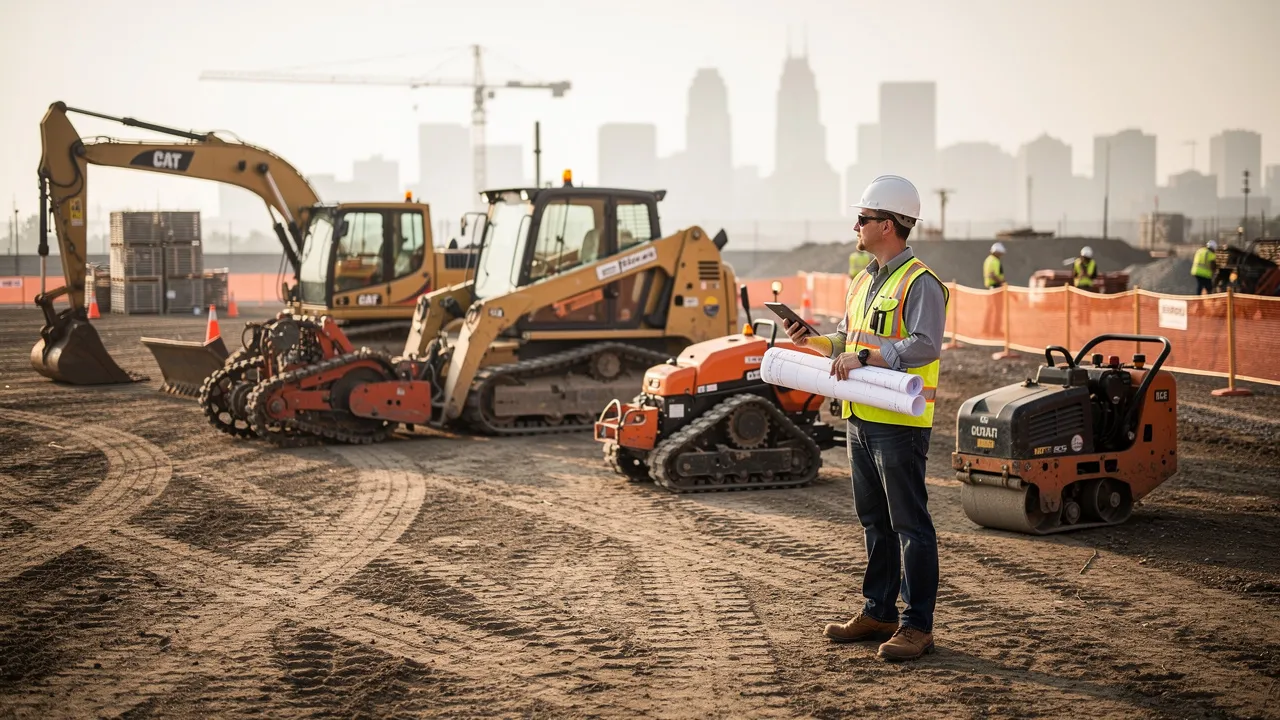
Build a phase handoff note for the Irving or DFW project before discussing a rental. Record what changes during each phase, what material is moved or prepared, what result the next phase receives, and which broad category should be discussed. Earthmoving work may use bulldozers, scrapers, graders, and dump trucks to move large amounts of earth. Trenchers are earthmoving equipment, while compactors and drum rollers are compaction equipment. A category remains a question to confirm; it does not identify a particular machine or establish availability or site suitability.
Write the phases as a sequence rather than as a list of interchangeable machines. One phase may reshape terrain, a later phase may create a narrow route, and another may consolidate a prepared area. Keep the transition visible by stating what the earlier phase leaves behind and what the next phase must address. This separates earth-moving machinery, trenchers, and compaction categories without presenting one label as a complete project plan.
Use these fields for each phase:
- Phase result: the terrain change, excavation, narrow route, or prepared area involved.
- Material: what is removed, displaced, rearranged, or prepared.
- Next handoff: the condition or work area that the following phase receives.
- Category to discuss: the earth-moving, trencher, or compaction category connected to that phase, not a selected machine.
- Confirmation points: the equipment specifications, attachments, access conditions, rental period, and other terms that still require discussion.
For example, a DFW site-work brief can state that the opening phase changes terrain through grading or leveling, the next phase creates a narrow route, and a later phase addresses the prepared surface. The request can name earth-moving machinery, trenchers, and compactors or drum rollers as separate category questions, with material, access, dates, and attachment needs attached to the relevant phase.
Another sequence may begin with removing and rearranging excavated material, then move to a prepared area. Record the excavation phase and the compaction phase separately instead of letting either label stand in for the full scope. The resulting note gives EZ Equipment Rental a defined work sequence to discuss, while the exact unit and arrangement remain subject to confirmation.
Use the following task screen before you ask about a rental:
- Moving or reshaping: If the primary work is shifting large amounts of earth, grading, leveling, or contouring, describe the volume and the intended finished area. Ask about earth-moving machinery and state that the category still requires a site-specific fit discussion.
- Digging or excavation: If the work is removing material below the existing surface, describe the excavation area, material, depth requirement, and where the material must go. Ask which excavation category is relevant, then leave the exact machine choice for confirmation.
- Narrow trenching: If the work is creating a narrow route, identify the purpose, approximate route, material, access, and any attachment needs. Ask about trenchers as an earthmoving category, but do not treat the label as proof of suitability.
- Compacting: If the work is consolidating or finishing a prepared area, describe the material and the area to be covered. Ask about compactors or drum rollers as compaction categories, then confirm the exact equipment and operating requirements.
End each branch with a question about the work, not an assumption about the machine. That keeps a category shortlist separate from a confirmed rental match.
Compare Categories by Their Physical Function
EZ Equipment Rental offers heavy earthmoving machinery along with high-reach aerial work platforms, towable air compressors, concrete demolition tools, surface preparation systems, mobile generators, trash pumps, and utility trailers.
This list does not identify a particular machine, establish current availability, or replace an equipment-fit discussion.
The strongest shortlist uses one primary category and, when necessary, one supporting category. For example, you might describe grading as the primary task and material transport as a supporting need, or describe trenching as the primary task and surface restoration as a later phase. State which task comes first and which task controls the rental timing.
Send the shortlist as a starting point rather than as a request for a predetermined unit. EZ Equipment Rental offers earth-moving machines and trenchers as categories to ask about, but the category does not identify a particular machine for your job. Ask for the exact equipment discussion after you provide the work and site details.
Compare a category shortlist by the outcome it explains, not by how many machine names it contains. A useful shortlist answers three questions: what changes first, what happens to the material during that change, and what condition remains when the phase is complete. A list that cannot answer those questions is still a topic label, not a clear category conversation.
For a foundation-oriented phase, the description can center on grading, leveling, contouring, and removal or rearrangement of material. For a route-oriented phase, center on the narrow path and the material involved, then identify trenchers as the category to discuss. For a finishing phase, center on the prepared area and the need for compaction, then identify compactors or drum rollers as the category to discuss. These comparisons explain why the same project may move from one category discussion to another as the site changes.
Use the category label as a translation of the work description. Earth-moving machinery is broad when the project changes terrain or moves large amounts of earth; trencher is narrower when the defining result is a narrow route; and compactor or drum roller relates to consolidation of a prepared area. The labels can coexist in a project plan, but they should not be presented as interchangeable answers to the same physical action. Keep the outcome and phase beside each label so the request remains understandable without asserting that any listed category fits the site.

Trace the Work Sequence Before Naming Equipment
Before naming equipment, form a phase map: the primary physical change, the material handled, the finished area or route, and the sequence of related phases. Note whether the site work involves broad movement, below-surface removal, narrow trenching, or compaction, and identify any transition between them.
Keep the map descriptive rather than predictive. It can state the task, material, access context, and sequence without claiming that a particular category or unit is suitable. The rental conversation can then test the category against exact equipment details, attachments, and operating requirements.
A useful request might describe a planned site-work phase in Irving, the material to be moved, the area or route involved, the available access, the intended users, the attachment needs, and the dates. A DFW project outside Irving should include the specific city and jobsite location rather than relying on a general “Dallas area” description.
Separate known details from open questions. Write down the facts you can provide, then label the items that need an answer about equipment category, exact specifications, availability, delivery or pickup, pricing, responsibilities, insurance, or rental terms. This prevents a broad category request from being mistaken for a confirmed arrangement.
Treat Access and Material as Classification Conditions
Describe the site's access and material before asking which category to discuss. Note whether the work involves broad movement, a narrow route, or a prepared area for compaction, along with the relevant material and access limits.
EZ Equipment Rental can deliver to multiple DFW locations, including Dallas, Carrollton, Plano, Garland, Duncanville, Coppell, Irving, Fort Worth, Arlington, Mansfield, Richardson, Frisco, Hurst, Euless, Bedford, and Grand Prairie. Confirm the appointment, cost, site access, and equipment fit with EZ Equipment Rental before arranging the rental.
Rental documentation may include identification, payment or credit approval, an insurance certificate, a signed rental agreement, and operator certification when required. Operator certification may be required for aerial lifts, forklifts, cranes, and specialized machines. The applicable documentation depends on the equipment and arrangement, so include the intended users and ask what information is required for the category under discussion.
Before the project begins, confirm the equipment specifications, rental period, availability, condition, documentation, accessories, delivery arrangements, and rental terms. Make sure the intended users understand the equipment and applicable operating requirements. Put each open item in the project brief so the handoff does not depend on memory.
Use this short access and delivery record:
- Jobsite: City, address or project identifier, entrance, and contact person.
- Route: Delivery path, staging area, surface information, and access limitations.
- Timing: Preferred delivery date, work dates, pickup date, and any schedule flexibility.
- Handoff: Delivery or pickup preference and the person available to receive the equipment.
- Operators: Intended users and any relevant authorization or certification details.
- Questions: Equipment specifications, accessories, responsibilities, delivery terms, and rental conditions that still need an answer.
The record gives EZ Equipment Rental a specific DFW location and a practical operating context for the discussion.
Turn the Classification Into a Bounded Rental Question
Before choosing a rental arrangement, ask about availability, pricing, delivery or pickup, responsibilities, insurance, and the exact rental terms. Before signing, review the machine details, rental rate, usage hours, extra fees, insurance terms, damage waiver, return deadline, pickup process, and maintenance responsibility.
Use this question set:
- Is the proposed category and exact unit available for the requested rental window?
- Which specifications and accessories relate to the stated task?
- What delivery or pickup arrangement applies to the Irving or DFW jobsite?
- Which party handles fuel, maintenance, transport, and other listed responsibilities?
- What usage hours, extra fees, insurance terms, damage waiver, return deadline, and pickup process apply?
- What documentation and operator information are required before release?
EZ Equipment Rental offers flexible rental durations tailored to project requirements. State the expected work period and ask which rental duration and terms apply to your request.
A rental quote or discussion should remain tied to the project facts you supplied. If the task, material, access, operator, or dates change, update the request before relying on the earlier equipment or terms discussion. If an exact unit, condition, accessory, price, delivery arrangement, or responsibility remains unresolved, leave that item open until it has been addressed in the rental arrangement.

Keep a Category Label Separate From a Confirmed Unit
At the end of the classification exercise, keep three statements separate: the work phase, the equipment category to discuss, and the exact unit or arrangement that requires confirmation. That separation prevents a broad earth-moving or trencher label from being read as proof of availability or site suitability.
For an Irving or DFW request, send the phase description, material, access context, sequence, and rental window to EZ Equipment Rental, then leave unresolved equipment details as questions. This preserves the boundary between identifying what to discuss and making a site-specific equipment decision.
Send EZ Equipment Rental a Decision-Ready Request
A decision-ready request connects the exact site task to the conditions under which the equipment must operate. State the DFW city and jobsite, the work sequence, material, access conditions, preferred equipment category, attachments, rental dates, intended users, and delivery or pickup preference. Then list the questions about exact equipment fit, availability, specifications, pricing, responsibilities, insurance, safety requirements, and rental terms.
Use this closing checklist:
- Location: Irving or the specific DFW city, plus the jobsite access and staging details.
- Work: Moving, digging, trenching, grading, leveling, or compacting, with the material and intended result.
- Equipment discussion: Preferred category, required attachments, and the conditions that affect use.
- Timing: Desired start date, rental window, work sequence, and pickup or return timing.
- People and documents: Intended operators, identification, payment or credit information, insurance documentation, and any certification question.
- Arrangement: Availability, specifications, condition, accessories, delivery or pickup, pricing, usage hours, fees, responsibilities, insurance, return deadline, maintenance, and applicable operating requirements.
The exact unit and rental arrangement still require confirmation before booking. A complete brief lets the conversation focus on those remaining decisions instead of returning to basic project facts.
EZ Equipment Rental is located at 1307 W Airport Fwy, Irving, TX 75062. We operate Monday to Friday from 7:30 AM to 5:30 PM and Saturday from 7:30 AM to 5:00 PM; we are closed on Sunday. EZ Equipment Rental serves multiple DFW Metroplex locations, including Arlington, Carrollton, Dallas, DeSoto, Euless, Fort Worth, Garland, Grand Prairie, Grapevine, Irving, Lewisville, Mansfield, Mesquite, Plano, Richardson, South Fort Worth, Duncanville, Bedford, Farmers Branch, Oak Cliff, Coppell, Lake Dallas, and Watauga.
Prepare the project brief before you reach out, and keep the unresolved fit and terms questions with it. For individual equipment suitability and project-specific requirements, a qualified project professional should make the final decision for the work.
What Should You Include in an Earth-Moving Rental Request?
What is considered earth moving in construction?
Earthwork includes reshaping terrain through grading, leveling, and contouring, as well as removing or rearranging excavated material. Site preparation may involve machinery for tasks such as moving soil, preparing a foundation area, or changing ground elevations.
What details should I include when requesting a trencher or related rental in DFW?
Describe the exact task, material, work area or trench route, site access, staging limits, attachments, desired start date, rental window, intended operators, and pickup or delivery preference. Also identify questions about specifications, availability, pricing, insurance, responsibilities, and rental terms. These details help EZ Equipment Rental discuss the appropriate category without treating a listed category as a confirmed fit.
What should I verify before using rented earth-moving equipment?
Confirm the exact equipment, specifications, accessories, condition, rental period, delivery arrangement, documentation, and operating requirements. At delivery, inspect for visible damage, leaks, tire or track issues, control and alarm problems, attachment discrepancies, fuel level, hour-meter reading, and safety-label concerns. Address unresolved equipment, operator, or project-safety questions before operation.