
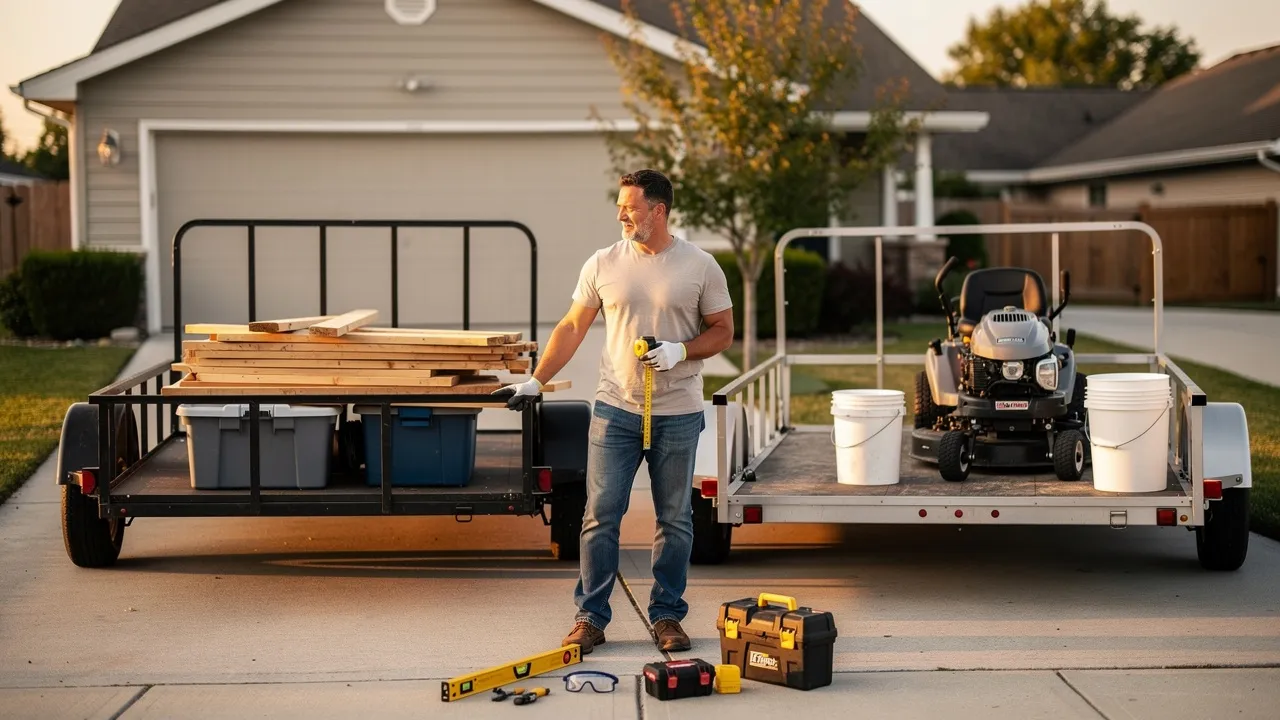
Start with the work, not the equipment label
A project fit screen should begin with the work, not a familiar equipment label. Start by classifying the task - moving material, changing ground, placing concrete, supplying power, cleaning a surface, or reaching an elevated work area - then compare the category's specifications with the site and load. Choosing equipment simply because it is available can create delays, compatibility issues, or additional project costs. Before arranging a rental, understand the job requirements, equipment specifications, site conditions, and rental terms.
Use the same comparison for a landscaping, hauling, repair, pressure-washing, demolition, flooring, or concrete project in Irving or the Dallas - Fort Worth area:
- Define the result the work must produce.
- Describe the material, load, waste, surface, or structure involved.
- Compare the relevant category options, such as trailer, earthmoving, concrete, cleaning, power, or lifting equipment.
- Test each candidate against access, ground conditions, clearance, working space, and capacity.
- Check transportation, timing, and the pickup or delivery arrangement.
- Stop before work begins if the category, specifications, documentation, or operating requirements remain unclear.
Matching equipment to the project requirements can help avoid compatibility issues. The first decision is therefore which category fits the work and site, not which specific model happens to be available.
The fit screen keeps the category decision separate from arrangement details. A trailer may suit hauling but exceed vehicle or hitch limits. An earthmoving machine may match the task but raise ground-support or access questions, while lifting equipment adds reach and overhead-clearance questions. Compare those category-specific conditions before discussing a model, pickup, or delivery.
Translate the project into a rental category
Your project task gives you the starting rental category, while the material, reach, capacity, access, and operating conditions determine whether that category can fit. We offer trailers, earthmoving equipment, concrete equipment, generators, pressure washers, pumps, saws, air compressors, and other equipment categories in the Dallas - Fort Worth area.
Use the task as a first sorting step:
- Moving, hauling, or removing waste: Start with trailer rentals and describe the load, dimensions, protection needs, and unloading plan. We offer a wide range of trailer rentals for moving, transporting heavy equipment, and managing waste.
- Digging, earthmoving, or landscaping holes: Start with earthmoving equipment or a mini excavator. We provide tailored mini-excavator rental solutions and a diverse fleet for varying project sizes and requirements.
- Stump removal: Start with the stump-grinder category. We offer a variety of auger stump grinders suitable for contractors and homeowners in the Dallas - Fort Worth area.
- Concrete, cutting, cleaning, pumping, or temporary power: Start with the relevant concrete equipment, saw, pressure washer, pump, or generator category, then describe the surface, material, power requirement, and work sequence.
- Flooring, repair, or demolition: Describe the material being removed or installed, the available work area, debris plan, and whether the job requires cutting, hauling, surface preparation, or temporary power before choosing a category.
An excavator's digging depth is a key specification. Smaller excavators may suit small landscaping holes and light-duty applications, while larger excavators can dig deeper holes. More reach can improve accessibility, but it can also mean a slower dig cycle. Check an excavator's lift and load capacity when using it for material handling, earthmoving, or loading and unloading materials.
Treat each category as a starting point rather than a model recommendation. State what you need the machine to accomplish, and then match the specifications and capacity to that task. For a residential project in Irving, the entrance, fence or gate width, working surface, nearby structures, and material-handling plan can matter as much as the name of the equipment category.
Classify the task and material before choosing a category
Your starting description should explain what the project must move, change, lift, remove, clean, power, or finish before you compare equipment categories. We offer trailer rentals for moving, transporting heavy equipment, and managing waste, while the appropriate arrangement depends on the actual job and load.
Build a task-and-material profile before comparing categories:
- The material, equipment, debris, soil, concrete, landscaping material, or waste involved.
- The approximate weight, dimensions, quantity, and shape of the load.
- Whether the load must stay dry, be covered, remain secured, or be protected from damage.
- Whether you are moving the load once, loading and unloading repeatedly, or transporting it on a recurring basis.
- Where the load starts, where it will go, and how it will be loaded and unloaded.
- Whether the task involves digging, lifting, hauling, demolition, pressure washing, flooring, concrete, or another defined use, so the discussion can start with a relevant equipment category.
Once the profile is complete, provide the Irving or DFW jobsite, what you are moving or changing, the intended use and protection needed, vehicle information, expected start date, duration, schedule uncertainty, and whether the need is one-time or recurring. Use those details to compare a trailer, earthmoving, concrete, cleaning, power, or lifting discussion without assuming a specific model or configuration is suitable.
Separate the work objective from the equipment label in your notes. Record the material, approximate weight, dimensions, loading method, protection needs, and site conditions before comparing the relevant categories. Those details identify the questions to ask even when the final rental arrangement is not yet known.
Separate transport fit from equipment-category fit
Transportation is one part of equipment-category fit. If a candidate must be towed, your tow vehicle, hitch, trailer, and loaded equipment each have capacity and rating limits. Towing capacity is affected by factors such as the suspension, transmission, and engine. Payload capacity covers weight in your truck's bed and cabin, while towing capacity covers the trailer weight your truck can pull.
For a towed candidate, check the complete combination rather than relying on one number:
- Vehicle payload: Include the weight carried in the truck's bed and cabin.
- Towing capacity: Check the trailer weight your vehicle can pull.
- GCVWR: This covers the maximum combined weight of the loaded trailer and towing vehicle.
- GAWR: This covers the maximum weight a single axle can handle.
- Hitch and tongue ratings: Check the hitch label for its maximum trailer and tongue weight and use it to determine whether the hitch class fits the load.
- Trailer capacity: Check the trailer's own rating and the loaded weight of the equipment or material.
Check the manufacturer's information each time you tow because towing and hitch capacities vary with the truck's configuration and installed equipment. Do not tow more than your vehicle's towing capacity; you may lose control and damage the truck or trailer.
Towing guidance lists bumper towing up to 2,000 pounds, receiver hitches up to 20,000 pounds, weight-distribution hitches up to 15,000 pounds, and gooseneck and fifth-wheel hitches up to 30,000 pounds. Those are listed hitch-type ratings, not permission to use any hitch with any load. Your vehicle, hitch, trailer, connection, and loaded weight still have to match.
One trailer checklist uses a standard 2-inch ball hitch and instructs you to check the vehicle's hitch receiver before renting. Do not assume that requirement applies to every trailer. Ask which connection the selected arrangement requires, then compare it with the vehicle and hitch information you provide.
A remaining 250 pounds does not establish that a truck-and-trailer combination is acceptable. An assumed 700-pound hitch load does not establish the correct load or distribution for another trailer. If the ratings, load distribution, hitch details, or vehicle documentation do not line up clearly, do not tow; provide the information for a project-specific review instead.
If a trailer or other towed candidate remains on the shortlist, record the vehicle year, make, model, cab or bed configuration, hitch type, trailer connection, and the ratings shown in the manufacturer's information. For a delivered machine or another category, record the site and equipment requirements instead. A general description such as “my truck can tow it” does not give the rental discussion enough information to test the full combination.

Test the site against the equipment category
Your jobsite determines whether equipment can reach the work area, be unloaded, and leave without damaging the property or creating an unresolved access problem. Delivery removes the towing problem, but delivery and pickup rates may vary by equipment type and location. If the applicable delivered-rental terms place responsibility with you until pickup, ask how those terms handle the equipment between drop-off and collection.
Prepare the site before delivery or pickup:
- Clear vehicles, materials, and other obstructions from the drop point.
- Walk the route from the entrance to the planned unloading area.
- Open gates and move panels if the delivery path requires it.
- Identify sprinklers, septic systems, private lines, soft ground, slopes, and narrow turns.
- Prepare plywood for soft spots if the delivery plan calls for it.
- Make sure someone can be reached by phone at the delivery time.
Plan a delivery location where the truck and trailer can pull in, unload with ramps down, and exit without backing across the lawn. A straight driveway section or firm curb shoulder may provide a workable starting point, while a tight turnaround or steep drive requires advance planning.
Trailer dimensions can affect the discussion, but examples from one delivery service are not EZ Equipment Rental specifications. That service transports a trencher, stump grinder, and buggies on a 5-by-10-foot utility trailer, full-size loaders and mini excavators on a 16-foot equipment trailer, and an MT100 on a 12-foot ramp trailer. Use those figures only as examples of why the equipment, trailer dimensions, route, and drop point need to be discussed together.
Choose pickup or delivery only after considering the property, vehicle, route, and load. If the delivery path cannot be described clearly, pause the arrangement and provide a site description before equipment is sent.
A simple site note can make the discussion more precise. Include the entrance location, gate measurements, driveway or curb condition, distance to the work area, slopes or soft ground, overhead clearance concerns, and a photo of any tight turn or unusual drop point. Do not treat a photo as a substitute for a site assessment; use it to explain the condition that needs to be discussed.

Use timing to compare the rental path
Timing is a category-fit question as well as a rental-term question. The work sequence, access window, expected delays, and return or pickup plan help you compare the arrangement to discuss. Our trailer rentals are available for a day or a week, and we offer flexible rental durations tailored to project requirements.
Record these timing details for each candidate category and arrangement:
- The date you expect to start.
- How long the active work should take.
- Whether the project depends on weather, another delivery, inspection, demolition, or a subcontractor.
- Whether you need the equipment for one project or recurring transportation.
- Whether pickup or delivery must happen during a particular window.
- What could extend the rental and when you would know that the schedule changed.
Understanding the rental agreement and terms is vital when renting construction machinery and equipment. Understand the rental rates, duration, and renter responsibilities, and confirm the rental duration to help avoid late fees. Knowing your rental duration can help you avoid late fees, which can add up quickly. Rental duration and renter responsibilities matter as much as identifying the machine you need.
For context, a U.S. telehandler rental source gives rates that typically range from a few hundred dollars per day to over $1,000 per day for larger, heavy-duty models; weekly and monthly plans may offer better value for longer projects. That range is not a quote for your project or for EZ Equipment Rental. Treat any general range as context only and ask for the applicable rate, duration, responsibilities, and terms for the arrangement under discussion.
A schedule with uncertainty is still useful when you describe the uncertainty honestly. Accurate timing helps the rental discussion address the project rather than a guessed return date.
Use the project sequence to distinguish active work time from waiting time and to compare the category discussion with the schedule. If the equipment cannot be used until another delivery, inspection, demolition phase, or subcontractor is complete, include that dependency instead of treating the entire period as active work. If the work may continue beyond the expected end date, describe the possible extension and ask how a changed return or pickup date is handled under the applicable terms.
Compare candidate categories before work begins
A stop-and-confirm gate should compare each candidate category before the project begins. Check the required specifications, capacity, worksite conditions, rental period, equipment condition, accessories, power requirements, delivery arrangements, and applicable documentation.
Use this pre-work checklist:
- For each candidate category, compare the equipment specifications and capacity with the task and load.
- Confirm the rental period, availability, condition, accessories, delivery arrangements, and rental terms.
- Confirm that the intended users understand the equipment and applicable operating requirements.
- Confirm how loading and unloading will be handled for the material involved.
- Confirm power requirements and any accessories needed for the planned work.
- Confirm that the equipment will not be operated beyond its rated capacity.
Workers loading and unloading materials should be instructed in safe procedures appropriate to the material they handle. OSHA identifies Powered Industrial Trucks under 29 CFR 1910.178 as the most commonly cited standard throughout the trucking industry. That reference does not decide your project-specific loading plan, so stop if the loading equipment, surface, personnel, or procedure is unclear.
Trailer brakes help slow the trailer and can help prevent jackknifing; types include electronic, surge, and electric-over-hydraulic brakes. Ask which braking arrangement applies to the selected trailer and whether the vehicle connection supports it. Do not infer that a trailer's presence, a hitch rating, or a remaining payload number resolves every loading or towing question.
If the equipment condition, documents, accessories, power interface, capacity, or operating requirements do not match the project, do not begin work. Resolve the mismatch before loading, towing, lifting, digging, cutting, washing, or operating the equipment.
Keep the confirmation gate specific to the category under discussion. For a trailer, focus on the load, connection, braking arrangement, loading method, and route. For an excavator, focus on digging depth, reach, lift and load capacity, ground conditions, and the work area. For a generator, pressure washer, pump, saw, or concrete machine, include the power or operating requirements that apply to that category. Compare those category-specific checks before treating any candidate as ready for arrangement.

Apply category-specific stop conditions
Safety conditions should influence category selection before the rental arrangement is discussed. Pause the project and seek qualified help when towing, loading, capacity, ground support, overhead clearance, energized lines, outriggers, or equipment contact conditions cannot be resolved from the applicable instructions and requirements.
Stop and address the condition when:
- Equipment capacity does not cover the load or the load weight is uncertain.
- Ground support, the travel route, load position, boom location, or overhead clearance has not been evaluated.
- The boom or another equipment part could contact an obstruction.
- Exposed energized lines are nearby and the required minimum approach distance is unclear.
- The equipment has outriggers but the ground or work area does not support their use.
- Wind, ice, or snow may affect equipment stability or rated capacity.
- The people loading, unloading, or operating the equipment do not understand the required procedure.
Use outriggers when the equipment has them. If terrain or the work area prevents their use, operate only within the manufacturer's maximum equipment load. Maintain minimum approach distances near exposed energized lines, and do not assume an aerial lift's insulated portion remains protective if the boom is improperly positioned or bridged by conductive objects. Keep the boom and other equipment parts from contacting any obstruction.
Do not guess at a clearance, rating, ground condition, or operating decision. Stop, preserve the boundary, and obtain the qualified evaluation required for the equipment and site.
Apply the same boundary when comparing a trailer or another equipment category. If vehicle ratings, hitch connection, load distribution, trailer brakes, loading surface, ground support, overhead clearance, or lifting capacity cannot be established clearly, leave the equipment where it is and seek qualified help rather than testing the setup on a public road or at the jobsite.
Prepare a category comparison brief
A provider-ready rental brief turns your project information into a category comparison. Give accurate project details when you contact EZ Equipment Rental so the discussion can start with the relevant equipment class; the closest available truck may not be the correct one.
Prepare this short brief for an Irving or DFW rental discussion:
- Jobsite: Give the city, address or area, entrance, access route, gates, surface, turning space, and intended drop point.
- Task and category question: Describe what you need to dig, move, lift, haul, remove, wash, cut, demolish, finish, or power, and note whether the request concerns trailer, earthmoving, concrete, cleaning, power, lifting, or another category.
- Load or material: Give the material, approximate weight, dimensions, quantity, protection needs, and loading or unloading method.
- Vehicle: Provide the tow vehicle information, hitch details, and the relevant payload, towing, axle, and combined-weight information if pickup or towing is being considered.
- Timing: Give the expected start date, duration, schedule uncertainty, and whether the need is one-time or recurring.
- Arrangement: State whether you prefer pickup or delivery and describe any access or site condition that could affect the choice.
- Open category questions: Identify anything you cannot resolve, such as capacity, accessories, power, ground support, clearance, documentation, or operating requirements, and explain which candidate category it affects.
We provide personalized recommendations based on your specific needs and budget. The recommendation still needs to be checked against the task, load, site, vehicle, timing, and applicable operating requirements. A complete brief helps the discussion begin with the project rather than a product label.
Use the brief to compare the category question with the project facts: name the project and city, explain what must be moved or done, describe the material and approximate load, identify the vehicle or delivery preference, give the start date and expected duration, and flag any access or safety question. Add a photo or site description when the entrance, drop point, slope, gate, or turning area is difficult to explain. Accurate details let EZ Equipment Rental discuss the relevant category without turning an unconfirmed category into a model decision.

Contact EZ Equipment Rental with the project details
Your completed rental brief gives EZ Equipment Rental the information needed to discuss a suitable rental category and arrangement for the project. We offer trailer rentals in the Dallas - Fort Worth area, along with personalized service, quality equipment, and on-site delivery for trailer rentals.
Include the task, material or load, jobsite, vehicle and hitch details, start date, expected duration, schedule flexibility, and pickup or delivery preference. Current fit, availability, pricing, delivery arrangements, and rental terms require confirmation for the specific request.
We are located at 1307 W Airport Fwy, Irving, TX 75062. We operate Monday to Friday from 7:30 AM to 5:30 PM and Saturday from 7:30 AM to 5:00 PM; we are closed on Sunday. Submit the project details through the EZ Equipment contact form to discuss the rental path. A qualified professional should decide individual suitability when the work involves unresolved towing, loading, electrical, structural, ground-support, or operating conditions.
The practical next step is to send the project brief only after you have recorded the task, load, site, vehicle, timing, and preferred arrangement. If any of those details remain unclear or unsafe, pause the project and obtain qualified guidance before proceeding.
What should you confirm before arranging an equipment rental?
Can I select equipment based only on what is available?
No. Availability alone can lead to delays, compatibility issues, or added project costs. First match the task, material or load, site conditions, capacity, access, power needs, and operating requirements; then confirm the specific equipment, availability, condition, accessories, and terms with EZ Equipment Rental.
What should I do if the delivery route is narrow, steep, or difficult to turn around?
Identify the drop point before arranging delivery and describe the entrance, gates, surface, slope, turning space, and exit route. A truck and trailer need room to pull in, unload with ramps down, and leave without backing across the lawn. Provide a site photo when a tight turnaround or steep drive needs advance planning, and do not assume delivery is workable until the arrangement is confirmed.
Does equipment delivery remove every transportation responsibility?
Delivery can remove the need to tow the equipment yourself, but it does not resolve site access, ground support, unloading space, or rental responsibilities. Delivery and pickup rates may vary by equipment type and location, and the applicable terms may keep the equipment your responsibility until pickup. Confirm the specific delivery, pickup, timing, and responsibility terms before work begins.
What should I do if the equipment, load, or jobsite conditions are unclear?
Stop before loading, towing, lifting, digging, or operating the equipment. Do not exceed rated capacity or proceed when vehicle ratings, load distribution, ground support, overhead clearance, energized-line distances, outriggers, weather effects, or operating requirements are unresolved. Obtain the applicable documentation and qualified evaluation before proceeding.
Sources
- Trailering Basics Part 1: Towing Capacity, Hitch Classes & Trailer Weight Distribution - mopar.com
- Weekend Equipment Rental: How to Plan a Job You Can Actually Finish - pdqequipment.com
- Towing Capacity: Can Your Truck Carry Your Rental? - rent.cat.com
- Mechanical Equipment Rules for Qualified Workers - incident-prevention.com
- Choosing the Right Size Excavator Rental | Cat Rentals℠ - rent.cat.com
- Preparing your site for equipment delivery and pickup - Ward's Equipment Rental - wardsrental.com
- Telehandler Rental Cost | Affordable Equipment Rental - news.ezequipmentrental.com
- Payload vs. Towing Capacity: Check the Exact Truck - craigandlandrethauto.com
- Trailer Rental Checklist: Everything You Need Before You Rent | Moovalot Blog - moovalot.com, 2026-02-20
- Construction Equipment Towing Done Safely - regionaltowing.com, 2026-11-12
- 1926.1417 - Operation. | Occupational Safety and Health Administration - osha.gov
- About Us - EZ Equipment Rental | Dallas, TX - ezequipmentrental.com
- Industrial Equipment Rental Checklist: 10 Things to Check - zoair.com
- Trucking Industry - Loading and Unloading | Occupational Safety and Health Administration - osha.gov
- Maximizing Efficiency: Tips for Renting the Right Equipment for Your Project - stowerscat.com