
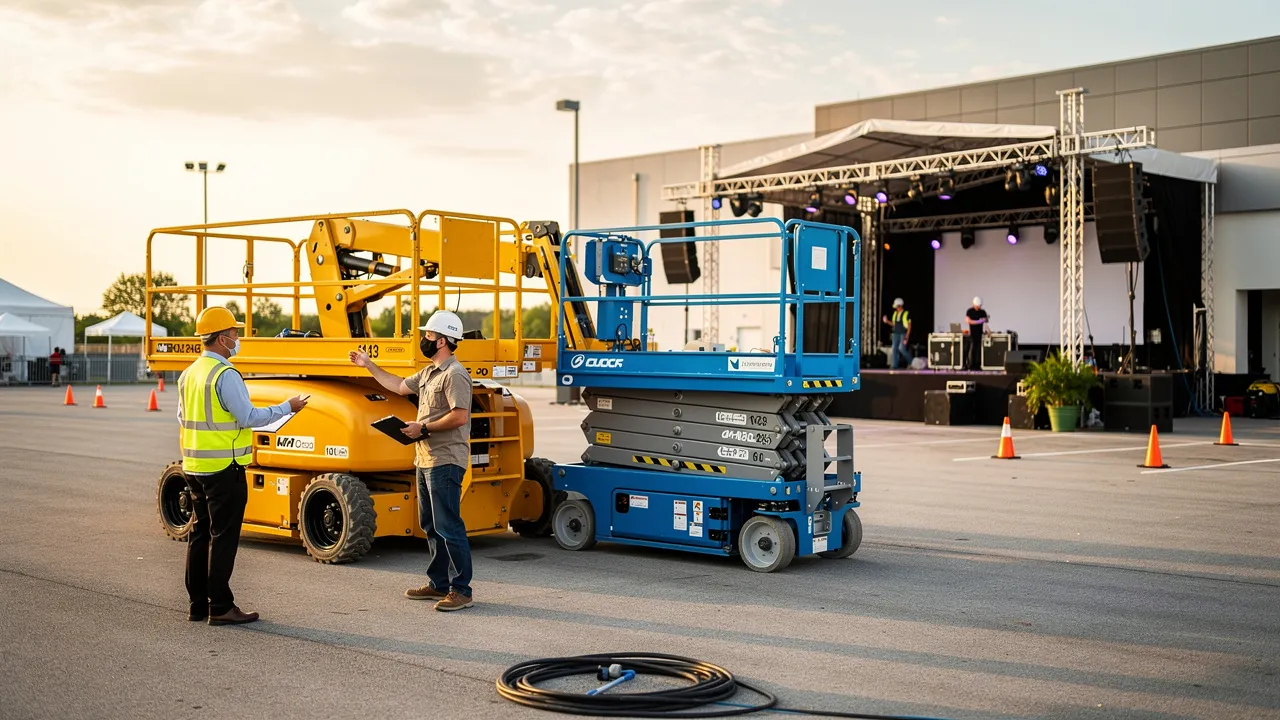
Screen the work path before searching nearby
A project in Irving or the wider DFW area should be screened by its work path before you choose a nearby lift. Start with the place where the crew must work, then determine where the machine can sit, how high the work is, whether the target is directly above or offset, and what the surface and access route will allow.
A scissor lift primarily raises its platform vertically, while a boom lift can provide vertical elevation and horizontal outreach. A scissor lift is positioned directly beneath the working area for vertical access. A boom lift can be positioned slightly farther away when its horizontal reach is needed, which may suit work that is offset or blocked by a fixed obstacle.
For an event setup, facility repair, lighting task, maintenance project, or construction activity, write down these starting facts:
- The work area and the point where the machine could be positioned.
- The required platform or working height.
- Whether the crew must reach over, around, or beyond an obstacle.
- The surface, slope, terrain, and indoor or outdoor setting.
- The number of workers, tools, and materials that must be supported.
- The doorway, gate, aisle, or access route the machine must use.
- The work date, expected rental duration, and delivery or pickup preference.
Working height, reach, terrain, and capacity requirements determine the lift type. When elevation or reach is uncertain, confirm the specifications before selecting equipment. Nearby location helps with the rental conversation, but proximity alone does not establish that a model fits the site.
Choose vertical access or offset reach
A scissor lift may fit direct vertical access when the machine can sit below the work and the crew needs a larger platform. A boom lift may fit an offset work area when the crew must reach outward, over an obstacle, or around an obstruction.
| Project requirement | Scissor lift | Boom lift |
|---|---|---|
| Primary movement | Raises the platform vertically | Provides vertical elevation and horizontal outreach |
| Machine position | Usually directly beneath the work area | May sit slightly farther from the work zone when outreach is needed |
| Typical task pattern | Straight vertical access above the machine | Work beyond a fixed obstacle or away from the machine |
Scissor lifts are often useful when workers need a larger platform and direct access above the machine. A larger platform may leave more room for tools and materials, but platform workspace and rated capacity remain model-specific. Compare the rated platform with the combined weight of workers, tools, and materials rather than choosing from the category name alone.
A scissor lift has a maximum height of 20-50 feet, but that range does not answer every site question. Doorway width, aisle width, machine dimensions, surface suitability, and the required working height still control the selection. A restricted entrance may suit either lift category depending on the model because actual dimensions and operating clearance determine suitability.
Use a simple decision path:
- Choose a scissor-lift candidate when the work is directly above the machine and a larger platform is useful.
- Choose a boom-lift candidate when the work is offset or requires significant horizontal outreach.
- Pause the category choice when the machine position, route width, working height, or rated capacity is unclear.
The final choice should be tied to the exact model and site conditions, not only to whether the equipment is nearby.
Match the boom configuration to the approach
A boom-lift configuration should match the approach from the machine to the work. A boom lift may suit work that is above and away from the machine because it combines vertical height with horizontal outreach. An articulating boom may suit up-and-over positioning around obstacles, while a straight or telescopic boom may suit an open approach where longer outreach is the priority.
For an articulating configuration, map the joints and the target area around items such as ductwork, structural elements, trees, lighting rigs, or other fixed obstacles. The useful question is not simply how high the platform can rise. Ask whether the boom can reach the work without placing the machine where the surface, traffic pattern, or access route prevents operation.
For a straight or telescopic configuration, identify an open approach and measure the distance from the planned machine position to the work area. This arrangement may suit a longer, more direct outreach path, but the exact model’s height, reach, dimensions, weight, and surface requirements still need confirmation.
Published comparisons give different height ranges for boom lifts. One guide reports articulating models up to 150 feet and straight models up to 210 feet, while another lists articulating models at 30-60 feet and telescopic models at 40-130+ feet. These figures are guide-specific rather than a universal range for every model, so confirm the exact model’s platform or working height with the rental provider.
A separate comparison lists maximum heights of 20-50 feet for scissor lifts, 30-60 feet for articulating booms, and 40-130+ feet for telescopic booms. The same comparison lists 30-75+ feet of horizontal reach for telescopic boom lifts. The differing figures make model-level confirmation necessary, especially when the project depends on a narrow height or reach margin.
Before requesting a boom lift, record:
- The target height and the required working height.
- The horizontal distance from the planned machine position.
- Any obstacle the platform must pass over or around.
- Whether the approach is open or requires articulated positioning.
- The space available for turning, setup, and movement.
- The number of workers, tools, and materials for the basket.
Use an articulating candidate for an up-and-over approach, a straight or telescopic candidate for an open approach where longer outreach matters, and a qualified equipment professional for an unresolved height or reach question.
Test height, surface, and indoor access
A lift’s working height, route width, surface, terrain, and operating environment must be tested together before either category is treated as suitable. A scissor lift may have the needed working height and still be too wide for an opening. A boom may provide enough reach and still need more maneuvering room than the site provides.
Working height is the platform height plus approximately six feet for an operator standing and working from the platform. Record the height of the work itself, then distinguish that measurement from the platform height requested in a rental conversation. A project that requires a worker to reach 20 feet above the ground, for example, needs a roughly 14-foot platform height; the exact model and work method still require confirmation.
Surface and terrain create a separate screening question. A boom lift may handle rougher outdoor terrain, but that does not make every boom model appropriate for every surface. For uneven or challenging ground, use a suitable verified model and follow the manufacturer’s surface requirements.
Indoor projects require their own measurements. Electric scissor lifts may suit hard, level indoor surfaces because they produce zero emissions and operate quietly. Check the doorway width, aisle width, ceiling or overhead clearance, floor condition, turning area, and route from the entrance to the work zone. A compact machine may pass through an opening that a larger platform cannot, while a compact footprint may provide less workspace.
Outdoor or rough-terrain work calls for a different check. Rough-terrain scissor lifts can have maximum working heights of up to 53 feet and high weight capacities; verify the model against the project’s surface and load requirements. Compact electric scissor lifts can have a maximum working height of up to 26 feet and are designed for lightweight tasks such as running IT cables or warehouse picking.
Use this site screen before you ask for a model:
- Measure the work height, overhead clearance, doorway, aisle, gate, and access route.
- Describe the surface as hard and level, uneven, sloped, finished, unfinished, indoor, or outdoor.
- Note whether the route crosses a floor that needs non-marking tires or special protection.
- Record the machine position, turning area, and space needed to maneuver.
- Separate platform height from working height in the project brief.
Stop the selection when a route, surface, or clearance measurement is missing. Ask for the exact specifications before treating either lift category as suitable.
Match the platform and power needs to the crew
A crew’s platform, load, power, noise, and operating-duration needs should be matched to the lift model rather than assumed from the project label. State how many workers will be on the platform, what tools and materials they will carry, how much working room they need, and whether the work occurs in an occupied indoor facility or an open outdoor area.
Platform size changes how the crew can work. A larger platform may provide more room for tools and materials, while a compact platform may suit a tight or confined space. Stay within the scissor lift’s weight requirements for safety and stability.
The platform-height example also illustrates why the terms need to be separated. That example describes a height relationship, not a universal selection for every job. Add the worker height, tools, materials, clearance, and work position to the request so the provider can discuss the exact model.
Power configuration affects emissions, noise levels, and operational duration. Common sources include electric batteries and diesel or gas engines. For an indoor venue, warehouse, retail space, data center, or interior construction area, state the air-quality and noise constraints before discussing a unit.
Scissor-lift categories can be screened this way:
- Electric models may suit smooth, hard, level indoor surfaces and noise-sensitive work.
- Rough-terrain models may suit outdoor or uneven applications when the manufacturer’s requirements are met.
- Compact models may suit narrow spaces and aisles where machine dimensions control access.
- Large-platform models may suit work that needs more workspace or a higher rated capacity.
The machine’s capacity must cover the complete platform load, not only the worker count. Add tools, fixtures, materials, and any equipment that will be carried. If the load is uncertain, do not estimate from memory; stop and request the rated-capacity and platform specifications for the proposed model.
Turn the screening into a provider-ready brief
A provider-ready lift brief gives the rental conversation the project facts needed to discuss a boom lift or scissor lift. Put the information in one message so the proposed category, model, timing, and logistics can be considered against the actual work rather than a short equipment label.
Use this checklist:
- Location: Give the Irving or DFW site address, access contact, and the area where the machine will work.
- Task: Describe the installation, maintenance, event setup, facility work, construction activity, or temporary lighting task.
- Height: Provide the work height and distinguish it from the required platform height or working height.
- Reach: State whether the machine must work directly above its position, reach outward, or pass over or around an obstacle.
- Crew and load: List the number of workers, tools, fixtures, materials, and the total rated-platform load to discuss.
- Dimensions: Provide doorway, gate, aisle, ceiling, machine-position, turning, and route measurements.
- Surface and terrain: Describe the floor or ground, indoor or outdoor setting, levelness, slope, and any access limitations.
- Power configuration: State whether electric, diesel, gas, emissions, noise, or operating-duration requirements affect the choice.
- Rental period: Give the planned start date, working days, and expected daily, weekly, or longer duration.
- Availability and logistics: Ask about the exact model, availability for the requested period, delivery or pickup, access requirements, and return arrangements.
A useful brief can read like this:
The work is at [site address] in Irving or elsewhere in the DFW area. We need access to [task] at approximately [work height]. The work is [directly above or offset] from the machine position, with [required reach]. The route includes [doorway, gate, aisle, or clearance measurements]. The surface is [description], and the work is [indoors or outdoors]. The platform must support [workers, tools, and materials]. We need [power configuration] for [rental duration]. Please discuss the appropriate lift category, exact model specifications, availability, delivery or pickup requirements, and rental terms.
Replace every bracketed item with a project fact before sending the brief. If a measurement is unknown, label it as unknown instead of guessing. The missing measurement may control whether the equipment can enter, maneuver, reach the work, or support the planned load.

Confirm the rental handoff before booking
A rental handoff should be confirmed against the project brief before you commit to a date. Ask for the exact model and its working height, reach, dimensions, rated capacity, surface requirements, power configuration, rental duration, availability, and operating conditions.
Confirm these commercial and logistical points:
- Whether the requested model is available for the full work period.
- Whether the rental is priced by the day, week, month, or another term.
- Whether delivery or pickup is available for the selected equipment.
- Whether the site can receive the machine through its gate, driveway, entrance, or loading area.
- Whether gate dimensions and ground clearance meet the delivery requirements.
- Whether fuel, charging, deposits, delivery, pickup, return, or other charges affect the total.
- What happens if the project duration changes or the work finishes early.
- Which site, operator, or documentation requirements must be handled before use.
Before delivery, confirm gate dimensions and ground clearance with the rental provider. Those measurements should describe the actual route, not only the property entrance. Include turns, overhead restrictions, soft ground, ramps, and any narrow approach that could affect the delivery vehicle or the equipment.
Booking lead time depends on the project timing and equipment demand. For a standard weekday boom-lift rental, booking 2 to 3 days ahead is usually sufficient. For weekends, spring or fall demand, or a project lasting a week or more, reserve 5 to 7 days ahead. These are planning guidelines, not a promise of availability for a particular Irving or DFW project.
Published planning ranges also vary by configuration. One guide lists towable boom lifts at $200 to $350 per day, mid-size telescopic boom lifts in the 40- to 60-foot range at $400 to $700 per day or $1,200 to $2,000 per week, and larger 80-foot or 120-foot rough-terrain boom lifts at $800 to $1,500 per day or $3,000 to $5,500 per week. Boom-lift rental costs vary by type, working height, and rental duration; delivery, fuel, and deposit requirements may add to the total, so request the full quote for the exact model and conditions.
In Dallas, scissor lift rental rates vary by working height, platform weight capacity, terrain type, and rental duration. Treat any planning range as a starting point. Ask for the complete project-specific total before you accept the handoff.
Use EZ Equipment Rental as the Irving contact point
We offer boom lifts for rent, including a fleet of well-maintained, top-of-the-line boom lifts. We also offer flexible rental terms and competitive pricing. Bring the completed project brief so the rental discussion can address the work path, height, reach, platform, site access, timing, and logistics together.
We are located at 1307 W Airport Fwy, Irving, TX 75062. Our listed hours are Monday to Friday from 7:30 AM to 5:30 PM and Saturday from 7:30 AM to 5:00 PM; we are closed on Sunday.
Use the conversation to describe the equipment need rather than asking only for a generic lift. State whether the project needs direct vertical access or offset reach, whether the machine will operate indoors or outdoors, and whether the approach includes a tight entrance, narrow aisle, uneven ground, or an obstacle. Include the required height, reach, workers, tools, materials, capacity, dimensions, clearances, surface, terrain, power configuration, and rental duration.
Published comparison figures can help frame the question, but they are not a quote from EZ Equipment Rental. One comparison lists daily rental costs of $150 - $350 for scissor lifts, $300 - $600 for articulating boom lifts, and $400 - $800 for telescopic boom lifts. The same comparison lists weekly rental costs of $500 - $1,000 for scissor lifts, $900 - $1,800 for articulating boom lifts, and $1,200 - $2,500 for telescopic boom lifts. Those ranges describe the listed equipment categories and periods; the exact total can vary with model, height, reach, duration, delivery, fuel, deposit, and site requirements.
EZ Equipment Rental can discuss the rental path for an Irving or DFW project, while the final selection must remain tied to the actual site, load, access route, and manufacturer requirements.
Stop when the project cannot be verified
An equipment selection should stop when the lift type, exact model, height, surface, load, access route, or operating requirements remain unclear. Do not operate equipment that has not been matched to the site, and do not bypass manufacturer requirements, required safeguards, training requirements, or site rules to keep the project moving.
Pause the rental decision when any of these conditions apply:
- The required working height or horizontal reach has not been measured.
- The lift cannot be confirmed to fit the doorway, gate, aisle, turning area, or machine position.
- The surface is uneven, sloped, soft, or otherwise outside the known model requirements.
- The platform load includes workers, tools, or materials that have not been totaled.
- The proposed machine’s rated capacity, dimensions, or power configuration is unknown.
- An obstacle requires an up-and-over approach that the proposed configuration may not provide.
- Delivery access, ground clearance, or the route to the work area remains uncertain.
Rough-terrain scissor lifts may use four-wheel drive, oscillating axles, deep-tread tires, higher ground clearance, and enhanced tilt sensors to help operators work on rough terrain, but those features do not make an unverified model suitable for every site.
Exceeding a scissor lift’s weight capacity can potentially cause the lift to tip over. The exact capacity and dimensions remain model-specific.
Lift categories and model specifications vary, so verify the proposed equipment against the project measurements. If the project cannot be verified from the measurements and specifications, stop and contact a qualified equipment professional or the responsible authority promptly.
Send the completed brief to request the next step
A completed project brief gives you a clear basis for discussing a boom lift or scissor lift in Irving or DFW. Include the work path, required height and reach, machine position, surface and terrain, indoor or outdoor setting, access measurements, crew and load, power needs, rental period, and delivery or pickup questions. A qualified professional should decide individual equipment suitability when any material site, load, or operating condition remains uncertain.
What should you confirm before requesting a nearby lift rental?
What should I check when searching for equipment rentals close to me in Irving?
Treat proximity as a starting point, not proof that a lift fits. Before choosing a nearby provider, confirm the required working height, horizontal reach, machine dimensions, access route, surface, terrain, platform capacity, power configuration, rental duration, availability, and delivery or pickup requirements for the actual site.
Can a scissor lift be used on uneven ground in Irving or DFW?
A scissor lift may require a flat, level surface and may not suit rough or uneven terrain. Verify the exact model and follow its manufacturer’s surface requirements; if the terrain or ground condition is unclear, stop and ask a qualified equipment professional before proceeding.
How should I describe the height requirement when requesting a lift?
Give both the height of the work and the required platform or working height. When requesting a scissor lift, provide both the work height and the required platform or working height; confirm the exact model, reach, clearance, and work position before selecting.
How far ahead should I plan a boom-lift rental?
For a standard weekday boom-lift rental, booking 2 to 3 days ahead is usually sufficient. For weekends, spring or fall demand, or a project lasting a week or more, reserve 5 to 7 days ahead. These are planning guidelines, so confirm current availability and the requested rental period directly before relying on them.
Sources
- Scissor Lift vs Boom Lift: Which suits your project? - easyrentall.com, 2023-07-21
- How to Choose the Right Scissor Lift - hercrentals.com
- Boom Lifts vs Scissor Lifts: A Comprehensive Guide to Choosing the Right Aerial Lift for Your Project - dozr.com
- Boom Lift Rental Guide: Costs, Types & Safety Tips - rntr.com, 2026-06-03
- A Guide to Choosing the Right Scissor Lift for Your Construction Project - Rentalex - rentalex.com
- Rental FAQ | EZ Equipment Rental | Dallas TX - ezequipmentrental.com
- Scissor Lift vs. Boom Lift: Choosing the Right Aerial Lift for Your Job - beehiverentalandsales.com, 2026-02-09
- Scissor Lift vs. Boom Lift vs. Vertical Mast: Which Access Rental Fits the Work? - burwellmh.com
- Boom Lift Rental Irving | EZ Equipment Rental - ezequipmentrental.com
- Scissor Lift vs Boom Lift: Key Differences Explained - avanzaequipment.com
- Boom Lift vs. Scissor Lift Comparison Guide - platformbasket.ca
- What Is a Scissor Lift? Uses, Types & How It Works | Avanza Equipment - avanzaequipment.com