
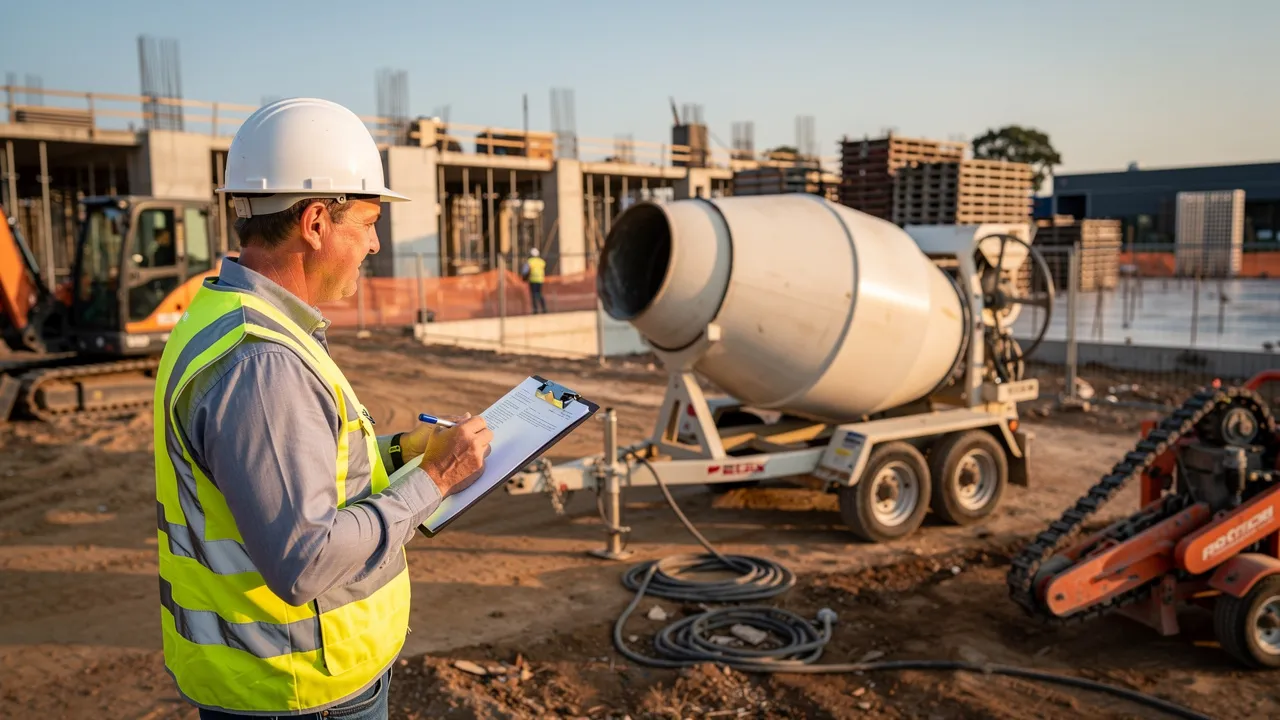
Decide from the pour plan, not a mixer label
A concrete mixer rental decision starts with the work the mixer must perform, not with a machine name from a search result. Begin by describing the material, the amount you need to mix at one time, the work area, the available power, the route to the pour location, the project schedule, and how the equipment will reach the site. Those details give you a practical basis for asking about fit without assuming a capacity, specification, price, or available model.
For a small batch, ask whether a portable mixer suits the work. For a larger pour, ask whether a towable unit or higher-capacity option is more appropriate. The answer depends on the batch volume, the material, the jobsite, and the way your crew will move and use the equipment. Electric mixers are typically quieter and easier to operate, while gas-powered mixers generally offer more power and mobility for larger outdoor jobs. Use those distinctions as questions for the selected equipment rather than as a substitute for model-specific confirmation.
This guide turns that starting point into a project brief for Irving and other Dallas–Fort Worth Metroplex jobs. You will work through the material, batch plan, site constraints, rent-versus-buy decision, schedule, transport, operating boundaries, cleanup, and inquiry details. By the end, you should have a focused request that separates known project requirements from equipment and commercial questions that still need answers.
Identify the material and mixing task
The material you plan to mix determines the equipment category you should discuss. Concrete mixers are designed for concrete, while mortar mixers are built for finer mixes such as mortar or stucco. Start your request by naming the material and describing the work that follows. Do not treat concrete, mortar, and stucco as interchangeable simply because the equipment names sound similar.
Your intended use should also identify where and how mixing will happen. State whether the work is indoors or outdoors, whether the mixer must move between preparation and placement areas, and how your crew expects to load materials. Electric equipment is typically quieter and easier to operate, while gas-powered equipment generally provides more power and mobility for larger outdoor jobs. These are general selection considerations; the selected model, fuel or power requirements, and operating method still need confirmation.
Write down these task details before requesting a recommendation:
- The material to be mixed, including whether it is concrete, mortar, or stucco.
- The work product and where the mixed material must go.
- Whether mixing occurs indoors, outdoors, or in more than one area.
- Whether the mixer will remain in one position or move around the jobsite.
- Any reinforcement, coatings, or other material conditions that affect the work description.
A precise task description helps separate a concrete-mixing need from a mortar-mixing need and gives the rental associate useful context for discussing fit and safety considerations.
Do not choose equipment solely because it is labeled for concrete. Describe the mix, the way your crew will use it, and the setting in which it will operate. Then ask which available equipment is intended for that task.
Turn the pour into batch requirements
The amount of material you need to mix at one time is one of the clearest equipment-fit questions. Estimate the volume for a typical batch and identify whether the work requires repeated small batches or fewer larger batches. Larger projects may need equipment that can handle multiple bags at once, while a small batch may suit a portable mixer. For a larger pour, ask whether a towable unit is more appropriate. Do not choose capacity from the total project volume alone; explain the batch pattern and ask how the proposed equipment handles it.
Your pour pattern matters as much as the total amount. Note whether your crew will mix on site or order a concrete truck for a large pour, and record the drum or hopper capacity your typical projects demand. If the work moves between several construction sites, include that movement in the request. A project that needs many smaller batches has a different planning question from a project that needs one large placement window.
Use a simple batch record:
- Estimated total volume for the project.
- Estimated volume for one normal batch.
- Number of batches or mixing cycles you expect.
- Material type and the mix work your crew will perform.
- Whether a concrete truck, on-site mixing, or another supply arrangement is part of the plan.
- Whether the equipment must move between locations during the rental.
This record does not determine mixer capacity or guarantee production speed. It gives you the facts needed to ask which current equipment can handle the intended batch pattern.
Use the batch record to frame the request in operational terms: “We need to mix approximately this amount per cycle, this many times, at this location.” That is more useful than asking for a generally large or small mixer, because it connects the equipment question to the actual pour plan.
Use the batch record as a coordination check, not only a capacity request. Note the sequence constraints around each cycle, including whether the crew must coordinate mixing with placement, whether the mixer stays near one pour area, and whether it must be repositioned. If a concrete truck or another supply arrangement is part of the plan, identify when the mixer is expected to support the work. These details help the rental discussion address the complete mixing sequence rather than treating drum or hopper capacity as the only decision. They do not establish a production rate; ask EZ Equipment Rental to confirm whether the proposed equipment fits the stated pattern.
Record jobsite conditions that affect equipment fit
Jobsite conditions can change the equipment conversation even when the material and batch volume are clear. Document the available workspace, access route, ground conditions, power, and indoor-or-outdoor setting before asking for a mixer. A mixer manual instructs you to use solid, flat, level ground capable of supporting the machine and its load, with the surrounding work area kept clear. Treat the setup surface and surrounding space as part of equipment fit, not as details to solve after delivery.
Describe the route from the access point to the mixing area. Include any restricted workspace, changes in ground condition, or other access condition that could affect placement or movement. State whether the equipment will remain in one location or whether your crew expects to reposition it. General equipment guidance recommends documenting workspace, access conditions, available power, and whether the work is indoors or outdoors before requesting a mixer.
Power information should be concrete rather than general. Tell the rental associate what power is available at the jobsite and whether the mixing area is indoors or outdoors. Electric mixers are typically quieter and easier to operate, but the selected equipment may have requirements that your site cannot support. Gas-powered mixers generally offer more power and mobility for larger outdoor jobs, yet fuel, placement, and operating details still depend on the model. Ask which power arrangement fits the work and what conditions must be present before use.
Before the inquiry, record:
- Exact jobsite address and the area where mixing will occur.
- Available working space and the route into that space.
- Ground or floor condition at the proposed setup point.
- Available power and whether the work is indoors or outdoors.
- Distance and access between the mixing point and the pour location.
- Any condition that could affect placement, movement, or keeping the surrounding area clear.
These notes help you ask a fit question without treating a general equipment category as proof that a particular machine can be used at your site.
After making the list, divide it into two groups: facts your crew can verify and questions the rental provider must answer. The first group can include the address, surface, workspace, route, power, and indoor-or-outdoor status. The second can include whether the proposed unit can be positioned there, what power arrangement it requires, and what movement limits apply. This separation keeps a known site constraint from being mistaken for a confirmed equipment capability.
If the proposed setup point cannot provide the required surface, workspace, or access, resolve that issue before selecting equipment. A mixer category alone cannot establish that the machine will fit the Irving or DFW jobsite.
Choose rental or ownership by expected use
Renting can make sense when you need a mixer for a defined project and do not want to buy, maintain, store, and depreciate the equipment. Concrete-equipment rental guidance describes rental as payment for the period of use, subject to the selected provider and equipment. That does not establish a price or promise a lower total cost for your project. It gives you a way to separate a temporary equipment need from a long-term ownership decision.
Ownership deserves a separate review when similar work occurs often enough to change the project pattern. Compare how quickly you need access, how long the current project lasts, how often your crew expects similar work, and the storage burden. Record whether large pours normally use a concrete truck, what capacity your projects require, how often equipment moves between sites, and what you spend on mixer rentals. Those questions create a decision record without relying on an unsupported purchase price, rental rate, or savings claim.
Use this rent-versus-buy screen:
- Choose a rental path for evaluation when the need is tied to a defined project or uncertain duration.
- Examine an ownership path when recurring work, storage, access speed, and repeated rental spending justify a separate financial review.
- Record the number of expected rental periods rather than guessing from one project.
- Compare the equipment capacity your recurring work requires with the capacity needed for this specific pour.
- Include movement between jobsites and storage responsibilities in the comparison.
The result should be a documented preference, not an assumption that rental or ownership is always cheaper. Request project-specific rental terms before making a commercial commitment.
For a single Irving project, start by documenting the temporary need and the period of use. For repeated work across DFW, retain the same records over several projects so your eventual ownership comparison reflects actual frequency, storage responsibility, and equipment demand rather than one unusual pour.
Align the request with the project schedule
Schedule information helps distinguish the equipment you need from the equipment you can actually plan to use. State the planned start date, the expected mixing period, the likely end date, and any uncertainty around the work sequence. Project duration and the speed at which you need access are recognized rent-versus-buy considerations. We offer flexible rental durations.
Concrete-equipment rentals may be available hourly, daily, or weekly, and many locations offer delivery or pickup; confirm the terms for the selected provider and equipment. Tell us whether you need a short work window, several consecutive days, or a schedule that may change. We can then evaluate the project requirements against the applicable rental arrangement without you planning around an unconfirmed term.
Include these schedule questions in your request:
- When must the mixer be ready at the jobsite?
- How long will the mixing work probably last?
- Does the pour depend on another crew, a concrete truck, or a site phase?
- Could the project extend beyond the expected period?
- Will the mixer need to move to another site during the same project?
- Is rapid access more important than keeping the equipment for a longer period?
This timing record helps you discuss a rental period that follows the work rather than choosing a term before the work sequence is understood.
Separate fixed schedule constraints from flexible preferences. Mark the date the mixer must be ready, the expected mixing window, and any possible extension; then note which dates are tied to another crew, a concrete truck, or a site phase. This gives the provider a clearer timing question and helps your team see which changes would affect the rental request. Any extension, term, and availability still require confirmation.
Do not schedule labor, deliveries, or the pour around an assumed rental period. Ask which term applies to the proposed equipment and what happens if the mixing window changes. Keep the start date, expected duration, and contingency window visible in the inquiry.
Treat transport and site handling as confirmation items
Transport is part of the mixer decision because the equipment must reach the work area and remain usable there. State whether you expect pickup, delivery, or another transport arrangement, and provide the jobsite address and access route. Many rental locations offer delivery or pickup, but that statement does not promise either option for a particular provider, machine, or DFW address. Ask what arrangement applies to the proposed equipment and what you must provide.
Explain how often the mixer must move. Frequent movement favors a conversation about portability, while a larger pour may lead you to ask about a towable unit. Do not infer that a mixer can pass through your access point, travel over your surface, or be positioned beside the pour simply from its category. Give the rental associate the route, access limits, setup point, and expected movement so the proposed equipment can be evaluated against the actual jobsite.
Prepare these handling details:
- Jobsite address in Irving or the relevant DFW municipality.
- Preferred pickup or delivery arrangement.
- Vehicle or transport information you expect to use.
- Access conditions along the route to the setup area.
- Where the mixer will be unloaded and set up.
- Whether the unit will move between mixing and pouring areas.
- How the surrounding area will remain clear during setup and operation.
Ask for the equipment-specific transport, placement, and movement requirements before committing to a model or schedule. Do not move a loaded or operating mixer; the applicable manual controls the exact handling instructions.
Transport and operation are separate questions. Even if the equipment can reach the jobsite, you still need to establish where it can be placed, how it will be set up, and whether the surrounding area can remain clear. Keep those answers tied to the actual Irving or DFW location.
Set operating and safety boundaries before use
Safety planning begins with the selected mixer’s owner’s manual and machine labels. Read and understand the application, limitations, controls, and specific hazards before operating the equipment. The manual and labels belong to the selected model, so do not substitute a general internet description for the instructions supplied with the machine.
Do not operate a mixer while impaired, tired, or distracted. Set it up on solid, flat, level ground that can support the machine and its load, and keep the surrounding work area clear of obstructions, grease, oil, trash, and other debris. These are general boundaries drawn from a mixer manual; the model-specific manual and applicable site requirements control your actual operating plan.
Do not move the mixer while it is loaded or operating. Plan the setup location before loading and identify how material will reach the pour without requiring an unsafe repositioning step. Ask about the proposed model’s controls, limitations, hazards, setup requirements, and movement restrictions before use. If the jobsite cannot provide the required surface, space, or operating conditions, pause the equipment decision and resolve that boundary before proceeding.
Add these safety questions to your equipment request:
- Which owner’s manual and machine labels apply to the proposed unit?
- What controls and limitations must your crew understand before operation?
- What ground, workspace, and load conditions are required?
- Which movement restrictions apply during loading, mixing, and discharge?
- What site requirements must your crew follow in addition to the manual?
This checklist supports a safety conversation. It does not replace the applicable instructions, required training, or jobsite decisions.
Turn the questions into a pre-use handoff. Before the first batch, the person responsible for operation should have the selected manual and labels, know which controls and limits apply, and confirm that the setup surface, load conditions, workspace, and movement plan match the applicable instructions. Record any unanswered question and resolve it with the rental provider before operating. This creates a stop point for unresolved model-specific issues without substituting this checklist for the manual or site requirements.
Resolve operating conditions before the mixer arrives. A suitable material and batch plan do not override the manual’s requirements for the surface, workspace, operator condition, or movement of the machine.
Follow the selected model’s procedure and cleanup instructions
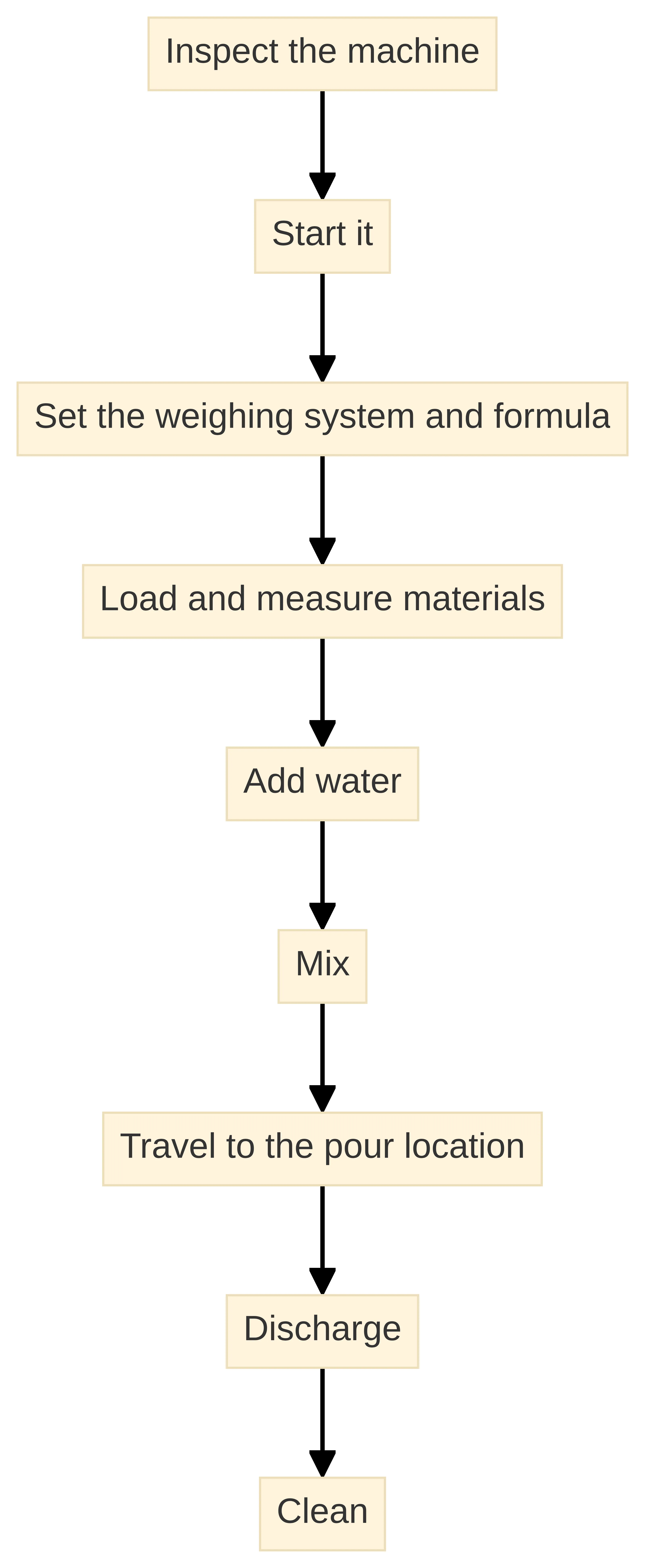
Operating controls and material-loading steps vary by model, so use the selected mixer’s operator’s manual for the exact procedure. For self-loading mixer guidance, the general sequence is to inspect the machine, start it, set the weighing system and formula, load and measure materials, add water, mix, travel to the pour location, discharge, and clean. That sequence describes a planning order, not a universal operating procedure for every concrete mixer.
Treat inspection and setup as separate planning steps before loading material. Confirm which controls, weighing functions, loading process, and discharge method apply to the proposed model. If the mixer is not self-loading, do not apply the self-loading sequence to it. Ask for the model’s manual and follow its instructions for startup, material loading, water addition, mixing, travel, discharge, and shutdown.
Cleanup begins after the remaining concrete is discharged. Follow the manual to empty and clean the drum and material-contact components, use the instructed flushing method, park on suitable level ground, engage the parking brake, and shut down the machine according to the manufacturer’s instructions. Cleaning guidance also identifies the loading bucket, hopper, and discharge chute as areas where material may accumulate on applicable self-loading equipment. Confirm which components and cleaning steps apply to the unit you receive.
Build the closeout into the schedule rather than treating cleanup as an afterthought. Your request should ask what must be cleaned before return, which components need attention, where the equipment may be parked, and how shutdown is performed. The manual controls the actual sequence and model-specific requirements. Keep the work within your crew’s training, site rules, and applicable requirements.
Before returning the equipment, use the applicable manual to work through the required discharge, cleaning, parking, brake, and shutdown steps. Record any model-specific closeout instruction in the project brief so the person responsible for return is working from the same procedure.
Assemble a confirmation-ready mixer inquiry
A useful concrete mixer inquiry puts the project facts in one place and separates known requirements from questions that need an answer. Include enough detail for the equipment discussion to address material, batch volume, site conditions, power, timing, movement, transport, and safety. The request should make clear what you plan to do, where you plan to do it, and when you need the equipment.
Use this inquiry checklist:
- Jobsite address, municipality, and mixing area.
- Intended use and material: concrete, mortar, stucco, or another specified mix.
- Estimated total volume and typical batch volume.
- Expected number of batches and whether a concrete truck or on-site mixing is involved.
- Indoor or outdoor location, available power, workspace, and access conditions.
- Ground or floor condition at the setup point.
- Whether the mixer must move between locations.
- Requested start date, expected duration, and schedule flexibility.
- Pickup, delivery, vehicle, or other transport information.
- Your crew’s questions about controls, limitations, hazards, setup, and cleanup.
Ask for specific confirmation rather than a general recommendation. Questions can include:
- Which current concrete-mixing equipment matches this material and batch pattern?
- What capacity, power arrangement, and operating requirements apply to the proposed unit?
- Can the equipment be transported and positioned at the described site?
- What rental period, pickup or delivery arrangement, and commercial terms apply?
- Which manual, labels, setup limits, operating steps, and cleanup instructions govern the model?
A focused inquiry does not guarantee a particular answer. It gives you a record against which to evaluate the proposed equipment and unresolved conditions.
A concise request can follow this order: identify the DFW jobsite, name the material and intended use, state the typical batch volume and number of cycles, describe power and access, give the required dates, explain transport, and list the equipment questions. Put the facts first. Then ask for the available option that fits those conditions.
To make the inquiry easy to send, convert the checklist into a fill-in message:
- Jobsite: [address and municipality]
- Mixing area: [indoor or outdoor, surface, workspace, and access]
- Material and intended use: [concrete, mortar, stucco, or another specified mix]
- Typical batch and total volume: [details]
- Batches or supply arrangement: [number of cycles, concrete truck, or on-site mixing]
- Power: [available arrangement]
- Movement: [whether the mixer must move and where]
- Dates and expected duration: [required start and anticipated period]
- Transport: [pickup, delivery, vehicle, and access information]
- Questions: [capacity, operating requirements, cleanup, pricing, availability, delivery, and terms]
End by asking which current equipment fits the described work and which details remain unconfirmed. Keeping the placeholders visible prevents an omitted field from being replaced with an assumption.
Leave capacity, specifications, availability, pricing, delivery, rental duration, and operating requirements as explicit confirmation items. A complete inquiry makes those gaps visible instead of filling them with assumptions.
Ask EZ Equipment Rental to verify the unresolved details
We provide project guidance through knowledgeable team members. Give us the material, batch plan, jobsite, access, available power, timing, transport preference, and operating questions you have prepared. That information lets us address the project as a concrete-mixing request instead of treating it as a generic equipment search.
Ask EZ Equipment Rental to verify each unresolved item for the proposed equipment:
- Whether a suitable concrete mixer is part of the current inventory.
- The available model, capacity, power arrangement, and operating requirements.
- Fit with the material, batch volume, workspace, access route, and ground conditions.
- Applicable rental duration, pricing, pickup or delivery arrangement, and other terms.
- The manual, labels, safety boundaries, operating procedure, and cleanup requirements.
This verification boundary keeps a broad concrete-equipment category from being treated as confirmation of a particular unit. Keep the answer tied to your jobsite, schedule, and intended use.
Once a response arrives, review it against the project brief before treating it as a usable rental option. A complete response should address the intended material and batch pattern, the jobsite’s power, surface, workspace and access, the required dates, transport, and the applicable operating and cleanup instructions. It should also identify the commercial items you asked about, including pricing, availability, duration, and pickup or delivery terms. If a material fit, site fit, or commercial item remains unanswered, keep it open and ask for confirmation rather than treating a category-level answer as approval.
For a project in Irving, Dallas, or another DFW municipality, include the exact jobsite rather than only the metro area. Local handling, transport, and equipment questions depend on the proposed unit and the location where your crew will use it.
Use the Irving contact point for the next step
EZ Equipment Rental is located at 1307 W Airport Fwy, Irving, TX 75062. For an Irving or DFW project, organize your inquiry around the actual jobsite and pour plan: name the material, state the batch volume, describe the access and power conditions, give the timing and transport details, and list the equipment and safety questions that still need answers.
A concrete mixer rental is ready for a project decision only after the equipment category, site conditions, schedule, transport arrangement, operating limits, and commercial terms are matched to your work. Keep specifications, availability, pricing, delivery, and rental duration as confirmation items rather than assumptions.
Have the completed project brief available with the jobsite, intended use, timing, batch plan, access conditions, and equipment needs. Use it to request project-specific guidance from EZ Equipment Rental.
Sources
- 4 Steps to Rent Mud Mixer Near Me for Your Project — blog.ezequipmentrental.com, 2025-07-22
- Concrete Mixer — images.thdstatic.com
- Concrete Equipment Rental: Mixers, Saws & Grinders - The Home Depot — www.homedepot.com
- How to Operate The Self Loading Concrete Mixer? — aimixconcretesolution.com
- Renting a Concrete Mixer vs. Buying: Which Saves You More? — ezgmfg.com
- Renting vs. Owning Construction Equipment: How to Choose | Billd — billd.com, 2021-09-22
- Contact EZ Equipment in Dallas, TX — www.ezequipmentrental.com
- About Us - EZ Equipment Rental | Dallas, TX
- Boom Rental | Rent A Boom Lift | Articulating Boom Lift | Forklift Rental Near Me
- Cargo Trailer Rental Dallas, TX | Rent Cargo Trailers | Equipment Rental Trailer