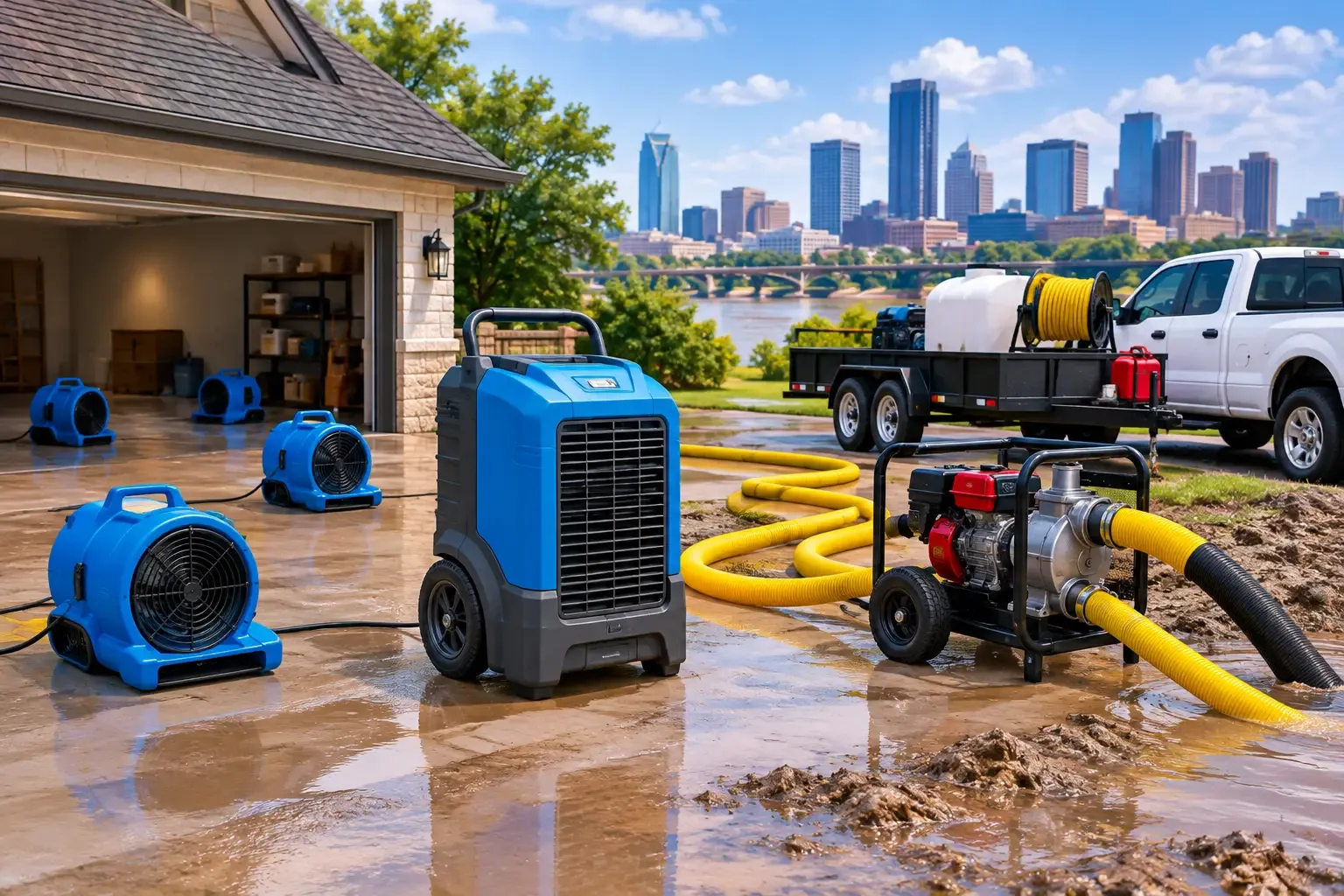
Flood recovery follows a simple sequence: extract water, move air, remove moisture, and clean the air when conditions call for it. Each machine has a specific job. Skipping a step can lengthen dry times and leave hidden moisture behind.
Pumps for Deep or Large-Volume Water
When water is several inches deep or collecting in a crawl space, basement, parking area, or low spot on a property, a pump handles the bulk removal. Submersible pumps work directly in standing water and are often the practical choice for deep pooled water. Trash pumps are built to move water that may contain debris, but they should be matched to the water conditions and hose size required.
Pump capacity matters. A high-capacity pump can move water quickly, but it still needs a safe discharge location. Do not send water toward neighboring properties, foundations, or areas where it can flow back into the structure. Make sure the discharge hose is long enough and secured before starting the pump.
For shallow water inside a building, a pump may leave a thin layer behind. That is where extraction equipment takes over.
Extractors and Wet/Dry Vacuums for Interior Water Removal
Carpet extractors and wet/dry vacuums remove water that a pump cannot reach. They are useful for wet carpet, hard floors, baseboards, tight corners, and localized losses. In a large commercial area, professional extraction equipment can remove substantially more water than a standard shop vacuum and reduce the time needed for drying.
The trade-off is speed versus precision. A wet/dry vacuum is a solid option for a small utility room, bathroom, or isolated leak. A flooded office suite, retail space, or multiple-room home typically needs more extraction capacity. The sooner water is removed from carpet and pad, the better the chance of limiting damage to subflooring and nearby walls.
Air Movers to Dry Surfaces
Air movers are high-velocity fans designed for drying, not simple comfort cooling. They push air across wet floors, walls, carpet, framing, and other surfaces to speed evaporation. They work best when positioned to create a consistent airflow pattern rather than pointed randomly into the room.
For example, after extracting water from carpet, place air movers along the perimeter so air travels across the carpet and up the walls. In a room with wet drywall, direct airflow along the lower wall section where water likely wicked upward. Keep interior doors open when drying connected spaces, unless isolating an area because of contamination or dust.
More fans are not automatically better. Too many air movers in a closed area can create turbulence without improving drying. The space, material type, and available dehumidification determine the right quantity.
Dehumidifiers to Remove Moisture From the Air
Air movers turn liquid water into water vapor. Dehumidifiers remove that vapor from the air so drying can continue. Without adequate dehumidification, a room can feel less wet while materials remain damp because the air is already holding too much moisture.
Commercial dehumidifiers are particularly useful after significant water intrusion, especially during humid North Texas weather. They help control indoor humidity and pull moisture from building materials over time. A small residential unit may be enough for a closet or bathroom, but it can be undersized for a flooded living area or a multi-room cleanup.
Keep doors and windows closed in the drying zone when possible. Open windows may seem helpful, but humid outdoor air can slow the process. The exception is when ventilation is needed for safety or when a professional has determined outside conditions support drying.
Air Scrubbers for Dust, Odors, and Airborne Particles
An air scrubber filters airborne particles as air passes through the unit. It can be useful when demolition, drywall removal, contaminated water cleanup, or mold-related work is involved. Air scrubbers are not a substitute for proper cleaning and containment, but they can help improve air quality while work is underway.
If a flood requires removing wet drywall, carpet, insulation, or other materials, containment and filtration become more important. This is especially true in occupied homes, medical offices, schools, and commercial spaces where keeping dust from traveling matters.
Size Equipment for the Job, Not the Worst-Case Scenario
The fastest way to waste money on a cleanup is to rent equipment based on guesswork. Start with the affected square footage, the depth of water, the materials involved, and the number of rooms. Then consider whether moisture has traveled into adjacent areas.
A single flooded bedroom with damp carpet may need an extractor, a few air movers, and a dehumidifier. A storm-damaged property with wet flooring, baseboards, and several connected rooms may require pumps, multiple air movers, commercial dehumidification, and air filtration. Larger jobs may also need generators if power is unavailable, extension cords rated for the load, and moisture meters to verify progress.
Power availability is a real limitation on flood jobs. High-capacity drying equipment draws significant electricity. Avoid overloading household circuits, daisy-chaining extension cords, or running equipment through damaged outlets. When utility power is out or insufficient, a properly sized generator can keep essential cleanup equipment running, but it must always operate outdoors away from doors, windows, and enclosed spaces.
A Practical Equipment Workflow
Once the space is safe to enter, remove standing water first. Pumps handle deeper water, while extractors and wet/dry vacuums handle shallow interior water and saturated flooring. Remove wet contents that can be moved safely, including rugs, furniture, and boxes, so air can reach affected surfaces.
Next, place air movers and dehumidifiers together. Air movers accelerate evaporation; dehumidifiers capture the released moisture. Check equipment regularly, empty collection tanks when needed, and look for areas that remain cool, damp, or musty. Those spots may indicate moisture behind walls, under flooring, or in insulation.
Finally, verify that materials are actually drying. Touch alone is not reliable. A moisture meter is useful for checking wood, drywall, and other materials against dry areas of the building. If readings stay elevated after several days, the issue may be hidden moisture, insufficient equipment, or materials that should be removed.
Rent or Buy? Choose Based on Frequency and Urgency
For one-time cleanup, renting professional-grade flood equipment is usually more practical than buying. You get the capacity needed for the job without storing, maintaining, or repairing specialized machines afterward. Rental also makes it easier to scale up if the first equipment setup is not enough.
Buying may make sense for restoration companies, property managers, maintenance departments, or contractors who regularly respond to water losses. The decision depends on how often the equipment will be used, who will maintain it, and whether it can be transported quickly when an emergency occurs.
EZ Equipment Rental can help DFW customers match pumps, dehumidifiers, air movers, air scrubbers, generators, and other jobsite equipment to the size and conditions of the cleanup. A quick equipment conversation before loading up can prevent an undersized setup and lost drying time.
Flood cleanup moves fast, but it should not be rushed blindly. Remove water, control humidity, keep air moving, and check moisture where it hides. The right equipment gives you a better chance to protect the property while there is still time to save it.