
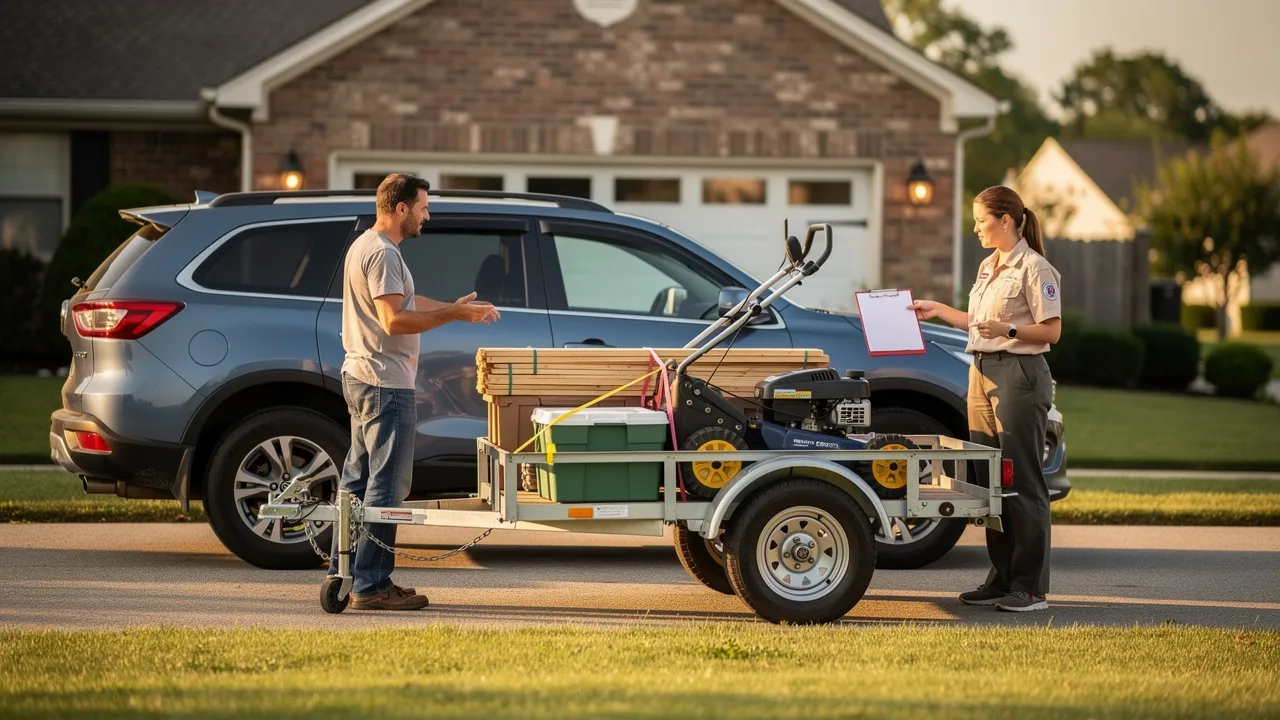
Start with the vehicle-and-load compatibility question
Trailer towing fit for a home project in Irving or elsewhere in DFW depends on the vehicle, hitch, trailer, and intended load considered together. A trailer category or a vehicle’s towing-capacity figure alone cannot settle whether the combination is suitable. The relevant question includes the vehicle, everyone and everything inside it, the trailer, and everything the trailer will carry.
A focused inquiry gives us project context so we can discuss an applicable option without requiring you to guess at a trailer specification. Prepare what you know about the job, load, vehicle, and planned trips, then ask about the parts that still need confirmation. That discussion helps keep two decisions separate: whether the project details are clear enough to discuss an option, and whether the actual combination is confirmed as compatible.
A useful inquiry keeps three questions distinct: what the vehicle and hitch must handle together, how the load bears on the hitch and its mounting assembly, and how you plan to use the trailer. Those questions relate to the same project, but an answer to one does not answer the others. The load, vehicle, trip pattern, location, and schedule give the rental provider context for discussing each point.
Describe what the trailer will carry
Your load description should name the materials, equipment, or waste you intend to move and include approximate load information you already have. If the load changes between project phases, note which phase changes it. This gives the rental provider useful context; it does not turn an estimate into a confirmed loaded weight. Trailer design is another point to discuss. If you are considering an open arrangement, say whether weather protection or enhanced security is relevant to the load; the trailer category alone does not establish that a particular option suits it.
A short load record can keep your inquiry specific. Write down what you expect to move, the approximate load information available to you, and any planned change during the project. For example, if the material or amount differs between phases of your DFW home project, describe those phases separately rather than compressing them into one broad label. If you do not have a precise figure, state what you do know and leave the rest open for discussion.
Load information is only one part of the towing question. The vehicle must be considered with its own weight, its occupants and contents, the trailer, and everything on the trailer. Keep your project estimate clearly identified as approximate so it is not mistaken for a confirmed account of the complete combination.

Check the complete towing combination, not one capacity figure
The vehicle-and-trailer combination includes more than the load you plan to pull. The tow vehicle must be capable of hauling its own weight, everyone and everything inside it, the trailer, and everything on the trailer together; the hitch must be capable of handling the same. The towing capacity also needs to exceed the heaviest weight you plan to pull.
A practical screening question starts with the vehicle you intend to use and any towing-capacity information available to you. Pair those details with your load description, including what is approximate or still unknown. Then ask the rental provider to discuss the actual combination rather than treating a number in isolation as proof of compatibility. You do not need to guess at a trailer specification to make that discussion specific.
A direct question can keep the conversation tied to your project: Given this vehicle, the capacity information I have, and this load, what should we discuss to determine whether an applicable option fits? Include the project context and ask about the complete vehicle, hitch, trailer, and load combination. A general category or partial figure is not confirmation of a match.
Treat hitch and load balance as separate questions
Load balance raises a separate question from whether the vehicle and hitch can handle the combined weight. A balanced towed load involves the horizontal force required to move it and the vertical weight it places on the hitch and on the assembly that mounts to the vehicle’s frame. Both aspects belong in a project-specific fit discussion.
Your inquiry can describe what you know about the vehicle, hitch, and load, then ask how those details apply to the actual arrangement. Do not infer a balance result from a trailer category or capacity figure. Keep this as a question for the specific setup, rather than trying to calculate or adjust it from a general description.

Explain the vehicle and trips you have planned
Your inquiry should identify the vehicle you plan to use, include any towing-capacity information available, and describe how you expect to use the trailer. Say whether your plan involves one trip, repeated trips, or travel between multiple sites. These details frame the compatibility discussion, but do not establish that a particular setup fits.
A vehicle note can record the vehicle you intend to use and the capacity information you have. If some information is unavailable to you, identify what you can provide rather than filling the gap by assumption. Keep the vehicle details alongside the load note, since the towing question concerns the vehicle and what it will pull together.
Your trip plan describes intended use in practical terms. State whether the work calls for one trip, repeated trips, or movement between sites, and name which applies to your project. You do not need to turn the trip pattern into a trailer specification. Share it as context and ask what it means for discussing an applicable option.
A concise way to explain your plan is to state the vehicle, the towing-capacity information you have, and whether you expect one trip, repeated trips, or multiple sites. Choose the description that matches your project, then ask what other details are needed to discuss an applicable option. Trip count alone does not settle towing fit.
Give the project area and rental window
Your project location should name the city or jobsite area and indicate whether the work is in Irving or another DFW community. A specific location gives the rental provider useful context for the request. It does not establish that a trailer is available for that location or date.
At EZ Equipment Rental, we offer trailer rentals in the Dallas–Fort Worth area. We are located at 1307 W Airport Fwy, Irving, TX 75062. Your jobsite and our Irving address are separate details, so include the actual project area in your inquiry.
Your timing note should include the planned start date, expected duration, and any uncertainty that could affect the rental period. A project estimate is useful context, not a confirmed rental period. If the start date or duration may shift, state that plainly so the discussion reflects the window you currently expect.
A single location-and-timing note can include the project city or jobsite area, planned start date, expected duration, and possible schedule changes. Name the actual work area, whether your project is in Irving, Dallas, Grand Prairie, Arlington, Fort Worth, or another DFW community. Then ask about the rental window that applies to your project rather than assuming your estimate establishes a confirmed period.
Keep an inquiry separate from a confirmed trailer match
A project description lets us discuss an applicable option without requiring you to guess at a trailer specification. It starts a conversation; it does not confirm a match for your vehicle and load. Keep that distinction in view as you prepare the facts and identify the questions that still need answers.
An inquiry record can separate what you know from what you need the rental provider to discuss. Use these prompts to organize it:
- Project and load: What you plan to move, the approximate load information available, and any change by project phase.
- Vehicle and capacity information: The vehicle you plan to use and the towing-capacity information you have.
- Planned use: One trip, repeated trips, or travel between multiple sites.
- Location and timing: The project city or jobsite area, planned start date, expected duration, and any timing uncertainty.
Use the record to describe your project and point out the questions you want addressed. Keep estimates distinct from confirmed details.
A general service area does not establish date-specific availability, project fit, pricing, pickup or delivery, or exact rental terms. Ask about the details that apply to your project instead of treating regional coverage as confirmation. Your inquiry can provide the location and schedule needed to discuss those questions without presenting an estimate as an agreed arrangement.
Use confirmed fit details to decide whether to proceed
You can pursue an inquiry once you have the project and vehicle details ready. At EZ Equipment Rental, we provide personalized recommendations based on your specific needs and budget. Ask us to discuss an applicable option and the actual vehicle, hitch, and load combination, including operating requirements, before you commit. If key fit questions remain open, do not treat a category or single capacity figure as confirmation; ask us to address the details that apply to your setup. Renting may suit occasional or uncertain project use, while ownership may suit predictable, frequent transportation needs. This use-frequency distinction does not determine the economics of a particular project or the fit of a specific trailer.
Your next step is straightforward: put the project, load, vehicle, trip plan, location, and timing into your inquiry, then wait for the specific fit and operating questions to be addressed before deciding whether to proceed. For an Irving or DFW project, contact us with those details.
What should you ask before arranging a trailer rental?
How much does it cost to rent a trailer in the DFW area?
Current rates and exact rental terms are not established here. Ask EZ Equipment Rental about pricing for your project, sharing the expected rental window and other project details so the response can address your request.
How can I check whether a trailer is available in Irving for my project dates?
Give EZ Equipment Rental the project area, planned start date, and expected duration, then ask about availability for that specific window. DFW service coverage alone does not confirm availability on a particular date.
What should I do if my project schedule or rental duration is uncertain?
Share the duration you currently expect and explain what might change it. Ask EZ Equipment Rental which rental period and terms apply; an estimate in your inquiry is not a confirmed rental period.
Sources
- Should You Rent a Trailer from EZ Equipment Rental for an Irving or DFW Home Project? — blog.ezequipmentrental.com, 2026-10-30
- How to Rent a Trailer for a Construction Project in Irving and DFW — blog.ezequipmentrental.com, 2026-10-27
- Towing Capacity Guide: Everything You Need to Know - Kelley Blue Book — www.kbb.com
- Cargo Trailer Rental Dallas, TX | Rent Cargo Trailers | Equipment Rental Trailer
- Equipment & Tool Rentals in Dallas TX - EZ Equipment Rental