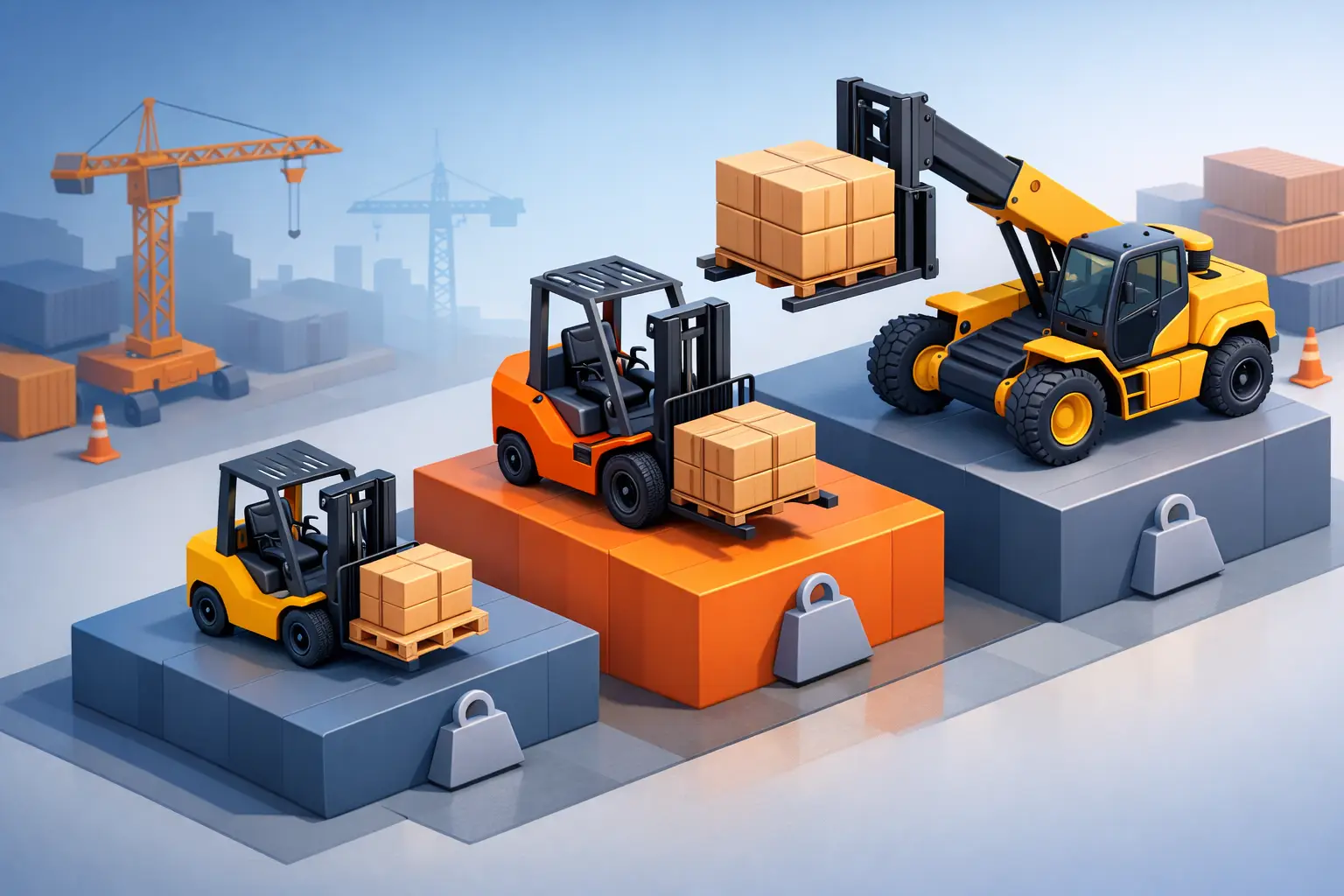
A pallet that weighs 4,000 pounds does not automatically call for a 4,000-pound forklift. When customers ask what forklift capacity they need for a job, the right answer starts with the actual load, then accounts for how far it sits from the forks, how high it must go, and what attachment is on the truck. A little margin is good. Guessing is not.
Choosing the right forklift capacity protects your crew, product, rack system, and schedule. It also prevents a common rental mistake: getting a machine that can pick up the load at ground level but cannot safely place it at the required height.
What forklift capacity do you need for your load?
Forklift capacity is the maximum weight a forklift can safely lift under specific conditions. That number is usually based on a standard load center, commonly 24 inches for many warehouse-style forklifts. The load center is the horizontal distance from the fork face or carriage to the load's center of gravity.
For a balanced, evenly loaded 48-inch-deep pallet, the center of gravity is typically 24 inches from the fork face. If the pallet is deeper, unevenly loaded, or handled with a clamp, jib, carton attachment, or long forks, the center of gravity moves forward. As it moves forward, the truck's usable lifting capacity goes down.
Start with the heaviest load you will actually move, including the pallet, container, forks, attachment, and any material that extends beyond the pallet. Then identify the maximum lift height and the load center. Those three details get you much closer to the right machine than weight alone.
A forklift's data plate is the final authority. It lists rated capacities for the truck's mast, tires, forks, and approved attachments. Never assume the capacity printed in an equipment description applies after you install an attachment or carry a load farther out on the forks.
Capacity is more than the number on the side
A forklift needs enough counterweight and stability to keep the combined center of gravity within its stability triangle. You do not need to calculate that triangle in the field, but you do need to understand what changes it. A load that is too heavy, too far forward, too high, or tilted forward can make a properly rated forklift unsafe.
Load center changes the rating
The basic principle is simple: a longer load creates more leverage against the forklift. If a truck is rated for 5,000 pounds at a 24-inch load center, it may not be rated for 5,000 pounds at a 36-inch or 48-inch load center.
For example, a 5,000-pound crate that is 72 inches deep has a nominal 36-inch load center if its weight is evenly distributed. That is a very different lift than a 5,000-pound, 48-inch-deep pallet. The proper data plate or capacity chart will show what the truck can safely handle at that extended load center.
Do not use a simple ratio as a substitute for the capacity plate. Mast design, lift height, attachment weight, and forklift configuration all affect the real rating. Use the ratio only as a reminder that longer loads reduce available capacity.
Lift height can reduce usable capacity
Many forklift ratings are based on a stated maximum lift height. Raising a load into high warehouse racking, onto a trailer, or over a jobsite obstruction changes stability. Some trucks have reduced capacity at higher elevations, especially telehandlers and forklifts with tall masts.
Tell your rental partner the highest point where the load must be placed, not just the rack or platform height. Include clearance under beams, door openings, sprinklers, and overhead utilities. A forklift must be able to lift the load to the needed height while leaving enough room for the mast and carriage to operate.
Attachments count as part of the load
Side shifters, fork positioners, clamps, carpet poles, drum handlers, and booms are useful tools, but they add weight and can move the load farther forward. That affects the truck's rated capacity.
A side shifter may have a modest effect, while a clamp attachment can significantly reduce capacity. Long forks can create the same issue when they are used to handle deep loads. The attachment must be approved for that specific forklift, and the truck needs an updated data plate that reflects the attachment.
Choose capacity with real job conditions in mind
A forklift that is right for a smooth concrete warehouse floor may be wrong for a muddy material yard, a sloped construction site, or loose gravel. Capacity is only one part of equipment selection.
For indoor pallet handling, an electric warehouse forklift often makes sense because it is quiet, maneuverable, and has no engine exhaust. Measure aisles, rack spacing, and turning areas before choosing a truck. A higher-capacity forklift can be physically larger, which may create clearance problems in tight storage areas.
For outdoor construction materials, a rough-terrain forklift or telehandler may be the better choice. These machines provide ground clearance and traction for uneven sites, but they have their own load charts. A telehandler's capacity can change significantly as the boom extends forward or upward. The load chart must be read for the exact reach and lift position, not just the machine's maximum rated capacity.
Pneumatic tires, solid tires, slope, wind, ground conditions, and travel distance also matter. A forklift should not travel across a slope with an elevated load, and loose or soft ground can quickly change the conditions assumed by a capacity rating.
A practical sizing process
Before renting or buying, gather the job details in one place. This prevents delays when the forklift arrives and helps ensure the machine is ready to work.
| Job detail | What to provide |
|---|---|
| Heaviest load | Total weight of product, pallet, container, and attachment |
| Load dimensions | Width, depth, height, and whether weight is evenly distributed |
| Pick and set height | Ground level, trailer height, rack level, or maximum boom reach |
| Site surface | Smooth concrete, asphalt, gravel, dirt, mud, or uneven terrain |
| Work area | Indoor or outdoor use, aisle width, doorway clearance, and overhead clearance |
| Attachment needs | Side shifter, clamp, long forks, jib, carpet pole, or fork positioner |
Photos of the load, rack, doorway, or work area can help resolve questions quickly. If the load has a marked weight, use it. If it does not, do not estimate from appearance alone. Check shipping paperwork, manufacturer specifications, scale tickets, or supplier information.
Build in capacity margin, but do it correctly
It is smart to select a forklift with room above the expected load weight. That margin helps account for varying pallet weights, moisture in lumber, packaging changes, and occasional heavier picks. But buying extra capacity does not replace checking the load center or capacity plate.
For instance, moving from a 5,000-pound to a 6,000-pound forklift may provide useful room for a standard 24-inch load center. It may still not be enough for a 6,000-pound load carried at a long load center or lifted high with an attachment. Bigger is not automatically safer if it creates aisle, floor-loading, transport, or visibility issues.
Common capacity mistakes to avoid
The most frequent mistake is selecting a forklift based only on the listed weight capacity. Another is forgetting that a forklift must carry the load with the mast tilted back and travel it safely, not merely lift it an inch off the ground.
Avoid these four problems:
- Treating the load's shipping weight as the total weight while ignoring pallets, containers, and attachments.
- Assuming a deep, long, or off-center load has the same rating as a standard pallet.
- Using an attachment without the correct approved capacity plate.
- Picking a machine for the load but not for the lift height, terrain, aisle width, or doorway clearance.
Operator training matters just as much as machine selection. The operator should inspect the forklift before use, verify the data plate, keep loads low while traveling, use the seat belt where equipped, and follow the site's traffic and pedestrian controls. If a load is unstable, damaged, or not centered, stop and correct the issue before lifting.
Get the forklift matched to the job
The fastest way to get the right answer is to provide the load weight, dimensions, lift height, attachment requirements, and site conditions. For a DFW warehouse delivery, construction material placement, or short-term cleanup project, those details allow EZ Equipment Rental to match the forklift type and capacity to the work instead of sending a one-size-fits-all machine.
When the load is unusually heavy, long, high, or hard to identify, take a few extra minutes to verify it before scheduling equipment. The right forklift is not simply the one that can lift the most. It is the one rated to safely move your actual load where it needs to go, ready to work when you are.