
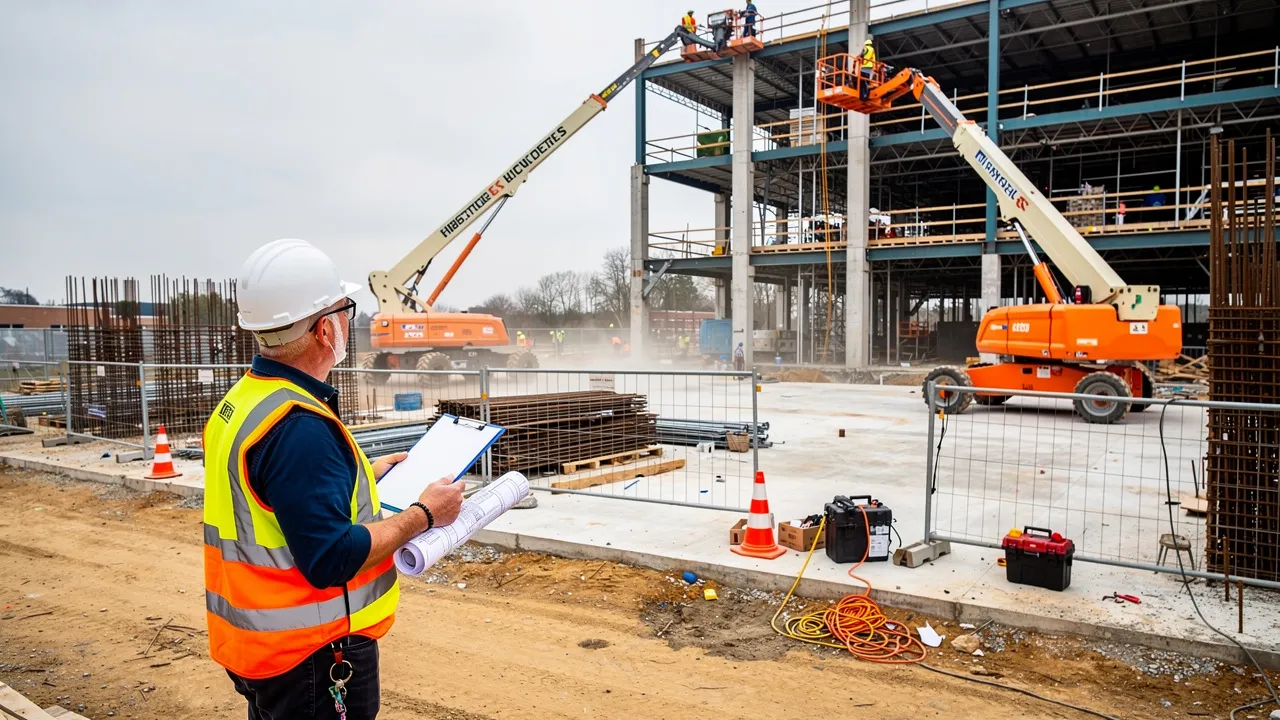
Start with the access problem, not a lift model
A boom lift rental starts with the access problem your project must solve, not with a preferred machine name. Before you ask about a rental in Irving or elsewhere in the Dallas–Fort Worth area, define where the worker must reach, what work must be completed, what may block the route, and when the equipment will be needed.
That order matters because aerial equipment is not interchangeable by label alone. An Irving aerial-equipment source distinguishes between scissor lifts used for indoor maintenance and boom lifts used for construction, fabrication, bridge repair, and other elevated work at different working heights. It also separates articulating booms, which extend up, out, and over obstacles, from telescopic booms, which provide horizontal reach for hard-to-reach places. Those descriptions give you a way to explain the work; they do not establish that a particular unit will fit your project.
Use this guide to prepare a focused rental inquiry. You will define the access geometry, record the site conditions that affect the conversation, separate questions from assumptions, and give EZ Equipment Rental enough context to discuss a current option. Specifications, availability, pricing, delivery arrangements, and operating requirements still need to be addressed for the actual project.
A useful decision has two parts: first, describe the work envelope and site; second, ask EZ Equipment Rental to address the equipment details that depend on those facts. Keeping those parts separate prevents a general category description from becoming an unsupported promise about suitability.
Describe where the worker must reach
The work area and required reach are the first facts to describe. Start with the point where the worker needs to perform the task, then describe how access must occur from the equipment’s position. A vertical destination is only part of the question. You also need to explain whether the work requires movement outward, over an obstruction, or across open space.
Write down the access problem in plain language:
- Identify the work surface or elevated area that must be reached.
- Describe whether the route is primarily upward, outward, or upward and over an obstruction.
- Note any overhead constraint, structure, roofline, or other obstruction that affects the approach.
- Describe whether the work is indoors or outdoors.
- State what the worker will do after reaching the position, such as construction, fabrication, repair, or another defined task.
- Identify where the equipment could be positioned without assuming that the proposed lift can access or operate from that point.
Do not replace these facts with a guessed working-height number. A height estimate without the horizontal path or obstruction details can point the inquiry toward the wrong access question. The selected Irving source gives examples of different aerial applications and working heights, but those examples are not a specification for your job.
A useful description might distinguish between “the work is above the open side of the structure” and “the work is behind an obstruction that requires the platform to reach up and over.” The difference helps frame the conversation without choosing a boom type in advance. If you cannot describe the route yet, measure or document the work area before requesting a recommendation rather than relying on a model name.
Keep the destination and the approach together. “The work is 30 feet up” describes only one part of the problem; “the work is above the far side of an obstruction and requires outreach from the available setup area” gives the rental conversation a more useful starting point without asserting a required machine specification.
Separate articulating and telescopic access questions
Articulating and telescopic boom lifts answer different access questions. Treat the categories as vocabulary for describing the job, not as a final selection.
An articulating boom is described as extending up, out, and over obstacles. That movement pattern is relevant when the work position is separated from the equipment’s location by a structure or another obstruction. Describe what must be cleared and where the worker must finish, but do not assume that an articulating configuration will meet the project’s reach or operating requirements.
A telescopic boom is described as providing horizontal reach for hard-to-reach places. That makes the length and direction of the reach central questions when the work area is farther away from the equipment position. State the required access path and the destination rather than treating “long reach” as a complete specification.
Use these questions to organize the inquiry:
- Does the worker need to rise and reach over an obstacle, or extend toward a more distant work position?
- Is the work area open, or does a structure affect the path from the equipment to the task?
- Does the job involve construction, fabrication, bridge repair, maintenance, or another intended use?
- Can the work location and access path be described clearly enough for EZ Equipment Rental to discuss the lift type and reach?
The answer may still require a different aerial category or a configuration that you cannot identify from a general description. Match the lift type and reach to the work area and task, then let EZ Equipment Rental address the current configuration.
This distinction also helps you avoid an incomplete request. Asking only for an articulating or telescopic boom leaves the access problem unexplained; describing the obstruction, destination, and direction of movement gives the category a project-specific context.
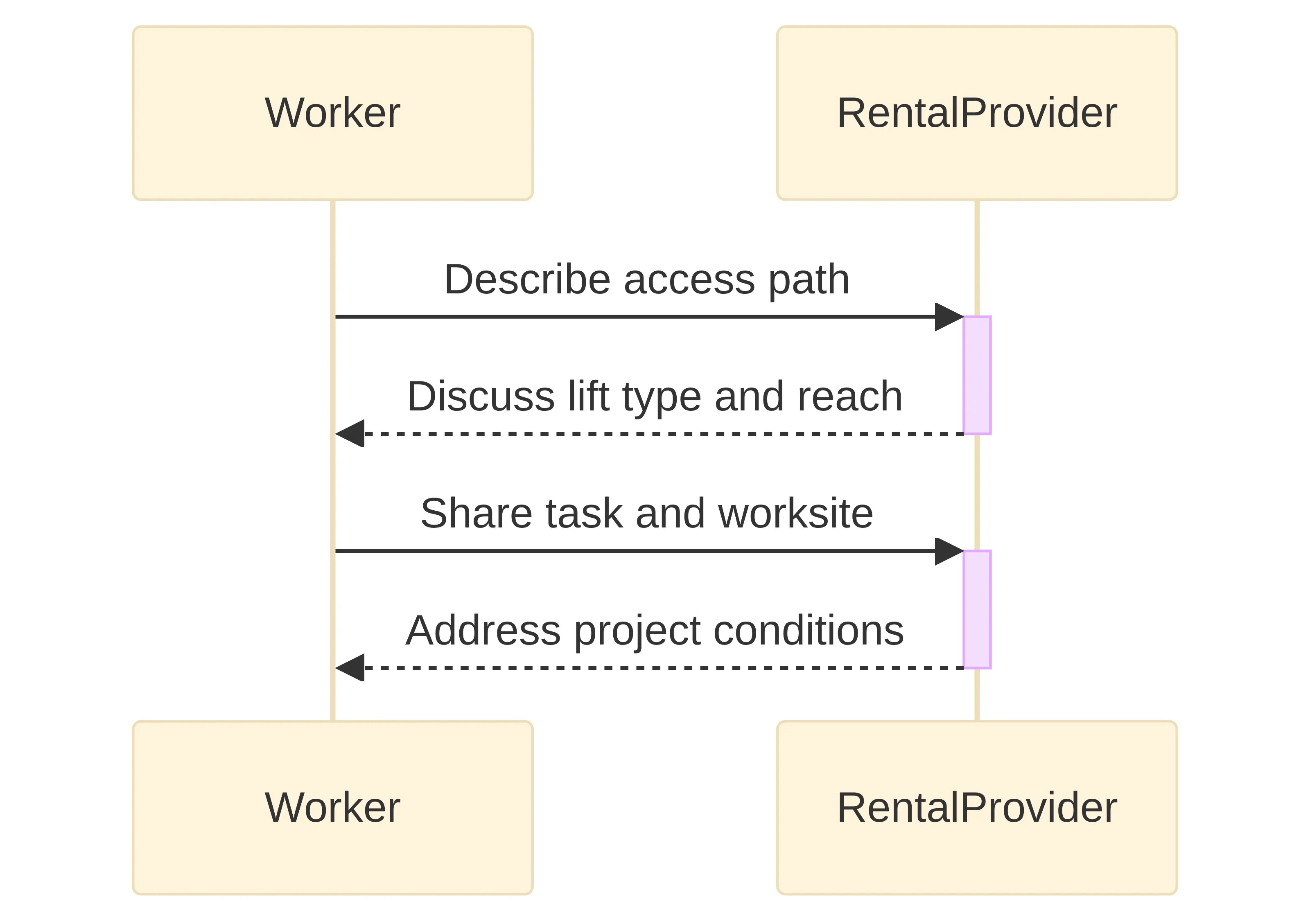
Screen the work area before asking for a recommendation
The work area determines whether your inquiry contains enough context for a useful equipment discussion. Screen the site before you ask EZ Equipment Rental for a boom-lift recommendation so the question reflects the actual project rather than only the desired height.
Record these site facts:
- Work location: Give the city and project location in Irving or the Dallas–Fort Worth area. If the job is outside Irving, identify the exact DFW municipality or jobsite area.
- Access geometry: Explain the vertical destination, horizontal outreach, and any need to work up, out, or over an obstruction.
- Work setting: State whether the work is indoors or outdoors and identify the construction, fabrication, repair, or other task involved.
- Obstacles and overhead constraints: Describe structures, rooflines, equipment, or other features that affect the approach. Use observable descriptions instead of assuming a lift can pass over or around them.
- Equipment position: Identify the area from which access would begin and describe any route the equipment may need to take to reach that position.
- Schedule: Give the planned start date, expected work window, and any timing issue that could affect the rental period.
- Intended use: Explain what the worker needs to accomplish from the elevated position.
This screen is a planning record, not a clearance decision. Do not infer that a boom lift can enter the site, reach the work area, or operate under the stated conditions until the applicable configuration and requirements have been addressed. The point is to give the rental conversation the conditions that shape the equipment question.
A short site description is more useful than a broad request such as “I need a lift for a construction job.” For example, identify the city, the elevated task, the direction of reach, the obstacles, and the timing in separate statements. That format gives EZ Equipment Rental a focused basis for discussing an appropriate option without promising suitability or availability.
If the site has several possible setup areas, list each one and explain what changes between them. That detail may affect the access question, but it does not determine which configuration is suitable. Leave that determination for the project-specific discussion.
Build the project intake record
A project intake record turns scattered jobsite facts into a rental question that can be answered. Keep the record concise, but include enough detail for EZ Equipment Rental to understand the access problem, location, timing, and intended use.
Use this order:
- Project location: Record the city and the worksite location in Irving or the Dallas–Fort Worth area.
- Task: Name the work to be performed from the elevated position, such as construction, fabrication, bridge repair, maintenance, or another specific activity.
- Required access: Describe where the worker must reach and whether the route is upward, outward, or over an obstruction. State the required reach as a project need, not as a chosen machine specification.
- Work-area conditions: Identify indoor or outdoor use, obstacles, overhead constraints, and any access feature that changes how the equipment would approach the work.
- Equipment position: Describe where the lift could be set up and whether the work requires access from one position or more than one.
- Timing: Give the planned start, expected duration, and whether the schedule is fixed or may change.
- Intended use: Explain what the worker will do at the work position and how the equipment fits into the project sequence.
- Budget context: If you have a project budget or a rental-period limit, include it as context for the conversation rather than assuming it determines the equipment choice.
- Open questions: List the specifications, availability, rental duration, delivery or pickup arrangement, and operating requirements that still need an answer.
This record helps separate what you know from what EZ Equipment Rental must determine. You may know the city, task, access path, and schedule while still lacking the exact lift type, working reach, or current availability. That is a normal reason to ask for a recommendation rather than select a unit from a general description.
The intended use deserves its own line. “Elevated access” does not explain whether you are performing construction, fabrication, repair, maintenance, or another task. The task gives the rental discussion context, while the access description explains the movement needed to reach it. Keep both in the record.
A concise inquiry can follow this structure:
- “The project is in [DFW city and worksite area].”
- “The task is [specific construction, fabrication, repair, or maintenance work].”
- “The worker must reach [destination] from [possible setup area], moving [upward, outward, or over an obstruction].”
- “The site includes [indoor or outdoor setting and observable constraints].”
- “The planned work window is [start and expected duration].”
- “Please address the lift type, applicable specifications, availability, rental terms, logistics, and operating requirements for this project.”
Replace the bracketed descriptions with project facts before sending the request. The structure gives you a complete starting point without inventing a model, rate, capacity, delivery arrangement, or operating permission.
If the project is in Irving, say so directly. If it is in Arlington, Carrollton, Dallas, DeSoto, Euless, Fort Worth, Garland, Grand Prairie, Grapevine, Lewisville, Mansfield, Mesquite, Plano, Richardson, South Fort Worth, Duncanville, Bedford, Farmers Branch, Oak Cliff, Coppell, Lake Dallas, Watauga, Colleyville, or another DFW location, name that place rather than describing the job only as “local.” The location affects the rental conversation without establishing delivery, pickup, or availability.
Treat specifications and availability as confirmation questions
A project record identifies the questions; it does not answer the equipment questions. Treat specifications, availability, pricing, rental duration, delivery or pickup, and operating requirements as items to address for the particular job.
Ask about the details that can change the fit:
- Which current boom-lift type addresses the described access path?
- What working height and horizontal reach apply to the proposed option?
- Which specifications must be considered for the stated work and site conditions?
- Is the proposed option available for the requested project period?
- Which rental duration matches the schedule, including any uncertainty in the work window?
- What delivery or pickup arrangement applies to the work location?
- Which operating requirements, training expectations, and site conditions must be addressed before use?
Do not turn a general equipment description into a promise about a specific unit. The selected Irving aerial source explains the difference between boom categories and advises matching lift type and reach to the work area and task. It does not establish the current specifications or availability for your project.
A useful inquiry separates confirmed project facts from questions that remain open. Put the city, task, access route, obstacles, and schedule in the first part. Put the lift type, specifications, availability, pricing, logistics, and operating requirements in the second part. That format makes it clear which information describes your project and which information EZ Equipment Rental needs to address for the requested period.
Do not treat a response about one detail as confirmation of every other detail. For example, a discussion of lift type does not by itself establish availability, delivery, pricing, or operating requirements. Keep each item visible in the request until it has been addressed for the actual project.
Put planning and safety review before operation
Equipment fit and operating readiness are separate decisions. Prepare the rental inquiry first, then address the requirements that apply to the equipment, worksite, and people who will operate it.
OSHA’s aerial-lift regulation includes design and construction requirements tied to ANSI A92.2-1969 for covered aerial lifts acquired on or after January 22, 1973, subject to the regulation’s stated provisions. That rule is a regulatory reference, not a basis for assuming that a particular rental unit meets every requirement for your project. Ask which current requirements apply to the proposed equipment and worksite.
OSHA’s interpretation also says that, in the covered aerial-lift situation described there, a body harness must be used and the equipment must meet the applicable fall-arrest requirements in 29 CFR 1926.502. The same interpretation says the cited training requirements in 29 CFR 1926.454 apply to equipment covered by Subpart L, including the equipment discussed in that passage. Confirm the current rule and training requirements for the equipment and worksite before operating.
Use a short readiness review:
- Identify the equipment category being considered and the work it will perform.
- Ask which current training requirements apply to the equipment and worksite.
- Address the applicable body-harness and fall-arrest requirements for the covered situation.
- Ask what operating requirements must be met before the equipment is used.
- Keep the project’s access description, site conditions, and intended use with the rental record so the operating discussion remains tied to the actual job.
- Record any unresolved requirement as an open issue rather than assuming it is covered by the rental request.
Do not treat a rental inquiry as operating authorization. The equipment category, worksite, and applicable requirements must be addressed before operation, and a general planning checklist cannot replace the required site and compliance decisions.
Keep this review separate from the fit question. A lift may be discussed as a possible match for the access path while training, fall protection, design requirements, and other operating conditions remain open. Both parts must be addressed before use.
Use EZ Equipment Rental’s DFW connection for the inquiry
We provide boom lifts for rent in the Dallas–Fort Worth area. We offer a fleet of well-maintained boom lifts and flexible rental durations tailored to project requirements. We also provide personalized recommendations based on your specific needs and budget.
We are located in Irving, Texas, at 1307 W Airport Fwy, Irving, TX 75062. That location gives you a clear geographic reference when you describe an Irving project or another DFW jobsite. It does not, by itself, establish that a particular lift is available, that delivery or pickup is included, or that the equipment will suit the work area.
Make the location part of the first sentence of your inquiry. State the project city, identify the task, describe the access path, list obstacles or overhead constraints, provide the timing, and explain the intended use. If the work is outside Irving, name the DFW city and jobsite area so the rental discussion starts with a specific location rather than a general regional label.
This approach fits both contractor planning and smaller construction or repair work. You do not need to choose a model before explaining the job. You need a clear project record that lets us discuss the lift type, reach, current specifications, schedule, and other project conditions that require confirmation.
For an Irving job, include the worksite area in addition to the city because a project location and our Irving address are separate pieces of information. For a job elsewhere in DFW, include the municipality and any useful site-location description in the inquiry. Local relevance begins with a named worksite; it does not establish a delivery arrangement or equipment reservation.
Submit a confirmation-ready boom-lift request
A boom-lift request is ready when it explains the project rather than naming only a machine. Before you proceed, assemble these points:
- DFW project city and worksite location
- Elevated task and intended use
- Required access direction and reach
- Obstacles or overhead constraints
- Indoor or outdoor setting
- Possible equipment position and access path
- Planned start and expected rental period
- Questions about lift type, applicable specifications, availability, pricing, delivery or pickup, and operating requirements
- Any budget or schedule constraint that affects the conversation
Use the request to ask for a current option, not to announce that a particular lift will fit. The project’s actual specifications, availability, terms, and operating requirements still need to be addressed for the worksite. When the task, access needs, site conditions, timing, and intended use are clear, your inquiry gives the rental discussion a practical starting point. If any of those details are still unknown, gather them before treating a boom lift as the project solution.
A clear request does not need to predict the answer. It needs to make the access problem, site, schedule, and intended use specific enough for the remaining equipment questions to be addressed.
What should you confirm before requesting a boom lift?
What factors should I consider when renting a boom lift for my project?
When renting a boom lift, consider the access geometry, including the height and reach required, any obstacles or overhead constraints, the work location, and the intended use of the lift. It's important to describe these factors clearly when making your inquiry.
How can I ensure that I provide the right information when requesting a boom lift rental?
Prepare a project intake record that includes the project location, task to be performed, required access direction and reach, any obstacles, indoor or outdoor setting, possible equipment position, timing, and any budget constraints. This will help EZ Equipment Rental understand your needs.
How do I determine the rental duration for a boom lift?
The rental duration should match your project schedule, including any uncertainties in the work window. Discuss your timeline with EZ Equipment Rental to find a flexible rental option that meets your needs.
What should I do if I have specific questions about boom lift specifications or availability?
When inquiring about a boom lift, list your specific questions regarding the type, specifications, availability, rental terms, and any operating requirements. This will help EZ Equipment Rental provide you with the most accurate information.
Sources
- Fall protection, training, inspection and design requirements of aerial lifts and scissor lifts/scaffolds. | Occupational Safety and Health Administration — www.osha.gov
- 1926.453 - Aerial lifts. | Occupational Safety and Health Administration — www.osha.gov
- Boom Rental | Rent A Boom Lift | Articulating Boom Lift | Forklift Rental Near Me
- EZ Equipment Rental provides industrial equipments -
- Equipment & Tool Rentals in Dallas TX - EZ Equipment Rental