
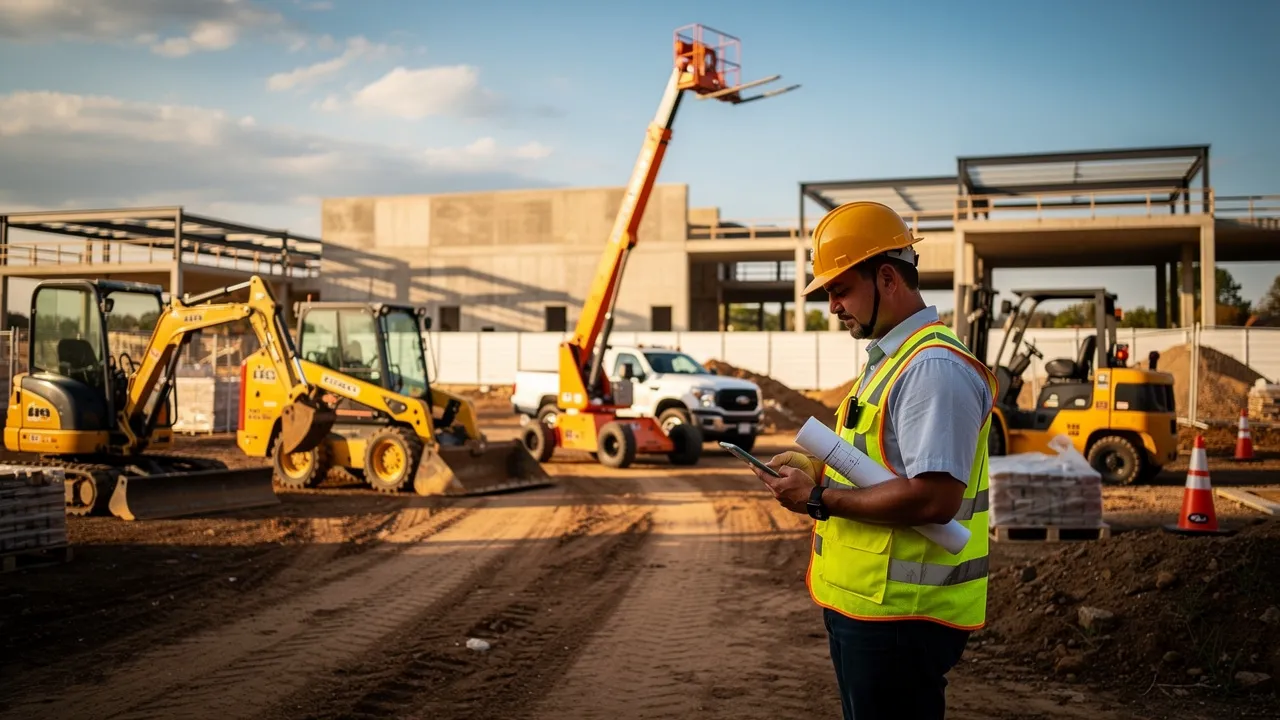
Verify local rental logistics in Irving and DFW
Searching for “rent equipment near me” in Irving or the Dallas-Fort Worth Metroplex is a starting point, not a rental decision. A useful local check asks four separate questions: Is the provider relevant to the jobsite? Is the needed category represented? Can pickup or delivery be discussed for that location? Which current availability, pricing, and rental terms still need confirmation? Keeping those questions separate prevents proximity from being treated as proof that a particular machine or arrangement is available.
For a job in Irving or another supplied DFW location, begin with local relevance. We serve multiple locations across the DFW Metroplex, including Irving, Dallas, Fort Worth, Arlington, Carrollton, Grand Prairie, Lewisville, Plano, and Richardson. That establishes a reason to evaluate EZ Equipment Rental for a DFW project, but it does not establish delivery coverage for a particular jobsite. Include the jobsite city, access conditions, and preferred pickup or delivery arrangement in the inquiry.
Use our rental catalog and the job’s plain-language output to name an equipment category rather than assuming a specific unit. Common categories include access, material handling, earthmoving, compaction, concrete, drilling, hauling, and mobile-crane work. The supplied classifications place boom and scissor lifts in access, forklifts in material handling, excavators and trenchers in earthmoving, and compactors in compaction. This gives the inquiry a useful starting label without asserting that a specific item is currently available.
A concise local-rental request can contain:
- Location and access: the jobsite city, gates or clearance limits, travel paths, and whether pickup or delivery needs to be discussed.
- Category and work: the equipment category, primary task, material, digging depth, lift requirement, or attachment need when relevant.
- Timing: the planned start, expected duration, project phase, and any weather or schedule uncertainty.
- Verification questions: current availability, applicable pricing, rental period, pickup or delivery coverage, and the terms that would apply.
Describe the rental period as a project estimate rather than an assumed package. Project phase can affect timing: earthmoving may be needed early, while lifting equipment or compactors may be needed later. If weather or a schedule change could extend the work, ask whether the rental arrangement can be adjusted instead of assuming that it can.
Use the EZ Equipment contact form to submit the jobsite, category, timing, and logistics questions together. Browse our rental catalog when you need a category label, then ask EZ Equipment Rental to confirm the details that a local search cannot settle: the exact unit, current availability, pricing, delivery eligibility, and rental terms. This approach turns “near me” into a short local-logistics check without establishing a machine, rate, delivery commitment, rental duration, or project outcome before confirmation.
Use the primary task to narrow the equipment category
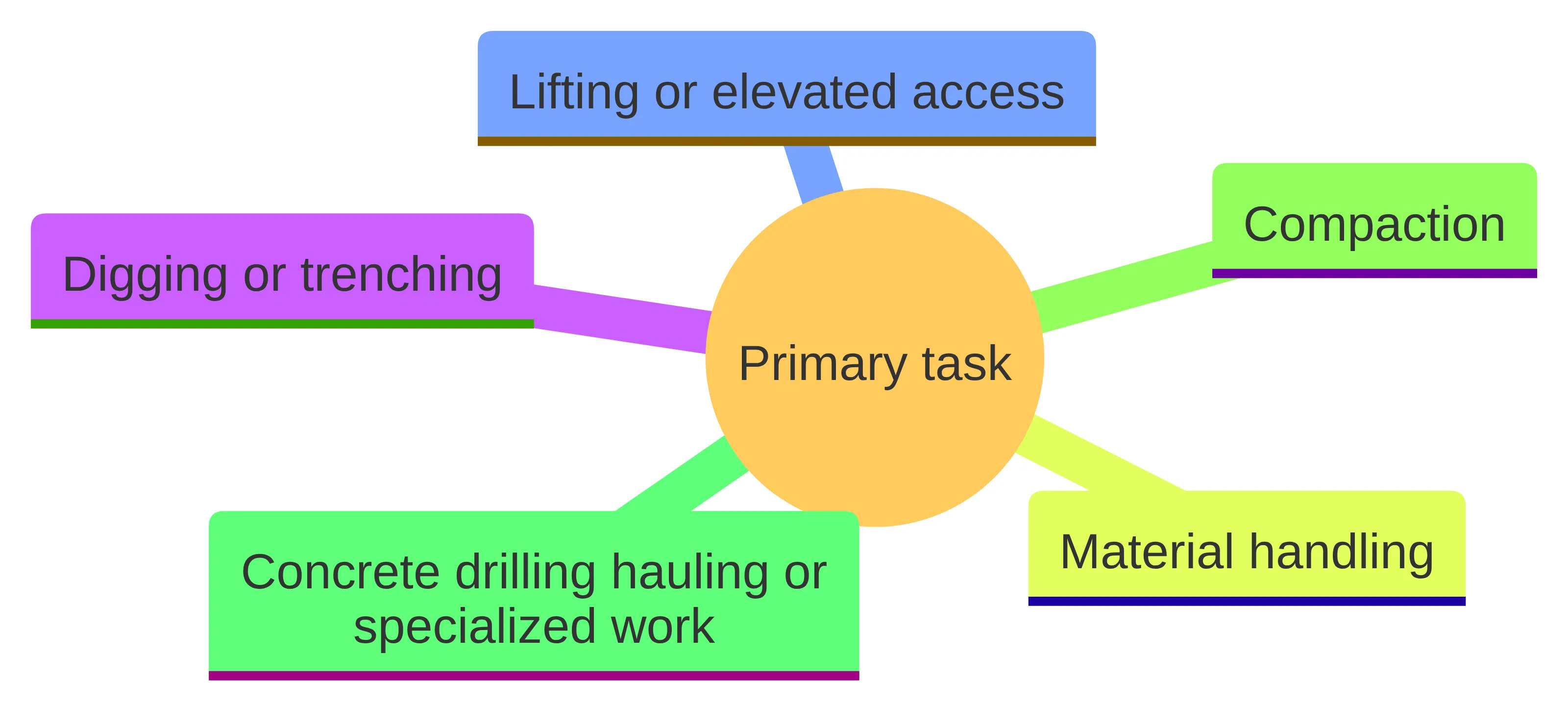
The primary task should determine the first equipment category you discuss, because a machine intended for access work answers a different project question from one intended for digging, material handling, or compaction. Common construction classifications include boom lifts and scissor lifts for lifting and access, forklifts for material handling, excavators and trenchers for earthmoving, and compactors for compaction.
Use the task as a starting point, not as a complete equipment specification. A request such as “I need something for site work” leaves several material questions unresolved. A request such as “I need to excavate along a defined route, work within a limited area, and remove the spoil during a stated project phase” gives the provider a direction for the next questions.
Use these category prompts to describe the work:
- Digging or trenching: State whether the work involves excavation, trenching, grading, or another earthmoving task. Include the required digging depth and the material involved.
- Lifting or elevated access: State whether people, tools, or materials need access at height. Describe the work position and any route or surface restrictions.
- Material handling: Describe what must be moved, how much it weighs, where it must travel, and whether the work involves loading, unloading, stacking, or clearing debris.
- Compaction: Describe the surface or material that must be compacted and the stage of the project in which compaction occurs.
- Concrete, drilling, hauling, or specialized work: Name the operation plainly. Other construction categories include concrete equipment, drilling equipment, hauling equipment, mobile cranes, and specialized excavation equipment.
EZ Equipment Rental offers a wide assortment of heavy machines for rent and sale for construction phases. That business fact identifies a broad rental scope; it does not mean every category, configuration, attachment, or unit is suitable for every job. Use the primary task to frame the conversation, then provide the conditions that determine whether the category can work at your site.
A useful first sentence for an inquiry is: “The primary task is [describe the work], at [city and site type], during [project phase].” Replace the prompts with your actual project details rather than selecting a machine name before describing the work.
Screen the Irving or DFW Jobsite Before Choosing a Rental Path
Searching for “rent equipment near me” in Irving or the DFW Metroplex is a location-and-logistics question before it is a machine question. Start with the jobsite city or area, decide whether pickup or delivery is the question you need answered, and then describe the work and timing. This sequence gives a rental provider enough context to discuss a relevant category without treating proximity as proof that a particular machine, price, term, or delivery option is available.
For a jobsite elsewhere in DFW, include the city and area in the inquiry and ask EZ Equipment Rental to confirm the relevant service and logistics details. Current inventory, rental terms, pricing, delivery coverage, hours, and contact details should be verified before you rely on them.
Use this location-first screen when preparing the request:
| Screening point | Details to record | Question to take into the inquiry |
|---|---|---|
| Jobsite location | City, jobsite address or area, and pickup or delivery preference | What location and logistics details need confirmation? |
| Site access | Entrances, gates, fences, structures, landscaping, clearances, turning space, and travel paths | Could the work area limit the equipment category or configuration? |
| Primary operation | Digging, trenching, lifting, access, material handling, grading, compaction, concrete, drilling, or hauling | Which category should be discussed first? |
| Timing | Project phase, estimated days or weeks, weather exposure, and schedule uncertainty | What rental period should be reviewed? |
| Operating requirements | Soil conditions, lift requirement, digging depth, attachments, material, and production demand | Which requirements should be included before an item is considered? |
Common classifications can help name an initial category. Boom and scissor lifts are associated with access work, forklifts with material handling, excavators and trenchers with earthmoving, and compactors with compaction. Concrete equipment, drilling equipment, hauling equipment, mobile cranes, and specialized excavation equipment cover other construction tasks. These labels narrow the inquiry; they do not establish that a specific item is currently available or suitable for every site.
EZ Equipment Rental’s rental categories include boom lifts, scissor lifts, forklifts, earth-moving equipment, concrete equipment, landscape and tree equipment, scaffolding and ladders, trenchers, generators, telehandlers, compaction and paving equipment, and more. Use the rental catalog to identify items to ask about, then confirm the current item, configuration, and timing for the project.
Rental period should follow the work plan rather than an assumed rate card. Match the request to the phase in which equipment will be used, note estimated days or weeks, and flag weather or schedule uncertainty. Ask EZ Equipment Rental to confirm the current rental duration, pricing, and what happens if the schedule changes. Do not infer daily, weekly, or monthly availability or delivery from the phrase “near me.”
Before submitting the request, note whether the intended operators are familiar with the category and how the equipment will be secured between work periods. Unfamiliar operators should be trained before use, and rental equipment should have a safe, secure storage location, especially for a longer rental. Add these details to the rental conversation when they affect the request.
Submit the details through the EZ Equipment contact form. Include the project city or jobsite area, pickup or delivery preference, primary operation and equipment category, key access or operating requirements, expected rental period, and questions about current availability, terms, pricing, and logistics.
Key Highlights
A field-ready equipment request is a short project record that answers the questions most likely to change the category, configuration, timing, or logistics. Keep these points together before you ask for a rental discussion:
- Name the work before naming the machine. Start with the operation and project phase. Common categories include access lifts, material-handling equipment, earthmoving equipment, trenchers, and compactors.
- Describe the actual ground and envelope. State whether the work area is soft, moist, stable, confined, bordered by fences or structures, or affected by landscaping and other obstacles.
- Give measurable requirements where you have them. Include digging depth, lift requirement, material type, approximate load, attachment needs, available width, and production demand.
- Separate pickup or delivery from equipment fit. A machine can appear relevant to the task while the logistics still require a separate discussion about the jobsite, access route, and timing.
- Match the term to the phase. Plan a preliminary timeline and budget, account for weather that could affect performance or completion times, and allow the rental period to follow the work rather than an untested assumption.
- Prepare the operator and site plan. Train unfamiliar operators before use, arrange secure storage for equipment that remains on site, and treat equipment condition as a separate check from category selection.
- Use a local contact with a complete request. Browse EZ Equipment Rental's rental catalog to select items.
This checklist is a practical writing aid. Use it to assemble the facts you already know and to identify the questions that still need a direct answer. It does not establish availability, a rate, a delivery commitment, or a particular machine for your project.
Screen ground and work-area constraints before requesting a machine
Ground and work-area conditions can narrow the equipment choices before you compare rental details. Soft or moist ground calls for equipment with good traction and lower ground pressure, while wheeled machines are better suited to stable, compacted surfaces. A confined site bordered by fences, structures, or landscaping can also limit the available choices.
Describe the jobsite from the machine's point of view. You do not need to predict the final unit, but you do need to report the constraints that a unit must meet. Walk the route from the likely unloading point to the work area and record:
- Ground that is soft, moist, loose, uneven, or stable and compacted.
- The narrowest gate, path, or opening the equipment must pass through.
- Overhead, side, and turning clearances near structures, fences, landscaping, parked vehicles, or stored material.
- The surface that the equipment must travel across and the surface where it will perform the task.
- The available place for staging, loading, unloading, and storing the equipment between work periods.
- Any section where the equipment must change direction, cross a constrained route, or remain within a defined work envelope.
For a project in Irving, Dallas, Fort Worth, or another DFW location, describe the actual site rather than relying on the city name to communicate access. Two jobs in the same city can have different gates, surfaces, structures, and staging areas. A jobsite address helps with logistics, but it does not describe the working envelope.
Ground conditions also affect the order of your questions. If the site is soft or moist, make traction and ground-pressure requirements part of the initial request. If the surface is stable and compacted, say so without assuming that every wheeled machine will meet the remaining task requirements. If the site is confined, provide the tightest known width and identify the obstacles that create the restriction.
End this part of the inquiry with a direct site statement: “The equipment must travel across [surface], pass through [tightest access point], and work within [available area].” Use your actual measurements and conditions. The provider can then respond to a defined site problem rather than a broad location label.
Record material, depth, access, and lifting requirements
Material, depth, access, and lifting requirements turn a general task into a usable equipment question. Equipment selection guidance calls for the task, soil conditions, available space, material-handling requirements, digging depth, lift requirements, attachments, project duration, and production demand. Construction classifications provide useful vocabulary, including excavators and trenchers for earthmoving, forklifts for material handling, boom and scissor lifts for access, and compactors for compaction.
Record the requirements in separate lines so a missing detail is easy to spot:
- Material: Name the soil, aggregate, debris, palletized goods, concrete-related material, or other material involved. Note whether the work is digging, moving, loading, placing, clearing, or compacting it.
- Depth: Give the required trench or excavation depth, or state that the work is shallow grading or surface preparation. A depth estimate is more useful than a general description such as “digging.”
- Reach and position: Describe where the work occurs relative to the machine's travel path, structures, edges, and loading point. State whether the equipment works directly beside an obstacle or must reach over or around something.
- Load and lift: State what must be lifted or moved, its approximate weight if known, the destination, and whether the task involves loading, unloading, stacking, or repeated travel.
- Attachments: List the attachment you expect to need and any additional attachment that may be required during another project phase. Do not assume that a machine category includes the attachment.
- Production demand: Describe the amount of material, number of loads, number of lifts, or area that must be completed during the work period. A production requirement helps distinguish an occasional task from repeated operation.
A compact request might say: “The work involves trenching to approximately [depth] through [material], with [access condition], and the removed material must move to [destination].” A handling request might state: “The equipment must move [material] weighing approximately [weight] from [starting point] to [destination] through [route].” These statements create a basis for discussing a category without claiming that a particular unit will meet it.
Keep unknowns visible. If you do not know the load, depth, clearance, or attachment requirement, label it as a question for the rental conversation rather than filling the gap with an assumption.
Match the rental period to project phases and schedule uncertainty
A rental period should follow the work phase, expected duration, and schedule uncertainty rather than a habit of choosing a single day or week. Rental duration commonly depends on project scope, weather, equipment specialization, and changes to the construction schedule. Earthmoving equipment may be needed early in a project, while lifting equipment or compactors may be needed later, so one project can require different categories for different periods.
Build the timing portion of the request in four parts:
- Project phase: State whether the equipment is needed for preparation, excavation, trenching, material handling, access, placement, compaction, cleanup, or another phase.
- Expected work period: Give the anticipated start date, number of workdays, or date range if known. If the schedule is still developing, state the planning window instead of presenting it as fixed.
- Schedule uncertainty: Identify dependencies such as preceding work, inspections, material arrival, weather exposure, or coordination with another crew. Severe heat, wind, and storms can affect equipment performance and completion times, so include weather exposure in the planning discussion.
- Extension question: State what may cause the rental to continue and how much additional time might be needed. This gives the provider a clear duration question without assuming an extension is available on a particular basis.
EZ Equipment Rental offers flexible rental durations tailored to project requirements. It also offers flexible rental terms and competitive pricing. Those are business facts about our offering, not a promise of a particular daily, weekly, or monthly term, price, unit, or extension for your project. The exact rental conversation still depends on the request.
Use a phase-based schedule when more than one category is involved. For example, describe when earthmoving work is expected to end and when lifting or compaction work is expected to begin. That separation prevents a single broad project date from obscuring the period in which each category is actually needed.
A useful timing statement is: “The equipment is planned for [phase] from [date or planning window] for approximately [duration], with possible changes caused by [known dependency].” Pair that statement with the task and site record before requesting rental details.
Evaluate EZ Equipment Rental’s Irving and DFW relevance
EZ Equipment Rental serves a relevant local starting point for a project based in Irving or the DFW Metroplex. Our listed service locations include Irving, Dallas, Fort Worth, Arlington, Carrollton, DeSoto, Euless, Garland, Grand Prairie, Grapevine, Lewisville, Mansfield, Mesquite, Plano, Richardson, South Fort Worth, Duncanville, Bedford, Farmers Branch, Oak Cliff, Coppell, Lake Dallas, and Watauga.
Location relevance has two parts: where the rental provider is based and where the equipment must be used. Put both in the inquiry. State the jobsite city and area, then state whether you are considering pickup, delivery, or another arrangement. A nearby Irving location may be useful to your planning, but the project record still needs to address the actual route, site access, timing, and equipment category.
We also offer flexible rental durations tailored to project requirements, and we provide personalized recommendations based on your specific needs and budget. Our rental catalog can be browsed to select items. These points explain the type of conversation available; they do not establish that a particular item is available, configured for your work, or deliverable to a particular site.
Use the local relevance screen below:
- Project geography: Is the job in Irving or another supplied DFW location?
- Jobsite detail: Have you supplied the city, work area, and access information that affects delivery or pickup?
- Equipment category: Have you identified the operation without assuming a specific unit?
- Timing: Have you stated the project phase and estimated period?
- Request quality: Have you included the material, depth, load, attachment, ground, or clearance facts that affect fit?
A local option becomes easier to evaluate when these details are in one place. The address and service-area information establish geographic relevance; the project record establishes whether the rental discussion is relevant to the work itself.
Separate a likely equipment category from details that require verification
A likely equipment category identifies what to discuss, while the remaining project details determine what still requires a direct response. EZ Equipment Rental offers a diverse fleet of mini excavators for varying project sizes and requirements.. That offering support beginning a category conversation; they do not establish a reservation or a specific fit.
Use three layers in your request:
Layer one: likely category. Name the category suggested by the task. Examples include an excavator or trencher for an earthmoving or trenching task, an access lift for elevated work, a forklift for material handling, or a compactor for compaction work. The category should follow the work description rather than replace it.
Layer two: project requirements. Add the facts that could change the category or configuration: material, depth, load, reach, attachment, ground, width, clearance, turning area, production demand, project phase, and duration. These details explain what the equipment must do and where it must operate.
Layer three: provider questions. Ask for the details that change with the request and cannot be settled by a general category description:
- Which available unit or configuration corresponds to the stated task and site requirements?
- What dimensions, operating limits, attachment options, and capacity information apply to that unit?
- Does the planned pickup or delivery arrangement fit the jobsite location and access route?
- What rental period, pricing, and extension terms apply to the requested timing?
- What information is needed from you before the equipment can be scheduled?
The distinction protects you from treating a category label as a commitment. “Mini excavator” is a starting point for an excavation discussion; it is not a statement about a particular model, digging depth, width, attachment, availability, or price. “Lift” is a starting point for access work; it does not establish the required height, reach, surface compatibility, or unit configuration.
Keep the likely category in one line and the unresolved questions in another. That format makes it easier to revise the request if the provider identifies a different category or configuration.
Turn jobsite facts into a rental verification brief
A rental inquiry can serve as a short fit-check brief rather than a request for an item by name. The useful sequence is to describe the operation, expose the jobsite constraints, and separate details that need confirmation from details already known. That approach gives EZ Equipment Rental a basis for discussing a category, timing, and logistics while keeping current availability, pricing, and terms open for confirmation.
Start with the operation
The primary task provides the first category signal:
- Digging or trenching points toward earthmoving equipment such as excavators or trenchers.
- Elevated access work points toward boom lifts or scissor lifts.
- Moving pallets or other materials points toward forklifts or related material-handling equipment.
- Compaction work points toward compactors.
- Concrete, drilling, hauling, or specialized excavation work points toward those respective equipment categories.
- A project involving several operations may need more than one category or a discussion of attachments.
These are category starting points, not a confirmation that a particular machine is available or suitable for every job. A request is more useful when it names the operation first and presents the likely category as a question for the rental provider.
Screen the jobsite
Site conditions can narrow the equipment options before rental details are discussed. The inquiry should identify the surface, the narrowest entrance or travel path, overhead and side clearances, turning space, nearby structures or landscaping, and the proposed staging area. Soil conditions matter as well: soft or moist ground may call for equipment with good traction and lower ground pressure, while wheeled machines are better suited to stable, compacted surfaces.
A contractor does not need to make a final equipment judgment from these general considerations. The value of recording them is that EZ Equipment Rental can respond to the actual site rather than to an item name without context. Include the jobsite city and area, whether the work is in Irving or another DFW location, and any route or unloading condition that could affect pickup or delivery discussions.
Describe the work the machine must perform
The request should contain the operating details that distinguish one configuration from another:
- material to be moved, removed, placed, or compacted;
- approximate load or lift requirement;
- digging depth, reach, or working height;
- expected production demand;
- attachment needs;
- working space and access limitations; and
- whether the job involves one task or several phases.
For example, “equipment for a site project” leaves the category open. “Equipment for trenching through soft ground with limited side clearance” gives the provider a task, ground condition, and access constraint to discuss. The second description does not decide the rental; it makes the question specific enough to receive a project-related response.
Treat duration as a project-phase question
Rental duration commonly depends on project scope, weather, equipment specialization, and changes to the construction schedule. State the anticipated start date or planning window, the phase in which the equipment is needed, the expected duration, and the uncertainty around that estimate. Earthmoving may be needed early in a project, while lifting equipment or compactors may be needed later.
A preliminary timeline and budget help frame the inquiry. Include weather-related schedule variables when they matter, since severe heat, wind, and storms can affect performance and completion timing. Instead of assuming that a daily, weekly, monthly, or other rental period will apply, ask which period and current pricing fit the request.
Separate known details from details to confirm
The project brief can state facts the contractor already knows and turn the remaining points into questions. Known details may include the task, jobsite city, access limits, ground conditions, material, depth, load, timing, and likely category. Points for confirmation may include:
- whether the requested category or configuration is currently available;
- which rental period and current pricing apply;
- whether pickup or delivery arrangements are available for the jobsite;
- which attachment or operating configuration matches the described work; and
- what information is needed to proceed with the rental.
EZ Equipment Rental provides personalized recommendations based on specific needs and budget. That makes a detailed project description useful, but it does not establish availability, pricing, delivery coverage, or a particular rental term in advance.
Use a three-part inquiry format
A concise request can follow this structure:
I need equipment for [primary task] at a [site type] in [DFW city]. The work involves [material, depth, load, reach, or access requirement]. The site has [ground, route, clearance, or staging condition], and the work is planned for [project phase] from [timing] for approximately [duration]. I am considering [likely category]. Please advise which available configuration, rental period, pricing, and pickup or delivery arrangements apply to these requirements.
Replace each bracketed prompt with a project detail before sending the request. If a detail is unknown, write “unknown” and make it a question rather than guessing. The jobsite location belongs in the request even when the project is near the Irving location, because the location affects the logistics discussion.
Include operator and storage considerations
If operators are unfamiliar with the rental equipment, training before use is preferable to learning the machine while the project is underway. Arrange a safe, secure storage location, particularly when the rental may extend beyond a short task. These points belong in the planning discussion without turning the inquiry into a final site-specific safety determination.
Submit the prepared request
Once the task, site, operating requirements, timing, and open questions are recorded, the next step is the EZ Equipment contact form. The request should carry the project details in one place and ask EZ Equipment Rental to discuss the available equipment response. This fit-check format supports a focused inquiry while leaving current equipment availability, rental terms, pricing, and pickup or delivery arrangements for confirmation.
Check operator readiness, storage, and equipment condition
Operator readiness, storage, and equipment condition are separate project checks that remain after you identify a likely category. Crews unfamiliar with rental equipment should be trained before use; learning while the project is underway can reduce productivity and increase the risks of misuse, operator incidents, and equipment damage. Rental equipment should also have a safe, secure storage location, particularly when it remains on site for a longer period.
Add these questions to the mobilization record:
- Which operators are expected to use the equipment, and what experience or training does the work require?
- Will an unfamiliar operator receive the needed instruction before operating the equipment?
- Where will the equipment be stored between work periods, and is the location secure?
- Who will control access to the equipment while it is on site?
- What condition information should be addressed at pickup or delivery?
- Who should receive a report if the equipment has a deficiency or the work conditions change?
Equipment condition also has a defined safety boundary under the cited OSHA provision. If an inspection identifies a deficiency and a competent person determines that the deficiency is a safety hazard, the equipment must be taken out of service until the deficiency is corrected. This requirement applies to the condition determination and corrective action described in that provision; it does not turn a general category selection into an operating authorization.
Keep condition questions factual. Record visible damage, missing components, warning indicators, leaks, or other issues through the applicable rental process before use, and ask who is responsible for resolving a reported deficiency. Do not treat an equipment category, a catalog listing, or a delivery plan as proof that a unit is ready for your specific work.
The safety portion of the project record should therefore contain three separate lines: operator readiness, secure storage, and equipment condition. Those lines support a controlled handoff between the rental discussion and jobsite preparation without adding unsupported assumptions about an individual machine.
Submit the prepared project details through the contact form
A prepared rental request gives you a practical basis for deciding whether EZ Equipment Rental is relevant to your Irving or DFW project. We are located at 1307 W Airport Fwy, Irving, TX 75062; we serve multiple DFW locations; we offer a wide assortment of heavy machines for construction phases; and we provide personalized recommendations based on your needs and budget.
Before you send the request, make sure the project record includes:
- The jobsite city and location details.
- The primary task and likely equipment category.
- Ground, access, clearance, and staging conditions.
- Material, digging depth, lift or load requirement, reach, attachments, and production demand.
- Project phase, anticipated timing, duration, weather exposure, and schedule uncertainty.
- Pickup or delivery preference and any route or storage constraint.
- Operator readiness, secure storage, and equipment-condition questions.
- The specific details you need answered about configuration, availability, rental period, pricing, and logistics.
Treat the category as a starting point, keep unresolved requirements visible, and use the project facts to guide the next equipment discussion. Bring the complete record together so the remaining fit and logistics questions can be addressed directly.
This approach gives contractors and construction project managers in Irving and the DFW Metroplex a clear way to evaluate a local rental option without assuming that proximity alone establishes equipment fit.
What should a contractor confirm before requesting equipment near Irving?
What types of equipment can I rent from EZ Equipment Rental?
EZ Equipment Rental offers a wide assortment of equipment including boom lifts, scissor lifts, forklifts, earth-moving machinery, concrete equipment, generators, and more.
How do I determine the right equipment for my project?
To choose the right equipment, define the primary task, assess ground conditions, consider available working space, and specify material handling requirements, digging depth, and lift needs.
What factors influence the rental duration for equipment?
Rental duration is influenced by project scope, weather conditions, equipment specialization, and changes to the construction schedule.
What should I include in my rental inquiry to EZ Equipment Rental?
Your inquiry should include project details such as the jobsite location, primary task, equipment category, ground and access conditions, material requirements, timing, and any specific questions about availability and pricing.
Can I get personalized recommendations for equipment rentals?
Yes, EZ Equipment Rental provides personalized recommendations based on your specific needs and budget.
What should I do if I need to extend my rental period?
If you need to extend your rental period, contact EZ Equipment Rental to discuss the possibility of extending your rental contract.
How can I ensure the equipment is safe to use?
Before using rental equipment, ensure that operators are trained, the equipment is stored securely, and any visible deficiencies are reported and addressed.
Sources
- Factors That Determine Equipment Rental Lengths — www.synergyequip.com
- 37 Heavy Construction Equipment Names | BigRentz — www.bigrentz.com, 2026-01-21
- A Complete Guide to Construction Equipment Rentals | Warren CAT — www.warrencat.com
- Skid Steer vs. Mini Excavator: Which Machine Should You Rent? | BigRentz — www.bigrentz.com, 2026-08-28
- About Us - EZ Equipment Rental | Dallas, TX — www.ezequipmentrental.com
- 1926.1412 - Inspections. | Occupational Safety and Health Administration — www.osha.gov
- Equipment & Tool Rentals in Dallas TX - EZ Equipment Rental — www.ezequipmentrental.com
- Boom Rental | Rent A Boom Lift | Articulating Boom Lift | Forklift Rental Near Me
- Cargo Trailer Rental Dallas, TX | Rent Cargo Trailers | Equipment Rental Trailer
- Equipment & Tool Rentals in Dallas TX - EZ Equipment Rental
- Excavators Rental | Mini Excavators for Rent | Excavator Rentals Near Me