
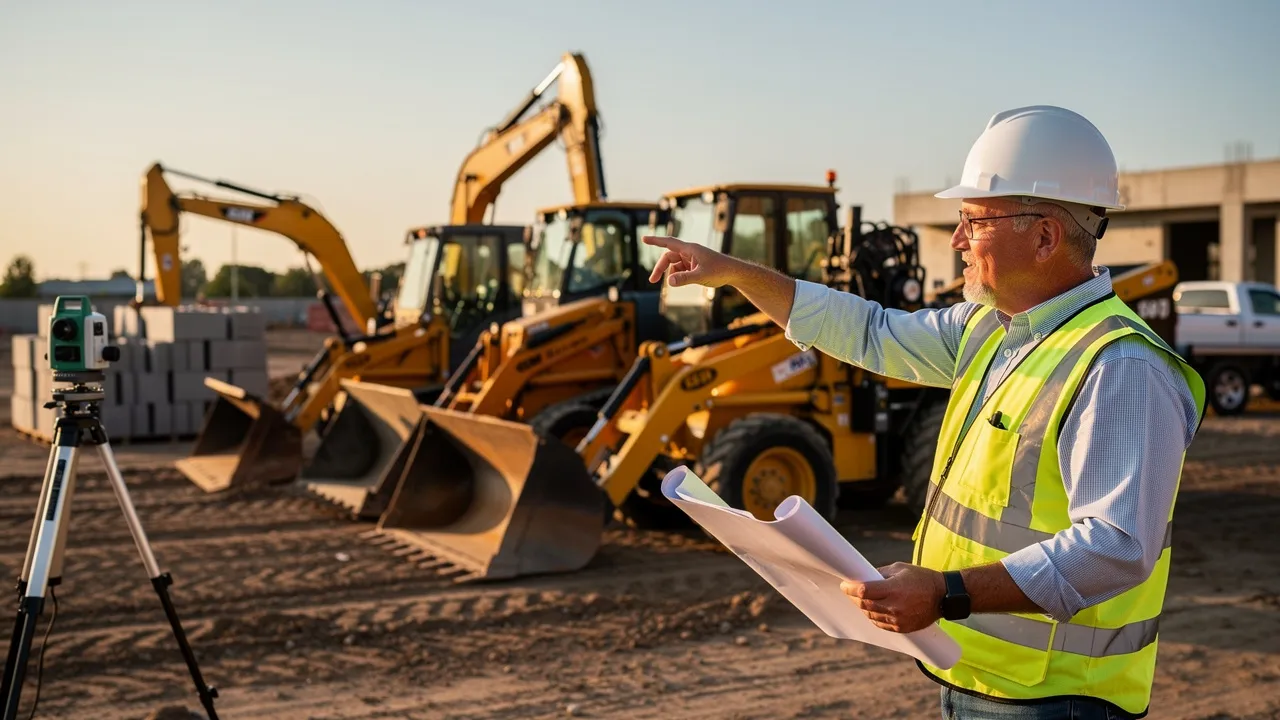
Build a Trench-Route Record Before Comparing Machines
A Danbury trenching decision starts with the route and the cut, not with a broad machine label. Record the required cut depth and length, the material to be moved, and the distance it must travel. Those details determine which equipment category deserves a rental conversation. Treat the trench as a set of conditions that the proposed machine must address rather than as a generic earthmoving job.
Use this sequence for a Danbury site-work decision:
- Name the primary task. Decide whether you need to dig, cut a trench, grade, clear land, move bulk material, or combine several activities.
- Describe the ground and material. Record whether the route or work area is sandy, loamy, loose, clay-heavy, wet, rocky, compacted, or affected by roots or pavement.
- Measure the work. Note trench or cut depth, width, length, the amount of earth to move, and the distance material must travel.
- Check access and scale. Consider the available entry route, working room, project size, and planned schedule before narrowing the category.
Use those details to request a category recommendation rather than asking for an unspecified “earth mover.”
Choose the Trencher Configuration for the Cut
Trenching narrows the equipment decision to the cut, the ground, and the access route. Tracked walk-behind trenchers are built for deeper digging and more difficult soil, while a mini excavator may handle rocky or heavily compacted ground or frost-line depths beyond 48 inches. Excavators are also used for trenching, digging, utility work, and foundation preparation.
- Workable route within the required range: Begin with a walk-behind trencher comparison.
- Soft, wet, sloped, or difficult ground: Ask about a tracked walk-behind configuration and its traction and stability characteristics.
- Rocky or heavily compacted ground, or a deeper cut: Ask whether a mini excavator is more appropriate for the stated conditions.
These are starting categories, not confirmations of suitability or availability. Provide the route facts before accepting a recommendation.
Use this comparison to turn the primary task into a focused rental question:
| Category | Primary work | Conditions or constraints to describe | Direct next step |
|---|---|---|---|
| Excavator or mini excavator | Digging, trenching, utility work, excavation, grading, or lifting | Required depth, material, access, and whether the work includes foundations or large trenches | Ask whether an excavator or mini excavator fits the dimensions and ground |
| Skid steer | Grading, material handling, and tight-access construction work | Entry width, turning room, attachment needs, and ground conditions | Request a skid steer comparison when access is limited or tasks are mixed |
| Wheel loader | Moving dirt, gravel, or debris across the jobsite | Quantity, haul distance, loading area, and receiving area | Give the material and travel distance before requesting a loader |
| Dozer | Grading, land clearing, and large-scale site preparation | Work area, cut or fill objectives, project scale, and access | Ask whether a dozer category matches the site-preparation role |
The table narrows the starting category; it does not establish that a particular machine is suitable or available for your site. Provide the dimensions and ground details before accepting a recommendation.
Skid steers are compact, versatile options for grading, material handling, and tight-access construction jobs. That makes a skid steer a reasonable starting category when the work area is constrained and the machine must handle more than one site-preparation task. The category still needs to be matched to the ground, attachment, dimensions, and operating space; compact size alone does not establish suitability. Ask for a skid steer recommendation when access is tight and grading or material handling is central to the job.
We offer mini excavators for tasks including digging trenches, landscaping, excavation, trenching, lifting heavy materials, demolition, and grading. We also provide personalized equipment recommendations based on your specific needs and budget. Include the intended task, ground conditions, dimensions, access restrictions, dates, and attachment needs so we can evaluate the request against the work rather than suggest a category from the project name alone.

Choose a trencher by cut, depth, and ground
Trenchers use either a toothed wheel or a chainsaw-like belt to cut the ground, and the main types are walk-behind and ride-on. A walk-behind trencher is designed around narrow, precise cuts with less effort than hand digging. The walk-behind models discussed here range from 11 to 27 horsepower, and the most powerful model in this range can cut up to 16 inches wide and 4 feet deep. Treat those figures as characteristics of the cited models, not as specifications for every machine available for your job.
Ground conditions and cut requirements narrow the choice further:
- Walk-behind trencher: Use this as a starting point for a narrow, precise cut when the soil is within the machine’s operating range. Walk-behind trenching covers most residential jobs at 12-48 inches deep when conditions are within the machine’s operating range.
- Tracked walk-behind trencher: Consider this category for deeper digging or more difficult soil. Rubber tracks can provide better traction and stability on soft, wet, or sloped ground than wheels, and larger tracked models typically extend to 48 inches of depth.
- Ride-on trencher: A ride-on model may be the better choice for hard or rocky terrain, pavement, fast trenching, large jobs, or other difficult ground. Some ride-on trenchers have more than 100 horsepower, but that figure does not identify the power of a particular rental unit.
- Mini excavator: For rocky or heavily compacted ground, or frost-line depths beyond 48 inches, a mini excavator may handle conditions a walk-behind trencher cannot reach. Ask for this comparison when the ground or required depth exceeds the walk-behind range.
The main trencher choices can be separated by cut, terrain, and access:
| Option | Cut or work profile | Ground and access question | Direct next step |
|---|---|---|---|
| Walk-behind trencher | Narrow, precise trenching within the machine’s operating range | Is the route workable and within the required depth and width? | Provide the dimensions and soil description before requesting this category |
| Tracked walk-behind trencher | Deeper digging and more difficult soil than other walk-behind models | Is the ground soft, wet, sloped, or difficult for wheels? | Ask whether tracks and the available chain-bar width fit the route |
| Ride-on trencher | Faster trenching, larger jobs, hard ground, or pavement | Does the site require more power, traction, or production capacity? | Describe the terrain, pavement, dimensions, and project scale |
| Skid steer trencher | Narrow utility, irrigation, drainage, or cable trenches | Can the skid steer and attachment reach the route and turn safely? | State the trench purpose, attachment needs, and access limits |
| Excavator | Deep excavation, foundations, and large trenches | Does the job require deeper excavation or more soil removal? | Compare an excavator when the trench exceeds a walk-behind use case |
These are starting comparisons, not equipment specifications for a Danbury rental. Confirm the actual machine, attachment, dimensions, and operating conditions before booking.
Trencher cutting tools should match the material. A wheel trencher uses a circular saw blade for tough materials such as roots and rock, while a chain trencher resembles a large chainsaw and can cut ground that is too hard for excavators. A dirt chain is intended for soft soil or clay without significant roots or rocks; a rock chain is engineered for frozen ground, hard shale, rocky soil, and asphalt cutting and has tungsten carbide-tipped teeth on every chain link.
For narrow utility, irrigation, drainage, or cable trenches, a skid steer trencher is the starting comparison. An excavator is better suited to deep excavation, foundations, and large trenches. End each equipment request with the required trench width and depth, the material to be cut, and whether the route includes roots, rock, pavement, or mixed ground.

Use soil and material conditions to narrow the choice
Soil type is one of the main criteria in earth-moving equipment selection. Hard or rocky soil requires more powerful equipment with greater digging force, while sandy or loose soil can be paired with lighter equipment. A smooth surface that spreads material quickly, sandy or loamy soil, wet clay, and rocky ground each point toward different starting categories. Describe the actual material rather than using only a broad label such as “dirt.”
- Sandy or loamy soil: Compare equipment suited to loose material and record how far the material must move.
- Hard, rocky, wet, or wet-clay material: Ask whether an articulated truck or another higher-power option is appropriate for the material and traction conditions.
- Changing ground or limited traction: Consider equipment that can adapt to changing soil and traction conditions; articulated haulers are flexible and versatile options for limited traction and sites with big weather changes.
A Connecticut excavation-cost table lists standard-soil excavation at $8, $12.50, and $18 per cubic yard. The quantity measures excavation service for standard soil in that Connecticut table, not a Danbury rental rate from us. Use the figures only as geographic and service-context information; ask for a current job-specific cost instead of transferring them to your equipment request.
A soil note should include the material type, wetness, compaction, rock or root content, and whether conditions may change along the route. If the machine will haul material, add the expected quantity and haul distance. Those details let you compare a lighter category with a heavier or more adaptable category without treating equipment size as a substitute for site information.

Match Depth, Width, Soil, and Access to the Route
For a trench route, spoil distance and earth quantity belong in the same equipment question. Smaller equipment is described as appropriate for shorter hauling distances, while greater distance combined with a larger quantity of earth calls for heavier equipment. A small machine may not sustain the load or pressure over a longer haul. Record where the cut begins, where material must go, how much must move, and whether the route allows the equipment to work without repeated repositioning.
Cut dimensions affect the equipment comparison. Record the trench or cut length, depth, width, material, and the distance that earth must travel. Cut length and material can affect the equipment comparison, so those measurements should accompany any category question. The dimensions are project inputs, not a universal threshold for every machine or soil condition.
Project scale and schedule help separate a small-machine request from a heavy-equipment request. Large projects may call for heavy machinery such as bulldozers and excavators, while small projects may suit small loaders or backhoe excavators. Compare the candidate machine’s size, capacity, power, and cost. Large buckets suit large-volume earthmoving, small buckets suit delicate work, and demanding excavation requires high-powered engines. Ask for a category comparison when the project combines several tasks or when the planned schedule makes repeated passes a concern.
Access information belongs in the equipment decision, not only in the delivery discussion. State the entry width, overhead restrictions, surface conditions, available turning room, and the distance from the unloading point to the work area. Then describe the intended production task and quantity. If the access route prevents the proposed machine from reaching the work area, request a smaller category or a different work plan rather than assuming that a larger machine will solve the problem.
Before you ask for a recommendation, write down the decision facts in one short record:
- task and secondary tasks;
- cut or trench dimensions;
- soil, material, roots, rock, pavement, and wetness;
- amount to move and haul distance;
- entry width, turning room, overhead limits, and unloading point;
- project scale and planned schedule; and
- the size, capacity, power, bucket, or attachment questions that remain open.
This record makes the equipment discussion specific. It also gives you a way to compare two proposed categories on the same work assumptions instead of comparing labels alone.
Prepare a Route-Specific Trencher Inquiry
A rental inquiry should identify the Danbury jobsite, intended use, ground conditions, dimensions, dates, expected duration, access constraints, attachment needs, and the questions that still require an answer. Include the trench or cut width and depth, material to be removed or moved, estimated quantity, haul distance, and the route the machine must travel. If the trench crosses more than one soil type, assess the route by its weakest layer rather than by an average description.
Easy penetration with modest force suggests workable soil for a walk-behind trencher at rated depth; significant resistance or a hard layer before 24 inches suggests that the trencher may struggle. Record where the ground changes and include those observations in the inquiry instead of describing the whole route as uniform.
Configuration questions should be specific. Larger tracked machines offer broader width options, with 4-12 inch chain bars available on larger tracked machines. Ask which width, depth, wheel or rubber-track configuration, and chain type fit the route. For our rental pricing, digging-depth requirements, wheel versus rubber-track configuration, soil conditions such as clay versus rock, and jobsite delivery distance are identified as cost factors. Request the current configuration and cost for the actual Danbury jobsite.
Connecticut excavation-service figures list almost $12.50 per cubic yard, with a range of $8 to $18 depending on project details. A Connecticut excavation-cost table also lists trench excavation at $8, $18, and $35 per foot. The first set measures excavation service by cubic yard; the second measures trench excavation by foot. Neither set is a quote from us, so use the route dimensions to request a current rental or service figure.

Separate Trencher Cost Factors from Connecticut Context
Trencher rental cost can change with the required depth, wheel or rubber-track configuration, soil condition, delivery distance, access, and amount of work. In the Connecticut cost figures shown here, soft soil costs less to handle, while yards with large boulders cost more per cubic yard. When trucks or machines cannot reach the work area, smaller equipment may be needed, which can take more time and increase total cost. State those conditions before asking for a price.
The cited Connecticut excavation-cost table gives several context ranges:
- Standard soil excavation: $8, $12.50, and $18 per cubic yard.
- Ledge-rock excavation: $50, $125, and $200 per cubic yard.
- Excavator cost: $185, $245, and $295 per hour.
The first two sets measure excavation by cubic yard under the listed soil conditions. The excavator figures measure cost per hour in that Connecticut table. These are published Connecticut context figures, not current Danbury rental prices or our rates.
Labor, permits, inspections, utilities, access, and project volume can affect the total cost of excavation work. For the Connecticut cost figures shown here, labor is the largest variable cost on most excavation projects. Most towns in Connecticut require permits and inspection from local authorities, and gas lines, water pipes, or electrical lines may require utility relocation that can increase land-excavation costs. Ask whether the amount you receive covers equipment only or also includes delivery, pickup, labor, permitting, utility work, or other project charges.
A useful cost request separates the assumptions instead of asking for a single unexplained total. Provide the jobsite, machine category, configuration, trench or cut dimensions, soil condition, access route, delivery distance, start date, expected duration, and attachments. Ask which cost lines are fixed, which depend on actual conditions, and which terms apply if the work takes longer. Do not treat a contextual excavation figure as a rental quote or assume that one machine category carries the same rate across sites.
For a quote that can be evaluated, ask for the assumptions behind each amount:
- equipment category and configuration;
- rental period and any extension terms;
- delivery and pickup charges for the actual address;
- attachments or cutting tools;
- operator, labor, or service charges, if any;
- permitting, inspection, utility, or site-preparation responsibilities; and
- the conditions that could change the amount.
A daily, weekly, or other term should be treated as a specific offer for the stated job, not as a general rate for every earthmoving request. Request a job-specific price and expected duration.
Ask About Irving and DFW Operations for a Danbury Jobsite
We are EZ Equipment Rental, located at 1307 W Airport Fwy, Irving, TX 75062. We are open Monday to Friday from 7:30 AM to 5:30 PM and Saturday from 7:30 AM to 5:00 PM, and we are closed on Sunday. We are located in Irving, TX, and serve the greater Dallas-Fort Worth area. We provide earthmoving equipment, attachments, trailers, and other construction and contractor equipment.
Our listed delivery locations include Dallas, Carrollton, Plano, Garland, Duncanville, Coppell, Farmers Branch, Irving, Fort Worth, Arlington, Mansfield, Richardson, Frisco, Hurst, Euless, Bedford, and Grand Prairie. We provide personalized equipment recommendations based on your specific needs and budget, and we have flexible rental terms and competitive pricing. Those operating and delivery facts apply to the locations and conditions stated for our DFW business.
A Danbury jobsite requires a separate answer about coverage, delivery, availability, equipment specifications, rental terms, and current cost. Do not assume that an Irving location or a listed DFW delivery area establishes Danbury service. Put the full Danbury address in your inquiry and ask whether we can serve that location, which equipment category is available for the stated work, how delivery would be handled, and which current terms and costs apply.
Confirm Route Conditions and Operator Qualification
Operator qualification should be settled before a trencher enters the planned route. Assign the trenching work only after the employer has addressed the applicable training and monitoring requirements.
A pre-operation review should cover the actual work area, the planned route, the machine instructions, the operator’s training, and the ground conditions. Check for changing soil along a trench because the weakest layer should govern the assessment when more than one soil type is present. If the operator, equipment instructions, ground, access route, or planned work cannot be confirmed as suitable, stop before operation and seek qualified help. Do not continue through an unresolved unsafe condition.
Use a short site check before the machine moves:
- confirm the work area, route, access limits, and changing ground conditions;
- identify hazards and utility questions that require the responsible authority or qualified professional;
- match the planned work to the equipment instructions and attachment;
- confirm that the operator has the required instruction and that any trainee will be continuously monitored as required; and
- stop and seek qualified help if the ground, equipment, operator, or planned work cannot be confirmed as suitable.
This check does not decide an individual engineering, legal, regulatory, or site-safety question. It gives you a clear boundary for pausing work before an unresolved condition becomes an operating decision.
Prepare a Danbury Equipment Request
A route-specific Danbury trencher request should give us enough detail to evaluate the actual cut rather than a general equipment label. Include:
- the complete jobsite address and access instructions;
- the trench purpose, width, depth, length, and material to be removed;
- soil changes, rock, clay, roots, pavement, wetness, and any route-probe observations;
- the amount of earth to move and the haul distance;
- start date, expected duration, schedule flexibility, and attachment needs;
- whether a wheel, rubber-track, walk-behind, tracked, or mini-excavator configuration is being considered; and
- questions about Danbury coverage, delivery, availability, specifications, terms, and current cost.
Use the response to separate route fit from service-area confirmation. A category recommendation does not by itself confirm that equipment is available or that delivery to the Danbury address is covered.
We can evaluate a request around your stated needs and budget, but the Danbury location, current availability, delivery arrangement, rental terms, and price must be answered for the specific jobsite. Before operating, follow the equipment instructions, complete the required training and monitoring, and stop if the conditions or equipment are unsafe. A qualified professional or responsible authority must decide individual engineering, legal, regulatory, and site-safety questions.
What should you confirm before arranging earth-moving or trencher equipment?
What do earth movers Danbury typically cost?
Request current job-specific pricing for the actual machine and jobsite. Connecticut excavation references list standard-soil excavation at $8, $12.50, and $18 per cubic yard, but those are service-context figures rather than a Danbury equipment-rental quote.
Does EZ Equipment Rental serve Danbury, Connecticut?
EZ Equipment Rental is confirmed at 1307 W Airport Fwy, Irving, Texas, and its listed delivery locations are in the Dallas - Fort Worth area. Danbury delivery, service coverage, availability, specifications, terms, and pricing are not confirmed, so provide the complete jobsite address and request verification before assuming the provider can serve the project.
What should I include in an earthmoving or trencher rental inquiry?
Include the complete jobsite address, primary and secondary tasks, trench or cut width, depth and length, soil and material conditions, roots or rock, pavement, wetness, estimated quantity, haul distance, access restrictions, start date, expected duration, attachments, and wheel or track preferences. Also ask for the proposed configuration, current availability, delivery and pickup charges, rental terms, and any conditions that could change the cost.
When should a site crew stop before operating rented earthmoving equipment?
Stop before operation when the ground, access route, equipment instructions, attachment, operator competence, or site hazards cannot be confirmed as suitable. Seek qualified professional or responsible-authority guidance for unresolved utility, engineering, legal, regulatory, or site-safety questions.
Sources
- 4.1 Selection of equipment for earthwork excavation Every ... - rcet.org.in
- Equipment Rental Tips for Any Jobsite | Columbus Equipment - columbusequipment.com
- 11 Types of Earth Moving Equipment and a Buying Guide - SANY Group - sanyglobal.com, 2026-05-19
- How Deep Can a Trencher Dig? What to Know Before You Rent One - bigrentals.com, 2026-05-13
- Skid Steer Trencher Attachment - bluediamondattachments.com
- 1926.1427 - Operator training, certification, and evaluation. | Occupational Safety and Health Administration - osha.gov
- Street Works | Soil Classification for Trenching: What Type A, B, and… - streetworksus.com
- Skid Steer Trencher vs. Excavator: Which Is Better for Trenching? - skidpro.com
- Connecticut Excavation Calculator 2026 | CostFlowAI - costflowai.com
- Excavation Cost in Connecticut: 2026 Prices by Town & Project Type - broadriverconstructionllc.com