
Match the project to the rental category
The right rental starts with the work you need to complete, not with the first equipment name you find. Write down the material or load, where the work will happen in Irving or the Dallas - Fort Worth area, how you will move the equipment, and what conditions could affect the job. Project labels are starting points, not equipment specifications. For a flooring project, describe the floor material, the area, what work is actually planned, whether the task is cleaning or another type of work, and how tools or materials must enter the room. Ask EZ Equipment Rental which available category fits those facts rather than assuming that the word flooring identifies a particular machine. Include the room's access, the expected work window, and any surface protection the project requires. The response still needs to confirm the item, availability, terms, and delivery or pickup arrangement.
For concrete work, separate surface cleaning from repair before naming equipment. A pressure washer can be considered for a cleaning task, but concrete repair is a different project description; state whether the goal is to remove dirt or residue or to address a repair condition, and ask what category is appropriate for the stated work. Do not treat pressure-washing equipment as a general answer to every concrete problem. Include the surface area, residue, available power source, water-temperature question, and route to the work area when the task is cleaning.
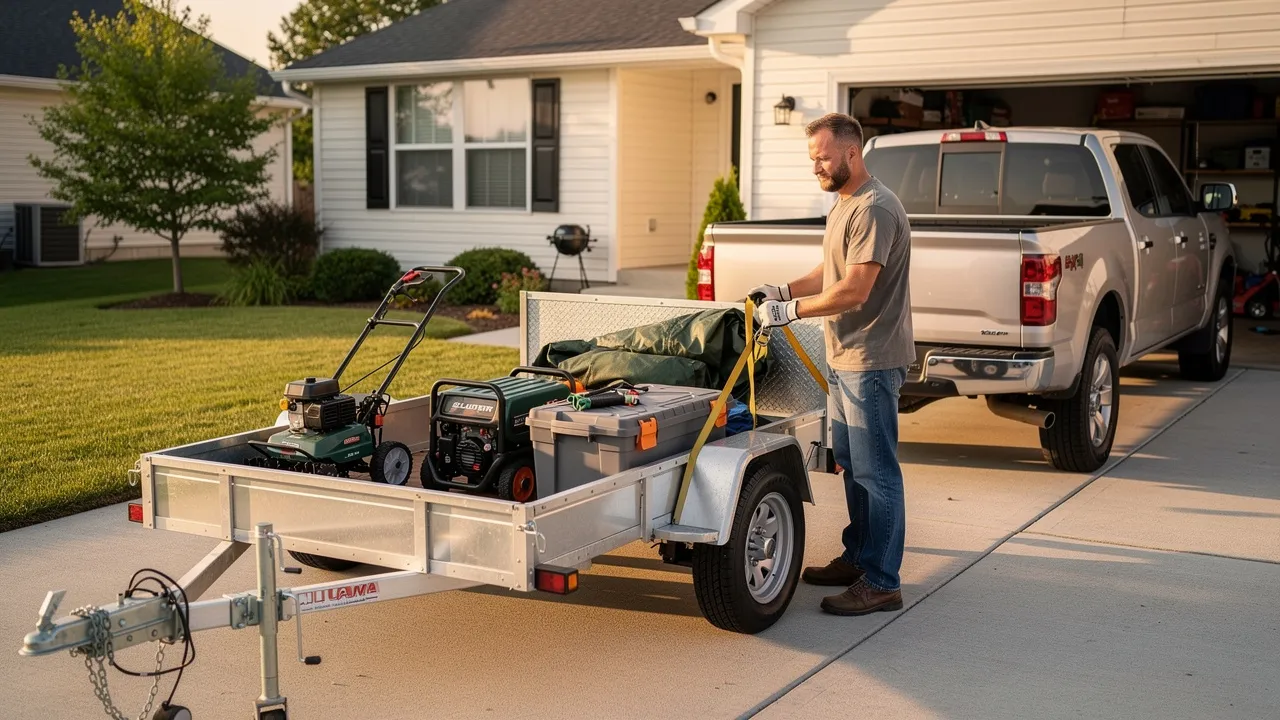
For landscaping, tree work, or a small move, identify the part that creates the rental decision. Yard debris, mulch, dirt, gravel, brush, or demolition waste raises a hauling question. A remaining stump raises a grinding question and may also create a transport question. Furniture, appliances, supplies, or lawn equipment call for a load description, dimensions, approximate weight, and an access plan. A project may therefore need separate discussions for the machine, the trailer, and the material that must leave the property.
This two-part description - what the equipment must do and how it will reach and leave the site - keeps the request specific without assuming that EZ Equipment Rental offers every type of home equipment or that one item covers every task. If the category remains unclear, send the project facts and the unresolved question to EZ Equipment Rental. EZ Equipment Rental can then discuss the relevant category, subject to current fit, capacity, terms, availability, and pickup or delivery confirmation.
EZ Equipment Rental provides generators, pressure washers, earthmoving equipment, attachments, and trailers. That range gives you several starting points, but it does not mean every item fits every home project. Describe the task before requesting a category: hauling material may require a trailer, surface cleaning may require a pressure washer, and removing a stump may require a grinder with a transport plan.
A first-pass project map can separate the main rental questions:
- Furniture, supplies, lawn equipment, appliances, or a small move: begin with the load, its dimensions, and the open space needed around it.
- Yard debris, mulch, dirt, gravel, or demolition waste: begin with the material's weight and how quickly you need to unload it.
- A driveway, deck, siding, patio, or concrete surface: identify the residue, surface material, cleaning area, and whether an outlet is available.
- A remaining stump: separate the grinding task from the question of how the machine will reach the property.
The project description comes first. The equipment category and transport plan follow from it.
Your first decision is whether the job needs a tool, a machine, a trailer, or a combination. A trailer may move equipment or loose material, while a pressure washer addresses surface cleaning and a grinder addresses a stump. Keep those functions separate when you describe the work so the rental discussion can address the full project instead of matching you to an equipment label alone.
Use the transport gate before choosing equipment
Transport can rule out an otherwise suitable machine. Compact power tools usually fit in a car or pickup bed, while stump grinders, skid steers, and larger chippers require a trailer. Account for loading, unloading, parking, gates, and the surface where the equipment will travel between the rental location and your Irving or DFW jobsite.
Some rental listings include a trailer with the equipment, while a separate skid steer trailer may be available if the provider does not bundle one. Ask whether transport is part of the selected rental or a separate item. Do not assume that a machine's ability to work on your property also means your car, pickup, or trailer can carry it.
Pressure-washing equipment shows why the transport question is more than a weight question. A 1500 PSI electric pressure washer works well for decks, siding, and outdoor furniture. A 1500 PSI gas-powered pressure washer handles larger driveways and concrete without needing an outlet nearby. Choose the power source around the surface, cleaning area, and available electricity, then ask how the unit will reach the property.
A transport check should answer these questions before you request a rental:
- Will the selected item fit in your vehicle, or does it require a trailer?
- If a trailer is needed, is it bundled with the equipment or rented separately?
- Can your vehicle and hitch configuration handle the planned load?
- Will pickup, delivery, or on-site drop-off suit the job?
- Can the equipment reach the work area through the available gates, parking area, and route?
If you cannot answer the first three, pause the equipment choice and ask EZ Equipment Rental to discuss the configuration.
A transport requirement can change the entire rental request. A compact tool may need only a vehicle, a larger chipper may need a trailer, and a towable machine may require both the machine and a compatible transport arrangement. State the equipment you are considering and the way you expect to move it so the fit conversation covers both parts.

Choose a utility or dump trailer by the load
Utility and dump trailers solve different hauling problems. Utility trailers are ideal for hauling equipment and vehicles, while dump trailers excel at moving loose materials. A utility trailer also gives you open access for equipment, long materials, and awkward loads; a dump trailer is built for loose, heavy material and getting it off the trailer quickly.
| Question | Utility trailer | Dump trailer |
|---|---|---|
| What is the primary load? | Equipment, vehicles, furniture, appliances, lawn mowers, ATVs, supplies, or small-move items | Yard debris, mulch, gravel, dirt, junk, construction debris, or cleanup material |
| How does the load go on and off? | Open side access helps with long or awkward items | The bed is built to raise and release loose material quickly |
| What project pattern fits? | Transporting a machine or a mixed load that needs access from the sides | Repeatedly hauling loose material that must be unloaded without extensive manual handling |
| What should you confirm? | Load dimensions, tie-down approach, vehicle fit, and towing details | Material weight, volume, load limits, vehicle fit, and unloading conditions |
Neither trailer is automatically the right choice. Match the trailer to the load and the way you need to unload it.
Use the load's shape and unloading method as the decision branch:
- Choose the utility-trailer question when you need open access for equipment, long materials, furniture, appliances, or awkward items.
- Choose the dump-trailer question when you are moving loose, heavy material such as yard debris, mulch, dirt, gravel, or demolition waste and need to unload it quickly.
- Describe both loads when a cleanup includes equipment transport on one trip and loose waste on another.
Then provide the load dimensions, approximate weight, vehicle information, and unloading conditions before relying on a trailer match.

Match pressure-washing work to the cleaning conditions
Pressure-washing fit depends on the surface, residue, water temperature, power source, and cleaning area. Electric pressure washers tend to be smaller, lighter, and easy to use, while gas units deliver more power for heavy-duty cleaning and do not require staying near an outlet. For a deck, siding, or outdoor furniture project, a 1500 PSI electric pressure washer may fit the described work; a larger driveway or concrete area may point toward a gas-powered unit, subject to the rental provider's fit check.
Water temperature should match the residue and surface:
- Cold-water pressure washers have less cleaning power but work well on loose dirt, mud, sand, and newer residues.
- Cold-water pressure washers are also preferred for wood and plastic, which can warp under high heat, and they work on dirt and stains on concrete and metal.
- Hot-water pressure washers remove oil and grease more effectively because heat reduces viscosity, and they can defrost surfaces.
- Hot-water pressure washers can heat water up to around 200 degrees Fahrenheit (93 degrees Celsius), sanitize surfaces, and defrost in cold weather.
Describe the material being cleaned before requesting a temperature or pressure recommendation.
A pressure washer described as 4 GPM and 4000 PSI can suit heavier grime, oil stains, or commercial-grade jobs because it can strip buildup that lower-pressure units cannot touch. That 4 GPM 4000 PSI pressure washer comes with the hose and wand included. Confirm the accessories included with the equipment available for your project rather than assuming every unit has the same setup.
Reported daily pressure-washer rental rates ranged from $40 for electric models to $90 or more for high-GPM gas units. Those figures were reported in rental guidance before November 27, 2026, so they are planning references rather than a price for your Irving request. Ask for the applicable rate, rental period, included accessories, and any pickup or delivery charge before comparing the total.
A pressure-washing request should name four conditions: the surface, the residue, the available power source, and the area to be cleaned. A deck with newer dirt presents a different question from an oily concrete area, and a surface near an outlet presents a different transport question from a large driveway without nearby power. Give those details before asking which pressure washer to rent.

Match tree and yard work to the removal task
Tree and yard work can involve separate tasks that need separate equipment decisions. Branches, brush, soil, and debris may require hauling or cleanup, while a remaining stump requires grinding. A hydraulic stump grinder chews through root balls, and rental providers offer grinders ranging from small walk-behind units to towable models. State whether you are removing a stump, moving the resulting material, or completing both tasks.
A towable 24hp Toro stump grinder needs a trailer for transport but clears larger stumps faster. That example makes transport part of the equipment choice rather than a later detail. Before selecting a grinder, provide the stump location, access route, available parking, and whether you need the machine moved between more than one area of the property.
Reported daily stump-grinder rental rates typically ran from $200 to $400 before November 27, 2026, and weekly rates may offer savings when you are working through multiple trees on a property. These reported rates are not an EZ Equipment Rental quote. Ask for a project-specific term after describing the number of stumps, the expected work window, the transport plan, and any schedule uncertainty.
A tree-work decision can follow three branches:
- If the task is limited to a stump and the access route is tight, ask about a smaller walk-behind grinder and how it will reach the work area.
- If the task involves larger stumps and the property can accommodate transport, ask about a towable configuration and the trailer required for it.
- If you also need to remove brush, chips, soil, or demolition material, add the hauling question rather than assuming the grinder handles that part.
Proceed only after the machine, transport arrangement, and jobsite access have been discussed.
The work sequence also affects the rental request. Grinding addresses the stump, while a trailer or another hauling arrangement may address brush, chips, soil, or debris. List each task separately, identify which material must leave the property, and state whether the equipment must move between multiple work areas. That description helps keep the grinding choice separate from the cleanup choice.
Check weight, vehicle, and site fit before requesting a rental
Weight can rule out a trailer before the load looks large. It is easy to underestimate how much dirt, gravel, or debris weighs, and utility trailers also have limits when hauling equipment, appliances, or multiple heavy items. A cubic yard of damp topsoil weighs somewhere around 2,200 lbs, and a cubic yard of gravel can run past 2,800 lbs. A utility trailer may reach its limit before the bed looks full if you load by volume rather than by weight.
A rental fit record should include:
- The material, equipment, waste, or load and its approximate quantity.
- The largest item dimensions and the expected total weight.
- Your vehicle, hitch, and towing information.
- The Irving or DFW jobsite and the access route.
- The intended use, required protection, and unloading method.
- The expected start date, duration, and any schedule uncertainty.
- Whether you need a single-project rental or recurring transportation.
A volume estimate alone is not enough for soil, gravel, debris, or a mixed heavy load.
Trailer fit, towing details, rental terms, availability, and pickup or delivery options are separate questions to check before renting. A trailer that can hold the load may still be a poor fit if your vehicle, access route, unloading area, or timing does not support the plan. Ask for the full arrangement instead of comparing an equipment-only option with a transported option.
If you cannot establish the load weight, vehicle fit, or unloading method, do not fill the trailer based on appearance. Set the uncertain detail aside and ask EZ Equipment Rental or another qualified professional to evaluate the unresolved requirement before you proceed.
The jobsite can change the answer even when the load and vehicle appear suitable. Include the route to the property, available parking, the unloading area, gate or access constraints, and the surface where equipment will operate. A fit discussion should address the place where the equipment will be used, not only the place where it will be loaded.

Prepare a quote-ready Irving or DFW inquiry
A clear inquiry lets the rental conversation start with the project rather than a vague equipment name. When requesting a trailer rental from us, include the Irving or DFW jobsite location, the material, equipment, or waste being moved, the intended use and required protection, vehicle information, expected start date, duration, schedule uncertainty, and whether the need is for a single project or recurring transportation.
A quote-ready request should contain these details:
- Project: Explain whether you are moving furniture, equipment, yard material, demolition waste, or another load.
- Load: Give the dimensions, approximate weight, quantity, and whether the load is loose, boxed, wheeled, or unusually shaped.
- Vehicle: Identify the vehicle and towing information you plan to use.
- Jobsite: Provide the Irving or DFW location, access details, parking constraints, and the intended drop-off or unloading area.
- Protection: Describe the protection the load or surface requires during transport and use.
- Timing: State the expected start date, duration, and whether the schedule may change.
- Pattern: Say whether this is a single project or recurring transportation need.
This record gives the rental discussion a concrete starting point.
The open decision should be part of the request: utility or dump trailer, bundled or separate transport, electric or gas pressure washer, cold or hot water, walk-behind or towable grinder, pickup or delivery, or another category question. Ask for fit, terms, availability, and logistics together so you are not comparing an equipment-only option with a fully transported option.
A weekend Irving yard-cleanup request could name the material, estimated volume and weight, your vehicle, the jobsite access, the date, the unloading plan, the protection needed, and whether you may need another cleanup run. You do not need to guess the final trailer class first; provide the facts that allow the rental discussion to address that choice.
A completed inquiry should let you answer one practical question: what still needs confirmation? It may be the trailer type, load capacity, vehicle fit, pickup or delivery arrangement, rental duration, or project timing. Name that unresolved point clearly so the response can address it rather than repeating only the equipment category.
Contact EZ Equipment Rental for local confirmation
We offer trailer rentals in the Dallas-Fort Worth area for moving, transporting heavy equipment, and managing waste. We offer personalized service, quality equipment, and on-site delivery for trailer rentals. We provide flexible trailer-rental options available for a day or a week.
We provide generators, pressure washers, earthmoving equipment, attachments, and trailers. Tell us which project category you are considering and what the equipment must do. We offer advice mid-project through knowledgeable team members, so include any unresolved transport, surface, load, access, or timing question in your request.
We are located at 1307 W Airport Fwy, Irving, TX 75062. We operate Monday to Friday from 7:30 AM to 5:30 PM and Saturday from 7:30 AM to 5:00 PM; we are closed on Sunday. Hours, availability, rental terms, pickup, and delivery should be confirmed for the project you are planning.
You can contact us to discuss your needs and find trailer-rental solutions. Include the project, load, vehicle, jobsite, timing, intended use, protection, and transport details so the conversation can address fit rather than only the equipment label.
The current rental conversation should confirm the specific item, capacity, rental period, availability, pickup or delivery arrangement, and project conditions. Our Dallas-Fort Worth trailer-rental offering and Irving location give you a local starting point, but the selected configuration still depends on the details of your load, vehicle, site, and schedule.
Use a stop-and-confirm safety gate
Equipment, towing, loading, unloading, or jobsite conditions that cannot be controlled are a reason to stop. Follow the rental provider's instructions, keep people away from an unstable load, and ask for qualified help promptly when you are unsure. Using mechanical equipment to move and store materials increases the potential for employee injuries, so uncertainty is a reason to pause rather than improvise.
Manual material movement calls for gloves for sharp or rough loads, eye protection, steel-toed safety shoes or boots, and metatarsal guards for impact or compression protection. Use blocking materials that are large and strong enough to support the load safely, and do not use cracked, rounded-corner, splintered, or dry-rotted materials.
Be cautious when placing blocks under a raised load, and make sure the load is not released before removing your hands from under it. Substantially block or crib heavy machinery, equipment, or parts held aloft before anyone works under or between them. If the load cannot be supported and controlled as described, do not work beneath it.
A powered industrial truck requires the load to be centered on the forks as close to the mast as possible to minimize the potential for the truck tipping or the load falling. Overloading a lift truck impairs control and causes tipping over. When traveling, adjust the load to the lowest position and follow the truck manufacturer's operational requirements.
Anyone loading or unloading materials should receive safe-procedure instructions appropriate to the material being handled. OSHA identifies Powered Industrial Trucks, 29 CFR 1910.178, as the most commonly cited standard throughout the trucking industry. Use the applicable instructions and requirements for the equipment and task instead of treating a general loading habit as sufficient.
Seek qualified evaluation when the plan cannot be verified
A trailer, load, vehicle, or jobsite that remains outside your ability to assess requires qualified evaluation. Examples include a damaged trailer that may not support a powered industrial truck, an overturned or falling forklift, or heavy machinery held aloft without secure blocking or cribbing. Do not load, unload, enter beneath, or continue operating in those conditions.
A damaged suspension-type highway trailer may not support the powered industrial truck used for loading or unloading, which can increase injury risk. Many fatalities occur when a worker is crushed by a forklift that has overturned or fallen from a loading dock. If the trailer condition, dock edge, load, or equipment position is unclear, stop and contact a qualified professional or responsible authority before attempting the operation.
Generator use requires a separate hazard check. Carbon monoxide is a colorless, odorless gas that can kill within minutes, often before you recognize symptoms. If generator conditions or equipment instructions are unclear, stop using the equipment and seek prompt qualified help rather than relying on smell or appearance to judge the situation.
The practical boundary is direct: stop unsafe equipment, follow the rental provider's instructions, and contact a qualified professional or responsible authority promptly when you are in doubt. A rental discussion can address equipment fit and logistics, but unresolved structural, towing, loading, electrical, or jobsite risks require the appropriate qualified evaluation before work continues.
Send the completed rental request
Your next step is a project-specific fit conversation, not a guess based on an equipment name. Gather the work description, load or material, approximate weight and dimensions, vehicle and towing details, Irving or DFW location, access conditions, intended use, protection needs, start date, duration, schedule uncertainty, and pickup or delivery preference. Use those details to ask about the appropriate category, trailer type, rental term, availability, and transport arrangement. A qualified professional decides individual suitability when the plan involves unresolved towing, loading, electrical, structural, or site risks.
EZ Equipment Rental can discuss trailer-rental solutions in the Dallas-Fort Worth area and the information needed for the next-step conversation. Submit the project details you have, identify the question you still need answered, and pause the work if equipment or site conditions cannot be controlled.
Sources
- Property Cleanup Equipment Rentals: Storm & Yard Cleanup - rntr.com, 2026-07-31
- Utility Trailer vs. Dump Trailer: Which One Is Right for You? - diversifiedtrucks.com
- Pressure Washer Tips: The Right Washer for the Job - rent.cat.com
- Dump Trailer vs Utility Trailer for Your Work - logbearworks.com, 2026-07-20
- utility trailer vs dump trailer - Trailer Resources - towlos.com
- Dump Trailer vs Utility Trailer: Which Do You Need? | TrailersPlus - trailersplus.com, 2026-08-24
- CPSC Warns of Generator, Carbon Monoxide and Fire Hazards Ahead of Hurricane Season - cpsc.gov
- Materials Handling and Storage - osha.gov
- Trucking Industry - Loading and Unloading | Occupational Safety and Health Administration - osha.gov
- 1926.600 - Equipment. | Occupational Safety and Health Administration - osha.gov