
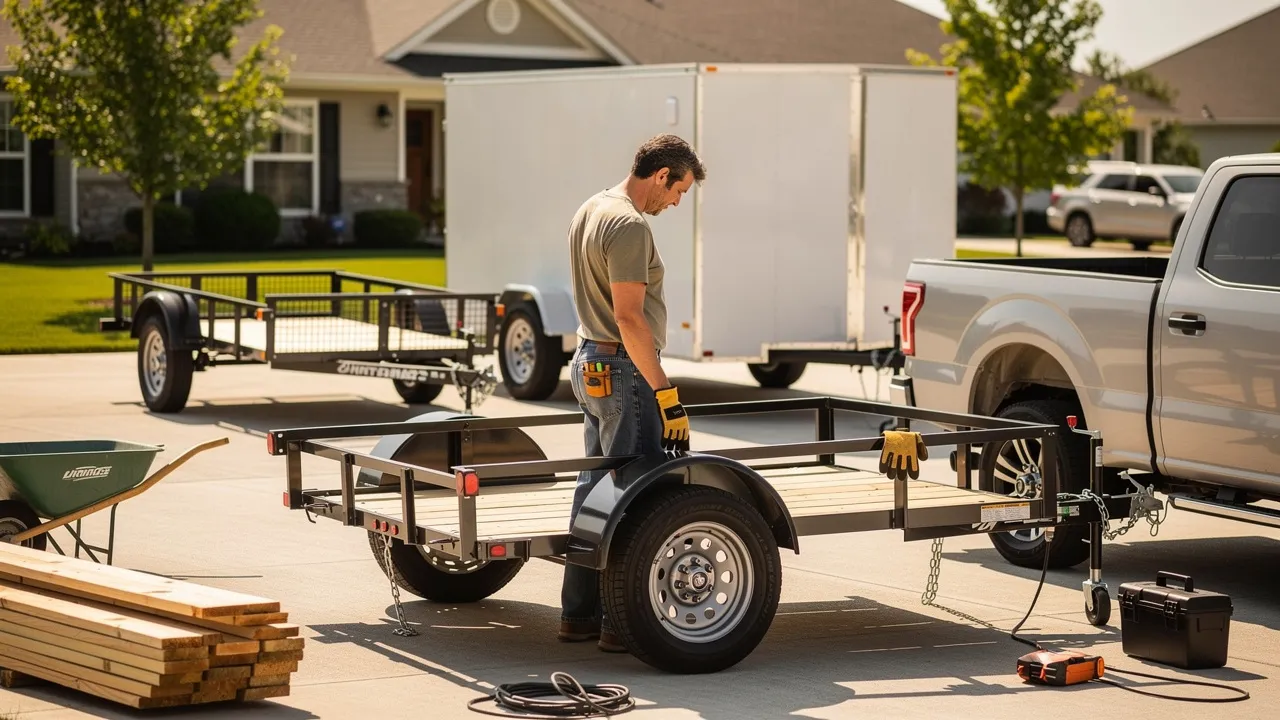
Start with the load, not the trailer label
The right trailer rental in Irving or DFW starts with the material, equipment, or waste you need to move. A trailer that looks suitable in a listing can still be a poor match if the load does not fit its dimensions, rated capacity, loading method, protection level, or your tow vehicle. Compare the job requirements first, then use trailer labels to narrow the request.
Start by writing down four details:
- What you are hauling, such as landscaping equipment, furniture, building materials, mulch, gravel, or renovation debris.
- The estimated weight, length, width, height, and number of items.
- Whether the load needs protection from weather and road debris.
- How you will load and unload it, including whether you need ramps, a tilt deck, tie-down points, or a dumping function.
The gear type, load weight, and required features such as ramps or tie-down points should guide the selection. Flatbed, tilt, and enclosed trailers are options tailored for specific loads. Treat “best” as the closest project fit, not as an objective ranking of every trailer available in the Dallas - Fort Worth area.
Use this first filter before comparing rental terms: if the load cannot be measured, weighed, secured, or matched to the vehicle and hitch setup, pause the comparison. Ask the rental team what information they need to confirm the match instead of choosing a trailer by length or appearance alone.
Match common trailer types to home projects
The main trailer types serve different home-project workflows. Utility trailers suit general hauling, enclosed trailers add protection, dump trailers suit loose material, flatbeds support equipment and building materials, and tilt trailers can simplify access for heavy machinery. The comparison below is a starting point for your request, not a substitute for checking the specific unit’s dimensions, capacity, and towing requirements.
| Trailer type | Loads and projects it may suit | Main advantage | Boundary before you choose |
|---|---|---|---|
| Utility or open | Landscaping equipment, general hauling, yard work, and items that do not need a roof | A flat deck with side rails or mesh sides is easy to load from different angles; ramps can help with rolling equipment | Choose it only after confirming that the exposed load can be secured and does not need enclosed protection |
| Flatbed | Mowers, skid steers, other equipment, and building materials | A low deck and sturdy ramps can make loading landscaping equipment easier than a steep incline | Confirm the load’s weight, dimensions, tie-down method, and the tow setup before reserving |
| Enclosed | Furniture, belongings, weather-sensitive materials, and longer hauls where road debris is a concern | The enclosed structure helps protect cargo from weather and road debris and can protect materials during longer storage | Measure the interior length, width, and height; a protected load still has to fit within the rated capacity |
| Dump | Mulch, gravel, dirt, renovation debris, and property cleanups | The dumping function can make loose material easier to unload than manual removal | Confirm that the tow vehicle, hitch, capacity, and operating requirements match the specific dump trailer |
| Tilt | Heavy machinery or equipment that benefits from an accessible loading surface | A tilt trailer can be beneficial for loading heavy machinery because of its accessibility | Ask whether the loading method, deck dimensions, and rated capacity fit the particular machine |
Utility trailers work well for landscaping equipment and general hauling. Enclosed trailers help protect furniture and belongings during moves, while dump trailers can be useful for renovation debris and property cleanups. Open trailers are also called utility or flatbed trailers in some rental descriptions; they have no roof and are typically versatile to load, but the listing label does not remove the need to check the actual specifications.
For a landscaping project, a flatbed with a low deck and sturdy ramps may be easier to load than a steep incline. For a cleanup, dump trailers make quick work of loose material such as mulch, gravel, or demolition debris. One equipment-rental guide also reports typical DFW equipment-trailer rates of $100 to $175 daily; that figure describes a guide’s typical rate range, not a quote for a specific trailer or date. Ask for current local pricing after the load and vehicle details are known.
Compare protection, access, and unloading effort
Protection and access often pull your choice in opposite directions. An open or flatbed trailer makes it easier to approach the load from different angles and can suit equipment or building materials, while an enclosed trailer adds a roof and walls for cargo that needs protection from weather and road debris. A dump trailer changes the unloading task for loose material by allowing the trailer to tip the load rather than requiring you to remove it piece by piece.
Use the project workflow to decide which trade-off matters:
- Landscaping equipment: A flatbed or utility trailer can provide ramp access for mowers and similar equipment. Confirm that the equipment can roll onto the deck and that you have an approved way to secure it.
- Furniture or belongings: An enclosed trailer may help protect the load during a move or longer haul. Measure the items and the interior space before relying on the roof or walls.
- Building materials: A flatbed can make long or bulky materials easier to place, but exposed materials need a suitable tie-down plan and protection from weather where applicable.
- Mulch, gravel, dirt, or demolition debris: A dump trailer may reduce manual unloading effort. Confirm that the material, volume, and vehicle fit the specific unit.
- A phased project: Utility and tilt models can support equipment movement when the same trailer stays on site for multiple phases, provided the trailer remains suitable for each load.
Loading equipment onto a utility trailer is typically easy when it rolls up a ramp, but unloading loose material from a utility trailer can be labor-intensive. Choose the trailer that reduces the hardest part of your actual project, then confirm the access feature rather than assuming every trailer in that category has the same ramp, gate, tilt, or dump configuration.
Protection is not a reason to choose an enclosed trailer automatically, and easy access is not a reason to choose an open trailer automatically. If weather exposure, loading angle, unloading labor, or tie-down access is uncertain, describe the load to the rental team and ask which available configuration addresses that specific constraint.

Check dimensions, weight, and capacity before reserving
Trailer dimensions and rated capacity determine whether the selected unit can carry the load. Measure the equipment or materials before reserving, including length, width, height, and any part that extends beyond the main body. Verify those measurements against the trailer’s usable dimensions and ensure the equipment fits without exceeding weight limits.
Trailer sizes vary widely across the rental industry, with no universal standard. Larger trailers generally cost more per day, although trailer type also affects cost. A 14-foot trailer in one listing may not provide the same usable space or rating as a 14-foot trailer in another, so compare the specific measurements and capacity rather than the label alone.
Gross Vehicle Weight Rating includes the trailer itself, so the trailer’s own weight counts against the total. Do not exceed a trailer’s rated weight capacity; doing so puts strain on the axles, tires, and hitch and can lead to a blowout or worse on the road. Weigh or estimate the load before booking and choose a trailer with enough buffer above that weight. If the weight is uncertain, ask a rental yard or local scale for an accurate reading.
When transporting a skid steer, the vehicle’s supported weight may range from 10,000 to 15,000 pounds, depending on the model. That range is not a universal skid-steer or trailer specification. Use the exact machine model, trailer rating, and tow-vehicle limits when asking for a match.
Before you request a trailer, record:
- The estimated loaded weight, including the trailer where the applicable rating requires it.
- The load’s length, width, and height.
- Whether the load needs ramps, tie-down points, a low deck, enclosed protection, or a dumping function.
- The trailer and vehicle GVWR information the rental team provides.
- Any uncertainty in the estimate, so the rental team can tell you whether a scale or additional measurement is needed.
If the load is close to a rating, do not treat the remaining capacity as a safe margin without qualified confirmation. Select a configuration that leaves room under the applicable limits.
Confirm the tow vehicle and hitch fit
The tow vehicle and hitch must match the specific loaded trailer. Before reserving, confirm the vehicle’s towing capacity, hitch class, ball size, and wiring setup for that trailer. A mismatch between trailer weight and tow-vehicle capability is one of the most common rental mistakes, so do not assume that a truck can pull any trailer.
Most utility and enclosed trailers use a 2-inch coupler and require at least a Class II hitch, while larger dump and car haulers typically need Class III or higher. Trailer wiring is usually four-pin or seven-pin. These are general patterns, not permission to tow a particular unit; confirm the specific trailer’s coupler, hitch, wiring, and other requirements before towing.
Tongue weight is ideally 10% to 15% of the total load, while the trailer and vehicle still have their own maximum limits. Check that the vehicle can safely handle the loaded trailer, and ask the rental team whether your specific vehicle make and model is a safe match. The percentage is a planning reference from the selected guidance, not an individualized towing determination.
Send the rental team the vehicle year, make, model, tow-package information if known, hitch details, ball size, wiring connector, and the estimated loaded trailer weight. If any item is unknown, say so. Do not reserve or tow until the vehicle-to-trailer match and connection requirements are clear.

Use project length and total rental cost as tie-breakers
Rental cost depends on more than the daily number. Trailer type, size, capacity, rental duration, delivery distance, deposits, and the local supply can all affect the total. Heavy-capacity and specialty trailers such as dump and gooseneck trailers generally cost more than basic utility or enclosed trailers, and a larger size within a type almost always means a higher rate. Trailer sizes have no universal standard, so compare the exact unit and terms.
A published guide says daily rental rates are the most expensive on a per-day basis, while discounted weekly or multi-day rates can sometimes be 30% to 40% lower per day than a single-day price. Treat that as a comparison point, not a promised discount. Ask for both the short-term and longer-duration total when your project may run beyond one day.
Published guides provide these reference ranges, each for its own trailer type and stated condition:
- Enclosed trailer rentals generally cost $50 to $175 per day; larger cargo trailers measuring 14 to 16 feet are reported at the higher end of that range.
- A 5×8 dump trailer is reported at approximately $80 to $150 per day.
- Larger 6×12 and 7×14 dump trailers are reported at $150 to $350 per day.
- Commercial-grade dump trailers can exceed $400 per day.
- Flatbed trailers are reported at $75 to $200 per day depending on weight capacity and length.
- Heavy-duty flatbeds rated for 10,000 or more pounds can reach $250 to $400 per day.
These figures come from published guides rather than a current quote for Irving or DFW. Ask about the exact trailer, current rate, included equipment, and any conditions attached to the price.
Some trailer owners deliver and pick up trailers, and delivery may add $50 to $150 or a per-mile charge depending on distance. Many trailer owners require a damage deposit, typically $100 to $500, held on a card and returned when the trailer comes back undamaged. Ask whether the quoted total includes delivery, pickup, deposit, insurance requirements, cleaning, late return charges, and extension terms.
Compare total project cost, not only the lowest daily figure. A trailer that fits the load and shortens loading or unloading may be more practical than a cheaper unit that creates extra trips or labor, but the actual choice still depends on the current quote and your project details.
Confirm pickup, delivery, return, and timing details
Pickup and return terms can change the practical cost of a trailer rental. Before signing, confirm the pickup or delivery window, return location, cleaning requirements, after-hours drop-off options, mileage limits, and what happens if the project runs long. Ask the rental provider about delivery to your Irving or DFW jobsite and whether the charge is flat or distance-based.
For a weekend move or project, a guide published June 11, 2026 recommended considering booking 1 to 3 days in advance, especially for popular sizes such as 5x10 open trailers or 14-foot enclosed trailers. The same guidance said local inventory could get tight during summer and early fall.
Insurance requirements also belong in the booking conversation. Before leaving with a trailer, check the hitch coupler, safety chains, wiring connections, tire pressure, and tire condition, and verify that your insurance covers trailer rental. Some owners require proof of insurance or offer supplemental coverage. Ask what documentation is required and do not assume that your vehicle policy covers every trailer, use, or loss.
Put these questions in your booking notes:
- Where and when will pickup or delivery occur?
- Where and when must the trailer be returned?
- Must the trailer be washed out or otherwise cleaned?
- Is after-hours drop-off available?
- Are there mileage limits or additional distance charges?
- What is the extension process if the project runs long?
- What deposit, insurance proof, and return-condition requirements apply?
- Which current rate covers the complete rental period?
Get the answers before signing so an uncertain project schedule does not turn into an unexpected return problem.
Send a provider-ready rental request
A provider-ready request gives the rental team enough project context to discuss a suitable trailer instead of answering a vague request for “the best” option. Include the Irving or DFW jobsite location, the material, equipment, or waste being moved, the intended use, required protection, vehicle information, expected start date, duration, schedule uncertainty, and whether the need is a single project rental or recurring transportation.
Use this format:
- Jobsite: City, neighborhood or general area, and whether pickup or delivery is preferred.
- Load: Material, equipment, furniture, or waste; estimated weight; dimensions; and quantity.
- Project: Landscaping, hauling, repair, renovation, move, cleanup, or another use.
- Protection and access: Open, enclosed, ramp, tilt, tie-down, or dump requirements.
- Tow vehicle: Year, make, model, hitch information, ball size, wiring, and known towing limits.
- Schedule: Start date, expected duration, flexibility, and what may cause an extension.
- Rental pattern: One project or recurring transportation.
Ask for the current trailer options, dimensions, capacity, towing and connection requirements, price, deposit, insurance requirements, pickup or delivery terms, return process, and availability for your dates. If you cannot provide a weight or measurement, identify that uncertainty instead of guessing.
A concise request might say: “I need to move [load] from or to [DFW location] for [project]. The load is approximately [weight] and [dimensions], and I need [protection or loading feature]. My tow vehicle is [year, make, model] with [hitch and wiring details]. I expect to need the trailer from [start date] for [duration], with [schedule uncertainty]. Please provide current options, total cost, availability, towing requirements, and pickup or delivery terms.”
Complete a pre-tow stability and connection check
A pre-tow check connects the paperwork to the physical setup. Before towing, verify the hitch rating, tow-vehicle capacity, trailer GVWR, and maximum tongue-weight limits. Keep the load within the trailer’s rated capacity and secure every item using the equipment and attachment points appropriate to that trailer.
Before leaving, check the hitch coupler, safety chains, wiring connections, tire pressure, and tire condition. Verify that your insurance covers trailer rental. Underinflated trailer tires amplify sway issues and increase blowout risk, so a visual glance is not a substitute for checking the condition and pressure required for the specific setup.
Use a short, controlled test drive before committing to highway travel. Pay attention to how the trailer tracks, turns, brakes, and responds to the loaded vehicle. If the trailer feels loose or unstable during the test drive, pull over safely and redistribute the weight before accelerating to highway speeds. Do not try to correct an uncertain setup while continuing the trip.
Stop before towing when a rating, connection, tire condition, insurance requirement, or load-distribution detail cannot be confirmed. Ask the rental team to identify the missing requirement and obtain qualified help rather than improvising with a mismatched hitch, unsecured load, or uncertain capacity.
Seek qualified evaluation when the setup is uncertain
Uncertainty about the vehicle match, hitch rating, trailer GVWR, tongue-weight limit, load distribution, wiring, tires, insurance, or applicable requirements is a stop point - not a reason to choose a smaller-looking trailer and proceed. Do not tow until the specific setup has been evaluated by the rental team or another qualified towing professional. If the trailer feels loose or unstable, pull over safely and correct the load only after you are in a safe position; do not continue toward highway speed while the problem remains.
Have the vehicle and trailer details, load estimate, measurements, hitch information, and connection questions ready when you ask for help. A clear “I cannot confirm this match” is more useful than an assumption based on the vehicle’s size or the trailer’s appearance.
Request a current Irving or DFW trailer match
The suitable trailer rental is the one that matches your load, loading method, protection needs, tow vehicle, hitch setup, schedule, and total rental terms. Before booking, send the jobsite, load or waste details, measurements, vehicle information, dates, duration, schedule uncertainty, and pickup or delivery preference. Ask for current inventory, specifications, pricing, availability, insurance requirements, and compatibility information, then stop if any material requirement remains uncertain.
We offer trailer rentals in the Dallas - Fort Worth area for moving, transporting heavy equipment, and managing waste. We provide personalized service, quality equipment, on-site delivery, and flexible trailer-rental options available for a day or a week. Use the project details above so we can discuss the current trailer options for your Irving or DFW job.
A complete request gives EZ Equipment Rental a clear basis for discussing the trailer type, load fit, towing setup, schedule, and logistics with you. Availability, suitability, pricing, rental approval, and applicable requirements still need to be confirmed for the specific request.
Sources
- Best Practices for Renting a 22' Equipment Trailer Effectively - blog.ezequipmentrental.com, 2026-06-19
- Trailer Rentals in Irving, TX From Local Owners | towlos - towlos.com
- Irving, TX Trailer Rental | Neighbors Trailer - neighborstrailer.com
- Trailer Rentals for Every Job | Manchester, ME - maineequipmentrentals.com
- Open Trailer vs Enclosed Trailer: Which Should You Rent? - rntr.com, 2026-06-11
- How Much Does It Cost to Rent a Trailer? | BigLoads - bigloads.com
- How Much Does It Cost to Rent a Trailer? | Angi - angi.com, 2025-01-29
- Long-Term Trailer Rental | Weekly Rates | AMD - amdtrailerrental.com
- The 60/40 Rule for Trailer Loading: Why Proper Weight Distribution Matters - Renown Cargo Trailers - renowncargotrailers.com
- How Much Does It Cost to Rent a Trailer in 2026? The Complete Price Guide - neighborstrailer.com, 2026-02-24
- Dump Trailer vs. Utility Trailer: Which One Makes More Sense for Your Projects? - Wright Way Trailers - wrightwaytrailers.com