
Answer the rental question through job conditions
A plate compactor rental may be relevant to your Irving or DFW project when the job calls for compacting soil, asphalt, or aggregate in confined spaces or over uneven terrain. Plate compactors are used for foundation work, tamping, and other compaction tasks in confined spaces or over uneven terrain. That description gives you a starting category, not a final equipment decision. The right request depends on the material, layer depth, moisture, surface shape, available maneuvering room, and the work area you need to cover.
Use this guide as a job-condition screen before you contact EZ Equipment Rental. Start with the work itself, then narrow the equipment conversation through a short sequence:
- Name the material and surface that need compaction.
- Describe the layer depth or the depth you need to address.
- Record whether the material is dry, workable, or saturated.
- Measure access, corners, trenches, slopes, and nearby obstructions.
- Decide whether forward-only movement could work or whether reversing would matter.
- Prepare the rental period, jobsite, transport, and scheduling details.
A plate may be a reasonable category for granular site work, asphalt repair, foundation preparation, landscaping, or soil and gravel work in spaces a roller cannot reach. If the material, depth, or access changes that starting assumption, carry the change into your inquiry rather than choosing by machine size alone.
The practical decision is not whether a plate compactor exists in the rental category. It is whether the proposed equipment can be discussed against the conditions of your work area. A useful request tells EZ Equipment Rental what you are compacting, where the work is located, how much area or depth is involved, when the equipment is needed, and which details remain uncertain. That approach keeps a category match separate from confirmation of a particular unit, rate, delivery arrangement, or project result.
Identify the work a plate compactor can address
Plate compactors are used for foundation preparation, asphalt repair, landscaping, soil, sand, gravel, aggregate, and tamping work. They can also suit confined spaces and uneven terrain. Those examples help you describe the task, but they do not establish that every plate or every material will fit your particular project.
Describe the task in production terms instead of writing only “plate compactor needed.” For example, your brief might say that a crew is preparing a granular base for a walkway in Irving, repairing an asphalt edge in Grand Prairie, backfilling a small foundation area in Dallas, or compacting aggregate around a landscaping installation in Fort Worth. Include the surface below the material and the finish you need to leave. State whether the work is a broad open area, a narrow strip, a trench, a corner, or a series of separate patches.
Also separate preparation work from repair work. A new base, a trench backfill, and an asphalt patch may all involve compaction, but they can present different material, depth, and access questions. If a site contains more than one work area, describe each area rather than combining them under one label.
A use case is not a performance guarantee. Do not promise a particular density, finished grade, number of passes, production rate, or project result from the category alone. Record the work you need to perform, the material you will place or repair, and the conditions that may affect the choice. Then ask for confirmation of the equipment fit and any technical limits that apply to your job.
Match the material and surface to the compaction task
Material is one of the first decision points because standard vibratory plates generally perform best on granular materials. Clay and silt may require impact or kneading action from equipment such as a rammer or trench roller instead. That distinction matters on DFW sites where a project may contain imported fill, native soil, aggregate base, sand, asphalt, or mixed layers within the same work area. Name the actual material rather than describing the job simply as dirt work.
Before requesting a unit, write down:
- The material to be compacted, such as gravel, sand, aggregate, asphalt, clay, silt, or mixed fill.
- Whether the material is loose fill, a repair layer, foundation preparation, trench backfill, or another defined task.
- The surface beneath the layer and the surface you expect after compaction.
- Whether the material is uniform across the site or changes from one area to another.
- Whether the work is inside a confined area, beside an existing structure, or near a finished surface.
- Whether the material will be placed in one layer or several separate layers.
A plate-compactor request becomes more useful when it distinguishes a granular base in a planned walkway from clay soil in a narrow trench. It also prevents the phrase “surface preparation” from hiding the material question. If the material changes across an Arlington, Irving, Plano, or Fort Worth site, list each condition separately.
Use the material description to set a boundary for the rental conversation. Soil, sand, gravel, and aggregate work may support a plate-compactor discussion, including areas where a roller cannot reach. Clay or silt may point toward impact or kneading equipment instead. That does not require you to select a rammer or trench roller on your own; it means the material should be raised before a plate is treated as the answer. Treat that branch as a handoff rule for the inquiry. The purpose is not to label the soil from a distance; it is to make the next question specific. For granular material, record the material type, the work area, and whether a roller cannot reach the section. For clay or silt, record that the plate assumption is unresolved and ask whether impact or kneading action should be considered. For mixed fill or changing layers, separate the zones so one favorable description does not hide a less suitable condition. Also distinguish the material from the task: aggregate base, trench backfill, and asphalt repair describe work contexts that may still require different depth and access information. This gives the rental conversation a clear decision path without turning a general category description into a promise about the result. When the answer is uncertain, preserve the uncertainty in the record and ask what additional project information is needed before choosing a unit.
Use required compaction depth instead of machine size alone
Required compaction depth is a better screening question than machine size by itself. An oversized unit may be excessive for thin layers, while an undersized plate may leave deeper material loose. A lightweight compactor can also create a firm surface crust while material below remains loose when deeper compaction is needed. The visible surface therefore cannot tell you everything about the condition of the layer beneath it.
Put the depth question into your project record:
- State the planned loose-layer thickness before compaction if that is known.
- State the layer thickness you need to address or the depth at which the base must be firm.
- Separate thin repair layers from deeper fill or backfill.
- Identify whether the work is one layer or several placed in sequence.
- Note any design, inspection, or testing requirement that controls the work.
If you do not have the depth information, record that as an unresolved project question rather than filling in a guess. A rental inquiry can still move forward, but the missing depth should remain visible when you ask about fit. This is especially useful when one project includes a shallow asphalt repair and a deeper aggregate or foundation area.
Do not treat the heaviest or largest available plate as the automatic choice. Machine size, layer thickness, and the condition below the surface need to be considered together. Give EZ Equipment Rental the depth and layer information, then ask which equipment category and specifications should be confirmed for that condition. Keep the requested result separate from the rental category: a plate discussion does not by itself establish that a specified density or depth will be achieved.
Check moisture and material behavior before requesting a unit
Moisture belongs in the fit screen because bone-dry material and saturated soil can compact poorly when particles cannot rearrange and lock together effectively. This does not turn a rental inquiry into a soil-treatment plan. It gives you a condition to report. A jobsite in Irving, Dallas, or another DFW community may change between an early estimate and the planned work date, so record what you know and identify what may change before the equipment is needed.
Describe the material condition with practical observations and project facts:
- Is the material dry, workable, damp, saturated, or affected by recent weather?
- Is the moisture condition consistent across the work area?
- Will material be placed or repaired in stages?
- Could rain, irrigation, drainage, or exposed groundwater alter the planned condition?
- Is the work surface protected, open, sloped, or exposed to traffic before the rental period?
Use plain descriptions instead of claiming that the material has a particular moisture content unless your project records establish it. If weather or site operations may change the condition, include that uncertainty in the request. The goal is to make the equipment discussion reflect the material that will actually be present, not an idealized condition from an early plan.
A plate should not be selected on a dry-versus-wet label alone. Moisture interacts with the material and the compaction task, and very dry material and saturated soil can both compact poorly. Ask EZ Equipment Rental what information is needed to discuss the equipment category, and keep any required soil, testing, drainage, or placement decision with the responsible project process.
Measure access before comparing plate direction
Access determines whether the machine can reach the work and move through it, not merely whether it can fit through the gate. Tight trenches and corners can make heavier compactors harder to manage. A reversible unit can travel forward and backward, which is useful for trenches and foundation backfill, while a single-direction unit travels forward only. Use the work envelope to frame the rental question before comparing force or nominal size.
Record the conditions that affect movement:
- Gate, doorway, corridor, trench, and working-width measurements.
- Turning room at the start and end of each pass.
- Corners, walls, foundations, curbs, utilities, edges, and other obstructions.
- Slopes, changes in elevation, uneven ground, and surfaces that cannot be disturbed.
- The distance between the staging point and the compaction area.
- Whether the operator must work in a continuous lane or in short sections.
- Whether nearby crews, vehicles, or pedestrians limit the available working area.
You do not need to turn this list into a machine specification. Its purpose is to expose constraints that a generic request would conceal. A narrow backfill area in Oak Cliff may present a different movement problem from an open aggregate base in Lewisville, even if both jobs are described as site work.
Use access to narrow the direction question. If the work area offers room to reverse and the task covers a larger area, tell EZ Equipment Rental that a reversible movement pattern may be relevant. If the work is small but constrained, give the exact access limits instead of assuming that a lighter forward-only unit will fit. Confirm the available dimensions, operating clearances, and maneuverability for the specific equipment before committing.
Compare single-direction and reversible movement
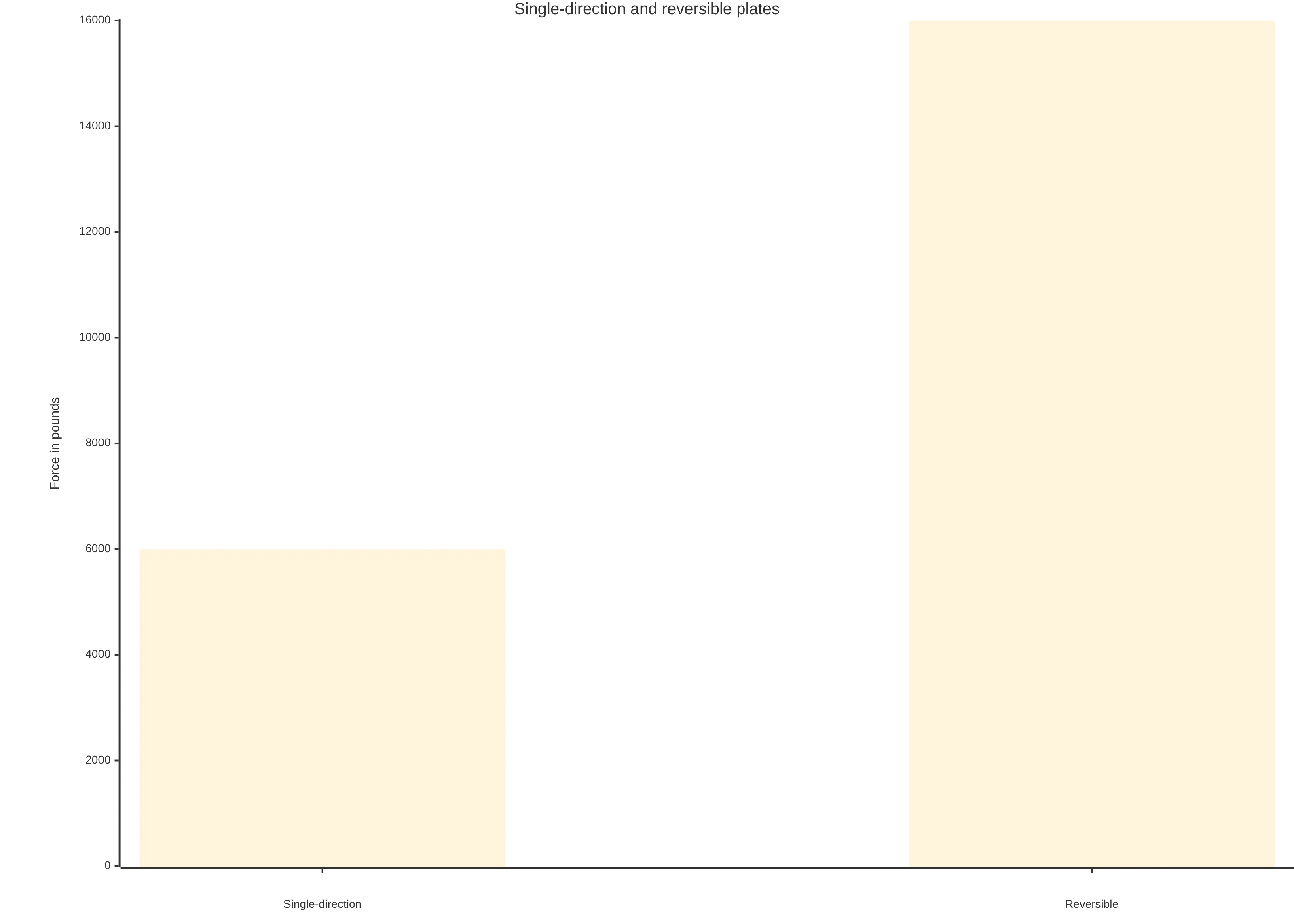
Single-direction and reversible plates differ first in how they travel and then in the kinds of work for which they may be considered. Single vibratory plates move forward only and are generally lighter machines for smaller areas of dirt, gravel, or asphalt. Reversible vibratory plates move forward and backward, are described as useful for larger areas such as driveways or cobblestones, and may provide greater force. The cited force ranges are broad reference information, not a specification for the unit you will rent: single-direction plates are generally described at 2,000 to 6,000 pounds, while reversible plates are described at up to 16,000 pounds.
| Decision criterion | Single-direction plate | Reversible plate |
|---|---|---|
| Movement | Travels forward only | Travels forward and backward |
| Described work pattern | Smaller areas of dirt, gravel, or asphalt | Larger areas such as driveways or cobblestones |
| Force information | Generally 2,000 to 6,000 pounds | Described as up to 16,000 pounds |
| Access implication | Plan how the machine will return or be repositioned | Reversing may help in trenches and foundation backfill |
| Screening question | Can the work area support forward-only passes and repositioning? | Does the area benefit from reversing, and can it accommodate the unit? |
Use the table as a question set rather than a ranking. A larger force range does not make a reversible plate suitable for every site, and forward-only movement does not make a single-direction plate suitable for every small job. Compare the material, layer depth, access, coverage area, and direction of travel together. Then state which movement pattern appears relevant and ask for the specific equipment details, dimensions, and conditions that still need confirmation.
A useful request can say, “The work is a narrow trench with limited turning room,” or, “The work is an open aggregate area where repeated forward passes are possible.” Those descriptions are more useful than naming a direction without explaining the site. Include the approximate area, the route into the work zone, and whether repositioning between passes is practical.
Recognize when another compaction category may fit better
A plate compactor is not the answer to every compaction task. Standard vibratory plates generally perform best on granular materials, while clay and silt may require impact or kneading action from a rammer or trench roller to reach density. Tight trenches and corners can also make a heavy compactor harder to manage. These boundaries are reasons to widen the equipment conversation, not reasons to select another category without reviewing the project conditions.
Use this short branch screen:
- If the material is granular and the work is in an area a roller cannot reach, continue the plate-compactor fit discussion.
- If the material is clay or silt, ask whether impact or kneading equipment should be considered instead.
- If the work is deep, record the required depth before treating a lightweight plate as sufficient.
- If the work is in a tight trench or corner, provide the clearances and ask how machine size and movement affect management.
- If the material changes from area to area, describe each area separately instead of using one category for the whole site.
The direct action is to give the material, depth, and access facts to EZ Equipment Rental and ask which category should be discussed for each branch. Keep the decision open until those conditions have been addressed.
A plate can suit foundation preparation, asphalt repair, landscaping, and soil, sand, or gravel work in areas a roller cannot reach. That range does not extend to a universal recommendation for clay, silt, deep material, or every trench. When your job falls near one of those boundaries, ask about the alternate compaction category and the conditions that would make it appropriate before requesting a particular unit.
Build a project record for the rental inquiry
A complete project record lets you request a plate compactor around the job rather than around a vague equipment name. Keep the record short enough to send in one message, but detailed enough to preserve the conditions that determine fit. Include the following sections.
Job and location
- Project type: foundation preparation, asphalt repair, landscaping, walkway, driveway, trench backfill, or another task.
- Jobsite city and address or the nearest useful location.
- Work-area dimensions, access route, staging area, and restrictions.
- Whether the site is in Irving, Dallas, Fort Worth, Grand Prairie, Mesquite, Plano, Richardson, or another DFW community.
- Whether the work area is open, enclosed, adjacent to an occupied property, or shared with other trades.
Material and depth
- Material name and whether it is uniform across the site.
- Surface beneath the material and the intended finished surface.
- Planned loose-layer thickness, required compaction depth, or the project information still needed.
- Current moisture condition and any weather or drainage issue that may change it.
- Whether the work is shallow surface preparation, deeper fill, backfill, or a combination of tasks.
Movement and equipment fit
- Open area, narrow strip, trench, corner, edge, or confined work zone.
- Clear widths, turning room, slope, obstructions, and the need to reverse.
- Whether a single-direction or reversible movement pattern appears relevant.
- Any required dimensions, force range, power source, or other specification that must be confirmed.
- Any part of the site where a roller cannot reach or where a larger machine may be difficult to manage.
This section should describe the conditions you know without converting them into an unsupported machine recommendation. If two areas have different material or access conditions, list them as separate work zones.
Project timing and responsibilities
- Planned start date and the number of working days or weeks.
- Whether the work is one continuous phase or several visits.
- Delivery or pickup preference, access hours, staging instructions, and the person receiving the equipment.
- Vehicle or transport information if you plan to move the equipment yourself.
- Contact name, phone number, email address, and the best way to resolve questions.
Do not fill gaps with guessed specifications, rates, availability, or delivery promises. Mark each unresolved item as a question for confirmation. A record that clearly labels known conditions and open decisions is more useful than a longer record built from assumptions. To make this record usable as a handoff, divide each item into three labels: known, to confirm, and responsible party. Known holds observations and project facts you can state without interpretation, such as the jobsite, material, work-area shape, planned dates, and access limits. To confirm holds the items that depend on the proposed equipment or current rental conditions, such as exact specifications, availability, rates, rental terms, pickup or delivery, and transport requirements. Responsible party identifies who must resolve the question: EZ Equipment Rental for rental and equipment details, or the project’s responsible team for design, testing, operating, and site-safety decisions. This structure prevents a missing specification from being mistaken for a negative answer and prevents a rental question from being used to settle a project-control question. Send the three labels with the request so the recipient can answer the open items without having to reconstruct the job from scattered details. If a condition is only estimated, label it as such and explain what would change the estimate.
Set the rental window and transport plan
Set the rental window around the work phase, not merely around the day you expect to place the request. We offer daily, weekly, and monthly rental terms tailored to variable project schedules and unexpected emergency repair situations. Those time-period options give you a clear subject for the conversation, but they do not establish a rate, availability, extension condition, or final agreement for your job.
Write down the schedule in a way that exposes uncertainty:
- Planned equipment start date.
- Expected active compaction days.
- Whether preparation, material delivery, inspection, or weather could delay the work.
- Whether the project may need a short extension or a second rental period.
- The date and time when the equipment must be available at the jobsite or ready for pickup.
- The person responsible for accepting, staging, and releasing the equipment.
Then separate the time question from the transport question. State whether you want to discuss delivery, plan to arrange pickup, or have not decided. Give the exact Irving or DFW jobsite, entrance instructions, access restrictions, and any loading or unloading concern. Do not assume that a vehicle, trailer, or route is suitable for a particular unit until the equipment and transport details are confirmed.
Your action is to request a rental period that matches the planned work while identifying the schedule risks that could change it. Ask EZ Equipment Rental to confirm the available term, extension process, pickup or delivery arrangement, timing, and any transport responsibility that applies to the equipment under discussion. Keep those confirmations separate from the material and compaction-fit questions.
If the project has uncertain weather, phased access, or several subcontractor handoffs, state that plainly. A flexible schedule question is different from a request for an open-ended rental. Give the expected period, explain the likely change, and ask how the available rental term would handle it.
Ask EZ Equipment Rental to confirm the unresolved details
We offer compaction and paving rentals in the Dallas-Fort Worth area, including vibratory plate compactors, ride-on rollers, and asphalt pavers. That range lets us discuss a plate-compactor request for an Irving or DFW project while keeping other compaction categories in view when the material or access calls for a different conversation. It does not confirm that a particular unit, specification, rate, or date is available for your job.
Send the project record and ask for direct confirmation of the points that remain open:
- Which available plate-compactor category fits the stated material, surface, depth, access, and movement needs?
- What dimensions, force information, power source, operating requirements, and other specifications apply to the proposed unit?
- Is the equipment available for the requested date and rental period?
- What daily, weekly, or monthly term applies to the project, and what happens if the schedule changes?
- Is pickup or delivery available for the stated Irving or DFW jobsite, and what loading, unloading, route, or access conditions matter?
- What vehicle or transport information is required if you plan to move the equipment yourself?
- Which operating instructions, site requirements, and equipment-specific conditions must be reviewed before use?
These questions keep commercial confirmation, technical fit, transport, and operating review in separate lanes. That separation prevents a general category match from being mistaken for a confirmed reservation or an operating approval. Use the reply as a set of decision checkpoints rather than as one general yes or no. First, check whether the proposed category is being discussed against the stated material, depth, access, and movement conditions. Second, check the commercial response separately: requested dates, rental period, rates, and availability still need confirmation. Third, check logistics: the jobsite, route, entrance, staging, pickup or delivery, and any self-transport responsibility should correspond to the actual work location. Fourth, check operating review: equipment-specific instructions, site requirements, and the project’s responsible safety process must still be addressed before use. If one checkpoint is unanswered, leave it marked open instead of inferring approval from the answers to the other three. For example, a discussion of a suitable category does not confirm an available unit, and an available unit does not resolve whether its dimensions or movement pattern fit the work area. If the material, depth, moisture, access, schedule, or transport plan changes, update the record and ask EZ Equipment Rental to revisit the affected checkpoint. This approach gives the project manager a documented basis for the next question while preserving the article’s boundary: the inquiry can organize a decision, but it cannot establish individualized technical, engineering, legal, or safety approval. It also makes comparison easier when more than one work zone or rental-period option is under discussion, because each option can be checked against the same project facts rather than judged by name alone.
We offer flexible rental durations tailored to project requirements, including daily, weekly, and monthly rental terms for variable schedules. Use that information to describe the period you need, then ask for the terms that apply to your specific request. Rates, inventory, delivery details, exact specifications, and project outcomes require confirmation for the equipment and date under discussion.
A focused message can follow this order: jobsite and access first, material and depth second, movement and work-area constraints third, then schedule and transport. End with the questions that need an answer before commitment. This ordering makes the conditions behind your request visible instead of leaving the rental conversation to begin with a model name or a guessed price.
Use EZ Equipment Rental’s Irving location for local coordination
We are located at 1307 W Airport Fwy, Irving, TX 75062. That address gives you a concrete location to include when you describe an Irving project, ask about pickup, or discuss coordination for a job elsewhere in the DFW Metroplex. Geographic proximity alone does not confirm delivery, route suitability, equipment availability, or a pickup appointment.
We provide equipment rental services in Dallas, Texas.
Use the local details in a practical way:
- Put the jobsite address, city, entrance, and access notes at the top of the request.
- State whether you want to discuss delivery, pickup, or both options.
- Identify the date and time when the site can receive the equipment.
- Explain any narrow entrance, restricted hours, surface concern, or staging limitation.
- Keep the Irving location as a coordination reference, not as proof that every requested arrangement is available.
The direct action is to give the complete location and access information when you ask EZ Equipment Rental to discuss the plate-compactor rental.
A job in Irving may have different transport constraints from a job in Fort Worth, Mesquite, or Plano even when the equipment category is the same. Include the exact entrance and the part of the property where the equipment will be used. If the site has a separate receiving address, controlled access, or restricted delivery hours, include that information with the request.
Keep operating and safety review separate from rental fit
Rental fit and operating approval are separate decisions. Do not treat a category match, a conversation about availability, or a rental agreement as permission to operate without completing the required review for the actual equipment and site.
Before the equipment is used, route these questions through the responsible site process:
- Which manufacturer instructions apply to the proposed unit?
- What site conditions, boundaries, traffic, utilities, slopes, edges, and nearby work affect the operating plan?
- Who is responsible for operator readiness, equipment inspection, communication, and stop-work decisions?
- What site procedures and protective measures apply to the work area?
- How will changing weather, moisture, material, or access conditions be handled?
This is a review checklist, not individualized operating advice. Use the equipment documentation and the project’s established safety process to resolve each item. If a condition changes, pause the rental-fit assumption and have the responsible site process address the change before work continues.
Keep technical and safety questions in the rental conversation without asking a general equipment category to settle them. Request the equipment-specific instructions and conditions, identify the person responsible for the site decision, and avoid promising that a particular plate is suitable for operation merely because it appears to match the work description.
Submit a confirmation-ready plate-compactor request
A confirmation-ready request connects the compaction task to the conditions that determine fit. State the material and surface, required depth, moisture condition, work-area dimensions, access limits, direction of movement, jobsite, schedule, transport preference, and unresolved technical questions. We offer DFW compaction and paving rentals, including vibratory plate compactors, so the next conversation can focus on matching those project facts with an available rental option rather than guessing from a category name.
Before sending the request, make sure it includes:
- The Irving or DFW jobsite and access instructions.
- The task, material, surface, layer depth, and moisture condition.
- The size and shape of the work area, including trenches, corners, slopes, and obstructions.
- Whether forward-only or reversible movement appears relevant.
- The requested rental period and any schedule uncertainty.
- Pickup or delivery preference and transport information.
- Questions about availability, rates, specifications, terms, operating requirements, and site conditions.
A qualified professional must decide individual suitability and operating requirements for the actual project. Once those responsibilities are clear, a precise project brief gives you a practical basis for discussing the rental details that still require confirmation.
Your next step is to send the project facts in one concise request, keeping confirmed conditions separate from questions about the equipment, term, transport, and operation.
What should you confirm before renting a plate compactor?
What types of projects can benefit from renting a plate compactor?
Plate compactors are suitable for various projects, including foundation preparation, asphalt repair, landscaping, and compacting soil, sand, gravel, or aggregate in areas where larger rollers cannot reach.
How do I determine the right size of plate compactor for my project?
Choosing the right size involves considering the material type, layer depth, and access conditions. Oversized units may be excessive for thin layers, while undersized plates can leave deeper zones loose.
What factors should I consider regarding moisture when renting a plate compactor?
Moisture affects compaction effectiveness. Bone-dry material and saturated soil can compact poorly, so it's important to assess the moisture condition before making a rental decision.
What are the differences between single-direction and reversible plate compactors?
Single-direction compactors move forward only and are typically lighter, suitable for smaller areas.
What information should I provide when requesting a plate compactor rental?
Include details about the job type, material and surface conditions, required compaction depth, access limitations, rental period, and any specific questions about equipment availability or specifications.
Where is EZ Equipment Rental located, and how can it assist with my rental needs?
EZ Equipment Rental is located at 1307 W Airport Fwy, Irving, TX 75062. They offer a range of compaction and paving rentals, including plate compactors, tailored to the needs of projects in the DFW Metroplex.
What rental terms does EZ Equipment Rental offer for plate compactors?
EZ Equipment Rental provides flexible rental terms, including daily, weekly, and monthly options, allowing you to choose a duration that fits your project schedule.
Sources
- Compaction & paving rentals Dallas TX, Where to rent compaction & pavings in Dallas, Irving, Grand Prairie, Mesquite, Garland, Plano, Richardson, and Fort Worth TX — www.ezequipmentrental.com
- Plate Compactor Guide: Forward, Reversible, and Vibratory Types Explained | BigRentz — www.bigrentz.com, 2026-09-02
- Plate Compactor Rentals | Sunbelt Rentals — www.sunbeltrentals.com
- EZ Equipment Rental Offers Air Compressor Rental Solutions Across Dallas
- EZ Equipment Rental provides industrial equipments -