
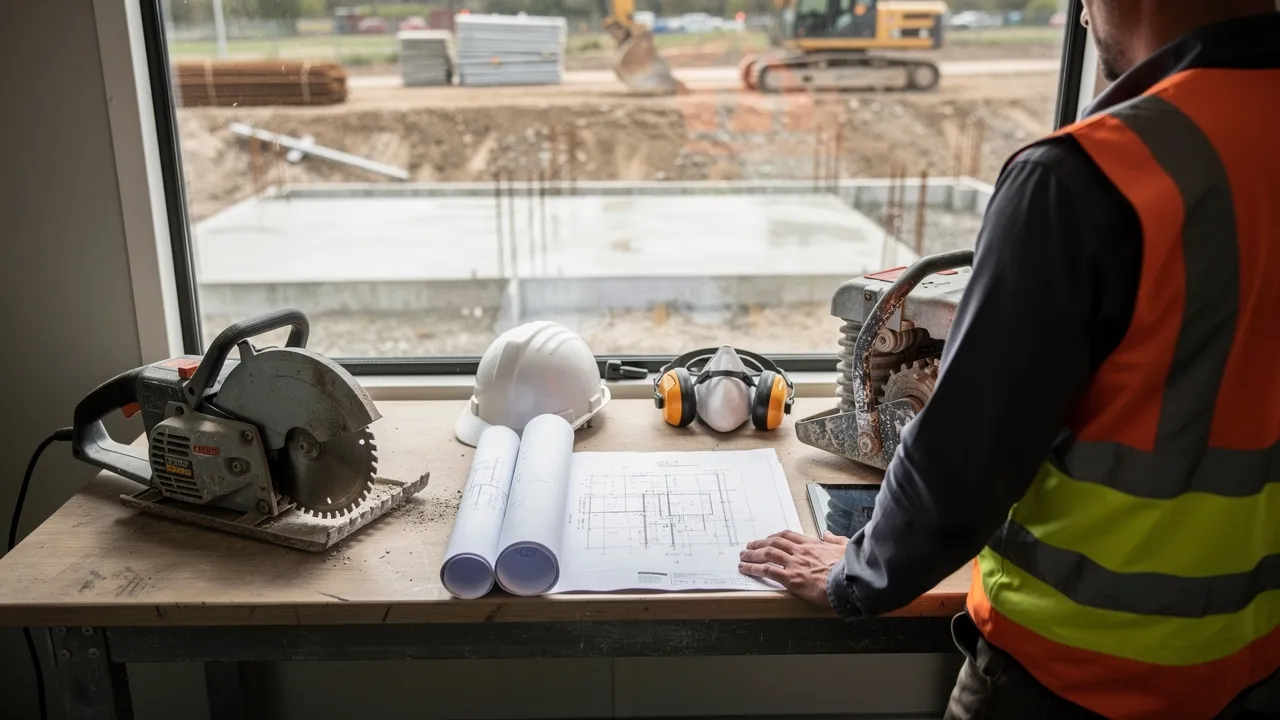
Use a category-and-logistics rental comparison
Use a category-and-logistics comparison for a concrete-cutting saw rental in Irving or the DFW Metroplex. In the project column, record the material, cut shape, required depth, whether the work is indoors or outdoors, and the dust-control approach; in the arrangement column, record the intended use, start date, expected duration, schedule uncertainty, and whether pickup or delivery needs discussion. These details help frame which concrete-saw rental category to ask about without treating a listed category as proof that a particular unit is available or suitable for the site. EZ Equipment Rental provides saws and concrete equipment among its rental categories. Its Irving and DFW presence gives the project a local contact for the comparison, while current availability, project fit, pricing, delivery, pickup, and exact rental terms still require confirmation.
A project-fit request should answer more than “Can I rent a concrete saw?” Include the task, material, approximate cut dimensions, location, intended use, start date, expected duration, schedule flexibility, and whether you need pickup or delivery discussed. Ask the rental team to address the equipment category, blade and wet-cutting questions, operating requirements, and unresolved logistics. This approach keeps a broad DFW rental search tied to the actual work and gives you a clear boundary: the final equipment choice, availability, and terms require confirmation before you arrange the rental.
Record the cut before requesting a saw
The cut record is the short project brief that turns a general concrete task into a useful rental question. Begin with the work itself and write down the facts you already know before contacting EZ Equipment Rental. A clear record helps separate a likely equipment category from details that still need confirmation.
Capture these points:
- Cutting task: State whether the work involves a slab, pavement, floor, wall, opening, joint, repair area, or another concrete-cutting task. Use the plainest description available.
- Material: Identify concrete, masonry, asphalt, or another material if known. If the surface includes more than one material or an unknown layer, write that down rather than assuming the saw or blade can handle it.
- Cut geometry: Describe straight lines, a square or rectangular opening, a perimeter cut, a joint, a localized repair, or another shape. Include the approximate length of each cut where you can.
- Required depth: Record the material thickness if known and the depth the cut must reach. Do not guess a saw’s maximum depth; ask about it.
- Site location: Name the Irving or DFW city, the jobsite type, and whether the saw will move through a building, across a yard, or along pavement.
- Intended use: Explain who will operate the equipment, how often the cut will be repeated, and whether the work is indoors, outdoors, or in an enclosed area.
- Work window: Note the planned start date, expected rental duration, and any uncertainty caused by inspections, preceding trades, weather, access, or schedule changes.
Saw selection depends on material, cut shape, required depth, and project location, including whether work is indoors or outdoors. Rental guidance also recommends asking about slab thickness and the proposed saw’s maximum cutting depth before renting.
The work window belongs in the first request because equipment fit and rental timing are related but different questions. A saw that appears appropriate for the cut still needs to be available during your actual window, and a service-area match does not establish that availability. Write “target date,” “earliest acceptable date,” and “latest return or completion date” when the schedule is uncertain. That gives EZ Equipment Rental a practical timeline to discuss without turning an unconfirmed date into a promise.
Describe the material and blade question
The material and blade question should be treated as one part of equipment fit. Concrete, asphalt, masonry, old repair material, and mixed surfaces can create different cutting requirements, so identify the surface before asking for a category. If you are unsure what lies beneath a finish or patch, say so in the inquiry and ask what information the rental team needs.
Blade selection should account for the material’s hardness. Cited rental guidance discusses diamond blades for concrete and matching the blade matrix hardness to the material; the matrix is described as wearing at a rate related to the material being cut. You do not need to select a blade from a generic list before you describe the job. You do need to provide the material and ask whether the proposed blade is appropriate for that material and cut.
Add these material questions to the project brief:
- What material will the blade contact from start to finish?
- Is the surface uniform, or does the cut cross a patch, joint, coating, aggregate change, or other transition?
- Is the work on a horizontal slab, pavement, floor, wall, or another surface?
- Does the proposed blade match the material’s hardness and the intended cut?
- How will blade wear be handled, including any responsibility or charge connected with wear?
A long straight cut across DFW pavement and a precise opening in an indoor floor may involve different equipment conversations even when both tasks are described casually as “cutting concrete.” Guidance on common saw types specifically distinguishes long, straight pavement cuts from precision square cuts and identifies project location as a selection factor. Use the description to narrow the discussion, then ask EZ Equipment Rental to confirm the category and blade question.
The blade and water questions should appear together when wet cutting is under consideration. Ask whether the proposed saw is set up for wet cutting and what water supply you need to provide. Include the site’s access to water, drainage, and cleanup planning in the conversation without assuming that a particular connection, flow requirement, or accessory is included. The rental team can address the equipment-specific requirements after reviewing the cut and jobsite details.
Match the cut geometry to a rental category
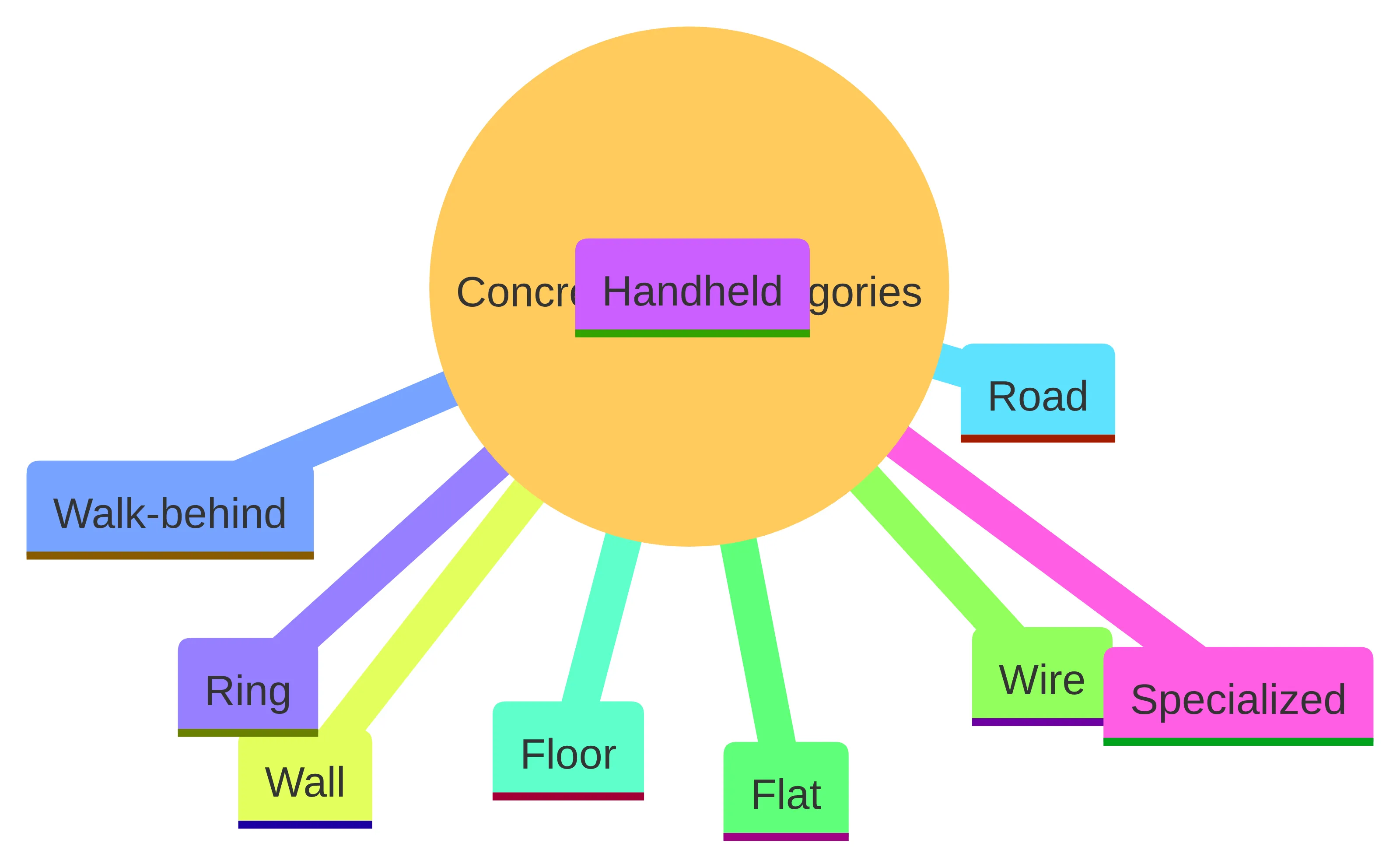
The cut geometry should guide the first category discussion. Concrete saw rental categories can include handheld, walk-behind, wall, wire, flat, floor, road, ring, and other specialized saws. These names describe possible categories, not a confirmed recommendation for your project.
Use the geometry as a screening map:
- Short, localized, or detail cuts: Ask whether a handheld category is appropriate for the access, shape, and required depth. Do not assume that a handheld saw can complete the cut simply because the cut is small.
- Long, straight horizontal cuts: Ask whether a walk-behind, flat, floor, or road-cutting category better matches the surface and layout. Guidance gives long, straight pavement cuts as an example of work that may call for a different saw from a precision square opening.
- Square or rectangular openings: Describe every side of the opening, the surface orientation, access around the cut, and the required depth. Ask whether the proposed category can make the complete geometry without treating one side of the opening as the whole task.
- Wall or vertical cuts: State that the cut is in a wall and explain the opening or line you need. Wall saw categories are listed among concrete saw rental categories, but the category still requires confirmation against the wall, access, and depth.
- Specialized or irregular cuts: Explain the shape, surface, and reason for the cut before naming a machine. Wire, ring, and other specialized categories are listed in rental guidance, but a category label alone does not establish suitability.
The action at this stage is simple: describe the geometry and ask for a plausible category, rather than requesting an unverified model or specification.
A comparison worksheet can make that discussion more precise without pretending that a category name settles the decision. If the project has more than one cutting phase, give each phase its own row instead of forcing the entire job into one label. A long, straight pavement cut and a precision square opening may lead to different equipment conversations even when they occur at the same site.
| What to document first | Category discussion to raise | Detail that still needs confirmation |
|---|---|---|
| A short, localized, or detail cut, including access around the work and required depth | Ask whether a handheld category is appropriate, or whether another category should be considered | Whether the proposed equipment and blade address the material, geometry, depth, and access |
| A long, straight cut across pavement or another horizontal surface | Ask whether a walk-behind, flat, floor, or road-cutting category should be discussed | Which category matches the surface, length, depth, operating conditions, and available route |
| A square or rectangular opening | Describe every side, the surface orientation, access around the opening, and the required depth before asking about a category | Whether the proposed setup can address the complete geometry and the material at each part of the cut |
| A wall or other vertical cut | Identify the wall, opening or line, access conditions, and depth, then ask whether a wall category is relevant | Whether the proposed category fits the wall, access, operating conditions, and requested depth |
| An irregular, specialized, or mixed-surface cut | Describe the shape, material changes, purpose, and constraints before discussing wire, ring, or another specialized category | Which category and blade question apply to the complete cut rather than only one portion |
This table is a screening aid, not a capability chart. The category names identify questions to ask because rental guidance lists them as possible concrete-saw categories; they do not establish cutting capacity, included accessories, current inventory, or suitability. Keep the unresolved item visible in the request. For example, “please advise whether a handheld or walk-behind category is appropriate” is more useful than naming one solely because the cut is short or long.
When a project combines categories, compare the phases by the factor that could change the rental decision: geometry, surface orientation, material, depth, work environment, or timing. State whether one arrangement must cover every phase or whether the phases can be scheduled separately. Ask whether a handheld saw, a walk-behind saw, or both should be considered when the work includes different kinds of cuts. This prevents the first visible task from determining the entire request while still keeping the conversation focused on the actual project.
Finish the worksheet with three explicit notes: what is known, what is estimated, and what EZ Equipment Rental must verify. A known cut shape can be recorded directly; an uncertain thickness should be labeled as approximate or pending confirmation; and a category should remain provisional until the material, depth, site, dates, and arrangement have been reviewed together. That record gives the rental team a structured comparison without turning an unverified category into a promise.
A category match remains provisional until the material, depth, location, and operating conditions are reviewed together. A floor cut may be indoors or outdoors; a pavement cut may have access, water, or electrical constraints; and a wall cut may require a different setup from a horizontal surface. Saw guidance identifies material, cut shape, depth, and project location as connected selection factors. Send those factors together and ask EZ Equipment Rental to confirm the category, current availability, and arrangement for the DFW jobsite. A listed service area does not establish any of those project-specific details.
Use slab thickness and required depth as screening questions
Slab thickness and required cutting depth are separate facts, and both belong in the rental request. Record the approximate thickness of the slab, pavement, wall, or other material if it is known, then state how deep the cut must go. A cut that only marks a surface has a different requirement from a cut intended to pass through a slab or create an opening.
Ask these questions before choosing a category:
- What is the material thickness at the intended cut?
- Does the cut need to pass through the material, or does it stop at a specified depth?
- Is the depth uniform across the work area?
- What maximum cutting depth does the proposed saw provide?
- Does the blade or setup change the usable depth for this task?
Rental guidance specifically recommends asking how thick the slab is and what maximum cutting depth the proposed saw provides. Selection guidance also identifies required cutting depth as a factor alongside material, cut shape, and project location.
Do not fill an unknown measurement with a product specification copied from another saw. If the thickness is uncertain, write “thickness to confirm” and explain how the measurement was estimated. If the cut crosses different thicknesses, list each area separately. That gives the rental conversation a boundary and makes it easier to identify which detail still needs site confirmation.
A depth question is a fit screen, not a guarantee that a particular unit is available. The rental record should therefore pair the depth request with the jobsite, date, duration, and intended use. A service-area listing does not establish project fit or current availability, so ask EZ Equipment Rental to confirm the proposed equipment against the complete cut profile before you commit.
Screen the work environment before arranging the rental
The work environment can change the rental conversation even when the cut itself is already defined. State whether the task is indoors, outdoors, or in an enclosed area, and describe the route from unloading point to the cut. A DFW project in an occupied building, warehouse, parking area, roadway, or residential site can create different questions about access, water, electricity, ventilation, cleanup, and staging.
Record the environment in practical terms:
- Is the cutting area open-air, inside a building, or enclosed by temporary barriers?
- Is there enough room to position and move the proposed category around the cut?
- Will the equipment need to pass through doors, gates, corridors, ramps, or other restricted access points?
- What surface will support the equipment during movement and cutting?
- Is water available, and where can runoff or slurry be managed?
- If an electric saw is discussed, what power source and connection questions need to be answered?
- Will other crews, occupants, vehicles, or customers be near the cutting area?
- How will the equipment reach the work area, and how will it leave when the rental ends?
Saw selection guidance identifies project location, including indoor or outdoor work, as a factor in choosing a saw. Rental questions also include whether the work is indoors, whether an electric saw is needed, and what circuit may be required. Those questions help you describe constraints without claiming that any one power source or setup is suitable.
The work area should also be screened for the conditions created by cutting. Concrete cutting can generate dust, debris, and high noise levels that pose serious health risks. If water is used for dust control, OSHA states that construction sites should use ground-fault circuit interrupters and watertight, sealable electrical connectors for electric tools and equipment.
Put those conditions into the inquiry as planning questions rather than promises: ask what the proposed setup requires, what you need to provide, and which jobsite controls apply. Follow the equipment manufacturer’s instructions and applicable jobsite requirements before operating the saw.
Treat dust control and silica requirements as part of planning
Dust control and silica planning belong in the rental decision before the equipment arrives. OSHA’s construction silica standard, 29 CFR 1926.1153, requires employers to limit worker exposure to respirable crystalline silica and take other protective steps.
For your project brief, identify the control questions that affect the saw discussion:
- Will the cut be performed outdoors, indoors, or in an enclosed area?
- Is wet cutting under consideration, and what water supply does the proposed saw require?
- If water is used, how will electrical connections and equipment be protected?
- Where will dust, slurry, and debris go during and after the cut?
- What does the employer’s silica-control plan require for this task?
- Which workers or other people could be exposed to dust or noise?
- What respiratory protection, exclusion area, cleanup, and hearing-protection requirements apply at the jobsite?
OSHA states that properly used wet methods can control silica dust outdoors. For wet cutting with walk-behind saws indoors or in enclosed areas, OSHA’s cited Table 1 requires respiratory protection with a minimum assigned protection factor of 10. That statement does not choose a control plan for your project; it identifies why indoor and outdoor conditions must be stated accurately.
The employer’s responsibilities remain part of the planning boundary. OSHA’s construction silica standard requires employers to limit worker exposure and take other protective steps, while the cited OSHA guidance describes control methods such as water or vacuum dust collection for covered tasks. If respirators are required for the task, OSHA’s cited guidance says employers must establish a written respiratory-protection program under 29 CFR 1910.134.
Ask the rental team what the proposed equipment is set up to do and what supplies or connections are needed. Do not treat a wet-cutting question as proof that the jobsite meets its safety obligations. Your employer’s safety program, the equipment manufacturer’s instructions, and applicable requirements govern operation.
The immediate action is to add dust-control questions to the same request as the cut profile. Ask whether the saw is set up for wet cutting and what water supply you need to provide. State the indoor or outdoor location, the planned work area, and the people who may be nearby. Those details help keep the equipment discussion connected to the actual Irving or DFW site instead of treating dust control as an afterthought.
Choose the rental period around the actual work window
The rental period should follow the actual work window rather than an optimistic cutting estimate. Separate the date you expect to start cutting from the date the site will be ready to receive equipment, then allow the inquiry to address delays caused by preceding work, access, inspections, weather, or coordination with other trades. State how many cutting sessions you expect and whether the schedule is fixed or flexible.
Include these timing details:
- Target delivery or pickup date, if known.
- Earliest date the jobsite can receive the equipment.
- Expected cutting days or work window.
- Whether the saw may need to remain available between cutting sessions.
- Latest acceptable return date or the point when the schedule must be revisited.
- Whether the project could extend and what rental-duration question that creates.
EZ Equipment Rental states that we offer flexible rental durations tailored to project requirements. That establishes a duration conversation, not a specific term, rate, extension, or availability commitment. Ask which duration options apply to the proposed arrangement and how schedule changes are handled. Rental guidance also recommends confirming the minimum rental period before renting and asking how a heavy saw will get to the jobsite and back.
A daily request may be reasonable for a tightly controlled work window, while a longer period may deserve discussion when access depends on other project stages. Do not choose between those paths from the calendar alone. Give EZ Equipment Rental the actual window and ask for the applicable terms.
The rental period also needs to be checked against current availability. A service-area listing does not establish that a saw will be available on your preferred dates or that an extension will be possible. Put the target dates and schedule uncertainty in the first message so the response can address timing rather than only category.
Separate likely equipment fit from rental confirmation
A likely equipment fit is a working hypothesis; a rental confirmation is an arrangement with specific terms. Keep those two conclusions separate in your notes. The cut profile may point toward a handheld, walk-behind, wall, flat, floor, road, ring, wire, or other category, but the category list does not tell you which unit is available or whether it satisfies your site conditions.
Use a two-column check:
| Planning question | Confirmation question |
|---|---|
| What material, shape, and depth describe the cut? | Does the proposed saw and blade match that material, geometry, and depth? |
| Is the work indoors, outdoors, or enclosed? | Is the proposed setup suitable for the stated location and operating conditions? |
| When can the jobsite receive the equipment? | Is the category available for the requested dates? |
| How long may the cutting phase last? | What rental duration, extension, and return terms apply? |
| Can the site manage water, dust, debris, noise, and power needs? | What responsibilities, supplies, and requirements belong to each party? |
| Will the saw be picked up or delivered? | What pickup or delivery arrangement, timing, and charges apply? |
Saw selection depends on material, cut shape, required depth, and project location. Rental guidance recommends confirming availability, pricing, delivery or pickup, responsibilities, insurance, and exact rental terms before choosing an arrangement.
A completed planning column does not authorize operation or reserve equipment. The confirmation column must be answered for the specific Irving or DFW jobsite, dates, cut, and arrangement. If any answer remains unresolved, keep it as an open question in the inquiry instead of converting an assumption into a product requirement or rental promise.
Prepare the pickup or delivery questions
Pickup or delivery is part of equipment fit because a saw must reach the cut area and return after the work. Describe the jobsite city, access point, surface, unloading area, and route to the cutting location. An Irving project may have different access questions from a Fort Worth, Dallas, Grand Prairie, or other DFW project, so name the actual site rather than giving only the metro area.
Ask these logistics questions:
- Is pickup or delivery available for the specific jobsite and requested dates?
- Where would the equipment be released, loaded, or unloaded?
- What access, clearance, surface, or staging information is needed?
- Who handles movement from the drop-off point to the cutting area?
- What equipment, vehicle, or loading arrangement is needed for return?
- What responsibilities apply to transport, fuel, water, cleaning, damage, or late return?
- What delivery or pickup timing should be coordinated with the site supervisor?
Rental guidance recommends confirming delivery or pickup, responsibilities, insurance, pricing, and exact rental terms before choosing an arrangement. The same guidance emphasizes asking how a heavy saw will get to the jobsite and back. These are confirmation questions, not assumptions about a particular saw’s weight, transport method, or included service.
EZ Equipment Rental lists an Irving location at 1307 W Airport Fwy, Irving, TX 75062. A local address can help frame a pickup discussion, but it does not establish that pickup is available for your dates, that delivery reaches your site, or that either arrangement has a particular price or term. Ask for the arrangement that applies to your project.
Build a confirmation-ready inquiry
A confirmation-ready inquiry gives EZ Equipment Rental enough project context to discuss a concrete-cutting saw category without making you repeat the basic facts. Organize the message in the same order that the work will be evaluated: task, material, geometry, depth, site, operating conditions, timing, and logistics.
Use this structure:
- Project and location: Give the project type, jobsite city, site address or area as appropriate, and the person coordinating the rental.
- Cutting task: Describe the surface, purpose of the cut, approximate cut length, shape, and number of cuts.
- Material and depth: State the material, approximate thickness, required depth, and any uncertainty about layers or patches.
- Saw category question: Ask whether the work should be discussed as handheld, walk-behind, wall, flat, floor, road, ring, wire, or another category. Do not insist on a category before the details are reviewed.
- Blade and water: Ask whether the proposed blade matches the material and whether the saw is set up for wet cutting. Ask what water supply you need to provide.
- Work environment: State indoor, outdoor, or enclosed conditions; access limits; nearby activity; power questions; and dust, debris, runoff, or noise concerns.
- Timing: Give the start date, expected duration, schedule flexibility, and any extension question.
- Arrangement: Ask about availability, pricing, pickup or delivery, responsibilities, insurance, and exact rental terms.
The seven-question rental guidance also directs you to ask about slab thickness, maximum cutting depth, handheld versus walk-behind use, blade matching, wet cutting, indoor electrical needs, and transport.
The project brief should use measurements and descriptions you can defend. Write “approximately” where a dimension is estimated, identify unknowns, and distinguish the work you need from the equipment question you want answered. Selection guidance identifies material, cut shape, required depth, and project location as factors in choosing a concrete saw.
A useful inquiry does not need an unverified model number, blade diameter, cutting capacity, rate, or availability claim. It needs enough information for the rental team to address those unresolved details against the actual Irving or DFW jobsite.
Ask EZ Equipment Rental to verify the unresolved details
EZ Equipment Rental provides saws and concrete equipment among our rental categories. We can discuss the project after you provide the cut profile, jobsite, timing, intended use, and arrangement questions. A category listing still does not establish a particular unit’s current availability, suitability, pricing, delivery, pickup, or exact rental terms.
Ask EZ Equipment Rental to verify the following points for your specific request:
- Which saw category should be considered for the material, cut geometry, depth, and location?
- Does the proposed equipment address the intended use and work environment?
- Which blade question should be resolved for the material and hardness?
- Is the saw set up for wet cutting, and what water supply or other site preparation is needed?
- Is the equipment available for the requested dates and expected duration?
- What pickup or delivery arrangement applies to the named DFW jobsite?
- What pricing, responsibilities, insurance requirements, and exact rental terms apply?
- What information should be supplied about power, access, transport, cleaning, or return?
We provide advice mid-project through knowledgeable team members. That means you can include schedule uncertainty or a changed cut condition in the conversation rather than silently carrying the original assumption forward. The answer still needs to be tied to the specific project and current arrangement.
The confirmation boundary is straightforward: do not treat the response as complete until the equipment category, dates, site arrangement, responsibilities, and terms are clear enough for the decision you need to make. A service-area match is not a substitute for that confirmation. Keep any unresolved item in the message so it receives a direct answer.
Submit the project details through the contact form
A concrete saw rental request is ready when it connects the cut profile to the rental arrangement. State the material, cut shape, approximate thickness, required depth, indoor or outdoor location, intended use, dust-control questions, start date, expected duration, schedule uncertainty, jobsite city, and pickup or delivery preference. Then ask EZ Equipment Rental to verify the category, blade question, wet-cutting requirements, availability, pricing, responsibilities, insurance, and exact terms.
Before sending the request, check that your message answers these practical questions:
- What exactly must be cut?
- What material and approximate thickness are involved?
- What shape, length, and depth describe the cut?
- Where will the work happen in Irving or the DFW Metroplex?
- Will the work occur indoors, outdoors, or in an enclosed area?
- What water, power, dust, debris, noise, and access questions need an answer?
- When must the equipment be available, and how long might the work window last?
- Do you need pickup or delivery discussed?
- Which equipment and rental details remain unresolved?
Follow the manufacturer’s instructions, your employer’s safety program, and applicable jobsite requirements before operating any saw.
EZ Equipment Rental provides saws and concrete equipment among our rental categories, while current fit, availability, terms, and logistics still need to be confirmed for your project. A complete project brief makes that confirmation conversation specific to your Irving or DFW jobsite.
What should you confirm before renting a concrete-cutting saw?
What information should I provide when renting a concrete-cutting saw?
When renting a concrete-cutting saw, you should provide details about the cutting task, material type, cut geometry, required depth, jobsite location, intended use, work window, and whether you need pickup or delivery.
How do I determine the right type of concrete saw for my project?
To determine the right type of concrete saw, consider the material being cut, the shape and depth of the cut, and whether the work is indoors or outdoors. Common types include handheld, walk-behind, and wall saws.
What should I ask about the saw's blade when renting?
You should ask whether the proposed blade matches the material's hardness and cutting requirements, and inquire about how blade wear will be handled during the rental.
How can I confirm the availability of a concrete-cutting saw for my project?
To confirm availability, contact EZ Equipment Rental with your project details, including the cutting task, location, and timing, as a service-area match does not guarantee availability.
What are the rental terms I should verify before committing?
Before committing to a rental, verify the pricing, rental duration, pickup or delivery options, responsibilities, and insurance requirements.
Where is EZ Equipment Rental located?
EZ Equipment Rental is located at 1307 W Airport Fwy, Irving, TX 75062.
What should I do if my project timeline changes after renting a saw?
If your project timeline changes, communicate with EZ Equipment Rental as soon as possible to discuss potential adjustments to your rental agreement.
Sources
- Rent Equipment Near Me in Irving and DFW: A Construction Project Decision Guide — blog.ezequipmentrental.com, 2026-10-26
- Concrete Saw Rental Market | Global Market Analysis Report - 2036 — www.factmr.com
- Renting a Concrete Saw: What to Know Before Choosing One — pdqequipment.com
- Walk-Behind Saws — www.osha.gov
- How to Rent the Right Concrete Saw — www.constructionequipment.com, 2010-09-28
- OSHA's Respirable Crystalline Silica Standard for ... — www.osha.gov
- How to Help Customers Choose a Concrete Saw — www.forconstructionpros.com, 2024-04-03
- Concrete Cutting Saw Safety: Essential Tips — experttoolsrental.com
- Contact EZ Equipment in Dallas, TX — www.ezequipmentrental.com
- About Us - EZ Equipment Rental | Dallas, TX
- Cargo Trailer Rental Dallas, TX | Rent Cargo Trailers | Equipment Rental Trailer