
Answer the rental question through the surface-preparation task
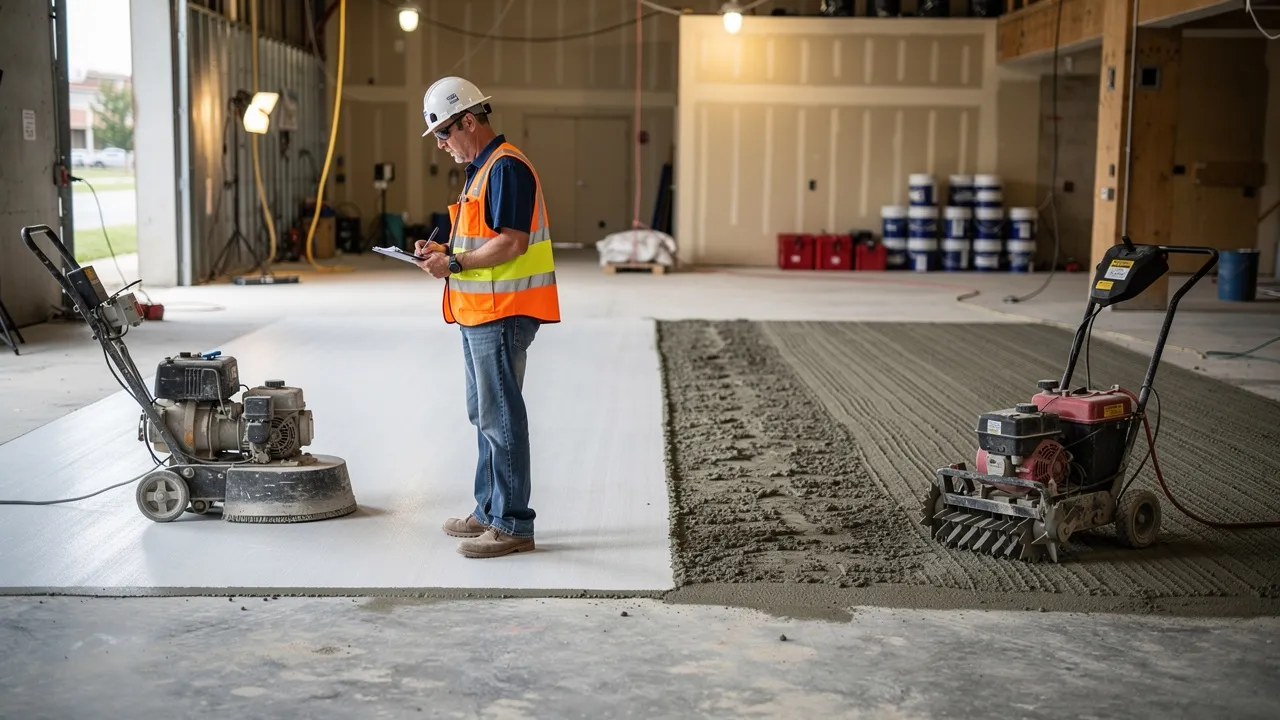
The concrete surface-preparation task should determine whether you pursue a grinder rental, a scarifier rental, or another preparation conversation. A machine name by itself says too little about the work. Start with what you need to remove, what surface you need to leave, and what the finished floor or slab must accept afterward. Floor-grinder selection depends on the surface, task, and desired finish because different models serve different applications. Concrete grinders and scarifiers are separate surface-preparation rental categories, so the distinction belongs in your first project description rather than after you have selected a machine.
A concrete grinder rental may fit a project involving surface laitance, old coatings, adhesive residue, or surface irregularities that interfere with bonding. Concrete receiving a coating, resurfacing system, mortar, or sealer should be structurally sound and clean before application. That means your inquiry should describe both the removal work and the next material or finish. Use this short starting record:
- State whether the task is surface preparation, residue or coating removal, smoothing, profiling, or another concrete-grinding objective.
- Identify the material on the slab and whether the substrate beneath it is concrete, a coating system, or another surface.
- Describe the finish or bonding condition you need after preparation.
- Note whether the work is on a broad floor, a small area, an edge, or a confined section.
If this is a periodic-use project rather than equipment you expect to use every day, renting may be a practical alternative to purchasing; compare the available rental terms and costs before deciding.
Define the material and result before choosing equipment
The material you need to address and the result you need to achieve are the first two equipment-fit questions. Concrete grinding can remove surface laitance, old coatings, adhesive residue, and surface irregularities that interfere with bonding. The same general category can therefore appear in different project conversations, but the appropriate configuration may change with the surface and finish. Describe the existing condition in ordinary terms rather than assuming that the word “grinder” communicates the entire job.
Your description can answer four questions:
- What is on the surface now: bare concrete, adhesive residue, a coating, weak material, or an unknown layer?
- What needs to happen: remove material, smooth an irregular area, prepare for a coating, or create a specified surface profile?
- What must remain afterward: a clean substrate, a particular texture, or a surface ready for the next system?
- What parts of the area are different from the rest, such as repairs, edges, transitions, or damaged sections?
Concrete surface preparation may include inspecting the substrate, removing non-durable concrete, decontaminating the surface, creating a profile, and repairing surface irregularities. Grinding is one part of that sequence, not a substitute for describing the full condition.
The intended finish should be stated before you ask about equipment. Surface preparation aims to remove weak, contaminated, or unwanted material and create a profile suited to the new system’s bonding requirements. A coating, overlay, mortar, or resurfacing system may have its own preparation expectations, so the final material matters to the rental conversation.
Do not turn a general surface-preparation description into a promise about adhesion or durability. Instead, give the rental discussion the condition that controls the next decision: the material to remove, the surface to expose, and the system or finish planned afterward. If you do not know the coating type, adhesive type, or required profile, record that uncertainty plainly. The missing detail is a confirmation question, not a reason to guess at a grinder configuration.
Unknown surface conditions deserve their own line in the project record. Separate what you have observed from what you still need to determine: for example, identify visible adhesive or coating, then note that the material beneath it or the required profile remains uncertain. This distinction keeps the equipment discussion tied to the actual slab instead of an assumed condition.
If a coating, overlay, mortar, or sealer will follow, record that next system before discussing tooling. If the next system is not selected, describe the finish you can identify and ask which preparation details still need confirmation. The useful decision is not whether you can name a grinder immediately; it is whether you have described enough of the surface and intended result for the category discussion to be meaningful.
Compare a grinder with a scarifier when the removal task changes
The grinder-versus-scarifier decision belongs to the removal task, not to a preferred machine label. Concrete grinders and scarifiers are distinct surface-preparation rental categories, and the appropriate choice depends on the project. Grinding can address laitance, old coatings, adhesive residue, and surface irregularities that may interfere with bonding. That description can help you explain a preparation objective, but it does not establish that every grinder handles every layer or condition.
Use the following branch points:
- If your main objective is to prepare a concrete surface for a coating or resurfacing system, describe the required cleanliness and profile, then ask whether a grinder is the relevant category.
- If your objective involves a different removal task or a more substantial change to the concrete surface, ask whether a scarifier or another category should be considered instead.
- If the existing layer, removal extent, or finished profile is uncertain, send those uncertainties with photographs or measurements when available and ask for category confirmation rather than choosing from the name alone.
The direct action is simple: state the removal objective first, then ask EZ Equipment Rental to confirm whether the conversation should remain with concrete grinders or include scarifiers.
The grinder-and-scarifier comparison has a practical boundary. The categories are distinct, and task, surface, and desired finish affect the choice; a general category description does not establish a removal-depth promise, production guarantee, or specification for your slab. Keep those details open until the equipment and operating requirements are confirmed.
Your inquiry should therefore avoid wording such as “I need the strongest grinder” unless you can explain what “strongest” means for the task. Replace it with a measurable project description: the material to address, the approximate area, the condition below the material, the desired surface, and any access or power limits. That information supports a useful category discussion without assuming a result.
Separate broad floor work from detail and edge questions
The work area should be described as more than total square footage. Grinder size depends on square footage, slab condition, and desired finish, while equipment fit also involves access, tooling mounts, power, and extraction requirements. A broad, open floor may create different questions from a narrow room, an edge-heavy layout, or a series of separated patches.
Record these area details before requesting a category:
- Approximate length, width, or total square footage.
- Whether the work is continuous or divided among rooms, bays, walkways, or repairs.
- The narrowest doorway, gate, corridor, stair route, or other access point.
- The amount of edge, corner, transition, or detail work compared with open-floor work.
- Whether the surface is indoors, outdoors, or connected to an occupied area.
The area description helps the discussion address maneuverability and coverage without assuming that a particular machine size is available or suitable.
Detail and edge work should remain visible in the inquiry instead of being treated as a small footnote. A grinder selected for broad floor work may not answer every question created by tight access, perimeter edges, transitions, or isolated repairs. Equipment should be matched to the task and work area; a specific edge-machine pairing or accessory package still requires confirmation.
Ask EZ Equipment Rental for a project-fit discussion if your work includes both open-floor preparation and detail areas. Include a simple split such as “approximately this much open floor and these specific edges or corners.” Ask which equipment category addresses each part, whether one setup can cover the work, and whether separate tooling or equipment should be considered. Keep the answer conditional until the area and available setup are reviewed.
Screen slab condition and finish requirements
The slab condition and desired finish should shape the equipment conversation before you ask about size. Concrete hardness and the desired finish affect grinding-wheel grit and bond selection; soft bonds are generally associated with hard concrete and hard bonds with softer concrete. Grinder size also depends on square footage, slab condition, and desired finish. These factors belong together because the same area can require different decisions depending on what the surface contains and what must follow.
Describe the condition you can observe:
- Bare, hard, soft, dusty, cracked, patched, coated, or contaminated areas.
- Adhesive, curing compounds, laitance, paint, epoxy, or another material on the surface.
- Surface irregularities, weak concrete, repairs, or changes across the slab.
- The planned finish, coating, overlay, sealer, or other next step.
- Any specified profile or finish requirement provided by the planned system or project documents.
A description is more useful than an unsupported request for a “heavy-duty” or “fine-finish” machine.
The tooling question should follow the surface and finish question. Diamond cup wheels can serve aggressive preparation, smoothing, and leveling, while grit and bond relate to concrete hardness and the desired finish. The profile should also match the new system’s bonding requirements. Those points support asking about tooling compatibility; they do not support choosing a grit, bond, or sequence without project-specific confirmation.
Use direct questions:
- What concrete condition should be reported before tooling is selected?
- What material must the tooling remove or refine?
- What finish or profile must remain?
- Does the planned coating or resurfacing system specify a preparation profile?
- Which tooling, mounts, or extraction arrangement should be confirmed for that task?
Send the finish requirement with the rest of the project record. Do not treat the grinder body, wheel, or tooling as interchangeable parts of one generic rental.
Check the work area before requesting a category
The work area can rule in or rule out a project-fit conversation before equipment is reserved. Equipment fit involves the work area, access, available power, tooling mounts, and extraction requirements when you prepare or grind a concrete floor. Grinder-size selection also connects with square footage, slab condition, and desired finish.
Build an access record with these details:
- Jobsite city and the room, floor, bay, driveway, patio, or slab location.
- Door, gate, corridor, stair, elevator, or route dimensions that affect entry.
- Surface transitions and the distance between the loading point and work area.
- Available electrical service or other power information known to you.
- Whether the equipment must operate near occupied spaces, stored materials, or finished surfaces.
- The approximate area and the number of separate work zones.
The point is not to calculate a machine specification from a checklist. The point is to give the rental conversation the site facts needed to discuss category, access, power, and setup.
Power and access constraints should be stated as limits, not hidden assumptions. If you know the available power, include it. If you do not know whether the site supports the operating setup, say that confirmation is needed. The same approach applies to tooling mounts, extraction connections, transportation through the site, and storage between work periods.
Ask EZ Equipment Rental to confirm the operating requirements that remain unresolved. Ask which facts are needed to determine whether the proposed category can enter the site and work in the area. Include the planned rental duration and any schedule uncertainty because duration, cost, accessories, and support services are useful comparison points. Do not commit to a category until the site constraints and operating requirements have been discussed.
Timing belongs in the site record even when the physical work area is already clear. State the planned start, the expected work period, and whether the schedule depends on another trade, coating, repair, or inspection. If the work may extend beyond the first estimate, identify that uncertainty rather than presenting one rental duration as settled.
Use the timing information to ask which rental duration, cost, accessories, and support details apply to the project. This does not establish a rental policy or price. It gives EZ Equipment Rental the conditions needed to discuss the requested period and identify what still requires confirmation before commitment.
Include dust control in the equipment conversation
Dust control or extraction should appear in the equipment conversation whenever the task involves concrete grinding or floor preparation. Extraction requirements are an equipment-fit consideration, and optional vacuum attachments may be relevant to cleanup. The arrangement depends on the work area, task, and proposed equipment, so the inquiry should ask rather than assume.
Add these questions to the project record:
- Does the proposed setup require dust-control or extraction equipment?
- Is an attachment, vacuum, or other extraction arrangement relevant to this task?
- How does the work area affect the extraction discussion?
- What connection, power, or access details need confirmation?
- What cleanup responsibilities should be understood before the rental period begins?
This list keeps dust control connected to equipment fit. It does not promise a dust-free process, define an air-quality control plan, or establish which attachment will be available.
The extraction question should be asked alongside the grinder question, not after the equipment decision. Compare included accessories and available support services, and ask whether the proposed rental includes the accessories needed for your task or whether those items require separate confirmation.
For an Irving or DFW project, include the room or slab location, access route, available power, approximate area, surface material, and expected finish in the same message. A complete setup question is easier to answer than a request for “a concrete grinder” followed by separate messages about dust, tooling, and access.
Prepare the concrete before treating grinding as the whole process
Concrete preparation includes more than operating a grinder across the surface. Surface preparation may include substrate inspection, removal and replacement of non-durable concrete, decontamination, creation of a surface profile, and repair of surface irregularities. Grinding can remove laitance, old coatings, adhesive residue, and surface irregularities that interfere with bonding, but the project still needs a condition review and a defined next step.
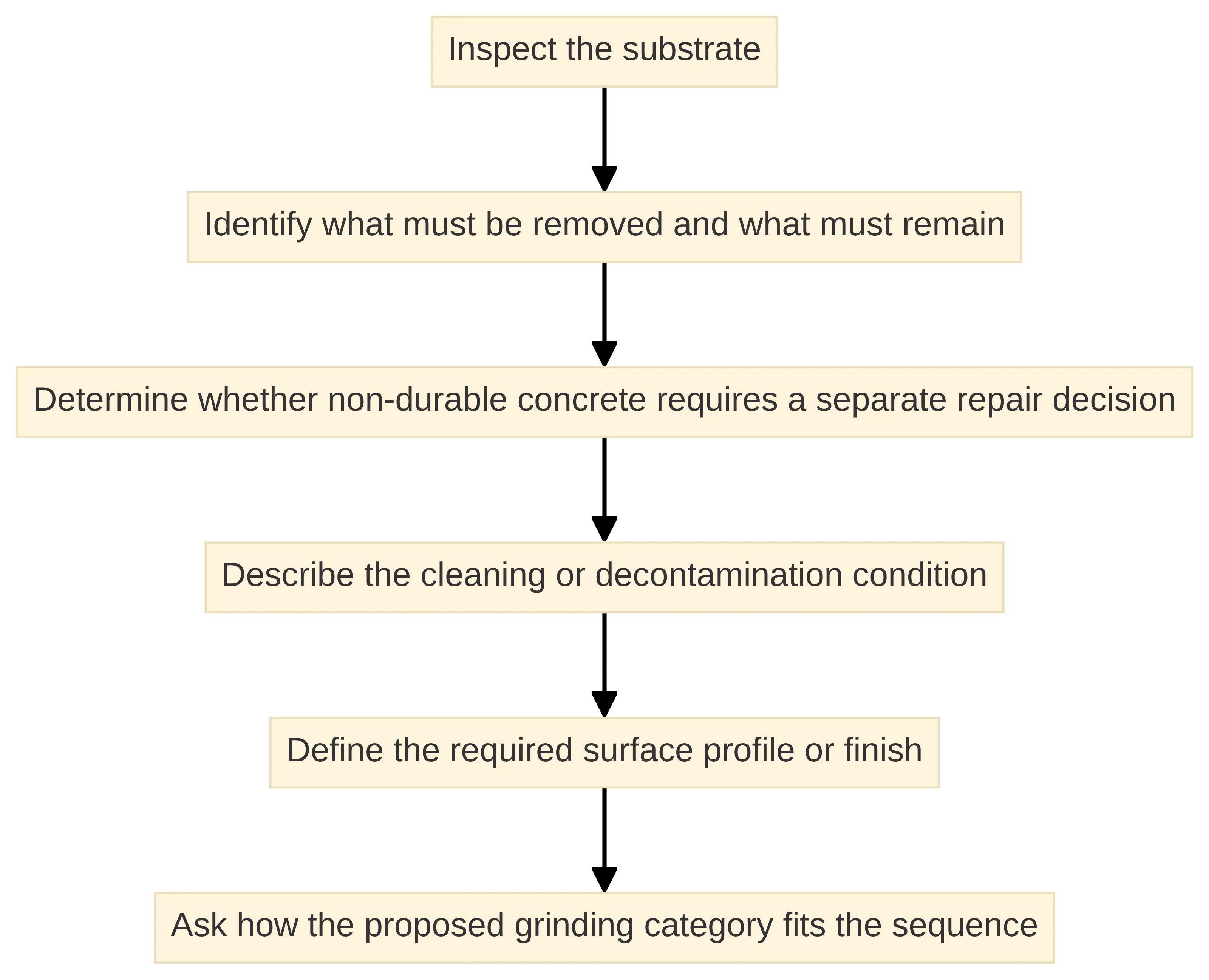
Use this preparation sequence as a planning aid:
- Inspect the substrate and record changes in condition, repairs, weak areas, contamination, and irregularities.
- Identify what must be removed and what must remain.
- Determine whether non-durable concrete or damaged sections require a separate repair decision.
- Describe the cleaning or decontamination condition needed before the next material is applied.
- Define the surface profile or finish required by the planned coating, mortar, resurfacer, or sealer.
- Ask how the proposed grinding category fits that sequence.
The sequence turns a broad preparation goal into a set of questions that can be discussed before rental commitment.
Operating readiness should remain a separate confirmation step. Equipment training and maintenance assistance are support services to ask about, and extraction requirements are part of the setup discussion. Include questions about available operating guidance, support, tooling, extraction, and the conditions under which the equipment can be used at your site.
Do not infer readiness from the fact that a category sounds appropriate. Record who will review the operating requirements, who will handle the preparation sequence, and which project condition still needs confirmation. If your site, power arrangement, surface condition, or planned finish creates an unresolved question, keep that question visible in the inquiry rather than treating a general grinder description as approval for your specific work.
Use preparation quality as a reason to verify the fit
Preparation quality gives you a practical reason to verify equipment fit before the work begins. Inadequate preparation may show up as delamination, peeling, edge dusting, or blistering, and appropriate preparation can reduce rework risk. Preparation also involves removing unwanted material and creating a profile suited to the new system’s bonding requirements.
These points do not prove that a particular rental will prevent a problem. They show why your inquiry should include the planned next material, the condition of the slab, the required profile, and the areas that differ from the main floor. Ask for a category and setup that can be discussed against those facts, then keep any result dependent on the actual surface, equipment, tooling, and operating conditions.
A fit check should end with a clear boundary between planning and confirmation. Planning can identify the task, surface, finish, area, access, power, extraction, schedule, accessories, and support questions. Confirmation must address the equipment configuration, tooling, operating requirements, rental duration, cost, and available support for your project.
Use the following test before you move from planning to inquiry: can you explain what the surface is, what must be removed, what must remain, where the work occurs, how the equipment reaches it, what finish follows, and which details are still unknown? If the answer is no, complete the project record first. If the answer is yes, submit the record and ask for a project-fit discussion instead of presenting an assumed machine as the answer.
Turn the project facts into confirmation questions
The project record should convert your surface-preparation facts into questions that can be answered. Before renting, compare the task, surface, desired finish, rental duration, cost, included accessories, and available support services. Equipment fit also involves work area, access, power, tooling mounts, extraction requirements, square footage, and slab condition.
Prepare one message with these fields:
- Jobsite: city, project area, access route, and indoor or outdoor location.
- Task: preparation, residue or coating removal, smoothing, profiling, or another objective.
- Surface: concrete condition, material to remove, irregularities, repairs, and unknowns.
- Result: clean substrate, finish, profile, coating, overlay, sealer, or other next step.
- Area: approximate square footage, room count, open-floor share, and edge or detail work.
- Constraints: access, power, tooling mounts, extraction, occupied areas, and storage.
- Timing: planned start, expected duration, schedule uncertainty, and rental period to discuss.
- Questions: grinder or scarifier category, tooling, accessories, extraction, operating requirements, support, cost, and availability.
This format gives the rental conversation enough context to address fit without inventing specifications or terms.
The confirmation questions should be specific enough to expose an unresolved decision. Ask whether the described task points toward a grinder, a scarifier, or another category. Ask which equipment size or configuration should be considered for the stated area and slab condition, and whether the intended finish changes that discussion. Ask what tooling, mounts, accessories, extraction, power, and operating requirements need confirmation.
Ask about duration, cost, included accessories, and support services before committing. Ask whether the proposed option is available for the project timing and whether the arrangement fits the stated jobsite. We provide personalized recommendations based on your specific needs and budget, so include those needs and budget constraints in the inquiry. Do not replace them with a request for a generic model or an unqualified promise about the finished surface.
A concise opening sentence can make the request easier to assess: name the concrete task, the material or condition involved, and the intended result. Follow it with the area, access route, available power, extraction question, expected timing, and any unusual edge or detail work. Finish by listing the decisions that remain open, such as grinder versus scarifier, configuration, tooling, accessories, cost, availability, and operating requirements.
Read the message once before sending it. Remove unsupported machine labels, separate observed facts from unknowns, and make sure the requested finish is stated in the same terms used by the planned coating, overlay, mortar, resurfacer, or sealer when that information is known. The result is a focused inquiry record, not a presumption that one machine will suit every part of the job.
Request a project-fit option from EZ Equipment Rental in Irving or DFW
A project-fit concrete-equipment inquiry should describe the task before it asks for a machine. Include the material to address, desired result, slab condition, area, access, power, extraction, finish, schedule, rental duration, and unresolved operating questions. We provide equipment rental services in Dallas, Texas, and we are located in Irving, Texas. We also serve multiple locations across the DFW Metroplex, including Irving, Dallas, Fort Worth, Arlington, Carrollton, Garland, Grand Prairie, Lewisville, Plano, and Richardson.
We provide personalized recommendations based on your specific needs and budget. Availability, pricing, specifications, operating requirements, accessories, and rental terms still need confirmation for your project. Before operating, review the equipment instructions, check the work area, access, and available power, and ask the rental provider about dust-control or extraction equipment and any operating support for the setup. Send the completed project record so the conversation can address the right equipment category and the conditions that affect the rental.
The next step is to turn your surface-preparation notes into a focused request that can be answered without guessing. Keep the grinder-versus-scarifier question open when the removal task is unclear, and keep tooling, extraction, power, access, pricing, availability, and operating requirements as confirmation items.
What should you confirm before renting a concrete grinder?
What should I consider when renting a concrete grinder?
When renting a concrete grinder, evaluate the specific requirements of your task, including the type of surface, the material to be removed, and the desired finish. Also, consider the rental duration, cost, included accessories, and the rental company's support services.
How do I determine the right size of concrete grinder for my project?
The size of the concrete grinder needed depends on factors such as the square footage of the area, the condition of the slab, and the desired finish. Larger grinders may be more suitable for commercial projects due to their higher production rates.
What are the differences between a concrete grinder and a scarifier?
Concrete grinders and scarifiers are distinct surface-preparation rental categories.
What details should I confirm with the rental provider before committing?
Before committing to a rental, confirm details such as the specific equipment fit for your project, available accessories, rental duration, cost, and any support services provided by the rental company.
How can I ensure proper surface preparation before using a concrete grinder?
Proper surface preparation involves inspecting the substrate, removing any non-durable concrete, decontaminating the surface, and creating a suitable profile for bonding. Ensure that the surface is clean and structurally sound before applying any coatings or resurfacing materials.
What factors affect the choice of grinding wheel for a concrete grinder?
The choice of grinding wheel depends on the hardness of the concrete and the desired finish. Soft bonds are generally used for hard concrete, while hard bonds are suitable for softer concrete. The grit selection also varies based on the specific task.
Sources
- Understanding Floor Grinder for Rent: Features and Benefits — blog.ezequipmentrental.com, 2025-06-21
- Concrete Grinder Rental in Dallas: Are You Prepping Your Slab the Right Way? — blog.ezequipmentrental.com, 2026-06-23
- guideline instructions for concrete surface preparation ( ... — industrial.sherwin-williams.com
- STI Floor Grinders & Concrete Polishing Buying Guide — www.usagranitetools.com
- Concrete Grinding Tools Buying Guide for Contractors — www.diamondtoolstore.com, 2026-08-05
- The complete guide to concrete surface preparation | Trelawny Blog — trelawny.com
- Concrete Grinder vs. Scarifier: Which Rental Is Right for Your Project? — rent.cat.com
- How to Choose a Concrete Floor Grinder | Substrate Technology — substratetechnology.com
- Equipment & Tool Rentals in Dallas TX - EZ Equipment Rental