
When a Rough Terrain Scissor Lift Belongs in the Equipment Conversation
A rough terrain scissor lift raises workers, tools, and materials to an elevated work area when the task requires vertical access outdoors. Unlike a boom lift, a scissor lift moves vertically rather than extending horizontally. That distinction gives you a practical first test: if the work is directly above a positionable base, this category may belong in the conversation; if you must reach outward or over an obstacle, a different access approach may need consideration.
Rough-terrain models are designed for outdoor construction and industrial maintenance applications. Their design is intended to maintain stability while lifting workers and heavy loads. For a residential project in Irving, Dallas, Fort Worth, or another DFW community, that description is a starting point—not a decision by itself.
Use the category when all of these statements are true:
- Your task requires people, tools, or materials to work above ground level.
- The work is primarily vertical rather than outward or across an obstruction.
- The work area is outdoors or involves construction-oriented ground conditions.
- You can evaluate the surface, route, hazards, weather, load, and required height before arranging equipment.
The machine name does not replace a site check. Treat the project conditions as the qualification.
Define the Work Before Choosing the Lift
The work task determines whether vertical platform access is relevant. Write down what you need to reach, where the work will occur, and whether the people on the platform must move only upward and downward or need horizontal outreach. A scissor lift raises personnel and materials vertically; it does not extend horizontally like a boom lift. That makes the task description more useful than starting with a machine name.
For a home project, describe the actual work rather than using a broad label such as repair, landscaping, or demolition. For example, identify the elevated surface or work area, the materials you expect to handle, and the position from which the work must be performed. This record gives you a clearer basis for discussing equipment fit.
Record two separate measurements before you inquire:
- Required work height: Identify the height of the work point you need to reach, not merely the height of the platform. Leave the selected machine's exact lift range for confirmation against a particular model.
- Platform load: Add the people, tools, and materials that may be on the platform during the task. The combined weight must not exceed the manufacturer's load rating.
A marketplace listing describes one electric category with maximum lift heights of 25–27 feet, depending on the model, and another gas-or-diesel category with maximum lift heights of 30–35 feet, also depending on the model. Those examples show why a category range cannot substitute for a model-specific check. They do not establish local availability or suitability for your site.
Do not choose by the highest-looking number. Give the rental team your required work height and anticipated platform load so the proposed unit can be checked against its instructions and rating.
Match Rough-Terrain Features to Outdoor Conditions
The useful distinction is not the rough-terrain label by itself. Focus the inquiry on the category features relevant to the outdoor conditions, then check the specific machine's operating limits and manufacturer's instructions.
Use a feature-to-condition check for the inquiry:
- Drive and tires: Ask whether the specific model provides four-wheel drive and the more aggressive tires associated with rough-terrain lifts.
- Gradeability: Ask how the model's gradeability relates to the project's outdoor conditions.
- Operating limits: Follow the specific machine's operating limits and the manufacturer's instructions.
This keeps the inquiry focused on rough-terrain characteristics and model limits. The comparison also helps separate the role of each feature. Higher ground clearance and more aggressive tires relate to moving through outdoor jobsite conditions; four-wheel drive and gradeability relate to the machine's ability to navigate those conditions; and stabilizing outriggers relate to the lift's setup for uneven terrain. These features explain why rough-terrain equipment enters the discussion for outdoor construction or maintenance, but they do not create a blanket approval for a residential yard. A feature is relevant only when it matches a condition you have recorded and the specific machine's instructions permit that use.
For a DFW homeowner, make the question specific: “The work position is [described surface], the route includes [described changes], and the task needs [vertical work description]. Which rough-terrain characteristics and model limits apply?” Do not ask only whether the lift is “good on rough ground.” That phrase hides the difference between crossing an outdoor route and safely positioning for elevated work. The category can be a starting point; the model-specific operating limits remain the deciding boundary.
Keep mobility and stability questions distinct in the notes. A request for four-wheel drive or aggressive tires is a question about the model's rough-terrain design; a request about outriggers and setup is a question about how the lift is intended to be positioned and operated. Neither answer replaces the surface description. This prevents a general feature list from becoming an unsupported conclusion about your specific property.
Make Ground Conditions the First Go-or-Stop Gate
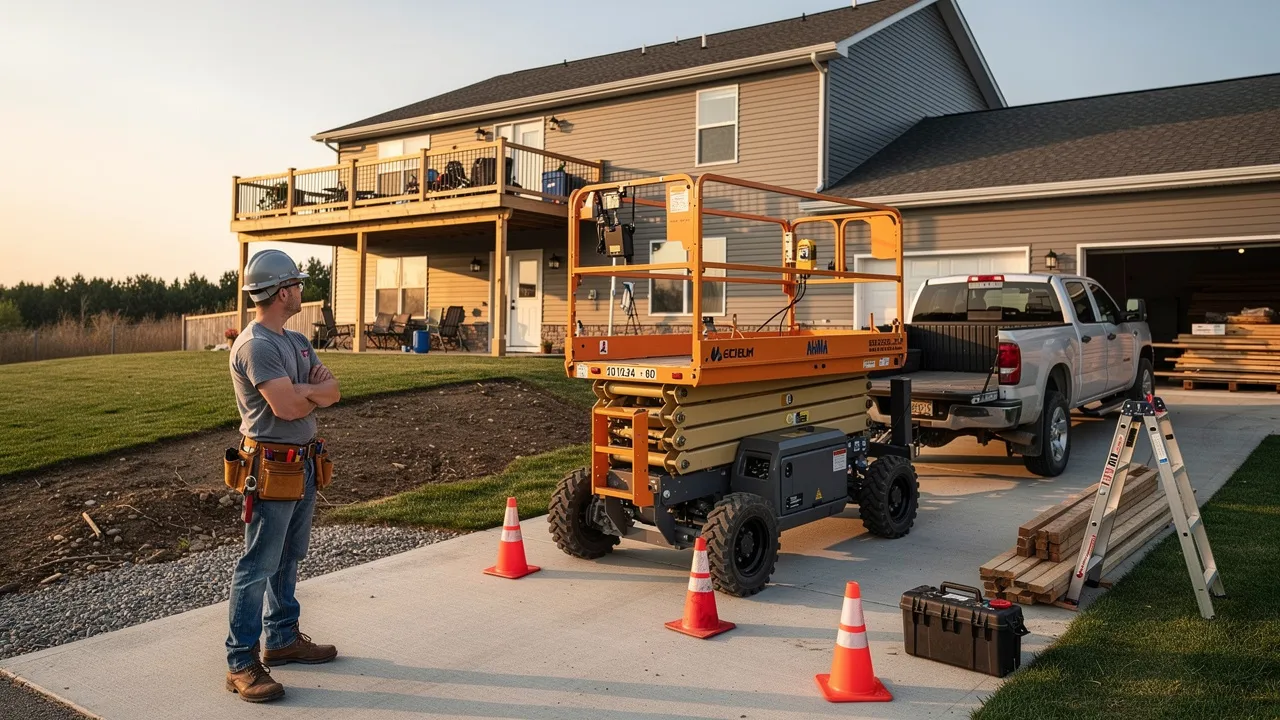
Ground conditions should determine whether you continue the inquiry. OSHA advises selecting a firm, level work surface away from drop-offs, holes, slopes, bumps, ground obstructions, and debris. That guidance matters in a residential yard as much as on a larger worksite: a driveway, lawn, construction area, or side access route can contain different surfaces and hazards within a short distance.
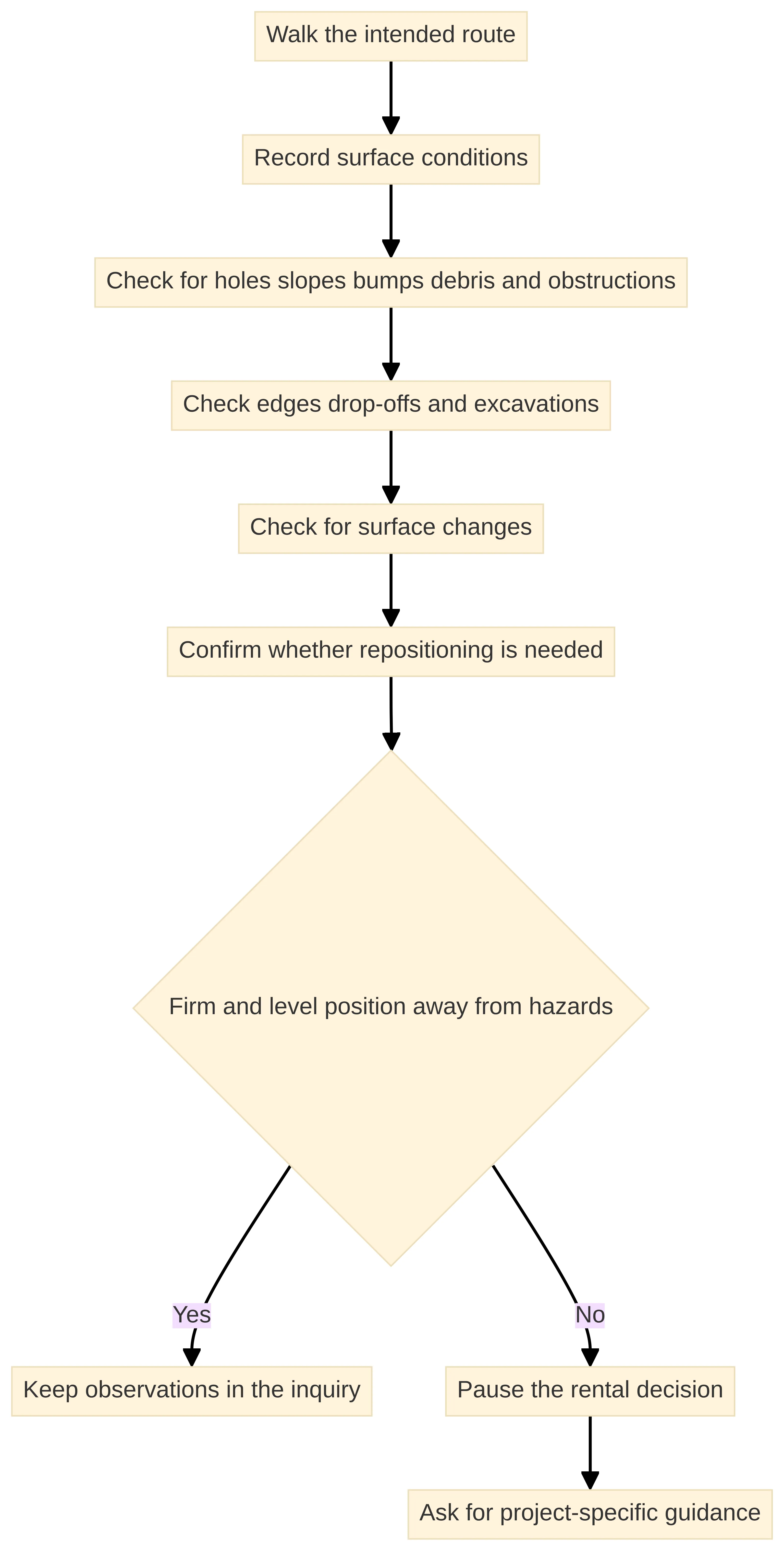
Walk the intended route and work position before you request a machine. Record:
- Whether the planned position is firm and level.
- Any holes, soft areas, slopes, bumps, debris, or fixed obstructions.
- Any edge, drop-off, excavation, or transition that could affect positioning.
- Whether the surface changes between the entry route and the work position.
- Whether the machine would need to be repositioned during the task.
Do not describe a site simply as “outdoors” or “uneven.” Describe the actual conditions.
Use the ground screen as a boundary rather than a score. A site that passes one part of the check may still fail another. For example, a firm driveway does not resolve a nearby drop-off, and a level work position does not resolve debris along the route.
If you cannot identify a firm, level position away from the listed hazards, pause the rental decision. Ask for project-specific guidance instead of assuming that four-wheel drive, aggressive tires, ground clearance, or outriggers make the location acceptable. If the position can meet the surface conditions, keep the observations in your inquiry so the selected machine can be matched to the described site. Keep two questions separate during the ground screen: can the machine reach the work position, and can it be positioned there under its operating limits? Rough-terrain features may help distinguish this category for outdoor travel, but a route that can be crossed is not automatically a suitable elevated-work position. Higher clearance, drive, tires, gradeability, or outriggers do not override the instruction to use firm, level surfaces away from drop-offs, holes, slopes, bumps, obstructions, and debris. Record the route and final position separately so the rental discussion does not collapse them into one description.
If the site changes from a firm driveway to a softer or sloped area, describe that transition rather than averaging the conditions. The relevant question is not whether most of the property seems workable; it is whether the intended route and work position can be evaluated against the selected machine's limits. Where the description leaves a hazard or surface condition unresolved, pause the assumption and ask for project-specific guidance.
Screen Access, Positioning, and Nearby Activity
Access is more than reaching the property. You need a workable route to the intended position and enough usable space to place the machine without moving into the hazards you identified. Describe the route from the expected entry point to the work area, including surface changes, tight approaches, gates or other access restrictions, turns, and the place where the machine would be positioned. The exact access requirements belong to the selected model, so use your description to start a fit discussion rather than to approve the route yourself.
Your access notes should answer these questions:
- Where would the equipment enter the property or work area?
- What surface would it cross before reaching the work position?
- Where would it be positioned while elevated?
- Would the work require repositioning?
- What nearby objects, edges, debris, or other activity could affect that position?
A clear route description helps separate a possible category from a site that still needs review.
Nearby activity must be part of the plan. OSHA advises isolating the scissor lift or using traffic-control measures so other equipment cannot contact it. On a home project, “other equipment” may include vehicles, deliveries, compact machinery, or tools moving through the same area. Describe what will continue around the work zone and whether the lift can be kept apart from that movement.
If you cannot separate the lift from moving traffic or equipment, do not treat the location as ready. Add that condition to your inquiry and wait for guidance about the proposed arrangement. Positioning is not complete when the machine reaches the property; it also includes keeping the work area separated from contact hazards.
Treat Weather and Platform Load as Hard Limits
Outdoor conditions can change the decision after the site has passed an initial ground screen. OSHA advises using a scissor lift outdoors only when weather conditions are good. OSHA also states that scissor lifts rated for outdoor use are generally limited to wind speeds below 28 miles per hour. That figure is not a universal permission for every model or every condition; the selected machine's instructions and limits still govern.
Before the planned work window, record the expected outdoor conditions and identify who will decide whether the work can proceed. If conditions are unsuitable, postpone the elevated work rather than treating the rough-terrain category as a substitute for the operating limits. Ask about the selected model's instructions when weather is likely to affect the schedule. Wind should be handled as a machine-and-weather check rather than as a benefit of the rough-terrain label. The approved OSHA guidance refers to scissor lifts rated for outdoor use and gives a general below-28-mph boundary; it does not turn that figure into a specification for an unidentified unit. Ask which outdoor-use instructions apply to the selected machine, and treat the answer as part of the go-or-no-go decision for the planned work window.
Likewise, do not use the machine's outdoor design to compensate for an incomplete load calculation. Rough-terrain suitability, outdoor wind limits, and platform load are separate checks. A project brief is stronger when it reports each one separately: the expected conditions, the selected model's applicable instructions, and the total platform load. If any check cannot be completed, the inquiry is not ready for an assumption of fit.
Platform load is another fixed boundary. Add the weight of every person, tool, and material that may be on the platform for the task, then compare that total with the manufacturer's load rating for the selected machine. Do not allow the platform weight to exceed that rating.
Use a written load list instead of estimating from the main material alone:
- People who may be on the platform.
- Hand tools and equipment carried up.
- Materials lifted or placed on the platform.
- Any added items required during the work sequence.
If the total is uncertain, say so in the inquiry. Do not resolve uncertainty by assuming a larger platform or a rough-terrain design automatically permits a larger load. The machine-specific rating remains the boundary.
Separate General Equipment Guidance from Provider Confirmation
Published category descriptions can help you frame the questions, but they do not confirm what is available for an Irving or DFW project. One marketplace listing describes an electric category with a 25–27-foot maximum lift height depending on the model. The same listing describes a gas-or-diesel category with a 30–35-foot maximum lift height depending on the model and notes that power availability varies by location.
Use those figures only as examples of how listings may group equipment. Do not present either range as the specification of the unit you may rent, and do not assume that the power source, dimensions, capacity, drive system, or operating limits will match your site. Give the rental team your required height, load, terrain, access route, and location so the proposed equipment can be checked directly. Use the category descriptions to ask targeted questions about the features that distinguish rough-terrain equipment from slab scissor lifts. For example, ask how the proposed model's ground clearance, drive, tires, gradeability, and outriggers relate to the described route and work position. Then ask which operating limits apply to the height, platform load, surface, weather, and setup. This is more useful than asking whether a listing's height range is generally available.
The distinction also protects against a common category error: treating an outdoor label as proof that the machine can work on every outdoor surface. The approved guidance supports rough-terrain use for demanding outdoor conditions, but it also says that uneven-surface suitability cannot be assumed. Keep the proposed unit, its instructions, and your recorded site conditions together when requesting confirmation.
A listed equipment category does not establish a unit's current availability or suitability for a particular site. Keep three questions separate:
- Category: Is this type of elevated platform relevant to the task?
- Model: Does a particular unit meet the required height, load, surface, access, and operating conditions?
- Arrangement: Is that unit available for the required location and rental period, with the applicable pickup or delivery and other terms?
The first question is what this guide helps you screen. The second and third require confirmation for your project. If any part of your description is incomplete, identify it rather than filling the gap with a category assumption.
Prepare a Rough Terrain Scissor Lift Rental Brief
A useful rental brief turns your project into facts that can be discussed. We begin by identifying the exact work, choosing equipment for the job, and deciding how long it is needed. Build your notes in that order, then add the site and operating details that determine whether the category is worth pursuing.
Include these items:
- Task: What elevated work must be completed, and what must be reached?
- Work geometry: Is the access vertical, or does the task require horizontal outreach?
- Height: What is the required work height and where is that measurement taken?
- Platform occupants: How many people may be on the platform?
- Tools and materials: What will be carried or handled above ground level?
- Load: What is the estimated combined weight of people, tools, and materials?
- Terrain: What type of outdoor ground surrounds the work position?
- Surface: Is the intended position firm and level, and are there holes, slopes, debris, bumps, or drop-offs?
- Access: How will the machine reach the site, and where will it be positioned?
- Nearby activity: What equipment, vehicles, or deliveries could approach the work zone?
- Weather: What outdoor conditions could affect the planned work window?
- Location: What Irving or DFW address will be involved?
- Duration: How long will the project need the equipment?
Use the brief to expose unresolved points before you ask for a unit. For example, “outdoor work at a two-story home” is less useful than a note that identifies the work point, required height, platform load, intended position, surface hazards, access route, nearby traffic, address, and expected work window. The added detail does not approve the site; it gives the discussion a defined basis.
Keep photos, measurements, and written observations together if they are available to you. Describe uncertainty plainly, such as an unconfirmed load or a route that may contain a surface transition. The purpose is to give a complete project record for fit and arrangement questions, not to substitute your record for the selected machine's instructions.
Ask About the Complete Rental Arrangement
Once your project brief is ready, ask us to address the arrangement as well as the equipment category. We advise asking about availability, pricing, delivery or pickup, responsibilities, insurance, and exact rental terms before choosing an arrangement. Those questions keep the inquiry connected to the actual work window and location.
Organize your questions into this short list:
- Is a suitable unit available for the requested project location and dates?
- Which unit or category matches the stated height, load, terrain, access, and weather conditions?
- What pricing applies to the expected rental period?
- Is delivery or pickup available for the project location, and what responsibilities apply to each option?
- What responsibilities apply during the rental arrangement?
- What insurance information or requirements apply?
- What exact rental terms should you understand before proceeding?
Do not treat a general category response as confirmation of a specific unit. Ask for the unresolved details to be addressed against your project brief.
Set the rental period around the work you actually expect to perform. We offer flexible rental durations tailored to project requirements, so include the expected start, the planned work window, and any schedule uncertainty in your request. A clear duration helps frame pricing and arrangement questions without assuming that a particular term, rate, or delivery condition applies.
If the project may extend beyond the initial window, say that before selecting an arrangement. If the work depends on suitable outdoor conditions, include that scheduling constraint as well. The rental period should follow the defined task and site plan, not a guess based only on the equipment category.
Send the Prepared Project Details to EZ Equipment Rental
A project-fit inquiry should carry the full decision record: the vertical task, required work height, platform load, ground and surface conditions, access route, nearby activity, weather considerations, location, and rental duration.
Use the category only after the job passes the basic gates: the work is vertical, the required height and platform load are defined, the surface and position can be described, access and nearby activity are considered, and weather and machine limits remain within bounds. A qualified professional should decide individual suitability and operating requirements for your project. Bring the prepared details forward for project-specific fit and availability guidance.
What Should You Confirm Before Requesting a Rough Terrain Scissor Lift?
What is a rough terrain scissor lift?
A rough terrain scissor lift is a machine designed to elevate workers, tools, and materials to work at height, specifically engineered for outdoor conditions and uneven ground. It provides stability while lifting heavy loads in construction and industrial maintenance applications.
What conditions should be considered when using a rough terrain scissor lift?
When using a rough terrain scissor lift, ensure the work surface is firm and level, free from drop-offs, holes, and debris.
What details should I gather before contacting EZ Equipment Rental about a rough terrain scissor lift?
Before contacting EZ Equipment Rental, prepare details such as the required work height, platform load, terrain conditions, access route, nearby activity, and expected weather. This information will help determine the suitability of the lift for your project.
How do I determine if a rough terrain scissor lift is appropriate for my project?
Assess whether your project requires vertical access outdoors, if the work area is primarily vertical, and if you can evaluate the surface and hazards before arranging equipment. If the site has slopes or unstable areas, seek specific guidance.
What should I ask about the rental arrangement for a rough terrain scissor lift?
Inquire about the availability of a suitable unit, pricing, delivery or pickup options, responsibilities during the rental, insurance requirements, and the exact rental terms before proceeding.
Where is EZ Equipment Rental located?
EZ Equipment Rental is located at 1307 W Airport Fwy, Irving, TX 75062, and serves the Dallas-Fort Worth Metroplex.
What are the limitations of using a rough terrain scissor lift?
Rough terrain scissor lifts are not suitable for every uneven surface.
Sources
- Rough Terrain Scissor Lifts | LGMG North America, Inc. — www.google.com
- Rent Equipment Near Me in Irving and DFW: A Construction Project Decision Guide — blog.ezequipmentrental.com, 2026-10-26
- Working Safely with Scissor Lifts — www.osha.gov
- Electric Vs Rough Terrain Scissor Lifts: Which Should You Rent? — namrentals.com
- Rough Terrain, No Problem: What Sets a Rough Terrain Scissor Lift Apart-Blog-Zoomlion Access — global.zoomlion-access.com
- What is a Scissor Lift? Explanation, Uses, and Types | Bailey Cranes Blog — www.google.com