
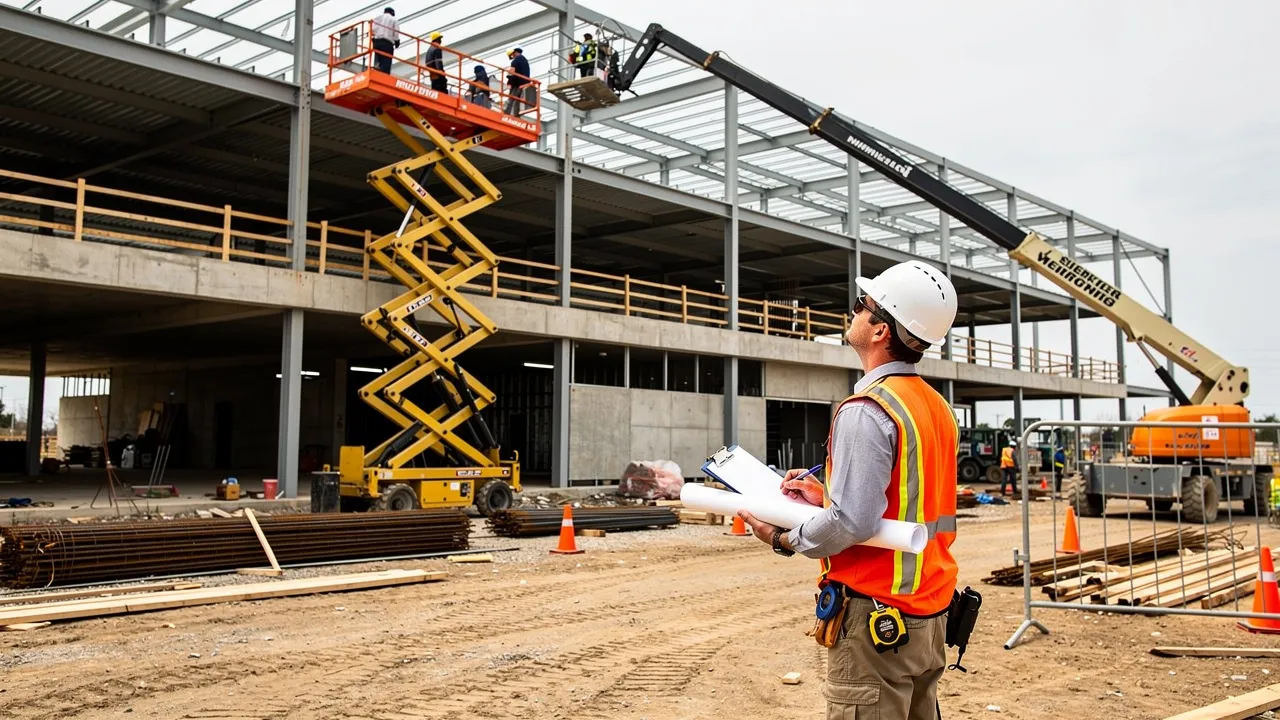
Start with the access question
An elevated-access decision for an Irving or DFW construction project starts with the task’s geometry, not with a machine name. A scissor lift raises a work platform primarily straight up and down, giving workers elevated access. Working height, overhead clearance, ground conditions, platform space, and the weight of people and tools also affect the fit.
Your first question is simple: does the work move upward from a stable position, or must the platform reach around, over, or beyond something? That distinction narrows the conversation before you ask about a specific unit.
Your project fit screen should capture five facts before you make a local rental inquiry:
- Access direction: Record whether the work is primarily straight upward or requires lateral reach.
- Reach requirement: Identify the actual work height and whether an obstacle separates the machine from the work area.
- Site envelope: Note entrances, travel paths, overhead clearance, and the surface where the equipment would operate.
- Platform demand: Count the workers and tools that must be on the platform, then compare that demand with the selected model’s rated capacity and workspace.
- Project setting: Separate interior work from exterior work and describe the ground conditions rather than assuming one category fits both.
This list gives you a focused starting point. It does not select a model by itself; specific equipment specifications still need confirmation when the project facts are uncertain.
What a scissor lift is designed to do
A scissor lift raises a work platform primarily straight up and down through crossed beams that operate in a scissor-like pattern. That movement gives you elevated access while keeping the platform’s path mainly above its base. OSHA describes this equipment as a work platform used to move workers vertically and to different locations across industries that include construction, retail, entertainment, and manufacturing.
For a construction project, the useful starting point is the relationship between the platform and the work face. If your crew needs to work above a slab, floor, or other accessible position, primarily vertical movement may match the task. If the work face is offset from that position, vertical travel alone may not provide the approach you need.
Straight vertical access and accessible overhead installation are situations to consider for this category. Examples can include overhead installation, maintenance, or construction work where the machine can be positioned beneath the work area and the platform can rise toward it. The platform’s working space may also matter when your crew needs to carry tools or work alongside another person, but the available area and rated capacity are specific to the model.
EZ Equipment Rental lists boom lift and scissor lift rentals through its Dallas-area rental service, including equipment intended for different access requirements. That local category offering gives you a place to begin the conversation, not a reason to assume that every elevated task has the same fit. Describe the work position first, then ask which equipment category should be evaluated. That distinction also changes the information you should give a rental contact. A primarily vertical task has a defined equipment position: the machine can be placed below the work area, and the platform’s main movement is upward. An outreach task starts from a different condition: the machine may not be able to sit beneath the work, so the inquiry must describe the offset, obstacle, or exterior position. This does not make one category automatically suitable. It identifies the access question that needs model-specific review. If the platform must reach beyond the machine’s base, treat that geometry as a central requirement rather than a minor detail after choosing a scissor lift. Likewise, a larger platform workspace does not resolve a reach problem; workspace and access direction are separate fit questions. Where the work point changes during the project, record each distinct position rather than summarizing the whole job as overhead work. Different positions can create different access geometries, even when the project uses one general equipment category.
Screen the work envelope before the machine
A construction work envelope is the combination of the work position, required reach, available space, surface, and load. Define that envelope before comparing machines so the equipment discussion follows the project rather than the other way around.
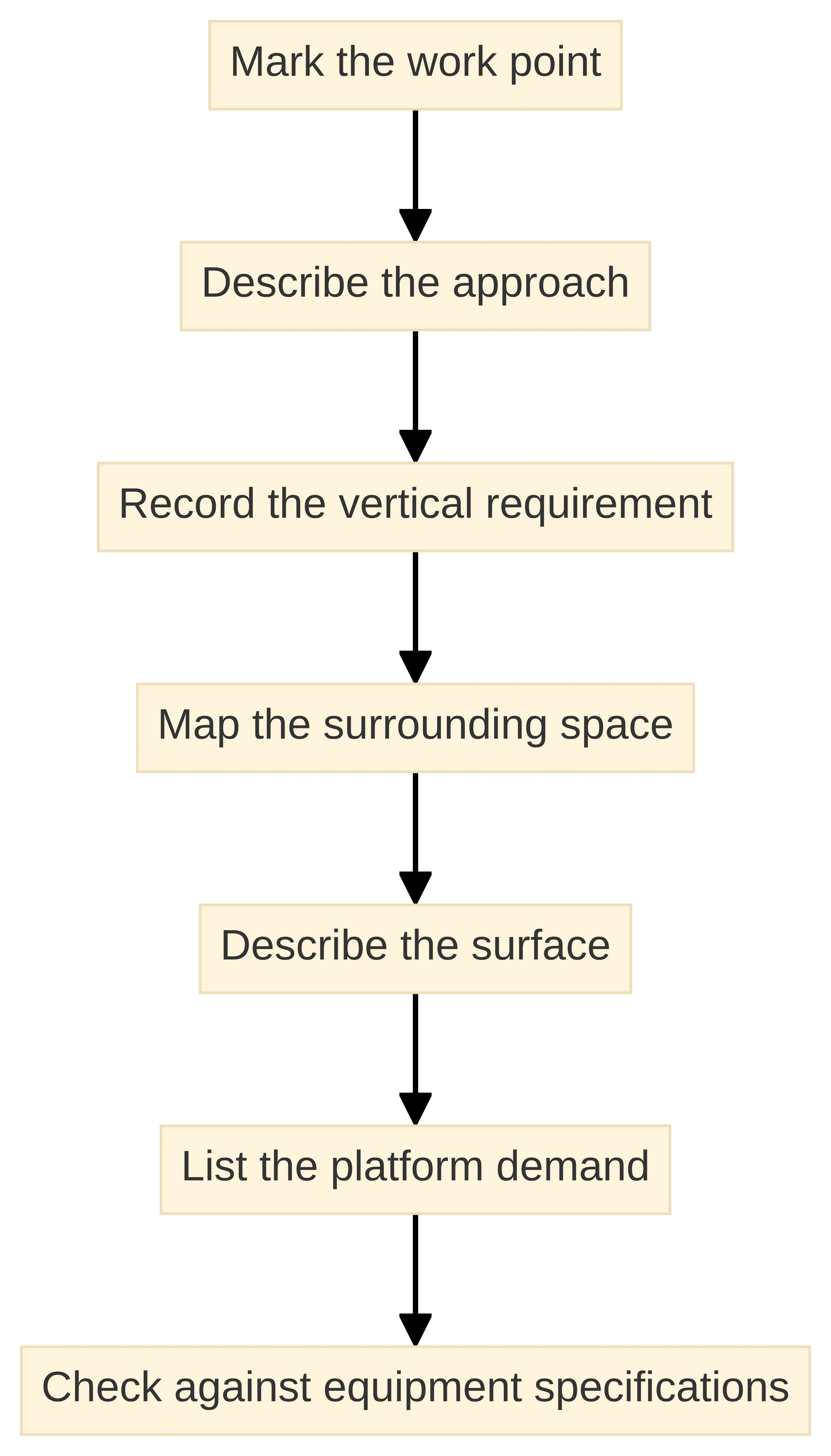
Use this sequence:
- Mark the work point. Identify the exact area where your crew must perform the task.
- Describe the approach. State whether the platform can sit directly below the work or must approach from the side or beyond an obstacle.
- Record the vertical requirement. Measure the height the workers must reach and distinguish that from the machine’s platform height.
- Map the surrounding space. Note overhead obstructions, entrance restrictions, travel paths, and operating clearance.
- Describe the surface. Identify whether the work is inside, outside, on a finished floor, or on another surface whose suitability needs confirmation.
- List the platform demand. Record the number of workers, tools, and materials that would occupy the platform.
This sequence creates a project description that can be checked against actual equipment specifications.
Your priorities should follow the work envelope. Required working height and overhead clearance come before a preference for a particular power source. Ground conditions and travel space matter before you assume that an indoor-oriented or outdoor-oriented configuration will work. Worker and tool demand matters before you treat a larger platform as interchangeable with a higher platform.
When elevation or reach is uncertain, confirm the specific equipment specifications before selecting a lift. Equipment category names are useful for narrowing the inquiry, but they do not replace model-level information about dimensions, capacity, workspace, or operating surfaces.
A useful planning distinction is category fit versus model fit. Category fit asks whether primarily vertical access appears appropriate. Model fit asks whether a particular unit can enter, position, rise, support the planned platform demand, and operate on the described surface. Keep those questions separate so an early category judgment does not become an unverified equipment selection. Reviewing the envelope in this order prevents one favorable fact from hiding a limiting fact. A required height that appears achievable does not show that the machine can pass through the entrance. A clear route does not establish that the intended surface is suitable. A platform that can accommodate the planned workers and tools does not show that the work point is directly above the machine. Treat each item as a gate in the conversation: establish the approach, verify reach and clearance, then compare surface, workspace, and rated capacity at the model level. If any gate is unknown, label it as an open question in the inquiry rather than filling the gap with a general category assumption. This makes the brief useful even when the final equipment choice remains unresolved.
Separate vertical access from horizontal outreach
A vertical-access-versus-outreach decision depends on how the platform must reach the work. Both categories provide elevated access, but their platform movement and working configurations differ.
| Project condition | Category to evaluate | Why the condition matters |
|---|---|---|
| Work directly above the machine | Scissor lift | Primarily vertical platform movement may match straight-up access. |
| Accessible overhead installation | Scissor lift | Direct vertical access may be appropriate when the machine can be positioned below the work. |
| Substantial horizontal outreach | Boom lift | A boom-supported platform may provide the positioning that vertical movement cannot. |
| Work beyond a fixed obstacle | Boom lift | The obstacle may require an offset approach rather than movement straight upward. |
| Exterior work at an offset location | Boom lift | Outreach may be necessary to reach the work face. |
| Restricted entrance | Either, depending on model | Actual machine dimensions and operating clearance determine whether a category can enter and work. |
The table is a screening aid, not a model selection. Evaluate a boom lift when the task requires significant outreach or access beyond an obstacle instead of assuming that a vertically rising platform will fit.
Your access description should use a direct sentence: “The work is located directly above the machine,” or “The work is beyond an obstacle and requires horizontal outreach.” That distinction gives a rental conversation a usable starting point. If you cannot describe the approach clearly, pause the category choice and confirm the site geometry and equipment specifications before moving forward.
For an Irving interior renovation, the first description may be enough to begin evaluating vertical access. For exterior work on a DFW site where the work face sits beyond a structure, roof edge, or other fixed obstruction, the second description points toward a different conversation. The location does not decide the category; the required approach does.
Check height, clearance, and platform needs
A height-and-clearance check separates the place where the platform stops from the height your workers must reach. One equipment guide describes working height as platform height plus approximately six feet to account for the workers. Use that description as a planning reference, then confirm the selected model’s actual specifications rather than treating the approximation as a universal equipment rating.
Record these details for your Irving or DFW project:
- The height of the work surface or installation point.
- The height your workers need to reach while performing the task.
- Any overhead structure, piping, framing, lighting, or other obstruction.
- The clearance available above and around the machine’s intended position.
- The distance between the equipment position and the work face.
The purpose of this record is to expose a mismatch early. A platform that reaches the required elevation may still fail the project if the machine cannot enter, position, or operate within the available clearance.
Platform demand is a separate check from elevation. If multiple workers or tools will be on the platform, compare the selected model’s rated capacity and available workspace because both characteristics are model-specific. Record the number of workers, the tools they expect to carry, and any materials that must be present during the task.
A restricted entrance also requires actual machine dimensions and operating clearance, not a category assumption. Measure doorways, gates, aisles, and the intended travel path where those constraints apply. Give those measurements to the rental contact as project facts that need confirmation. Do not substitute a general platform description for the dimensions and capacity of the model under consideration.
Treat height and clearance as linked but separate questions. A route may allow the machine to reach the work area while an overhead obstruction limits the platform’s usable travel. Conversely, an open ceiling may provide vertical room while a doorway or aisle prevents the machine from reaching the intended position. Record both conditions.
Match the lift to the Irving or DFW jobsite
An Irving or DFW jobsite should be described by its setting rather than by city name alone. State whether the work is inside a building, on a finished surface, in an open exterior area, or on ground whose condition requires confirmation. The setting affects the lift type’s design, capabilities, maneuverability, and suitable operating surfaces.
The cited equipment guidance describes electric models as generally more compact, often equipped with non-marking tires, and suited to indoor use because they produce no exhaust emissions. Outdoor models are usually labeled rough-terrain models; most are diesel-powered, although some rough-terrain models are electric. These descriptions help you frame the question, but they do not establish that a particular unit fits your surface, access route, or work conditions. Power source and site setting should be discussed together, not as a standalone preference. For interior work, the cited guidance describes electric models as a category to evaluate because they are generally compact, often have non-marking tires, and produce no exhaust emissions; the actual model and site conditions still need confirmation. For exterior work, a rough-terrain label makes surface and maneuverability important parts of the review, while the cited guidance notes that most such models are diesel-powered and some are electric. Use these distinctions to formulate questions about the jobsite, not to infer a specification, availability, or permission to operate. In DFW, naming the city helps locate the project, but describing the entrance, finished floor, open area, or challenging ground supplies the facts relevant to equipment fit. If a project has indoor and outdoor phases, describe each work area separately; a category that appears suitable for one setting should not automatically be carried to the other.
Your local jobsite screen should include:
- City and site type: Name Irving, Dallas, Fort Worth, or the relevant DFW location, then describe the work area.
- Entry route: Record the entrance, path, and clearance that the equipment must pass through.
- Operating surface: Describe the surface and any uneven or challenging ground that requires a verified model and surface review.
- Work position: State whether the platform can be placed directly beneath the task.
- Environment: Identify interior or exterior work and any need to consider emissions, noise, or tire marks as part of the project discussion.
This information helps distinguish a category that appears relevant from a model that still needs technical confirmation. Keep the location specific so the rental inquiry can address the actual DFW jobsite rather than a generic project.
A downtown Irving interior project may present different entrance, surface, and clearance questions from an open exterior site in Fort Worth or Mesquite. Use the same screen for both, but describe the conditions precisely instead of relying on the city label as a substitute for site information.
Know when a scissor lift may not fit
A lift may not fit when the work requires more than primarily vertical movement or when the site conditions exceed the category’s confirmed operating envelope. Use these boundaries to decide whether to continue with the category or change the question.
- The work is beyond an obstacle: Evaluate a boom lift because substantial horizontal outreach may be required.
- The work is offset from the machine position: Describe the distance and approach instead of assuming that platform height solves the access problem.
- The entrance or travel path is restricted: Compare actual machine dimensions and operating clearance; either category may fit depending on the model and site.
- The ground is uneven or challenging: Do not infer surface suitability from the category name. Request confirmation for a suitable verified model and its surface requirements.
- The elevation or reach is uncertain: Confirm specific equipment specifications before selection.
- The platform will carry several workers or tools: Compare rated capacity and available workspace for the selected model.
Each branch ends with a different action: evaluate another category, measure the site, or obtain model-specific confirmation.
Your decision boundary is reached when you cannot state the access direction, required reach, entrance conditions, surface, or platform demand with enough clarity to compare equipment. At that point, do not turn an uncertain category into a rental assumption. Assemble the missing measurements and ask for the equipment assessment needed to resolve the uncertainty before selecting a lift.
A different category is not automatically the answer either. A boom lift may address outreach, but the selected model still has to match the route, surface, working height, and platform demand. Change the question when the access geometry changes, then run the site facts through the new category rather than transferring the original assumption.
Keep safety and professional assessment separate from fit
A category match does not establish that a worker may operate the equipment or that the jobsite controls are in place. OSHA’s hazard alert says employers using scissor lifts should assess the worksite, select appropriate equipment, and address fall-protection, stabilization, and positioning hazards.
The same alert states that only trained workers should use this equipment and that employers should ensure those workers can use it properly. It also identifies following the manufacturer’s instructions, maintaining the equipment, providing needed personal protective equipment, and implementing safe work practices as part of safe use. Those responsibilities belong in the project’s safety and operating process, separate from the initial equipment-fit screen.
Your fit screen answers a limited planning question: whether the project’s access geometry and site conditions appear to point toward this equipment category or another category. It does not establish operating permission, worker readiness, site controls, or suitability for a particular task.
Use the planning record to communicate the work envelope, then keep the employer’s worksite assessment and trained-worker requirements in the operating process. If the access path, surface, load, or reach remains uncertain, stop at the boundary and obtain the required equipment and site assessment rather than treating a general category as a final decision.
Keeping these decisions separate makes the inquiry clearer. Your rental brief can describe the task and site; the employer’s safety process and the applicable equipment instructions govern whether and how trained workers may use the selected unit.
Assemble a rental-ready project brief
A rental-ready project brief turns your access question into information that can be checked against equipment options. Keep the brief concise but specific:
- Project location: Name the Irving or DFW city and identify the jobsite setting.
- Primary task: Describe the installation, maintenance, or construction work at the elevated location.
- Access geometry: State whether the work is directly overhead, offset, beyond an obstacle, or dependent on horizontal outreach.
- Required reach: Provide the work height and the working-height information you are using as a planning reference.
- Clearance and route: List entrance dimensions, travel-path restrictions, overhead obstructions, and operating clearance.
- Surface: Describe the interior or exterior surface and any uneven or challenging ground.
- Platform demand: Record worker count, tools, materials, required workspace, and the work’s weight requirements.
The brief is a communication tool. It does not replace confirmation of model specifications or a worksite assessment.
Your inquiry can then ask focused questions rather than requesting a generic elevated-access machine:
- Does a platform with primarily vertical movement match the described access geometry?
- If the work requires outreach or access beyond an obstacle, which category should be evaluated instead?
- Which model specifications need confirmation for the required height, clearance, surface, capacity, and workspace?
- Does the entrance and travel path match the actual machine dimensions and operating clearance?
Bring the answers back to the project brief. If a key fact changes—such as the work point, route, surface, or number of workers—recheck the fit instead of carrying the original assumption forward.
Before sending the inquiry, read the brief as if someone unfamiliar with the project had to understand the access problem. If the description says only “overhead work,” add the work position, route, height, clearance, and platform demand. If it says only “outdoor job,” add the surface and approach conditions. Specific facts make the category question easier to evaluate. Ask for an answer that separates three outcomes: a scissor-lift model appears worth evaluating, a boom lift or another category should be considered because of the approach, or the available information is insufficient until dimensions, surface conditions, or load details are confirmed. This keeps the inquiry from becoming a request for an unspecified machine. Include the same facts for each work area if the project spans more than one setting, and identify which measurements are estimates and which still need verification. The goal is not to make the rental contact responsible for the employer’s safety process; it is to give the equipment conversation enough context to identify the specifications and open questions that must be resolved before selection. A focused brief also makes the inquiry easier to revise if the work point, access route, surface, or platform demand changes.
Use EZ Equipment Rental for the local inquiry
We are located in Irving, Texas. We serve multiple locations across the Dallas–Fort Worth Metroplex, including Irving, Dallas, Fort Worth, Grand Prairie, Mesquite, Garland, Plano, Richardson, Arlington, Carrollton, DeSoto, Euless, Grapevine, Lewisville, Mansfield, South Fort Worth, Duncanville, Bedford, Farmers Branch, Oak Cliff, Coppell, Lake Dallas, and Watauga.
Your prepared brief gives the local conversation a clear starting point: identify the work position, separate vertical access from outreach, describe the route and surface, and list the height and platform demands that require confirmation. We provide personalized recommendations based on your specific needs and budget, so include those project facts rather than relying on a category name alone.
Your next practical step is to send the completed brief so the access question can be matched with the equipment information that still needs confirmation.
Sources
- Scissor Lift vs Boom Lift: Key Differences Explained — avanzaequipment.com
- Boom lift & scissor lift rentals Dallas TX, Where to rent boom lift & scissor lifts in Dallas, Irving, Grand Prairie, Mesquite, Garland, Plano, Richardson, and Fort Worth TX — www.ezequipmentrental.com
- Working Safely with Scissor Lifts — www.osha.gov
- How to Choose the Right Scissor Lift — www.hercrentals.com
- Cargo Trailer Rental Dallas, TX | Rent Cargo Trailers | Equipment Rental Trailer
- Equipment & Tool Rentals in Dallas TX - EZ Equipment Rental