
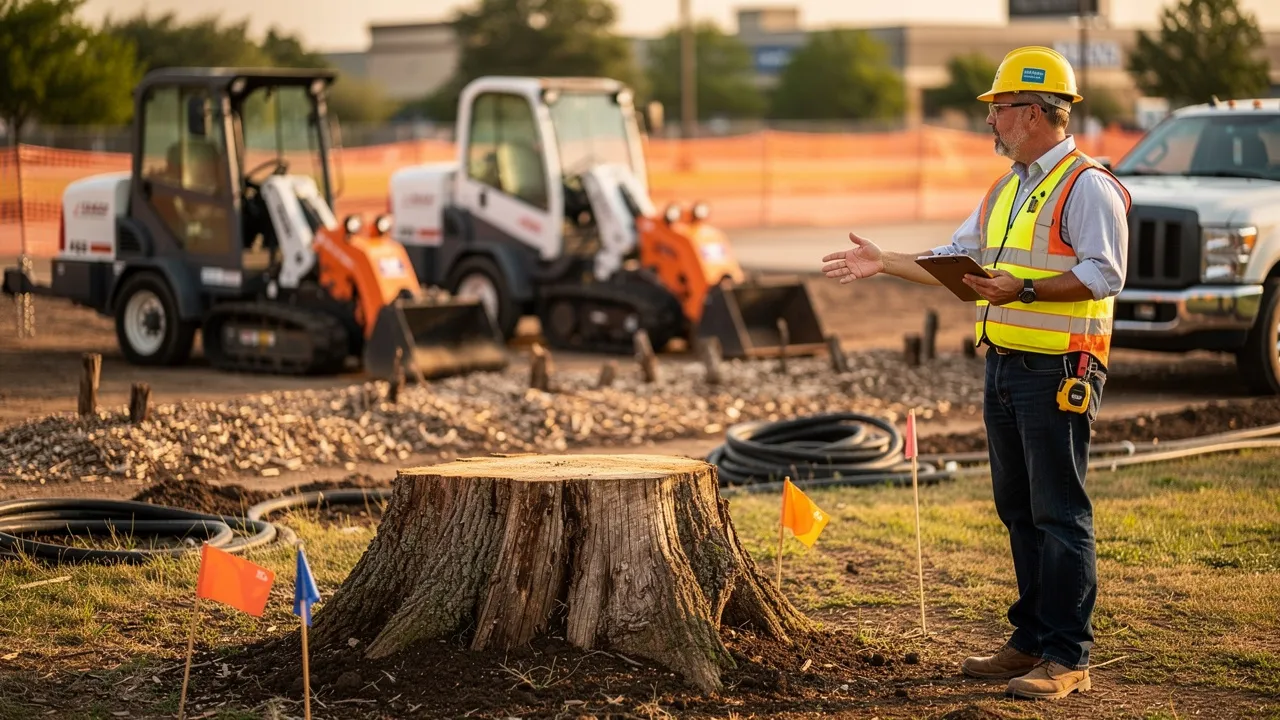
Define the site outcome before considering a rental
A stump grinder rental fits your Irving or DFW project only if grinding can meet the site outcome you need and a provider confirms equipment suitable for the job. Start with the finished condition—not with a machine category or an assumed rental. Do you need to reduce the stump, clear an area for follow-on work, or achieve a different result? Write down what must be true when the work is complete. If the project calls for a result beyond grinding, settle that difference before treating a grinder rental as a fit.
Your project record can establish whether a rental is worth discussing, but it cannot establish current inventory, machine dimensions, pricing, delivery options, or rental conditions. Those details need confirmation from the provider. This distinction matters on a construction schedule: a plausible equipment match is not a confirmed rental arrangement. Use the guide below to describe the stump work and site, then keep the decision open until the provider responds to those specifics.
Your Irving or DFW site conditions should shape the questions you ask. A stump near a gate, building, active work area, or constrained route raises different access questions from a stump in an open work area. Treat those as possibilities to check on your own site, not assumptions about the region. Your aim is to give the provider an accurate picture of the work area, the route to it, and the result the project requires.
Decide whether grinding meets the removal scope
Stump grinding reduces the wood reached by the cutter wheel; it does not automatically extract the entire stump and its root system.
Root grinding is a separate scope decision subject to equipment limits and site conditions. If your specification, follow-on work, or handoff requires attention to roots, describe that requirement separately when you discuss the job. Do not treat the phrase “stump grinding” as confirmation that root work is included.
Grinding does not guarantee that no shoots will return. If the project requires a particular long-term condition, state that outcome explicitly and ask whether the proposed scope addresses it; do not assume grinding alone settles that question.
Your scope decision can be straightforward: if reducing the stump is the required result, continue assessing the workload and site; if the required result includes complete stump or root extraction, ask about that difference before proceeding with a grinder-only inquiry. If you cannot yet define the finished condition, clarify it with the project team first. That keeps the equipment conversation tied to the actual deliverable rather than to a vague request to “remove a stump.”
Document stump size, height, condition, and workload
Your stump inventory gives a rental provider the basic workload to discuss. Record the number of stumps and, for each one, estimate its diameter and height; note the wood condition and whether the stumps are clustered or spread across the work area. If you have several stumps, identify any that differ substantially from the rest. A single average can hide the largest or most demanding item in the job.
Diameter is one dimension the provider can use when discussing equipment fit. Give the provider the largest stump measurement and ask what equipment class could address it.
Taller stumps need grinders with deeper cutting capacity. Include height alongside diameter so the equipment discussion accounts for both measurements.
Hardwoods like oak require more horsepower, while older, rotted stumps are easier to cut. If you know the species or can describe the wood condition, include that information; if you are uncertain, label the detail as an estimate instead of presenting it as confirmed.
A few stumps can be managed with small grinders, but forestry work with many stumps requires larger, more powerful equipment. The number of stumps therefore belongs in the equipment conversation alongside the size and condition of the largest ones. Avoid converting a general workload comparison into a specific capacity promise: ask the provider to assess your actual count and stump dimensions.
Your notes should keep separate facts separate: a larger diameter, greater height, harder wood, and a high stump count are different details, not substitutes for one another. Send the measurements and descriptions together. If your measurements are approximate, say so and ask which dimensions the provider needs before discussing a suitable machine. The purpose is to support a project-specific equipment conversation, not to select a model from a measurement alone.

Check access and site conditions against possible machine fit
Your access notes should describe the route a machine would need to take from the site entrance to the stump. Record gate openings, narrow passages, turns, overhead constraints, and any point where the route changes surface or slope. Include measurements where you have them, and label anything you have not measured. A clear route description gives the provider something concrete to compare with equipment dimensions and access requirements.
Your work-area notes should identify the stump’s position relative to nearby structures, boundaries, active work, and other constraints that could affect maneuvering. Describe whether the ground is sloped, uneven, or otherwise different across the route and work area. These are site facts to report, not a conclusion that a specific machine can enter or work there. Ask the provider to consider the described conditions when discussing possible equipment.
Stumps on slopes or in tight areas are best handled with smaller, maneuverable machines. Use that as a prompt to raise slope and clearance constraints with the provider, not as a stand-alone machine recommendation. A machine’s dimensions and suitability for your particular access route still need confirmation.
Your site brief should state the utility-locate status for the work area, using a clear label such as completed, pending, or unknown, and identify who is coordinating that item. This records a project condition for the conversation; it does not determine whether the site is ready for work. Keep the status distinct from equipment sizing so neither you nor the provider has to infer it from a route description.
Your access record is more useful when it distinguishes measured facts from open questions. For example, report a measured gate width as a measurement, but mark an unmeasured overhead clearance as unknown. Ask which dimensions or site details the provider needs to assess access. If a route, slope, or working-area constraint has not been assessed, make that boundary explicit rather than treating an unconfirmed fit as settled.
Compare the project workload with crew resources and timing
Your work window and your rental window are related but separate planning details. Estimate when the work is expected to begin, how much time the project has set aside for it, and when the equipment would need to be on site. Then state the rental period you want to ask about. A provider can discuss whether the requested dates and period are available; your estimate alone does not establish a booking or a rental duration.
Your workload description should combine the stump count, range of dimensions, wood condition, and how the stumps are distributed across the site. Note whether the task is limited to a few identified stumps or forms part of a larger clearing scope. That distinction helps frame the equipment question without assuming that one machine or rental period will suit every workload.
Your crew plan should identify who would be involved, what relevant equipment experience is available, and what project resources are allocated to the work. Do not use the word “experienced” as a substitute for confirming any operator conditions that apply to a particular rental. Ask the provider what operator requirements, if any, are part of the rental arrangement, and keep your own staffing decision within your organization’s responsibilities.
Your schedule can expose a mismatch before you make a commitment. If the site will not be ready when the equipment is expected, if the work window is uncertain, or if the requested rental period does not cover the planned work, resolve that uncertainty in the inquiry. Ask how the quoted rental period is defined and what process applies if your schedule changes. Do not assume an extension is available or that an estimated end time matches the provider’s rental terms.
Your project is ready for a rental discussion when you can describe the required result, the stump workload, the site constraints, the crew context, and the expected dates. If key details remain uncertain, identify those gaps and ask what information is needed to continue. If the work is much broader than the stump list you have documented, update the scope before asking for an equipment match. This keeps a short work window from becoming a substitute for a clear workload description.

Prepare a site-work brief for the rental inquiry
Your site-work brief should put the outcome, stump inventory, access, schedule, and open questions in one place. Use this checklist to turn your project notes into a concise provider inquiry:
- Required outcome: What finished condition does the project need, and is the request for grinding, root work, or another scope?
- Stump workload: How many stumps are involved, and what are the estimated diameter, height, and wood condition of each or of the largest examples?
- Site route: What gate, passage, overhead, turning, slope, or surface constraints occur between the entrance and the work area?
- Work area: Where are the stumps in relation to structures, boundaries, and other site constraints?
- Utility-locate status: Is the status completed, pending, or unknown, and who is coordinating it?
- Work plan: What dates and work window are planned, and what rental period do you want to discuss?
- Crew context: What relevant experience and project resources are available, and what operator conditions need clarification?
- Transport constraints: What access, timing, or haulage details may affect getting equipment to or from the site?
- Open questions: Which measurements, site conditions, or scope details still need confirmation?
Your measurements and workload notes should lead to questions, not an unsupported model choice. For example, ask whether a possible machine’s dimensions can pass along the described route.
Your inquiry can be brief without leaving out decision-making details. State the site location in Irving or elsewhere in DFW, the intended outcome, the stump count and approximate dimensions, the main access constraints, and the dates and rental period you want to discuss. Then list any unknowns as questions. A specific brief makes it easier to address the project you have, while leaving suitability and availability for the provider to confirm.
Confirm availability, charges, logistics, and return obligations
Your rental inquiry should treat availability as unconfirmed until the provider confirms the requested dates and equipment. Ask which machine or machine class is available for those dates, what its relevant dimensions are, and whether any attachments or other items discussed are included. If the confirmed unit differs from the one discussed, revisit the route and site details before treating the fit question as resolved.
Your price comparison should use the same rental period and the same stated scope for each quote. Ask for the daily and weekly rate options that apply to your requested dates, how the rental period is counted, and what charges are included or may be added. Ask whether transport, fuel, cleaning, deposits, taxes, or other fees apply, rather than assuming any of them are included or excluded. Request the total quoted amount and the conditions attached to it; do not compare a headline rate with a quote that covers a different period or scope.
Your schedule questions should cover what happens if the work starts late, runs beyond the planned period, or needs a different return time. Ask whether an extension can be requested, how it is approved, and how any change affects charges. Confirm the provider’s process for changing or cancelling the request as well. These are questions for the actual rental terms; no estimated work window can answer them for you.
Your transport plan should state whether you are asking about delivery or pickup and what the site can accommodate. Ask whether the requested option is available for your location and dates, what charges and timing apply, and what transport requirements or responsibilities fall to you. Include the route and access measurements from your site brief. Do not assume that equipment can be delivered to a particular point or that the delivery arrangement includes moving it through the site.
Your return plan should be based on the provider’s stated conditions. Ask about the return deadline and location, the condition expected at return, and any fueling, cleaning, inspection, or late-return requirements that apply. Have the provider distinguish which items are required from which are optional or chargeable. Record the answers with the quote so your project team can plan around the actual arrangement rather than a customary practice you may have encountered elsewhere.
Your equipment discussion should include a question about what operating information, orientation, or safety materials are supplied and what conditions apply to the person using the machine. Treat the provider’s answer and any applicable professional guidance as separate from the rental price. This guide does not provide operating instructions; keep that question with the people responsible for the site and equipment.
Use confirmed project details to choose the next step
Your next step depends on the required outcome and the provider’s confirmation. If grinding matches the project scope and the provider confirms suitable equipment, dates, and terms, proceed with the rental discussion; if the scope requires full stump or root extraction, revisit the work plan instead of assuming grinding includes it. Root grinding remains a separate scope decision subject to equipment limits and site conditions.
A qualified professional should decide any site-specific operating or safety questions. Keep your inquiry focused on the facts you have assembled and the items that still need confirmation. If equipment fit, scope, timing, or terms remain unresolved, keep the decision conditional.
What should you confirm before renting a stump grinder?
How much does it cost to rent a stump grinder in Irving or DFW?
Ask the rental provider for a current quote covering your dates and requested rental period, and clarify how the period is counted, the total charges, and whether transport, fuel, cleaning, deposits, taxes, or other fees apply.
Does stump grinding remove the roots too?
Not necessarily. Grinding reduces the wood reached by the cutter wheel; it does not automatically extract the entire stump and root system. Treat root grinding as a separate scope question, and state the required finished condition when discussing the job.
What information should I give a provider when asking about a stump grinder rental?
Share the intended result, stump count, estimated diameter and height, wood condition, access route and work-area constraints, utility-locate status, planned dates, and rental period. Include transport constraints and crew context, and label measurements or conditions that are still unknown.
What should I confirm before agreeing to the rental?
Confirm that the equipment and dates are available and ask about relevant machine dimensions, rental-period rules, total quoted charges, pickup or delivery arrangements, transport requirements, and any extension process. Also clarify operating information and the provider’s fueling, cleaning, inspection, and return conditions; do not assume these are included.
Can grinding prevent shoots from returning?
Grinding does not guarantee that no shoots will return. If the project requires a particular long-term condition, describe that requirement separately and ask whether the proposed scope addresses it.
Sources
- Stump Grinder Access Requirements: Gates, Travel Routes, and Working Space — www.farmry.com, 2026-09-25