
Can you rent a tree shredder?
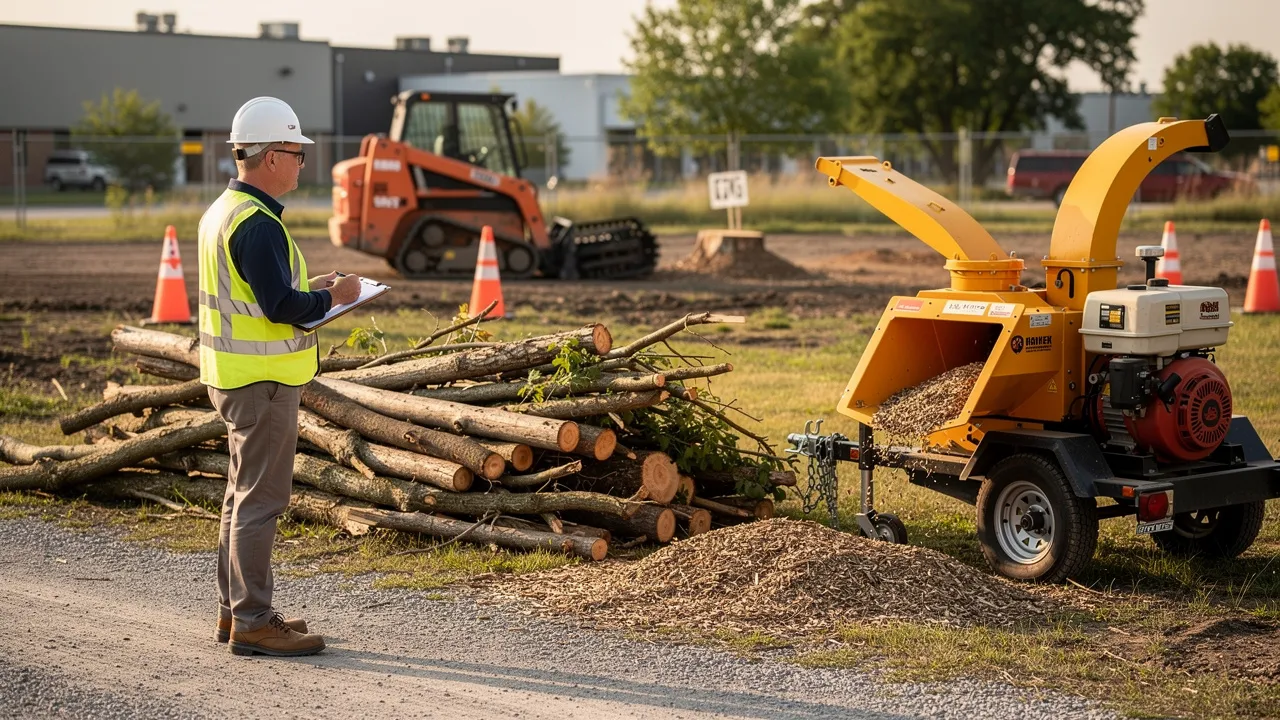
Wood and brush chippers are a rental-equipment category for tree care and land clearing. Sunbelt Rentals describes them for those uses, including commercial landscaping and grounds maintenance. So renting this type of equipment is an option in general, but that does not establish current availability, specifications, or rental terms for a particular Irving or DFW job.
A tree-shredder rental is worth exploring when your work includes processing cut branches or brush, but the category alone cannot settle whether a particular machine fits your job. Start with the material you need to process and what you want to do with the output. Then consider the amount of material, the largest pieces, and how equipment would reach the work area. A provider needs those details to discuss a possible fit and confirm what is available for your dates.
Use this guide to prepare that conversation. You will distinguish a chipper from a mulcher, separate branch processing from stump work, and organize the site and rental questions that remain open before you commit.
Choose equipment by the material and the result you need
Your material and intended output form a practical first screen. Woodland Mills says a wood chipper is more suitable for larger branches, tree limbs, or substantial woody material, while a mulcher is a better choice for leaves, small twigs, and softer garden waste. It also connects the equipment choice to the kind of material you want afterward:
| Project factor | Wood chipper | Mulcher |
|---|---|---|
| Material | Larger branches, tree limbs, or substantial woody material | Leaves, small twigs, or softer garden waste |
| Intended output | Larger wood chips for pathways or deep mulching | Finer mulch for garden beds or composting |
If your DFW clearing pile contains a mix, describe that mix instead of requesting a machine by name alone. Woodland Mills also advises considering property size, typical green waste, and the intended use of the processed material. Those details can help you explain the project; the provider still needs to confirm whether any available equipment fits it.
Your material inventory can be brief and still useful. Note whether the pile is mostly branches and woody material, mostly leaves and softer debris, or a combination. Describe whether the branches are already cut and whether a few larger pieces stand out from the rest. Estimate the amount you expect to process, and say whether you plan to use the output on site, move it elsewhere, or have not decided yet.
If your material and intended output seem to point toward different equipment categories, raise that mismatch in your inquiry rather than choosing by assumption. Your goal is to describe the work clearly enough for the provider to discuss a suitable option—not to select equipment from a label before the details are considered.
Treat the output plan as a separate part of the scope. If chips or mulch will be moved or used elsewhere on the site, identify the intended destination and whether that task is part of your plan; the equipment category by itself does not establish that handling or transport is included. If you have not decided where the processed material will go, state that as an open question. This prevents a rental-fit discussion from silently standing in for a material-handling plan.
Keep branch chipping separate from stump grinding
Your clearing scope should list branch and brush processing separately from any stump work. A request to process cut material does not explain what you want done with stumps left in place, so do not assume that one task or rental arrangement covers both. State which parts of the site work are included before discussing equipment.
Write down which of these apply:
- Processing cut branches or limbs.
- Processing brush, leaves, or other smaller material.
- Addressing stumps that remain on the site.
- Collecting, using, or moving the processed material.
This list describes your requested work; it does not establish that one machine or rental arrangement covers every item. Ask the provider which parts of your scope the equipment under discussion is intended to address. If stump work is included, ask about it as a separate task and keep the answer distinct from the branch-and-brush equipment discussion.
Your task wording matters when a site plan combines several kinds of work. “Clear the trees” can leave open whether you mean cutting, processing branches, handling stumps, or moving the resulting material. Replace broad shorthand with a short list of tasks and identify anything that is not part of the rental question.
If you coordinate a crew or subcontractors, use the same scope description in your equipment inquiry and work plan. Ask the provider to identify any part of the requested work that the proposed rental does not address. Keep unanswered tasks out of your assumptions; treat them as separate scope questions until you know what the rental arrangement covers.
Describe the largest material and total volume before discussing capacity
Your largest branch and the total amount of material are separate details to report. Note the approximate largest diameter you expect, then describe the overall volume in a way you can explain consistently—for example, by the number and general size of piles or the area the material comes from. Label estimates as estimates. You are not expected to turn them into a machine specification; use them to give the provider a clear description of the work.
Also describe how consistent the pile is. Mostly small branches with a few larger pieces is a different material profile from a pile where large branches are common. Say whether the larger pieces are occasional or frequent, and ask what else the provider needs to know about the mix. If you cannot estimate a dimension confidently, say so rather than presenting a guess as a measured limit.
A rough volume description can still be concrete. You might explain how many piles there are, where they sit, and whether they are roughly similar in size. If you do not have a useful estimate yet, note what you still need to assess at the site. That gives you a clear follow-up task without making an unsupported capacity assumption.
A capacity label does not describe every condition of your pile. Rntr says a 6-inch wood chipper handles branches up to 6 inches in diameter, and says that a 6-inch chipper will move through material quickly when the project material is mostly under 4 inches. Rntr describes commercial 12-inch brush chippers as built for high-volume professional work, accepting branches up to 12 inches in diameter and using diesel engines in the 60-to-100-horsepower range.
Those descriptions are examples, not confirmation of a local rental, a production rate for your job, or availability on your dates. Use them as a reminder to describe both the largest pieces and the amount of material. Ask the provider to confirm the specifications of any actual unit under consideration and whether those specifications fit the job you described.
Your capacity question should connect the equipment discussion to your material: “Here is the largest branch I expect, the usual size range, and the estimated amount. What available equipment should I compare with that?” Then ask what limits or operating requirements apply to the specific unit. If the answer depends on details you have not supplied, find out what information is needed before treating the equipment as a fit.
Check the route from delivery point to the work area
Your job address is only one part of the access picture. Describe where equipment could arrive, how it would get to the work area, and where branches or brush would be staged. For a project in Irving or elsewhere in DFW, include the actual site conditions you know rather than assuming that the address alone tells the provider what the route involves.
Before contacting a rental provider, make a short access note that covers:
- The job address and the point where you expect delivery or pickup to take place.
- The route between that point and the work area, including gates, turns, or narrow sections.
- Any overhead clearance, surface, slope, or ground conditions you already know about.
- Where branches and brush will be staged in relation to the intended work area.
These details are not clearance standards. Ask what dimensions or site conditions need to be checked for the actual equipment and transport arrangement.
The route from the delivery point to the work area deserves its own description. If access depends on a gate being open, a particular area being clear, or another site condition, include it. You can then ask whether the proposed transport and equipment arrangement accounts for the route you described.
Keep site access and machine capacity as separate questions. A capacity specification that sounds relevant does not answer whether equipment can reach or be positioned at your work area. Ask the provider to address both. If an access detail is unknown, mark it as unconfirmed and ask what needs to be measured or described before you schedule the rental.

Verify timing, total charges, and operating requirements
Your work window and rental window are related, but they are not automatically the same. Give the provider your preferred dates and the period you expect the equipment to be on site. Ask whether equipment is available for those dates, what rental period applies, and how the start and return times are handled. If your schedule could change, ask how an extension or an early return would be treated instead of assuming either is included.
Ask for the complete price picture before you agree to an arrangement. Find out how the rental period is priced, what the quoted amount covers, and whether delivery, pickup, or other charges apply to your request. Ask what payment, deposit, or return conditions apply, if any. These questions do not assume a particular fee exists; they help you understand the terms for the dates and arrangement you are asking about. Get those details directly from the provider.
Your delivery or pickup preference affects the logistics you need to discuss. State which option you prefer, then ask what can be arranged for your location and dates. If you plan to collect the equipment, ask what transport requirements apply to the specific unit. If you prefer delivery, share the drop-off point and route details from the previous section. Treat the arrangement as a question to resolve, not as a feature to assume.
At EZ Equipment Rental, our guidance is that wood chippers require strict safety protocols, including operator training on proper feeding techniques and maintaining a safe distance from the infeed chute. Ask what training and operating requirements apply to the specific equipment you are considering, and what instructions you need before use. Follow the machine’s instructions and the provider’s directions; general category descriptions do not replace requirements for the actual unit.
Prepare a project brief for the rental inquiry
A concise project brief lets you bring equipment fit, site access, schedule, and rental terms into one conversation. Put the facts you know in one place and label estimates as estimates. Include:
Your project brief should cover these details:
- Location: The Irving or DFW job address, preferred delivery or pickup point, and route to the work area.
- Work scope: Whether you need to process branches, brush, or other material, and whether stump work is also part of the project.
- Material: The kinds of material, approximate amount, largest expected branch diameter, and whether the pile includes a wide range of sizes.
- Desired output: How you intend to use or move the processed material, or that you have not decided yet.
- Site access: Known gates, turns, overhead clearances, surface or ground conditions, slopes, and material-staging location.
- Schedule: Preferred rental dates, expected time on site, and any uncertainty in the work window.
- Logistics and terms: Whether you prefer delivery or pickup, and your questions about availability, rental period, complete charges, and applicable conditions.
- Operation: Your questions about the specific unit’s specifications, training, instructions, and safety requirements.
Your inquiry should ask four direct questions: Is equipment available for the dates you requested? What available unit, if any, matches the material and site details you described? What are the rental period, complete charges, and delivery or pickup arrangements? What operating and safety requirements apply to that unit?
If a detail is missing, say what you still need to determine. For example, explain that your largest branch size is an estimate or that the access route has not been measured. That is more useful than supplying a precise figure you cannot support. Keep the provider’s response tied to the project details you shared, and make a note of any question that remains unanswered.
Use the project details to get a confirmed next step
The rental category alone cannot settle whether a particular machine is available, fits your material, can reach your work area, or matches your schedule and budget. Your project brief narrows those questions; the provider’s answers determine what is available and which terms apply. Treat unanswered questions about capacity, access, charges, delivery, or operating requirements as unresolved rather than assuming the arrangement will work.
Submit your task list, material estimate, access notes, preferred dates, and open questions through the EZ Equipment Rental contact form.
What should you confirm before renting a tree shredder?
Can you rent a tree shredder for just one day?
A one-day rental may be an option, but the article does not establish a minimum rental period or current availability in Irving or DFW. Ask the provider whether your dates are available, how the rental start and return times work, and whether the quoted terms cover the time you need.
How much does it cost to rent a tree shredder in DFW?
No current rental price is established here. Request a quote for your dates and preferred delivery or pickup arrangement, and ask what the total covers and whether any additional charges or conditions apply.
What should you confirm if the site has tight access or difficult ground conditions?
Describe the route to the work area, including gates, turns, overhead clearance, slopes, and known surface or ground conditions. Ask the provider what measurements or site details are needed to assess the specific equipment and transport arrangement; do not treat a machine’s capacity rating as proof that it can reach or operate at the work area.
Sources
- Renting a Wood Chipper: Complete Guide | Rntr — rntr.com, 2026-06-23
- Wood Chipper vs Mulcher — woodlandmills.com
- Wood and Brush Chipper Rentals | Sunbelt Rentals — www.sunbeltrentals.com
- Clearing Land in Dallas? Wood & Brush Chipper Rentals Are the Efficient Answer