
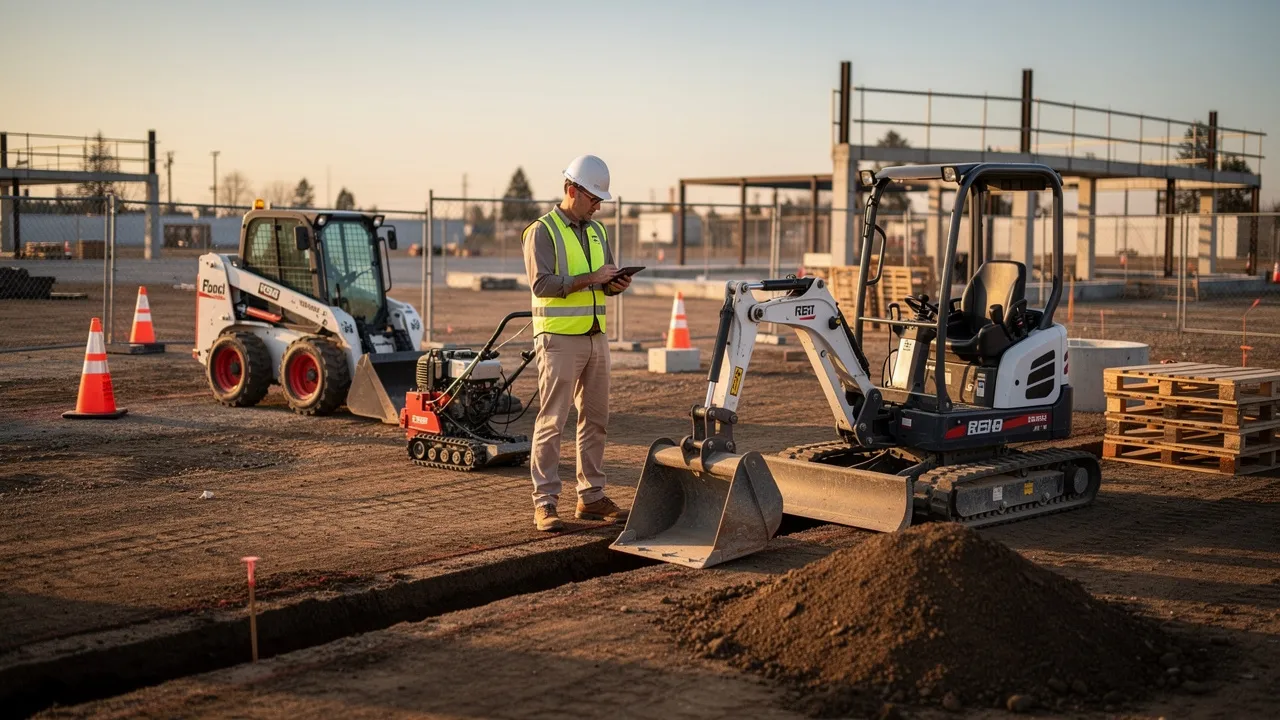
Map the Dirt-Moving Sequence
Begin with a movement map: note what must happen to the dirt, in what order, and where each load must go. Separate the cut, scoop, load, grade, and haul stages before comparing equipment; the sequence may show that one machine will not cover every stage.
Start by describing the movement that controls the job:
- Dig: You need to cut below grade, open a trench, excavate a footing, or reach into a hole. Begin with a mini excavator.
- Scoop and load: You need to gather loose dirt, load a truck, backfill, or move material across a work area. Begin with a compact loader or skid steer.
- Grade: You need to spread, level, scrape, or finish a surface. A skid steer or compact loader may fit the work better than a digging-focused machine.
- Haul: You need to carry loads repeatedly along a narrow route. Consider whether a mini dumper is more suitable than asking an excavator or loader to perform both excavation and transport.
A project that combines these movements needs a closer look. Digging a trench and then carrying spoil a long distance may create two separate equipment demands rather than one machine choice.
A grading task has a different shape from excavation. One guide estimates that grading a 500-square-foot backyard section typically takes 3 to 4 hours with a machine’s front backfill blade and bucket; that figure describes a specific backyard example, not a production promise for your site. For confined excavation, a compact excavator’s house and workgroup can rotate or slew 360 degrees, allowing the machine to work where a larger unit may not fit. A separate equipment description says that a mini excavator’s 360-degree rotation is crucial for precise work around utility lines or foundations, but utility conditions still require qualified site controls.
Use the task distinction before you compare rental categories. If the controlling need is below-grade digging, do not choose a loader merely because it can scrape or carry dirt. If the controlling need is repeated loading and grading, do not assume a mini excavator will be the most practical single machine.
Write the task in one sentence before you request equipment: for example, you might need to excavate a trench, place the spoil beside the cut, and then backfill it. That description separates digging, spoil handling, and backfilling, making it easier to identify whether one machine can cover the sequence or whether the work calls for separate equipment phases.
Assign a Machine Role to Each Stage
Use the movement map to assign each stage a machine role. Small earthmoving equipment can work in confined spaces and support digging, lifting, grading, trenching, and material handling through attachments, but the machine’s main operating pattern still governs below-grade digging versus loading, grading, and material travel.
Rental terminology varies: a skid steer commonly refers to a wheeled compact loader, while a compact track loader is the tracked configuration of a similar loader design. Confirm whether the specific unit has wheels or tracks because that affects ground pressure, traction, speed, and suitable surfaces.
| Machine category | Work it generally suits | Main boundary to keep in view |
|---|---|---|
| Mini excavator | Digging, trenching, excavation, and reaching below grade | It is primarily a digging machine rather than a general loading and grading machine |
| Skid steer | Scraping, loading, hauling, grading, and varied attachment work | It cannot match an excavator’s digging depth or downforce for deep excavation |
| Compact loader or mini skid steer | Scooping, light loading, grading, trenching, and attachment-based work in smaller spaces | Confirm the attachment, rated capacity, route, and surface before treating the category as a fit |
A skid steer is a compact multipurpose machine used mainly for digging and hauling materials, with many attachment options beyond a bucket. Skid steers excel at scraping, loading, and forward grading, but they cannot match an excavator’s digging depth or downforce for deep excavations. That distinction is useful when a project brief contains the word dirt but does not explain whether you need to remove it from below grade, carry it, or spread it.
Mini excavator classifications vary by guide and model family. One equipment guide describes mini excavators, also called compact excavators, as ranging from 2,000 to 18,500 pounds and being used primarily for digging and trenching. The same guide gives a digging-depth range of 6 to 24 feet depending on unit size. Treat both figures as broad category descriptions, not as specifications for a machine you can reserve without checking.
A mini skid steer loader in the 1,000 to 2,500 pound rated operating capacity range is described as handling trenching, grading, brush clearing, pallet forks, auger drives, and hydraulic breakers. A 1,400- to 1,600-pound compact track loader is described as suitable for light-duty loading, backfilling, grading, and transporting materials. Those descriptions help you form a shortlist; the exact unit, attachment, rated capacity, and site conditions decide whether the shortlist survives a rental conversation.
For a mixed job, write down the order of operations. A mini excavator may open the cut, while a loader or hauling machine may move spoil and backfill. That sequence is more useful than choosing equipment from a single broad label such as dirt machine.
Published depth and weight ranges should remain separate from your jobsite decision. The broad category range describes different units and configurations, while your project depends on the exact machine’s reach, arm, bucket, width, operating weight, and working conditions. Ask for those specifications when the required depth or access route is close to the limit.
Test Each Route Segment and Surface
Apply the movement map to each travel stage. The entrance, turning space, and work area determine whether equipment can enter and work without conflicting with fences, structures, landscaping, or existing pavement. A skid steer can turn in place because the wheels on each side move independently, and its hydraulic lift arms can use attachments such as buckets, forks, and augers. That maneuverability helps in tight spaces, but turning room and clearance still need to be measured.
A mini skid steer typically weighs under 2,500 pounds and can fit through a standard 36-inch gate, while full-size skid steers often weigh 6,000 to 9,000 pounds and need wider clearance. Those figures describe typical categories, not a substitute for the exact rental unit’s width, operating weight, attachment dimensions, or transport requirements. Measure the narrowest passage, including the space available while turning into it.
Skid steers are also described by a broader frame-based range of 6,000 to 10,000 pounds. The difference between that classification and the smaller mini-skid-steer description shows why the phrase compact loader is not precise enough for a quote request. Give us the actual opening, route, surface, and work area instead.
After footprint, record the ground and surface conditions for each route segment. Soft, moist ground calls for equipment with good traction and lower ground pressure, while wheeled machines perform best on stable, compacted surfaces. Track skid-steers are better suited to rough terrain, whereas wheeled skid-steers are best on flat, even ground; track units also tend to move significantly slower.
Mini track loaders distribute weight over a larger surface area, which may reduce ground pressure and minimize damage to sensitive surfaces. They generally offer superior stability on sloping or uneven terrain. Identify the ground condition, route, and surface you need to protect, then ask which configuration matches those conditions.
Use this screen in order:
- Measure the entrance and working clearance.
- Describe whether the route is firm, compacted, soft, moist, rough, sloped, paved, or landscaped.
- Identify whether the machine must travel quickly between work areas or can work from a fixed position.
- Ask for the exact machine dimensions, attachment dimensions, and operating guidance before treating the category as suitable.
The same site may need different answers at different points. A machine that handles a compacted construction entrance may not be the right choice for a wet landscaped area, and a track configuration that protects a surface may move more slowly along a long haul route. Describe each part of the route rather than giving the whole site one label.
Measure the route before choosing machine size
The equipment route should be measured before you select machine size. Consider the primary task, soil, working space, material-handling requirements, digging depth, lift requirements, attachments, project duration, and total production demand. Then record four route facts: the narrowest passage, the maximum gradient on the loaded route, the discharge height and position, and whether the machine must haul, work the ground, or do both.
Write the measurements in a short site record:
- Entry: Record the narrowest clear opening and the width available at turns.
- Travel: Record the route length, surface, and maximum gradient on the loaded route.
- Discharge: Record where the dirt must be placed and the height and position of the discharge point.
- Work area: Record the turning room, overhead clearance, nearby structures, and room for a truck or trailer if applicable.
- Machine function: State whether the machine only carries material, works the ground, or performs both jobs.
The loaded route matters because a machine that fits empty may have different clearance, balance, or operating requirements once the bucket or attachment is carrying material. Do not use a general category name as proof that the route works.
Record the route in the same units and from the same reference points each time. Note the narrowest gate, the tightest turn, the lowest overhead obstruction, the steepest loaded section, and the final discharge point. Those details give the rental conversation a usable physical picture instead of a general description such as easy access.
Small access points still need exact confirmation. A cited guide says smaller micro-excavators under 1 ton can drive through standard 36-inch backyard gates. That statement describes the guide’s category and gate example; it does not confirm that every unit under 1 ton, attachment, gate, or route will fit.
Published excavator data also illustrates why model specifications matter: an excavator size chart lists the Cat 303.5 CR at 4.19 metric tons and 3.11 meters, in the 2- to 5-ton category, using maximum cab operating weight and long-stick depth. That is a model-specific listing, not a specification for an EZ Equipment Rental unit.
Discharge height can control the choice as much as entrance width. A 1,400- to 1,600-pound compact track loader is listed with a 92-inch maximum dump height. A 2,100- to 2,200-pound compact track loader may have a 93- to 98-inch maximum dump height depending on model. Measure the receiving truck, pile, bin, or placement area and ask for the exact unit’s dump-height specification before arranging the rental.
Also note what must remain outside a general comparison. Do not determine site-specific ground-bearing capacity, underground utility conditions, slope limits, load limits, or permit requirements from a width or weight example. Flag those questions for the qualified person or responsible authority who controls the site.

Match capacity and attachments to the production need
Production demand should connect the material, volume, attachment, and schedule to the machine specification. Large buckets suit large-volume earthmoving, while small buckets suit more delicate operations; demanding excavation requires a high-powered engine. Consider project scale, site conditions, schedule, machine size, capacity, power, and cost together rather than selecting the biggest available category.
For mini excavators, consider operating weight, digging depth, reach, terrain, and intended tasks before choosing a size. Mini excavators typically range from 1 to 6 tons; smaller models suit tighter spaces, while larger models offer greater power and capabilities. That typical range differs from another guide’s broader 2,000- to 18,500-pound classification, so ask us to identify the exact unit’s operating weight and specifications.
Compact track loader capacity also varies by model. A 1,400- to 1,600-pound compact track loader may have a rated operating capacity of 1,400 to 1,600 pounds. A 1,800- to 1,900-pound compact track loader may have a rated operating capacity of 1,800 to 1,900 pounds. A 2,100- to 2,200-pound compact track loader may have a rated operating capacity of 2,100 to 2,200 pounds. Each figure is the rated operating capacity range for that equipment class, depending on model; it is not a blanket load allowance for your job.
Attachments should appear in the rental question, not as an afterthought. Before renting a mini excavator, ensure that you have the attachments your project needs, such as buckets, augers, or breakers. Describe the material and the work for each attachment so the requested configuration can be matched to the task.
Use these prompts in your project brief:
- What material will the bucket or attachment handle?
- Is the work excavation, grading, backfilling, loading, trenching, or repeated transport?
- What digging depth, reach, discharge height, or lift requirement must the machine meet?
- Will one attachment cover the work, or will the job change after excavation?
- What exact rated operating capacity applies to the machine and attachment?
Loads can drastically change a machine’s balance. Know the rated operating capacity for the exact unit and attachment, and check the placard and manual before lifting anything if you are unsure. A bucket or attachment that appears physically large enough is not proof that its loaded use is permitted.
Describe the attachment as part of the work sequence. A digging bucket, grading attachment, forks, auger, breaker, or blade changes the task the machine must perform, and the attachment may also change dimensions, capacity, transport, or the space required for operation. Ask for the attachment by function and confirm that it belongs with the exact unit under consideration.

Decide whether one machine is enough
The work sequence should determine whether one machine can perform the job without compromising the controlling task. If the work includes excavation and a real haul distance, two machines may be more practical than one compromised machine. A mini excavator can open and shape the excavation, while a loader or hauling machine can move material; that is a workflow question, not a recommendation to reserve multiple units without confirming scope and cost.
A compact track loader in the 1,400- to 1,600-pound class is described as suitable for light-duty loading, backfilling, grading, and transporting materials. Its rated operating capacity is 1,400 to 1,600 pounds, depending on model, and one listing gives a 92-inch maximum dump height. A 1,800- to 1,900-pound compact track loader is described as suitable for loading, backfilling, grading, and transporting materials; its rated operating capacity is 1,800 to 1,900 pounds, depending on model, and its maximum dump height is listed as 90 to 98 inches.
A 2,100- to 2,200-pound compact track loader is described as suitable for medium-duty loading, backfilling, grading, and transporting materials in confined spaces. Its rated operating capacity may be 2,100 to 2,200 pounds, depending on model, and its maximum dump height may be 93 to 98 inches, depending on model. Use those published class descriptions to frame questions, then confirm the exact machine and attachment.
Use a simple split before requesting equipment:
- Choose a compact loader when scooping, grading, or loading controls the work.
- Choose a mini excavator when digging, trenching, or reaching below grade controls the work.
- Consider a mini dumper when material must be carried repeatedly through a tight route.
- Ask about a two-machine plan when excavation and hauling are both substantial and occur in separate work phases.
End the decision at the point where your measurements, material, attachment, and production scope can be explained. A category choice without those details is only a starting point.
If the job changes after excavation, update the equipment question rather than forcing the original choice to cover a new task. Tell us whether the project moves from digging to loading, grading, or hauling, and identify which phase controls the schedule. That makes it possible to discuss a single versatile machine, separate rental periods, or a two-machine plan without assuming that one category covers every phase.
Build a realistic Irving or DFW cost question
A published Irving price is a planning anchor, not a quote for your project. One Irving equipment listing available on November 26, 2026 shows a skid steer for moving material and grading at $190 per day. The same Irving listing shows an auger for fence and deck post holes at $8 per day. The auger figure describes that attachment and use; it is not a daily price for dirt-moving equipment.
Use the figures to make your question specific rather than to assume a final total. Ask which machine category matches the work, whether the quoted price covers the requested attachment, and which rental term applies to the actual schedule. Ask separately about delivery or pickup, insurance, and any other fees. A published price for one listing does not establish our current rate, availability, or terms.
The $190 figure measures one listed skid-steer day for moving material and grading in Irving. It does not measure a mini excavator, a compact track loader, a mini dumper, an attachment package, transport, or a multi-day rental. Keep each planning figure tied to its machine, use, location, and rental period.
The cost question should include the variables that can change the equipment choice and the quote:
- Machine type and size: A compact loader, skid steer, mini excavator, and mini dumper serve different work patterns.
- Attachments: Ask whether buckets, augers, breakers, forks, or other attachments are included or priced separately.
- Duration: Give the expected start date, number of working days, and any schedule uncertainty rather than asking only for a daily figure.
- Transport: Ask whether pickup or delivery is available for the Irving or DFW jobsite and how transport is priced.
- Insurance and terms: Ask about additional delivery or insurance fees and the rental terms that apply.
- Availability: Ask whether the requested machine and attachment are available for the intended dates.
A 2,100- to 2,200-pound compact track loader may have an operating weight of 8,000 to 8,800 pounds, depending on model. That operating-weight range is a specification question with transport consequences, not a rental-price estimate. Include the requested machine’s dimensions and operating weight in the logistics discussion before planning a trailer or delivery.
For a useful cost comparison, request the same assumptions for each option: machine category, exact attachment, rental duration, start date, jobsite city, transport method, insurance or other fees, and return requirements. Daily, weekly, and longer rental terms can answer different planning needs, so explain whether the work is a fixed-duration project or may shift as site conditions change.
Turn the Movement Map Into a Rental Request
At EZ Equipment Rental, we offer a diverse fleet of mini excavators for varying project sizes and requirements. Our mini excavators can support digging trenches, landscaping, excavation, trenching, lifting heavy materials, demolition, and grading. We provide earthmoving equipment, attachments, and trailers among our equipment offerings.
Use the movement map to show us the task sequence, material, route, dimensions, schedule, and attachment requirements; that keeps the equipment discussion tied to the conditions controlling fit.
Your project brief should contain these details:
- Jobsite: State the Irving or DFW address, access point, and whether the work is at a construction site, landscape site, residential property, or another contractor location.
- Primary movement: State whether you need to dig, trench, scoop, load, grade, backfill, or haul dirt, and identify the order of operations.
- Material and scope: Describe the soil or material, approximate quantity or work area, required depth, discharge location, and expected production need.
- Access and ground: Give the narrowest opening, working clearance, route gradient, surface, ground condition, overhead clearance, and turning room.
- Machine and attachments: Name the likely category if you have one, then list the required bucket, auger, breaker, forks, blade, or other attachment.
- Schedule: Give the expected start date, duration, working days, and any uncertainty that could change the rental term.
- Operator and transport: State who will operate the equipment, what operator considerations need to be addressed, and whether you need pickup, delivery, or a trailer.
Before renting a mini excavator, familiarize yourself with its operation and, if possible, request a demonstration so you can use it safely and effectively. A demonstration does not replace required qualifications, applicable rules, or a site-specific suitability decision.
Add the questions that remain unresolved. If you are unsure about the machine category, give us the task and measurements instead of guessing. If you are unsure about the attachment, describe the material and intended movement. If the schedule may change, state the likely range so the rental term can be discussed against the actual project plan.
Confirm transport, terms, and the handoff
Transport should be confirmed after the machine and attachment are identified. Our tilt-deck and equipment trailers feature heavy steel ramps designed for loading skid steers, mini-excavators, and trenchers. Trailer fit still depends on the exact equipment dimensions, operating weight, towing vehicle, route, and applicable requirements.
Before arranging transport, confirm:
- The trailer’s available deck width, length, ramp arrangement, and fit for the exact machine.
- The equipment’s operating weight, attachment configuration, and loading plan.
- The towing vehicle information and any towing details that apply.
- Whether pickup or delivery is available for the Irving or DFW jobsite.
- The rental term, availability, fees, and timing for the handoff and return.
Check car-hauling trailer fit, towing details, rental terms, availability, and pickup or delivery options. Do not treat a trailer category as confirmation that your loaded machine can be transported. Give us the machine, attachment, vehicle, and jobsite details together so the handoff question is complete.
Separate the transport question from the machine-fit question. A trailer may be appropriate for moving the equipment, but the machine must still match the work area, ground, route, and attachment requirements after it arrives. Include loading, unloading, staging space, and the planned return in the same logistics discussion.

Run the pre-use decision gate
Obtain qualified help before proceeding when the site condition cannot be evaluated with the information available to you.
The equipment and work area need a pre-use inspection. Before operating, inspect for leaks, hydraulic damage, tire or track problems, attachment locking and damage, visibility, alarms, lights, overhead clearance, debris, and turning room.
Use this sequence:
- Look beneath the machine for fresh drips or puddles.
- Inspect hydraulic hoses, fittings, and couplers for cracks, abrasion, wet spots, bulges, or loose connections.
- Check tires or tracks for damage, low pressure, missing lugs, embedded debris, packed material, or other visible problems.
- Confirm that the attachment interface locks and that pins or locking components engage fully.
- Check the bucket, forks, blade, or other attachment for cracks, bent parts, worn edges, and missing pins.
- Clear the work area, confirm overhead clearance, and check turning room.
- Confirm that visibility equipment, alarms, and work lights operate as expected.
Never use your hand to search for a hydraulic leak because it can cause burns or other injuries. Stop the inspection and seek qualified assistance when a defect, leak, attachment problem, or alarm condition cannot be resolved safely.
Load capacity is a separate gate from machine size. Loads can drastically change a machine’s balance, so know the rated operating capacity for the exact unit and attachment. Check the placard and manual before lifting anything if you are unsure, and do not proceed on an assumed capacity based only on the equipment category or bucket size.
Stop and seek qualified evaluation when the plan cannot be verified
Unverified site or equipment conditions are a reason to stop before operation. Pause the plan when you cannot confirm firm and adequately prepared ground, the exact machine and attachment specifications, rated capacity, attachment engagement, visibility, clearance, or the condition of the tires, tracks, hydraulics, alarms, and work area.
Do not search for hydraulic leaks with your hand. Do not lift a load when the exact unit-and-attachment capacity is unknown; check the placard and manual first.
Utilities, slopes, underground conditions, load limits, operator qualifications, required permits, and site-specific engineering questions need qualified evaluation when you cannot verify them. Stop and contact the responsible authority or qualified site professional promptly rather than trying to resolve a consequential uncertainty by choosing a smaller machine or changing the attachment. Resume only after the unresolved condition, equipment fit, and operating requirements have been addressed.
If the jobsite changes after the rental is arranged, repeat the decision gate before operating. A new excavation area, wet route, altered discharge point, added attachment, or different load can change the conditions that controlled the original equipment choice.
Send the completed dirt-moving request
A completed dirt-moving brief gives us the facts needed to discuss the current machine, attachment, availability, pricing, and delivery or pickup details for your Irving or DFW jobsite. Include the task, material, scope, depth or discharge requirement, route measurements, ground conditions, attachments, schedule, operator considerations, transport plan, and any uncertainty that could change the rental term. Qualified professionals remain responsible for individual suitability, site-specific engineering, operator requirements, and applicable rules.
Questions to answer before requesting small dirt-moving equipment
What is small equipment to move dirt usually called?
Common terms include compact loader, mini skid steer, skid steer, mini excavator, and mini dumper. A compact loader or skid steer generally suits scooping, loading, grading, and backfilling; a mini excavator suits digging and trenching; and a mini dumper may suit repeated hauling through a tight route. Terminology varies, so describe the task, access opening, material, and route rather than relying on a category name alone.
How deep can a mini excavator dig?
Digging depth varies substantially by unit size, configuration, arm, and bucket. Published guidance places mini-excavator depths across a broad category range of about 6 to 24 feet, while commonly referenced smaller units may be around 8 to 12 feet. Confirm the exact rental unit’s digging depth, reach, operating weight, and configuration for the required excavation; a general category range is not a site-specific specification.
What should I confirm before accepting a dirt-moving equipment quote?
Confirm the exact machine and attachment, rental duration, availability for your dates, delivery or pickup, transport requirements, insurance or damage-related terms, and any additional fees. One Irving listing showed a skid steer for moving material and grading at $190 per day, but that figure was for one listing and does not establish EZ Equipment Rental’s current rate, availability, or total cost. Provide the jobsite, material, scope, access measurements, ground conditions, operator considerations, and schedule so the quote can be matched to the actual work.
Sources
- Skid Steer vs. Mini Excavator: Which Machine Should You Rent? | BigRentz - bigrentz.com, 2026-08-28
- 5 Types of Small Earthmoving Equipment - shop.equipmentshare.com, 2023-08-08
- 11 Types of Earth Moving Equipment and a Buying Guide - SANY Group - sanyglobal.com, 2026-05-19
- Excavator Size Chart: Weight, Dig Depth & 19 Models - turn2engineering.com
- Types of Earthmoving Equipment for Your Next Project - DW1 - dw1.com
- Compact Utility Loader: Mini Skid Steer, Track Loaders | Toro - toro.com
- Best Dirt Machine for Tight Spaces: Loader, Excavator, or Dumper? - terracub.com
- A Guide to Safe Skid Steer Operation - oshaeducationcenter.com
- Excavator vs Skid Steer: Which One Do You Need? - sinkfarmequipment.com
- Skid Steer vs. Mini Excavator: Which Beast Do You Need - typhonmachinery.com
- Online Government Auctions of Government Surplus | Municibid - municibid.com, 2026-09-17
- 1926.1402 - Ground conditions. | Occupational Safety and Health Administration - osha.gov
- Skid Steer Loader vs Mini Excavator | Compact Loader vs Excavator Comparison - sksefo-equipment.com, 2026-03-17
- Earthmoving equipment: what to look for | Cormidi - cormidi.com, 2026-10-07
- Myths vs Reality in Mini Skid Steer Loader Selection - typhonmachinery.com
- Mini Excavators in Dallas, TX - Rates & Local Delivery | EquipMap - rent.equipmap.com
- YANMAR EXCAVATOR RENTAL in DFW VIO50 for Rent in Irving, TX | RNTR - rntr.com
- Mini Excavator Rental Guide: How Long Do Common Backyard Projects Actually Take? - readydig.com