
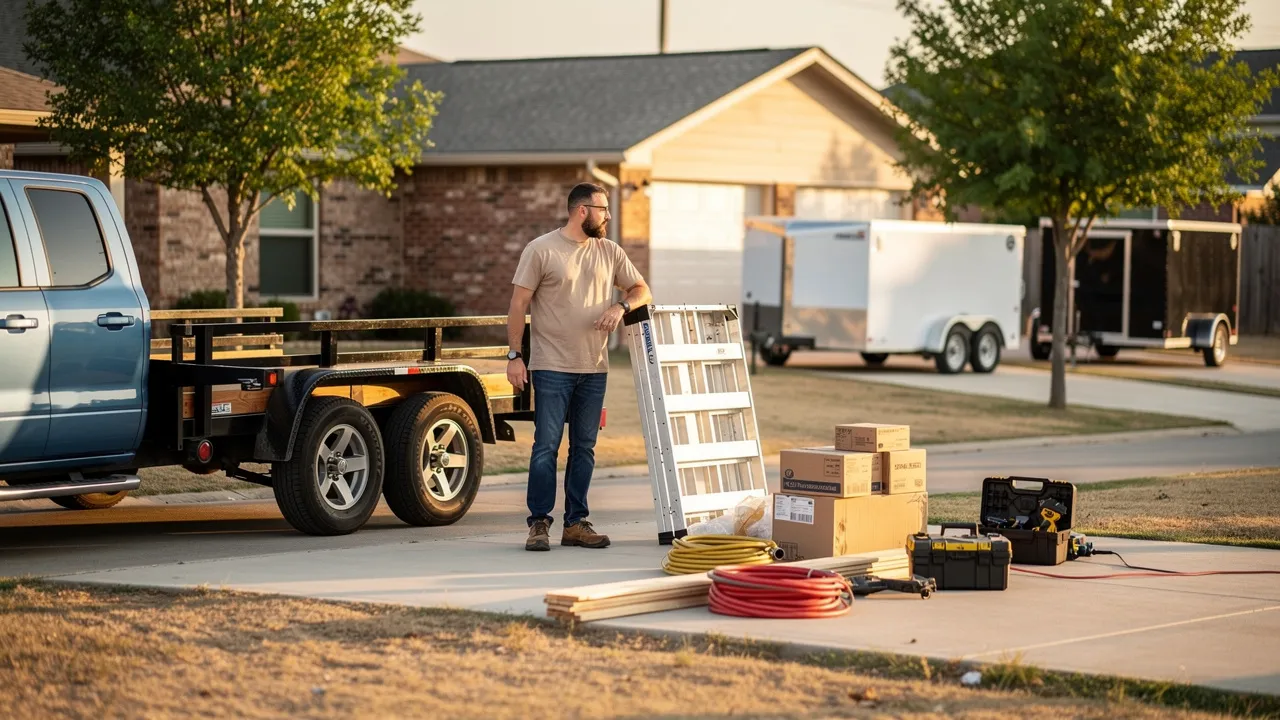
Turn the project into a rental brief
A trailer rental brief gives you a practical starting point for a move, yard cleanup, equipment haul, landscaping project, demolition job, or small repair in Irving or the Dallas - Fort Worth area. Trailer rental can help haul furniture, equipment, landscaping debris, or event supplies without buying an infrequently used vehicle. The rental source, trailer type, and quote will depend on what you need to move and how your vehicle can tow it.
In Irving and across the Dallas - Fort Worth area, trailer rentals are widely available through local providers, national chains, and participating stores, and they commonly serve homeowners handling household moves, yard work, equipment transport, and waste projects. Availability, trailer selection, and rental conditions vary by location. Treat the search as a fit question rather than a simple request for the nearest trailer.
Write down these details before you ask for a recommendation:
- What material, equipment, furniture, debris, or supplies will you move?
- How much space will the load occupy, and does it need weather protection or a lockable enclosure?
- What vehicle will tow the trailer, and what hitch and wiring equipment does it have?
- Where will you pick up, load, unload, and return the trailer?
- When will the work start, how long might it last, and could the schedule change?
Separate facts from estimates as you prepare the brief. Measure or describe the load as accurately as you can, identify anything that could be damaged by weather, and mark unknown vehicle or hitch details instead of filling them in by assumption. This short brief helps you compare a trailer against the actual project instead of choosing by a label alone.
Published rental figures illustrate why the project details matter. Small utility trailers measuring 5x10 typically rent for $40 to $70 per day, mid-size open trailers measuring 7x14 run roughly $60 to $100 per day, and enclosed trailers generally cost $80 to $150 per day. These are general estimates, not a quote for a particular Irving or DFW trailer.
Home Depot rents 5×8 open-frame trailers and 5×8 open solid-wall trailers, with rental-period options that may include four-hour, daily, weekly, or four-week rentals. Common 5x8 Home Depot models are estimated at about $56 to $60 per day, with selection varying by store. A flatbed trailer is estimated at $120 - $200 per day and has an open deck for lumber, machinery, and oversized loads. Ask for a project-specific total before deciding that a smaller or larger trailer will cost less overall.
The figures also show why trailer dimensions alone do not answer the cost question. A small trailer with a specialized function can cost more than a larger trailer with a different use. Start with the load and the work, then use the rate as one part of the decision.
Build a like-for-like trailer quote comparison
Use a like-for-like quote comparison sheet before choosing among trailer options. For each option, record the material or equipment being moved, protection needs, loading and unloading plan, trailer type and size, quoted rate and rental period, deposit, required documents, hitch and wiring requirements, and pickup, return, or delivery arrangement. This keeps differences visible when providers describe similar equipment in different ways.
Trailer sizes vary widely with no universal industry standard, and the size you need directly affects the daily rate. Keep any unknown field open until the provider checks the selected trailer and load together; a trailer label or a lower quoted rate does not by itself establish that the setup fits.
| Trailer type | Material or project described as a fit | Feature to discuss before choosing |
|---|---|---|
| Utility trailer | Yard cleanup, furniture moves, and light hauling | Confirm that the dimensions and load rating fit the material |
| Cargo or enclosed trailer | Household moves and gear transport | Weatherproof and lockable protection may suit the load |
| Equipment trailer | Skid steers, mini excavators, and other powered equipment | Confirm the heavy-duty deck rating and loading method |
| Dump trailer | Dirt, gravel, debris, and demolition material | A hydraulic lift dumps the load; confirm the material and unloading location |
| Flatbed trailer | Lumber, machinery, and oversized loads | The open deck may suit bulky material; confirm securement and dimensions |
| Gooseneck trailer | Heavy or long loads | Uses a fifth-wheel hitch and has higher capacity; confirm the tow vehicle setup |
Use rate ranges to orient the comparison, not to assume a local quote. A pricing guide lists peer-to-peer daily ranges of $50 - $100 for a utility trailer, $100 - $140 for a car hauler, $125 - $195 for a dump trailer, and $150 - $230 for a gooseneck. These are marketplace estimates, not guaranteed Irving prices.
Trailer size and type both affect cost, and a smaller trailer can still cost more than a larger one when the type or features differ. Weekly rates are usually available and can offer meaningful savings over multiple daily rates, but security deposit requirements vary by equipment owner.
Write the rate period, deposit, required documents, and any pickup or delivery charge or condition beside each option. Compare quotes only after the providers have stated the same rental period and the conditions attached to it. The project description remains part of the comparison because the lowest figure is not useful if the proposed setup does not address the material, protection, or unloading needs.

Set a realistic time and cost question
Rental duration should be part of the first quote request because a one-day job and a week-long project may be priced under different rate structures. Most trailer owners charge a daily rate but discount multi-day rentals.
For a job lasting two or three days, a weekend or weekly flat rate may cut 20-30% from the per-day price; ask whether that option is available. A separate estimate says weekly rates are typically 30 to 40 percent cheaper per day than daily rates. The two ranges describe different rate structures and rental lengths, so ask for the total for your exact dates instead of applying either percentage automatically.
Give the provider both your expected work period and your schedule uncertainty. A project that may finish early raises a different return question from a project that may run several days longer. Ask how changes affect the total, the return time, and any additional charges before you choose a rate structure.
Trailer rental cost depends on trailer type and size, rental duration, location and market, deposit requirements, delivery, and insurance arrangements. Local trailer rates may be as low as about $15 per day for some options and reach roughly $90 per day depending on the trailer, while specialized or larger trailers can reach roughly $200 per day. A general estimate puts daily trailer rental rates at roughly $50 to $200 depending on type; a few dozen rental days can approach the price of a new utility trailer.
Use the quote to separate the base rate from the full cost. Ask about:
- The daily, multi-day, weekly, or four-week total for your expected dates.
- The security deposit and how its return is handled.
- Delivery or pickup charges, if you cannot collect and return the trailer yourself.
- Insurance requirements or arrangements for the tow vehicle and rented trailer.
- Additional charges tied to schedule changes, late returns, or the selected use.
A lower daily number may not be the lower project cost if the rental period, deposit, delivery, or required equipment changes the total.
Some owners deliver and pick up trailers; delivery usually adds $50-$150 or a per-mile charge depending on distance. Include the Irving or DFW jobsite and the preferred pickup or delivery arrangement in your first request so the quote addresses the actual logistics. A current quote is the useful comparison point because general price ranges do not establish availability, local terms, or suitability for your vehicle.
Ask for one total that identifies the rental period, trailer type, deposit, delivery or pickup charge, and any insurance arrangement. That format makes two options easier to compare without treating a published estimate as a commitment.

Send one project brief for comparable trailer quotes
Use the same project brief for each inquiry so the replies can be compared on the same terms. A comparison-ready brief identifies the Irving or DFW jobsite, the pickup and return locations if different, the material or equipment being moved, the intended use and protection required, the tow vehicle information, the expected start date, the duration, any schedule uncertainty, and whether the need is for one project or recurring transportation.
The brief can also ask each provider to state the proposed trailer type and size, rate period, deposit, required documents, hitch and wiring requirements, and pickup or delivery arrangement. Keep uncertain vehicle or load details marked for confirmation rather than treating an assumption as a confirmed rating or fit before reservation or towing.
A comparison-ready request can be as direct as: “I need a trailer for a landscaping cleanup in Irving. I will move bagged material and yard debris with my tow vehicle. I can provide the vehicle information, planned start date, expected duration, and whether the schedule may change. Please identify a suitable trailer and state the rate period, total price, deposit, required documents, hitch and wiring requirements, and pickup or delivery arrangements.”
Include the actual vehicle, date, duration, and project details in the message. Most providers require a valid driver's license, a credit or debit card for a security deposit, and proof of a compatible hitch; some locations also require proof of insurance or vehicle registration. Local requirements vary, so ask for the applicable conditions before setting the pickup time.
Keep the same information in each inquiry so differences in fit, terms, timing, and total cost are easier to identify.

Audit fit and terms before accepting a quote
Treat vehicle compatibility as a quote condition that must be answered for the selected trailer. Record the receiver class, ball size, wiring connector, and any trailer-specific requirement beside each quote. Common ball sizes include 2-inch and 2 5/16-inch, but the selected trailer may differ. Most trailers require one of those ball sizes and matching wiring; 4-flat and 7-round are common connectors.
Utility and enclosed units commonly use 2-inch couplers with at least Class II hitches, while larger dump and car haulers often call for Class III or higher. Use those descriptions as questions for the provider, not as a substitute for checking the actual trailer, vehicle, load, and applicable requirements. If any item remains unknown, keep that quote unresolved and get qualified assistance before towing.
U-Haul states that the optimal ball height for its trailers is 18½ to 18¾ inches, measured from the ground to the middle of the hitch ball before connection. That measurement applies to U-Haul's stated trailer requirements, not automatically to every trailer rental. Ask the provider for the selected trailer's ball-height and connection requirements before you arrive.
A booking decision should wait until the vehicle information, hitch receiver, ball, wiring, trailer requirements, and required documents line up. Do not use a price or pickup time as a reason to overlook an unresolved fit question. The correct next step is to obtain a trailer-specific answer or qualified help before towing.
Confirm the rental handoff and transport logistics
The rental handoff should settle fit, timing, terms, and movement of the trailer before you accept the arrangement. Contractors are advised to check car-hauling trailer fit, towing details, rental terms, availability, and pickup or delivery options; the same checks are useful for a homeowner moving furniture, debris, or equipment.
Ask these questions in a single conversation:
- Is the proposed trailer suitable for the material, dimensions, weight, protection needs, and unloading method?
- Is it available for the complete period, including any schedule uncertainty?
- What are the deposit, insurance, identification, registration, and return conditions?
- Can you pick it up, or can it be delivered to the Irving or DFW location?
- What loading equipment, tie-down requirements, ramps, or connection details apply?
- What should you do if the project takes longer or the load changes?
A clear answer to each question gives you a decision boundary. If any answer depends on an unconfirmed load, vehicle, or date, keep that item open before committing.
We offer personalized service, quality equipment, and on-site delivery for trailer rentals in the Dallas - Fort Worth area. Delivery still needs to be discussed for your location, date, trailer, and project conditions; the general estimate for some owners is an added $50-$150 or a per-mile charge depending on distance.
A car hauler trailer is estimated at $100 - $140 per day, uses ramps to load a vehicle onto its deck, and is described as suitable for project cars, classic vehicles, and auction pickups. A cargo or enclosed trailer is estimated at $90 - $175 per day and is weatherproof and lockable for household moves and gear transport. Those figures are general estimates, so ask for the current total and confirm that the proposed trailer matches your tow vehicle and load.
Pickup and delivery also affect the physical plan for the project. Confirm where loading can occur, whether the trailer can reach that location, and how the trailer will be returned if the work finishes outside the original schedule. Keep those logistics in the same conversation as price and availability.
A marketplace estimate says a same-size trailer often runs $20 - $40 per day cheaper from a local owner using a peer-to-peer marketplace than from a national rental chain. That comparison does not establish a DFW price or prove that either option fits your vehicle. Compare the complete project cost and conditions rather than choosing on the daily rate alone.
The useful comparison is the complete arrangement: suitable trailer, confirmed vehicle connection, available dates, deposit, insurance conditions, delivery or pickup, and return process. A cheaper base rate does not resolve an unanswered fit or logistics question.
Complete the loading and pre-tow check
Trailer loading should keep the load balanced and secured for the trip. Secure the load to the trailer with tie-downs to prevent it from shifting in transit.
Use a short loading sequence:
- Distribute the remaining material so it does not create an uneven or unstable load.
- Secure furniture, equipment, debris containers, and other movable items with suitable tie-downs.
- Recheck the load after securing it and before moving the vehicle.
If the load cannot be placed or secured as required, stop and get qualified help. Do not improvise a loading arrangement for the sake of leaving on schedule.
The pre-tow inspection should cover the connection, safety equipment, tires, and documented condition. Before leaving pickup, check the hitch coupler, safety chains, wiring connections, tire pressure, and tire condition, and take photos of the trailer's pre-rental state.
A damage deposit may also affect the handoff. Many owners require a damage deposit, typically $100-$500, held on a card; it is returned when the trailer comes back undamaged. Ask how the deposit, condition record, and return inspection work before you leave the pickup location. A photograph records condition, but it does not confirm that the trailer fits your vehicle or that the load is properly arranged.
The final decision to leave should come only after the trailer, vehicle, connection, load, and documents agree with the rental instructions. If a coupler, chain, connector, tire, load, or required document cannot be confirmed, keep the trailer parked and resolve that issue first.
Use the inspection as a final go-or-no-go point. Resolve a missing connection, uncertain tire condition, incomplete document, or unstable load before entering the road; a rushed departure does not make an unresolved condition acceptable.
Stop and seek qualified help when the setup is uncertain
Trailer fit uncertainty is a reason to pause, not a reason to guess. Stop before towing and seek qualified help promptly if you cannot confirm the trailer's size, load requirements, hitch receiver class, ball size, wiring, coupler, safety chains, tire condition, or loading arrangement.
Do not tow an incompatible or improperly loaded trailer. Do not rely on a common ball size, a photograph, a price, or a familiar vehicle model as proof that the complete setup is suitable. Ask for a trailer-specific answer and follow the applicable rental and towing requirements before moving the trailer.
A qualified professional should decide individual suitability when the vehicle, load, hitch, or towing conditions remain uncertain. That boundary protects the decision process: first establish the fit, then arrange the rental and transport.
Request a current trailer match from EZ Equipment Rental
Our trailer rentals serve the Dallas - Fort Worth area. We offer a wide range of trailer rentals for moving, transporting heavy equipment, and managing waste, along with personalized service, quality equipment, and on-site delivery for trailer rentals. We provide flexible trailer-rental options available for a day or a week.
Use the project brief to ask about the trailer type, load fit, vehicle connection, rental period, total cost, deposit, insurance requirements, pickup or delivery, and return conditions. We offer advice mid-project through knowledgeable team members, but the specific trailer, price, availability, and requirements still need to be confirmed for your project and date.
Our Irving location is at 1307 W Airport Fwy, Irving, TX 75062. Our listed hours are Monday to Friday from 7:30 AM to 5:30 PM, Saturday from 7:30 AM to 5:00 PM, and closed on Sunday. These details help you plan a pickup conversation, but the rental arrangement must still address the trailer, load, vehicle, timing, and logistics you provide.
Contact EZ Equipment Rental about a trailer rental in Irving or DFW. Include your Irving or DFW jobsite, material or equipment, vehicle information, expected start date, duration, schedule uncertainty, and whether the need is for one project or recurring transportation when you reach out.
An equipment trailer is estimated at $80 - $150 per day and is rated for skid steers, mini excavators, and other powered equipment. If your project involves powered equipment, identify the machine and loading conditions instead of assuming that an equipment trailer is suitable. Ask us to confirm the specific trailer and requirements before you reserve or tow it.
A complete inquiry lets us address the project rather than only the trailer name. Include the approximate load dimensions and weight when known, the protection required, the tow vehicle details, and whether you need pickup or delivery. Current inventory, availability, pricing, terms, and towing requirements must be confirmed for the date you plan to rent.
Send the project-ready inquiry
A project-ready inquiry brings the decision down to a few concrete facts: what you are moving, where the work is located, which vehicle will tow the trailer, when you need it, and how long the rental may last. Add the protection, loading, hitch, wiring, deposit, insurance, and return questions that still need answers. If any part of the setup remains uncertain, pause and seek qualified help before towing.
With those details assembled, you can move from a broad local search to a project-specific confirmation of fit, timing, cost, and logistics. A qualified professional should decide individual suitability when your vehicle, load, hitch, or towing conditions remain uncertain.
What should you confirm before towing a rented trailer?
How long do trailer rentals usually last?
There is no established typical duration for ordinary trailer rentals in the Irving or DFW area. Available arrangements may cover part of a day, one day, several days, a week, or longer, depending on the provider and trailer. State your expected start and return dates, include any schedule uncertainty, and ask for the total under daily, multi-day, or weekly terms before committing.
What is the cheapest trailer rental option for a Texas project?
A utility trailer is often listed at a lower daily range than specialized equipment, dump, flatbed, or gooseneck trailers, but no single option is cheapest for every project. Trailer type, size, rental period, location, deposit, delivery, insurance arrangements, and provider affect the total. Choose based on the load and vehicle first, then request a current all-in quote rather than relying on a general rate.
What should I compare when reviewing two trailer rental quotes?
Compare whether each trailer fits the material, dimensions, weight, protection needs, loading method, and tow vehicle - not just the advertised daily rate. Check the complete rental period, deposit, insurance requirements, pickup or delivery charge, availability, return conditions, and any schedule-change terms. If either quote leaves the hitch, wiring, load, or towing suitability unresolved, pause before reserving or towing.
Sources
- Trailer Rentals | U-Haul - uhaul.com
- Irving, TX Trailer Rental | Neighbors Trailer - neighborstrailer.com
- What to Know Before Renting a Trailer | RNTR - rntr.com, 2026-06-09
- How to Choose the Right Size U-Haul Trailer Rental - U-Haul Tips - uhaul.com
- trailer specs - Trailer Resources - towlos.com
- How Much Does It Cost to Rent a Trailer? | Angi - angi.com, 2025-01-29
- How to Rent a Trailer for a Construction Project in Irving and DFW - blog.ezequipmentrental.com, 2026-10-27
- Cargo Trailer Rental Dallas, TX | Rent Cargo Trailers | Equipment Rental Trailer - ezequipmentrental.com
- Best Trailer Rental Companies in 2026 (Types, Costs & Tips) - hireahelper.com
- How Much Does It Cost to Rent a Trailer? | BigLoads - bigloads.com
- Trailer Rental Cost Guide: Prices by Type | BigLoads - bigloads.com
- Rent vs Buy a Trailer in Texas: Cost Comparison (2026) - trailerplace.com