
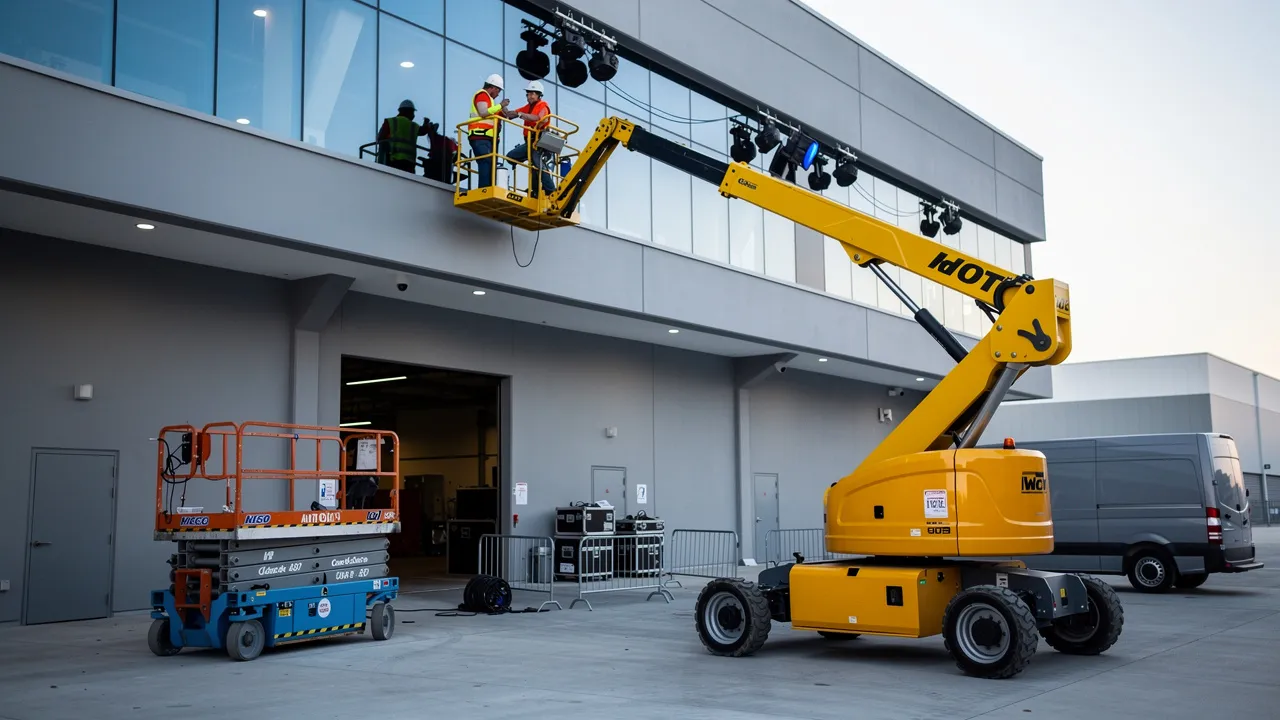
Start with the access problem a boom lift solves
A boom lift is an aerial work platform with a bucket or platform attached to a hydraulic boom on a mobile base. The boom can move workers vertically and horizontally, allowing the platform to approach an elevated or offset work area rather than remaining directly below it.
That access pattern can matter for facility maintenance, construction, exterior work, and temporary event setup in Irving and the wider Dallas - Fort Worth area. A boom lift may be relevant when the work point is above an obstacle, beyond a fixed edge, or positioned away from the machine’s base. The equipment category alone does not establish whether a particular lift will fit your site.
The access path is the first question to answer. Straight vertical access may point toward a different lift category, while significant horizontal outreach or an offset exterior work area may make a boom lift the category to consider. A boom lift’s useful reach depends on the model, load, and permitted operating configuration, so a general definition cannot replace a project-specific review.
For an Irving or DFW job, start by locating the exact work point and describing how the platform would need to get there. Include the obstacles, entry route, surface, workers, tools, and materials before you ask whether a boom lift is plausible.
Overview
A boom lift combines a mobile base, a hydraulic boom, and a platform or bucket to move workers to elevated or offset work areas. Its defining difference from a primarily vertical platform is the ability to provide horizontal outreach as well as vertical elevation. That outreach can help you approach work above or beyond an obstacle, but the permitted path still depends on the actual machine and its operating limits.
Boom lifts come in two principal designs: articulating and telescopic. Articulating models use hinged boom sections, while telescopic models extend through straight sections. The two designs can serve different approach paths, so the name “boom lift” is only a starting point for a rental conversation.
A scissor lift primarily raises its platform vertically, while a boom lift can provide both vertical elevation and horizontal outreach. Scissor lifts are often useful when workers need a larger platform and direct access above the machine. Boom lifts may be more appropriate when the work area is offset or workers need to reach over or around an obstacle.
Do not use an aerial lift as a crane, hoist materials with it, or carry objects larger than the platform. The personnel-access purpose should remain clear from the first project description.
Published comparisons cite different upper-end figures for boom-lift working height - up to about 185 ft. or 200 ft., depending on the source and equipment category. Those are category-level figures rather than specifications for a machine you might rent. Confirm the actual model’s working height, horizontal reach, load limits, and permitted configuration before relying on any height figure.

Recognize the two boom-lift designs
Boom lifts come in articulating and telescopic designs, and the difference is the way the boom reaches the work area. The design affects whether the platform approaches directly, reaches over an obstruction, or travels outward toward a distant work point. It does not, by itself, confirm that the machine will fit your entrance, surface, load, or operating envelope.
An articulating boom lift uses multiple boom sections that hinge or articulate. The jointed arrangement can let the platform reach up, over, and around obstacles or barriers, which may suit tight-access and hard-to-reach work areas.
Articulating designs may support work in facilities, indoor construction, building maintenance, theatres, sports arenas, manufacturing plants, and other settings where a straight approach is blocked. Your site still needs to be checked for entrance dimensions, overhead clearance, surface conditions, and the complete boom path.
A telescopic boom lift has one or more boom sections that extend outward in a straight line. These machines are also called stick booms because of their straight appearance. The design provides a direct, long-range approach and is associated with greater horizontal outreach than other aerial-platform types.
A telescopic design may suit an open work area where the platform needs to reach a taller or more distant point without moving around several obstacles. That description is a starting point only; the model’s reach chart, load condition, clearances, surface requirements, and permitted operating position still govern the decision.
Match the boom shape to the approach
The boom shape should match the route from the machine’s base to the work point. An articulating boom is intended for reaching around obstacles, while a straight boom is designed for maximum horizontal outreach and height on open job sites. The practical question is not simply how high the work is; it is how the platform must travel to reach the person’s working position.
Articulating booms use joints to clear obstacles and can provide up-and-over access over rooftops, machinery, buildings, or other barriers. Articulating booms have less horizontal outreach than telescopic booms, but they provide greater versatility for reaching up, over, and out.
This approach may make sense for a facility façade partly blocked by a structure, an interior maintenance point beyond equipment, or an event area where the work position is not directly above the parking location. Mark the obstacle and the intended platform position rather than assuming the jointed boom can clear it.
Telescopic booms offer straight, long-range reach, and a telescopic boom lift has one or more sections that extend outward in a straight line. The design can suit an open construction or maintenance area where the machine can be positioned with a direct line toward the elevated work point.
Boom lifts focus on placing a worker in a specific location, and their weight capacities are usually limited to 500-1,000 pounds for a crew and immediate supplies. Treat that range as a general description rather than a model specification. Add the weight of workers, tools, and materials together, then compare the total with the proposed platform’s rated capacity.

Separate boom access from direct vertical access
A boom lift and a scissor lift can both provide elevated personnel access, but their primary movement patterns and site questions differ.
| Project criterion | Boom lift | Scissor lift |
|---|---|---|
| Access path | Can provide vertical elevation and horizontal outreach | Primarily raises the platform vertically |
| Offset work | May suit work beyond an obstacle or away from the base | Usually requires direct positioning below the work area |
| Platform arrangement | Often uses a narrower basket, depending on the model | Often provides a larger platform, depending on the model |
| Uneven-surface comparison | One comparison says boom lifts can typically tolerate up to 5° of tilt | The same comparison says scissor lifts handle up to 2.5° |
The height and tilt figures are general comparison values, not permission to operate a particular machine under those conditions. Verify the actual model specifications, site conditions, and applicable manufacturer requirements before relying on them.
A restricted entrance does not automatically rule out either category. Compare the actual model dimensions and operating clearance, including the path through a warehouse doorway, facility entrance, event access point, or other confined route. Do not choose from the category name alone.
Surface conditions also change the question. A comparison may describe different tolerance levels for boom and scissor lifts, but the applicable equipment information still controls the site decision. On uneven or challenging ground, use a suitable verified model; manufacturer requirements govern surface suitability.
If the platform will carry multiple workers and tools, compare rated platforms because capacity and workspace are model-specific. The larger-looking platform or higher category figure is not enough to establish that the proposed lift fits.
Keep the platform’s purpose clear
A boom lift is designed to provide personnel access within its approved platform and operating limits. The boom positions the occupied platform; it is not a substitute for a crane that lifts a separate suspended load.
Describe the job in terms of who needs access, where the platform must be positioned, and which tools or materials those workers need inside the approved platform. That description helps separate an aerial-access need from a material-handling need before equipment is discussed.
An aerial lift must not be used as a crane or to hoist materials, and objects larger than the platform must not be carried. Do not add an improvised lifting point to the basket or structure. If the planned task requires a separate suspended load or an oversized object, stop the boom-lift plan and obtain a different equipment assessment.
The platform’s approved capacity also includes the combined weight of workers, tools, and materials. Keep that total within the manufacturer’s load-capacity limit rather than treating the basket as open storage.
Describe the job before judging the fit
Project fit depends on the work point, approach path, surface, clearance, hazards, and platform requirements. Assess the worksite for possible hazards before selecting equipment, then record the conditions that could change the boom design or make operation unsuitable.
Use this short project record before asking for a rental recommendation:
- Work point: Identify the exact place where the worker must stand, such as an overhead facility component, exterior maintenance point, construction area, or event structure.
- Required height and outreach: Record the working height and the horizontal distance from a feasible machine position to the work point. A boom lift’s useful reach depends on the model, load, and permitted operating configuration.
- Approach path: Mark rooftops, machinery, trees, structures, barriers, power-related hazards, and other obstacles that the boom or platform may need to clear.
- Entry and clearance: Measure entrances, gates, doorways, aisles, overhead openings, turning areas, and the proposed machine position. A restricted entrance requires comparison against the actual model dimensions and operating clearance.
- Surface and terrain: Describe whether the route and setup area are level, uneven, sloped, paved, compacted, indoors, or outdoors. On challenging ground, manufacturer requirements govern surface suitability.
- People and platform contents: Count the workers and list the tools and materials that will be in the platform. Compare the combined load with the model-specific rated capacity and workspace.
- Working conditions: Record wind exposure, nearby operations, fall hazards, stabilization needs, and positioning constraints so the worksite controls can address fall protection, stabilization, and positioning.
The project record narrows the equipment question; it does not approve a machine for operation. A machine may reach the final point while lacking the clearance needed to get there, and an apparently suitable location may fail the surface, stabilization, or hazard review.
Use the record to ask about the proposed model’s actual reach chart, dimensions, capacity, operating configuration, and site requirements. Keep each answer tied to the work point you recorded.

Read model limits before relying on reach
Confirm the actual model’s working height, horizontal reach, load limits, permitted operating configuration, and required clearance before relying on a category description.
Include these details in the inquiry:
- Job location in Irving or the wider DFW area
- Work area and exact elevated or offset point
- Intended use, such as facility maintenance, construction, or event work
- Required working height and horizontal reach
- Obstacles, entrance dimensions, overhead clearances, and travel path
- Indoor or outdoor setting, surface, terrain, and stabilization conditions
- Number of workers plus the combined weight of tools and materials
- Planned schedule and any conditions that could affect positioning or operation
The completed record gives a rental provider enough project context to discuss whether a boom lift is a plausible category and which model-specific questions still require qualified review.
Set the before-use safety gate
The before-use gate starts with trained and authorized operation, a worksite assessment, and equipment checks. In the United States, only trained and authorized persons may operate an aerial lift, and workers must demonstrate that they can use it properly. Safe aerial-lift use includes maintaining the equipment, following the manufacturer’s instructions, providing needed PPE, and using safe work practices.
Before each work shift, conduct a pre-start inspection to verify that the equipment and all its components are in safe operating condition, following the manufacturer’s recommendations. Under the cited ANSI A92.5 guidance, perform pre-start and workplace inspections before using the equipment.
Use the following boundaries before anyone operates or positions the lift:
- Test the lift controls each day before use to confirm that they are in safe working condition.
- Set the brakes, position outriggers on pads or a solid surface, and install wheel chocks when working on an incline, according to the cited safe-use guidance.
- Keep the combined weight of workers, tools, and materials within the manufacturer-specified boom and basket load limits.
- Stand firmly on the platform floor. Do not sit or climb on the edge, and do not use planks, ladders, or other devices to gain height.
- Do not move an aerial lift truck with the boom elevated and employees in the basket unless the equipment is specifically designed for that operation.
Do not operate an aerial lift beyond its vertical or horizontal reach limits or in high winds above those recommended by the manufacturer. Do not override hydraulic, mechanical, or electrical safety devices.
The cited guidance says every MEWP manufactured after early spring of 2020 has a load-sensing device that monitors platform weight and may disable functions when the specified limit is exceeded. The functions affected can vary by manufacturer, so the device does not replace the operator’s obligation to follow the specific manual and load limits.

Stop for qualified evaluation when the plan is unclear
Unconfirmed site conditions are a stop condition, not a reason to improvise. Pause before operating or positioning the lift if you cannot confirm the work path, clearance, surface suitability, stabilization, hazard controls, operator readiness, or combined platform load.
Worksite controls for an aerial lift should address fall protection, stabilization, and positioning. If any of those controls cannot be established for the proposed location, keep people out of the operating area and seek qualified evaluation before continuing.
Immediate qualified help is appropriate when the boom path passes near an unresolved hazard, the machine appears unable to reach the work point without exceeding its limits, the surface or clearance is uncertain, or the planned load cannot be confirmed. A machine reaching the final point does not prove that its permitted path, load, or position is acceptable.
Do not send an untrained person to test the equipment, do not climb on the platform rails, do not add makeshift height or lifting attachments, and do not move an elevated platform unless the equipment is specifically designed for that operation. Stop and involve the responsible authority or qualified person promptly when the plan remains unclear.
Key Highlights
Keep these points in view:
- Articulating designs use hinged sections to reach up, over, and around obstacles.
- Telescopic designs extend in a straight line for direct, long-range outreach.
- A scissor lift primarily provides vertical access, while a boom lift may provide offset reach.
- Useful reach depends on the model, load, permitted configuration, clearance, and site conditions.
- Boom lifts are classified as Type 3, Group B MEWPs.
- Assess the worksite before selecting equipment, and use trained and authorized operators who follow the manufacturer’s instructions.
The practical decision is whether the proposed access path, boom design, surface, clearance, platform load, and operating controls align with the work point. If you cannot confirm those conditions, do not operate or position the lift until qualified help evaluates the plan.
Prepare an Irving-ready project inquiry
An Irving-ready project inquiry should carry the access problem into the rental discussion. Provide the job location, work area, required height and horizontal reach, intended use, schedule, entrance and clearance details, surface and terrain, obstacles, stabilization conditions, and the combined weight of workers, tools, and materials.
Those details make it possible to discuss whether a boom lift may be a plausible category for an event, facility, maintenance, or construction task in Irving or the wider DFW area. Actual suitability still depends on the proposed model, its permitted configuration, the site assessment, and the operator requirements.
EZ Equipment Rental is headquartered in Irving, Texas. We offer advice mid-project through knowledgeable team members, and we provide access to high-quality boom lifts for rent. Bring the completed project record so the discussion can stay focused on the work point, approach path, site conditions, and model-specific questions.
A qualified professional must decide individual suitability before operation or positioning begins, with the manufacturer’s instructions, site controls, operator readiness, and applicable requirements addressed. Use the documented job details as the starting point for that review.
Questions to resolve before discussing a boom-lift rental
Can anyone operate a boom lift?
No. Only trained and authorized workers who can demonstrate proper use should operate an aerial lift. Before operation, the worksite and equipment should be assessed, controls tested, and the manufacturer’s instructions and required protective measures followed. If operator readiness or site hazards cannot be confirmed, stop and obtain qualified help.
How much weight can a boom lift carry?
Capacity is model-specific and includes the combined weight of workers, tools, and materials. Some boom lifts are described as carrying 500-1,000 pounds, but that is not a specification for a particular machine. Check the proposed model’s rated platform capacity and permitted configuration before loading it.
Can a boom lift be used to lift materials?
A boom lift is intended to provide personnel access within its approved platform and operating limits, not to act as a crane or hoist a separate suspended load. Do not add an improvised lifting point, carry objects larger than the platform, or exceed the manufacturer’s load limits. A separate material-handling assessment is needed when the task involves lifting an independent load.
Is a boom lift suitable for indoor work?
It may be, depending on the model and site. Articulating designs can suit some indoor maintenance, construction, and facility work where the platform must reach over obstacles, but entrance dimensions, overhead clearance, floor or surface conditions, turning space, and the complete boom path must be verified. A qualified review is needed before positioning or operating equipment indoors.
Sources
- Scissor Lift vs Boom Lift: Key Differences Explained - avanzaequipment.com
- Scissor Lifts vs. Boom Lifts: A Comparative Analysis - atlanticforkliftservices.com
- SAFE USE PLAN GUIDANCE - genielift.com
- Boom Lift vs. Scissor Lift Comparison Guide - platformbasket.ca
- Boom Lift vs. Telehandler: Which Machine Does Your Project Need? - unitedlift.com, 2026-09-07
- Articulating vs Telescopic Boom Lift: Choose the Right Rental - rentproco.com
- Boom lift applications and reach | Industrial Man Lifts - industrialmanlifts.com, 2017-02-11
- Everything About Boom Lifts - hwlifts.com
- Boom Lift Daily Inspection Checklist (ANSI A92.5 Compliant) | BigRentz - bigrentz.com, 2026-07-07
- Understanding Platform Weight Limits - Alexander Equipment Rental - aerialliftequipment.com
- eTool : Scaffolding - Aerial Lifts | Occupational Safety and Health Administration - osha.gov
- Articulated Boom Lifts: Aerial Lift Excellence - genielift.com
- Telescopic Boom Lifts: Aerial Lift Mastery - genielift.com
- Find the Right Mobile Elevating Work Platforms for Your Needs | JLG - jlg.com, 2021-05-13
- What is the difference between an articulating boom and a telescopic boom? - genielift.com
- Straight vs Articulated Boom Lift | How to Decide | JLG - jlg.com, 2021-03-21