
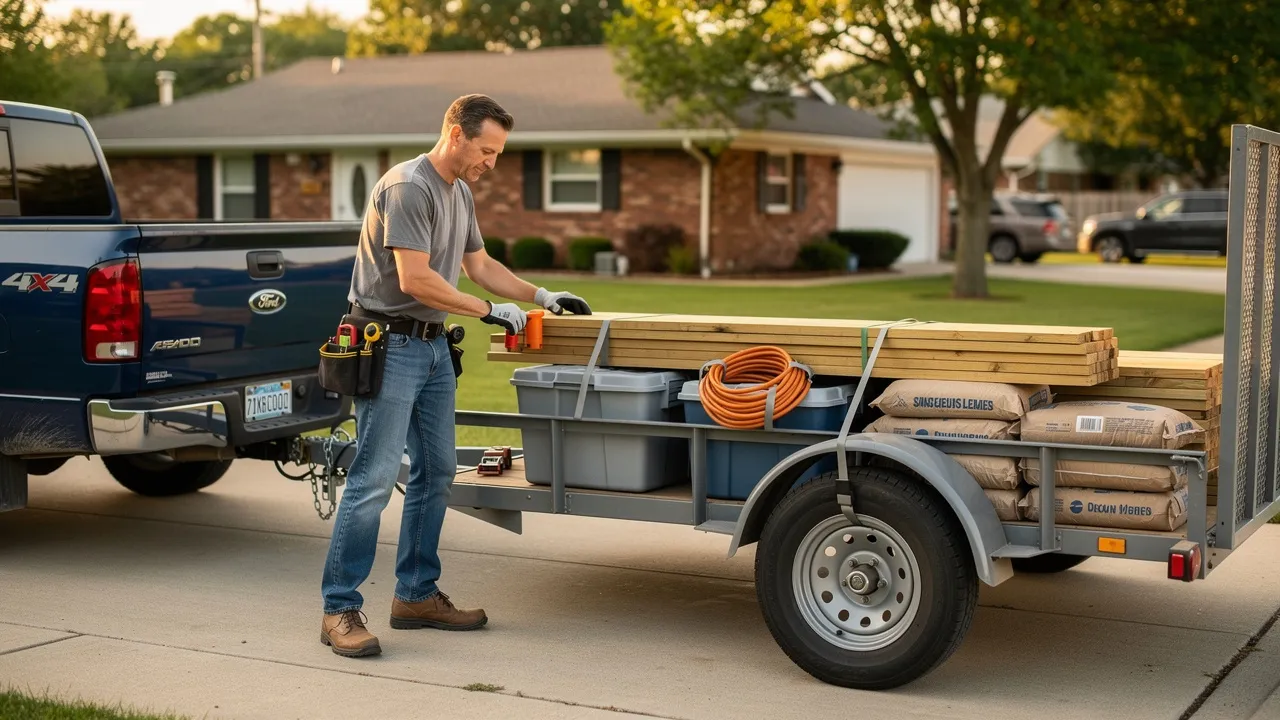
Start with the hauling task
The right trailer rental in Irving starts with the hauling task, not with a provider name. Write down what you will move, where it starts and ends, whether the load needs weather protection, and whether the project is a single trip or repeated transportation. Furniture, landscaping debris, a mower, renovation waste, and a vehicle create different trailer requirements, even when each project lasts only a weekend.
In Irving, homeowners frequently use utility trailers for landscape materials, renovations, and garage cleanouts. Enclosed trailers can protect furniture and belongings during relocations, while common weekend projects include driveway work, fence installation, and mulch delivery. Renting a trailer can help you haul furniture, equipment, landscaping debris, or event supplies without buying a vehicle you may use only occasionally. Start by describing the load and its destination; then compare trailer categories that can handle that job.
Price is a comparison point, not a substitute for fit. Neighbors Trailer says utility trailers in Irving typically run $40 - $60 per day, enclosed trailers fall between $80 - $150 daily, car haulers average $100 - $150 per day, and dump trailers range from $100 - $180 per day depending on size and condition. Those are platform-specific ranges, not a quote for every Irving rental.
Use the project description to narrow the request before you compare a daily rate. A lower price does not solve a hitch mismatch, an uncovered load that needs protection, or a trailer that cannot accommodate the equipment. Ask for the trailer type, dimensions, capacity, required connection, rental period, and pickup or delivery arrangement together.
Match the trailer type to the load
Trailer listings around Irving typically include open utility trailers, enclosed cargo trailers, flatbeds, and heavier equipment trailers, although selection depends on which owners or rental locations are active. Match the category to the load rather than choosing by appearance:
- Utility trailer: General hauling, landscaping equipment, yard materials, and smaller home-project loads.
- Enclosed cargo trailer: Furniture, belongings, or other items that benefit from protection during a move.
- Flatbed trailer: Equipment, pallets, and materials that can be loaded from an open deck.
- Equipment trailer: A mower or compact equipment that needs suitable loading access and tie-down points.
- Car hauler: A vehicle or project car that requires the correct deck, ramps, capacity, and towing setup.
- Dump trailer: Renovation debris or a property cleanup where a dump feature is relevant.
These categories describe possible uses, not an approval of your specific setup. The load, loaded weight, dimensions, and vehicle must still match the selected trailer.
BigLoads says most listed utility or cargo trailers and equipment trailers around Irving rent for about $120 a day, most car haulers rent for about $125 a day, and most listed dump trailers rent for about $150 a day. The figures measure typical listed daily rates for those trailer categories on that platform; they do not establish a universal Irving price or confirm availability for your dates.
Treat the category as the first branch in your decision. If you are hauling loose mulch or a mower, ask about an open trailer, loading access, tie-down points, and payload. If you are moving furniture, ask whether an enclosed trailer offers the protection you need. If you are moving debris, ask whether a dump feature is suitable and what loaded-weight and braking requirements apply.

Check space, payload, and loading features
Trailer fit depends on more than the name of the category. Check the trailer’s dimensions, payload capacity, and loading space against the actual items you plan to carry. Measure long, wide, tall, or irregular items before you request a rental, and account for the room needed to load, secure, and unload them.
Write down the heaviest item and the combined weight of the load. Equipment, materials, and debris can change the loaded-weight calculation quickly. A trailer that has enough floor space may still be unsuitable if its payload capacity is too low or if the tow vehicle cannot handle the loaded combination.
Ask which loading features are included or required for your project. Ramps, tie-down points, loading gates, and hydraulic dump features may each matter depending on what you are transporting. A mower or compact machine may need ramps and tie-down points; loose renovation debris may make a loading gate or dump feature more useful; furniture may need enclosed space and a way to load without damaging it.
Use this short fit check before comparing rates:
- Record the load’s length, width, height, and estimated total weight.
- Identify whether the load needs weather protection.
- Ask about ramps, gates, tie-down points, and any dump function.
- Confirm that the trailer’s capacity and loading space match the complete load, not only the largest single item.
Treat each fit check as a gating question rather than a preference. A trailer fails the project fit screen when any required dimension, payload, or loading feature is unresolved, even if other characteristics look suitable. For a load made up of several items, evaluate the complete combination because the trailer must accommodate the items together, not only the largest item individually. Loading space also includes the practical room needed to position and secure the items, so a measured dimension alone does not confirm usability. Ask the rental provider to confirm which measurements and capacities apply to the selected trailer before comparing price or scheduling pickup. If a required feature cannot be confirmed, keep that option out of the final comparison until the answer is available.

Compare Irving rental options by fit and logistics
Compare Irving rental options by the same questions each time: Does the trailer category fit the load? Does the available capacity fit the loaded weight? Does the tow vehicle meet the connection and braking requirements? Can the rental period match the project? Is the trailer available for the required start date? Will pickup or delivery work for your location and schedule?
Big Rentals says enclosed trailers see the most use among its Irving listings. That observation may help you explore an enclosed option for a move, but it does not make an enclosed trailer suitable for every load. A listing or rental location is worth considering only after the trailer’s dimensions, capacity, features, connection, and logistics fit your project.
Use a two-pass comparison for each Irving trailer option. In the first pass, record whether the option has a confirmed or unconfirmed answer for load category, dimensions, payload, loading features, towing limits, connection, braking, dates, rental terms, and pickup or delivery. In the second pass, compare the options that have no unresolved required condition by the factors that matter most to the project, such as weather protection, loading convenience, rental duration, or route logistics. A missing answer is a reason to ask the provider for confirmation, not a reason to assume that the option fits. This method keeps a low listed rate from outweighing an unresolved capacity or connection question. For a single-day or weekend project, compare the complete arrangement for the requested period rather than comparing daily prices in isolation. For recurring transportation, compare whether the expected pattern can be discussed under the available rental terms rather than assuming that one short-term rate applies to every trip. A simple note with one line per option and one entry per required condition can preserve the comparison. The resulting record gives the requester a basis for asking focused questions and choosing only after fit and logistics are confirmed.
BigLoads says most rentals on its Irving listings are available by the day, weekend, or week, and that local listings range around $18 - $600 per day.
BigLoads also says most flatbed, car-hauler, utility or cargo, and equipment trailers around Irving rent for about $120 a day, while most listed dump trailers rent for about $150 a day. Use those platform-specific figures as comparison context only. Ask every rental location or listing for the complete arrangement, including the trailer, dates, terms, pickup or delivery, and any requirements attached to the selected setup.
Choose your comparison path from the project:
- For a move or furniture: Compare enclosed and utility options by protection, interior space, loading access, and your vehicle’s limits. Ask whether the load can be secured without shifting.
- For yard work or landscaping: Compare utility, cargo, or equipment options by open space, ramps, tie-down points, and payload. Confirm that the mower, materials, or debris fit together.
- For a vehicle: Compare car-hauler options by deck dimensions, ramps, loaded weight, hitch and brake requirements, and the vehicle you will tow with.
- For renovation debris: Compare dump or utility options by capacity, loading method, protection needs, and braking requirements. Confirm how the loaded trailer must be secured.
End the comparison when an option fails a required fit or towing condition. Do not select it because its listed rate is lower.
Build the towing match before booking
Your vehicle’s towing capacity must cover the trailer plus the load. Match the trailer size and type to the towing setup and cargo, and leave capacity rather than planning to tow at the maximum limit. Never exceed the confirmed limits for the vehicle, hitch, or trailer.
Separate the weights you need to understand:
- GVWR is the vehicle’s maximum weight, including the vehicle itself, passengers, cargo, and fluids, without the trailer.
- Gross combined vehicle weight includes the vehicle, trailer, passengers, and payload together.
- Tongue weight is the weight placed on the tow vehicle through the trailer’s tongue. It should generally be about 10% to 15% of the trailer’s total or gross trailer weight.
Use the ratings for your specific vehicle, hitch, and trailer. A general category or an estimate from a listing cannot replace the marked limits.
BigLoads says a standard Class C license covers most rentals under 26,001 pounds combined in Texas, but that statement does not determine every license, vehicle, trailer, or load requirement. Verify current requirements for the specific setup with the responsible authority and the rental provider before travel.
Moovalot says its trailers use a standard 2-inch ball hitch and that a loaded 5x8 trailer requires a minimum 3,500 lb towing capacity. Those figures apply to Moovalot’s described equipment and do not establish the requirement for another trailer. Ask for the selected trailer’s loaded weight, connection, and vehicle requirements rather than applying the example to your project.
Before requesting availability, have the vehicle year, make, model, towing rating, hitch information, and expected load ready. If the rating or loaded weight is uncertain, pause the booking conversation until the figures can be confirmed.

Confirm the hitch, wiring, and braking setup
A trailer can fit the load and still fail the vehicle-connection check. Before booking, confirm your vehicle's towing capacity, hitch size, electrical connection, and brake-controller requirements. Your vehicle’s hitch class must match the trailer’s weight rating, and the vehicle’s electrical system must match the trailer’s wiring configuration.
Confirm these points directly:
- Which ball size does the trailer require?
- What receiver class and rating are required?
- Does the trailer use a 4-pin or 7-pin connector?
- Is an adapter needed, and does the vehicle support the trailer’s lighting system?
- Does the loaded trailer require a brake controller?
- What braking requirements apply to the specific trailer and load?
Heavier trailers usually need a brake controller. Calculate the total loaded weight, including equipment and materials, and confirm braking requirements before towing.
Hitch-ball guidance varies by trailer and source. One towing guide identifies 1 7/8-inch balls as common for small trailers and 2-inch balls as common for medium and large trailers. Another rental guide says most trailers require either a 2-inch or 2-5/16-inch ball, with 4-flat or 7-round connectors among the common wiring types. These are commonly cited sizes and connector types, not a universal specification.
Confirm the required ball size, receiver rating, and wiring connector with the rental facility for the specific trailer. Do not infer the correct connection from the trailer’s appearance, a different rental, or a general size chart. If the ball, receiver, plug, or brake arrangement does not match, stop before pickup or travel and obtain qualified help.
Set the rental period and handoff plan
We provide flexible trailer-rental options available for a day or a week. That offer describes available term choices; it does not establish that a trailer will be available on your preferred date or that every project fits one of those periods.
Set out the timing in your request:
- planned start date and approximate pickup time;
- expected return date or duration;
- whether the schedule may move because of weather, materials, or project progress;
- whether you need pickup at the Irving location or delivery to the project area; and
- whether the trailer is for one project or recurring transportation.
Ask when the selected trailer, terms, and pickup or delivery arrangement can be confirmed, and do not travel to collect equipment until the arrangement is confirmed. If the schedule may move, say so before the arrangement is confirmed and ask how a changed return date, pickup window, or delivery discussion would be handled under the rental terms. For a one-time job, state the expected handoff and return period; for recurring transportation, explain the pattern you expect.
Availability and logistics should be checked alongside trailer fit. We recommend checking car-hauling trailer fit, towing details, rental terms, availability, and pickup or delivery options. The same questions apply when you need a utility, enclosed, equipment, flatbed, or dump trailer.
Build extra planning room into an Irving pickup or delivery plan when your route may use SH-183, SH-114, Loop 12, or I-635. BigLoads says those roads can back up at rush hour.
Prepare a request for EZ Equipment Rental
A clear request gives EZ Equipment Rental the details needed to discuss a suitable trailer arrangement. Include the project facts in one message rather than starting with only a trailer category or a requested price.
Use this request checklist:
- Location: Give the Irving or Dallas - Fort Worth jobsite address or service area.
- Load: Describe the material, equipment, vehicle, furniture, or waste being moved, including estimated total weight and dimensions when known.
- Purpose: Explain whether the trailer is for landscaping, a move, demolition, renovation debris, equipment transport, pressure-washing support, concrete work, or another home project.
- Protection: Say whether the load needs weather protection and whether it is valuable or vulnerable to damage.
- Vehicle: Provide the tow vehicle information, towing capacity, hitch details, electrical connection, and brake-controller information when available.
- Timing: Give the expected start date, duration, and any schedule uncertainty.
- Logistics: Ask about pickup or delivery, the handoff timing, and the relevant rental terms.
- Use pattern: State whether the need is a single project or recurring transportation.
We offer trailer rentals in the Dallas - Fort Worth area and can discuss your needs and possible rental solutions.
Ask EZ Equipment Rental project-specific questions about the load, vehicle compatibility, protection, timing, and rental terms. You can make the request more useful by explaining how the trailer will be loaded and unloaded, whether the load will travel uncovered, and whether the project involves one trip or repeated trips.
For example, describe a mulch delivery by giving the project location, the material, the expected amount and weight, the protection needed, the tow vehicle, the desired start date, the expected duration, and whether pickup or delivery is preferred. For equipment, include the machine type, dimensions, loading method, tie-down needs, and vehicle details. For renovation waste, identify the debris and ask which trailer features and braking requirements fit the loaded setup.
These details do not guarantee a trailer selection. They create a complete starting point for confirming fit, availability, terms, and handoff arrangements.
Before sending the request, separate facts you know from facts that need provider confirmation. Give dimensions and estimated weight as estimates when that is all you have, identify the trailer feature you believe is needed, and ask EZ Equipment Rental to confirm whether the selected arrangement can accommodate the complete load and vehicle. Do not replace an unknown dimension, payload, connection, or braking requirement with a generic trailer label. If the project has more than one trip, describe whether the same load will move each time or whether the loads will change; different loads can require a new fit check even when the project location stays the same. If weather or project progress may move the start or return date, state the uncertainty before confirmation instead of presenting a flexible schedule as fixed. If pickup and delivery are both possible, state the preferred choice and ask what arrangement is available for the selected trailer and date. A request organized this way helps distinguish a question about trailer suitability from a question about current availability, rental terms, or handoff logistics. EZ Equipment Rental can then discuss the missing details or possible solutions without the requester assuming that a category name or general rate confirms a rental. EZ Equipment Rental provides equipment including bucket trucks, concrete equipment, generators, lighting, pumps, saws, jumping jacks, air compressors, pressure washers, earthmoving equipment, attachments, and trailers. If a project requires a trailer alongside related equipment, state that combination in the request so the equipment discussion remains separate from confirmation of trailer fit, availability, terms, and handoff.

Use the Irving location and delivery choices
Our Irving address is 1307 W Airport Fwy, Irving, TX 75062. Irving is in Dallas County, about 9 miles west of Dallas, beside the Dallas - Fort Worth airport, and home to the Las Colinas business district. We offer trailer rentals in the Dallas - Fort Worth area, including options for moving, transporting heavy equipment, and managing waste.
We offer personalized service, quality equipment, and on-site delivery for trailer rentals. We can deliver to Irving and multiple Dallas - Fort Worth locations, including Dallas, Carrollton, Plano, Garland, Coppell, Farmers Branch, Fort Worth, Arlington, Mansfield, Richardson, Euless, Bedford, and Grand Prairie. Ask whether pickup at the Irving location or delivery to your project area fits the selected trailer and schedule.
Our listed operating hours are Monday through Friday from 7:30 AM to 5:30 PM, Saturday from 7:30 AM to 5:00 PM, and closed Sunday.
When you contact EZ Equipment Rental, include the jobsite, load, vehicle, start date, duration, schedule uncertainty, and whether you prefer pickup or delivery. A location is useful only when it works with the trailer’s requirements and your route. Ask for the selected trailer, handoff timing, and delivery or pickup details together.
Inspect the connection before leaving
Before leaving pickup, walk around the trailer with the owner and inspect the complete connection. Check the coupler, safety chains, wiring, tires, and the trailer’s visible condition. Make sure the tow vehicle has the right hitch class for the trailer’s weight rating and that the vehicle’s electrical system matches the trailer’s wiring configuration.
Complete the handoff check in this order:
- Confirm that the coupler is seated and secured on the correct ball.
- Check the safety chains and their attachment points.
- Connect the wiring and confirm that the vehicle and trailer systems match.
- Inspect the tires and their condition before loading.
- Compare the trailer condition with the pre-rental record.
- Photograph the trailer’s pre-rental state.
Do not leave the pickup location while a required connection or visible condition remains uncertain.
After the trailer connection is checked, confirm the load before travel. Make sure the trailer dimensions, payload capacity, and loading space suit the items you placed inside or on the deck. Secure the load according to the trailer and project requirements; BigLoads says loads must be secured or tarped.
Check that the loaded trailer does not exceed the vehicle, hitch, or trailer limits. Confirm the braking setup, verify that the wiring is connected, and make sure the trailer is not improperly attached. If the load changed after the initial request, recalculate the complete loaded weight and resolve the change before moving.

Stop when the towing setup cannot be verified
Stop before travel when you cannot verify the loaded weight, hitch connection, wiring, braking setup, insurance coverage, or trailer condition. Seek qualified help immediately when the setup is uncertain or appears unsafe. Do not tow a trailer or load that exceeds a confirmed vehicle, hitch, or trailer limit, and do not tow an improperly connected trailer.
Neighbors Trailer says most utility and enclosed trailers use a 2-inch coupler and require at least a Class II hitch, while larger dump and car haulers typically need Class III or higher. Those statements describe the trailers covered by that source, not a universal rule for every trailer. Confirm the exact coupler, ball, receiver, and rating before relying on the connection.
BigLoads says trailers over 4,500 pounds gross need brakes and that loads must be secured or tarped; verify current requirements for the specific setup. The same source says trailers over 4,500 pounds gross need brakes in Texas. Because the requirement concerns a trailer’s gross weight and the particular setup, do not estimate it from the trailer category alone.
Verify that your insurance covers trailer rental before you drive. If the policy, braking requirement, weight, connection, or load security cannot be confirmed, keep the vehicle parked and obtain qualified help. A short route does not remove the need to meet the confirmed limits and connection requirements.
SH-183, SH-114, Loop 12, and I-635 can back up at rush hour in the Irving area. Plan the handoff and route with that possibility in mind, but do not let a traffic concern pressure you into towing before the setup is verified. If the trailer, load, vehicle, or connection remains uncertain, stop and resolve that uncertainty first.
Send the confirmed project details
The suitable Irving trailer choice is the arrangement that matches your load, space, payload, vehicle, connection, timing, and handoff plan. Prepare the project location, load description, protection needs, vehicle information, expected start date, duration, schedule uncertainty, and pickup or delivery preference before you ask for availability. A qualified towing professional or other responsible authority should decide individual suitability when the limits, connection, braking, or legal requirements are unclear.
EZ Equipment Rental can discuss your trailer-rental needs and possible solutions for an Irving or Dallas - Fort Worth project. Send the completed details so the trailer fit, current arrangement, rental terms, and handoff can be addressed before you travel.
What should you confirm before requesting a trailer?
How should I plan rental timing for a trailer rental in Irving?
Irving rental timing depends on the selected trailer and provider, so confirm the booking, terms, and pickup or delivery timing before you travel. Separate your requested rental duration - such as a day or week - from provider availability, and ask when the specific trailer, terms, and handoff arrangement will be confirmed before traveling.
What do I need to provide before renting a trailer in Irving?
Most trailer rental providers require a valid driver’s license, a credit or debit card for a security deposit, and proof that your tow vehicle has a compatible hitch. Some locations also require proof of insurance or vehicle registration, so confirm the local requirements. Have your project location, load description, vehicle information, expected rental duration, and pickup or delivery preference ready as well.
What should I do if my trailer and towing setup are uncertain?
Keep the vehicle parked until the loaded weight, hitch and ball connection, wiring, safety chains, tires, braking setup, insurance coverage, and trailer limits are confirmed. Do not exceed any confirmed vehicle, hitch, or trailer limit or tow an improperly connected trailer. If any required point remains uncertain or appears unsafe, stop and seek qualified help before travel.
Sources
- Trailer Rentals Irving TX: Flatbeds, Car Haulers & Utility - bigloads.com
- Irving, TX Trailer Rental | Neighbors Trailer - neighborstrailer.com
- What You Should Know Before Renting a Trailer | Capital One Auto Navigator - capitalone.com
- Towing Capacity Guide: What You Can Tow Safely - westsiderental.ca
- Contact EZ Equipment in Dallas, TX - ezequipmentrental.com
- Trailer Rental Checklist: Everything You Need Before You Rent | Moovalot Blog - moovalot.com, 2026-02-20
- Trailer Rentals in Irving, TX From Local Owners | towlos - towlos.com
- What to Know Before Renting a Trailer | RNTR - rntr.com, 2026-06-09
- Irving, TX Trailer Rentals | Big Rentals - bigrentals.com