
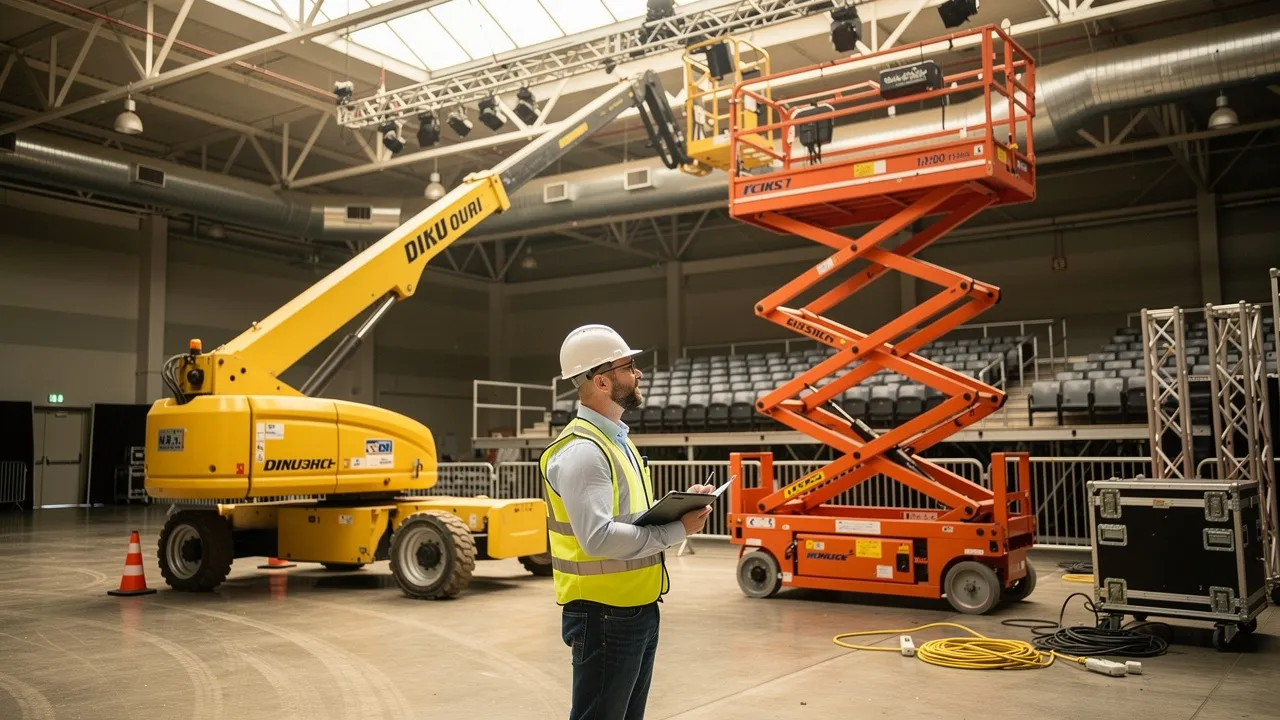
Start with the controlling tradeoff: vertical position or outreach
Boom-versus-scissor decisions in Irving and the Dallas-Fort Worth area are easier when one controlling tradeoff is named first: does the work need the platform to stay above the machine, or must it reach from an offset? Then test that first answer against platform workspace, rated load, entrance clearance, terrain, and changing conditions. The result is not a universal winner; it is a category to advance for model-specific review or a category to set aside until a different requirement is resolved.
Event and facility managers may encounter either condition while arranging temporary lighting, maintenance, construction, or work around an Irving or DFW venue. We list boom lift and scissor lift rentals through our Dallas-area rental service. That listing gives you a place to begin the equipment conversation, but it does not establish that either category fits every elevated task. Describe the work position first, then ask which category and model-specific requirements should be evaluated.
Use this first screen before you focus on height:
- Directly above the machine: Consider a scissor lift when the work calls for straight vertical access and the machine can be positioned below the work area.
- Offset from the machine: Consider a boom lift when the work requires significant horizontal outreach or the platform must reach beyond a fixed obstacle.
- Uncertain position: Write down the obstacle, offset, exterior location, and intended platform position before requesting guidance.
The screen identifies the category question; it does not decide the model or site suitability.
Compare the categories by the requirement that controls
Use this tradeoff matrix as an initial screen for an Irving or DFW project:
| Controlling requirement | Category to evaluate first | What can overrule that starting point |
|---|---|---|
| Work directly above the machine with primarily vertical movement | Scissor lift | Uncertain elevation or reach requires equipment specifications before selection. |
| Significant horizontal outreach or reaching beyond a fixed obstacle | Boom lift | The required approach and reach still need model-specific confirmation. |
| Multiple workers and tools or a need for more platform area | Compare rated capacity and workspace, including the scissor-lift platform-area question | Both capacity and workspace are model-specific. |
| Restricted entrance or operating area | Either category | Actual dimensions and operating clearance determine suitability. |
| Uneven or challenging ground | A verified model rather than an automatic category choice | Check the candidate model against the manufacturer's surface requirements. |
| Adverse weather or high-traffic, changing worksite | Neither category is resolved by the label alone | The planned conditions require further project and model review. |
The matrix produces a category starting point and a reason to pause it; it does not establish a particular model’s suitability.
Your initial decision path can stay simple:
- Locate the work: Decide whether the platform can sit beneath the task or must approach from an offset.
- Describe the reach: Record required height, horizontal outreach, obstacles, and the position from which the work must be performed.
- Screen the site: Note entrances, route dimensions, operating clearance, terrain, traffic, and weather conditions.
- Describe the work demand: Record workers, tools, materials, load, and platform workspace needs.
- Prepare the inquiry: Provide the project location, intended use, timing, expected rental period, height, load, terrain, access, and weather details.
This sequence narrows the conversation without turning a general category into a project-specific promise.
A rental recommendation for an Irving or DFW project still requires details that a category name cannot supply. The requested dates and location affect the rental discussion, while the exact model, dimensions, operating requirements, and arrangement require confirmation before you proceed. Treat the comparison as a way to organize your facts and questions, not as a substitute for reviewing the equipment and project conditions.
Use direct vertical access as the scissor-lift screen
A scissor-lift comparison is the better starting point when the work remains in a straight vertical position and the machine can sit below it. Its platform movement is primarily vertical, and a scissor lift often offers more platform area, depending on the model. That makes workspace and rated capacity the controlling tradeoff when workers and tools are involved; both remain model-specific. Do not carry the scissor category forward as a settled answer when the work is offset, beyond an obstacle, or uncertain in height or reach.
Boom lift selection becomes relevant when the work cannot be reached by simply moving upward from the machine’s base. Significant horizontal outreach, a fixed obstacle, or an exterior work position can require boom-supported platform positioning. Describe the offset instead of writing only “reach the wall” or “work at height.” Include the side from which the platform must approach, what blocks a position directly below the work, and whether the work position changes along the task.
Your direct action is to sketch the machine base, the elevated work area, and any obstacle between them. If the work area sits above a workable machine position, ask for a scissor-lift category to be evaluated. If the work area is offset or beyond an obstacle, ask for a boom-lift category to be evaluated. If the sketch does not make the platform position clear, send the uncertainty with the inquiry rather than choosing from the category names alone.
Let reach geometry—not a generic height label—guide the comparison
Working height and horizontal reach describe different parts of the work envelope. Working height addresses how high the task is; horizontal reach addresses how far the platform must approach from its base. A lift that reaches the stated height may still be a poor category match if the platform cannot get to the required position. Write both measurements or estimates, along with the point from which each measurement starts.
An equipment guide describes articulating boom lifts as reaching up to 150 feet, straight boom lifts as reaching up to 210 feet, and scissor-lift working height as averaging between 30 and 50 feet. The same guide states that a scissor lift cannot be used for an elevated workspace above 70 feet. These figures describe guidance rather than a universal threshold for every machine, configuration, or worksite, so do not use them as a substitute for the candidate model’s specifications.
The height information should change the questions you ask, not end the evaluation. A task near the upper end of a general range deserves exact working-height and platform-position questions. A task that requires outreach deserves boom configuration questions even when the vertical height appears modest. A task above the general scissor-lift guidance should be treated as a reason to discuss another category or configuration, not as proof that a particular boom lift is suitable.
If elevation or reach is uncertain, confirm the equipment specifications before selecting a lift. Include these details in your request:
- The height of the work surface or task.
- The approximate horizontal offset from the possible machine position.
- The required platform position at the point of work.
- Any obstacle, roofline, façade, tree, structure, or event installation that affects approach.
- Whether the platform must reach one point or several points.
The category discussion becomes more useful when the geometry is visible.

Compare platform workspace and rated load for the task
Platform workspace matters when the task involves people, tools, materials, or repeated movement within the elevated work area. A scissor lift often offers more platform area than a boom lift, depending on the model. That difference can matter for an overhead installation or maintenance activity where the work position is primarily vertical and the team needs room to arrange tools. Platform area alone does not establish whether the lift can reach the task or operate on the site.
Use workspace as a tradeoff, not as a default preference. If the work is directly above a workable machine position and the team needs room to arrange tools, a scissor-lift category can remain the first category to evaluate. If the platform must approach from an offset or beyond an obstacle, additional area does not resolve the access problem; the scissor starting point should be paused while boom-supported positioning is evaluated. The reverse check matters too: a boom-lift starting point is not established merely because it can approach an offset. If the planned workers, tools, or materials exceed the candidate platform's rated capacity, that candidate must also be paused. For temporary lighting or facility maintenance, state whether the work calls for one primarily vertical workspace or access to several offset points. That distinction tells the rental contact whether platform area or positioning is controlling, without turning either category into a model-fit conclusion.
Rated platform capacity matters whenever multiple workers and tools will be elevated together. Capacity and workspace are model-specific, so list the people, tools, materials, and equipment that must be on the platform rather than describing the load as “light” or “normal.” Keep the load description tied to the platform position and task. A larger work area does not remove the need to compare the rated capacity of the candidate model.
Capacity and workspace should be treated as separate gates. A task may pass the reach screen and still fail the load screen, or offer enough platform area while failing the access screen. Record the combined platform demand before comparing candidate specifications, then ask which requirement limits the options. This is useful when a facility or event task changes between installation and maintenance: do not assume that the same category remains appropriate if the worker, tool, or position requirements change. A category advances only when its reach, workspace, and rated-capacity questions can all be answered for the proposed model.
Prepare a short platform-demand note before you request a recommendation:
- Number of workers who may be on the platform at one time.
- Tools and materials that must accompany them.
- Approximate combined load for the intended work.
- Workspace needed to perform the task without relying on an unplanned position.
- Whether the work requires repositioning between locations.
Use that note to ask which platform workspace and rated capacity should be evaluated. Do not treat a category label as a capacity specification.
After making the note, label the controlling constraint as position and reach, workspace and load, or access and terrain. If workspace and load control while the task is directly overhead, keep a scissor lift under evaluation. If position and reach control because of an offset, keep a boom lift under evaluation. If access or terrain controls, neither label is enough until the model requirements are checked. This prevents a larger platform from being treated as a reach solution or a reach-capable category from being treated as a capacity solution.
Let route and clearance overrule a category shortcut
Route and clearance can overrule either first category screen. For a restricted entrance, either category may work depending on the model; actual dimensions and operating clearance determine suitability. A scissor-lift starting point should be set aside if its dimensions or operating clearance do not work, and a boom-lift starting point should be set aside on the same basis. Provide the entrance, route, and final operating area for a model-specific comparison.
Treat route fit as a rejection test rather than a minor detail. A candidate that cannot pass the entrance, follow the route, or occupy the final operating area should be set aside even when its platform movement matches the task. Conversely, an open route does not establish that the lift has enough operating clearance around the intended platform position. For an Irving or DFW venue or facility, separate the route used during delivery or setup from the area where the lift will work; describe both, along with any unconfirmed measurement. The useful outcome is not “either lift fits” in the abstract. It is a narrower question: which candidate dimensions and operating clearances should be checked against the actual route and work area? If those measurements are unknown, keep both categories provisional.
Operating clearance is more than the entrance measurement. Your route record should identify the space needed to position and operate the machine at the work area, including the space around the platform’s intended position. A lift may pass through an entrance yet fail to fit where the task occurs. Send both the access route and the final operating area when asking which model should be considered.
Your route action is to provide dimensions and photographs or a simple site sketch if available, while identifying any measurement you have not confirmed. Ask whether the proposed category and model dimensions match the entrance and operating clearance. Either lift category remains a possibility until those actual dimensions are compared with the worksite.
Pause the category comparison for surface and changing conditions
Surface and changing conditions can pause the category comparison rather than favor one category automatically. For uneven or challenging ground, carry forward only a verified model whose manufacturer requirements allow the surface. Adverse weather and high-traffic, continually changing worksites create additional aerial-lift hazards, so neither a boom nor scissor label resolves the site question. Record the surface and planned work conditions for the model-specific discussion instead of treating an outdoor or event setting as evidence of category fit.
Adverse weather and high-traffic, continually changing worksites create additional aerial-lift hazards that can expose workers to injury. An Irving or DFW event site may change between setup, public access, maintenance, and teardown, so describe when the lift will operate and what activity may be nearby. Include weather conditions that could affect the planned work window in the rental inquiry rather than treating the date alone as sufficient.
For an event or facility task, use the work window to test whether the category decision remains valid. During setup, the route may be open; during public access, maintenance, or teardown, nearby activity may change the operating conditions. That does not make one lift category preferable by itself. It means the inquiry should identify the phase in which the lift will operate, the traffic or activity nearby, and the weather conditions expected for that window. A direct-vertical task can still begin with a scissor-lift comparison, and an offset task can still begin with a boom-lift comparison, but either starting point should be paused when the surface, traffic, or weather review is incomplete. This gives event and facility managers a practical outcome: identify the condition that could reject the initial category before requesting model-specific confirmation.
Use three separate questions for the site:
- Can the machine reach the work? Describe height, offset, obstacles, and platform position.
- Can the machine occupy the route and work area? Describe dimensions, clearance, terrain, and surface conditions.
- Can the planned work window be evaluated with its changing conditions? Describe traffic, nearby activity, and weather.
If any answer is uncertain, carry that uncertainty into the request. The correct next step is model and site review, not an automatic category decision.

Keep operating and permit questions outside the category shortcut
Aerial-lift category guidance does not replace project-specific operating preparation. Inspections, manufacturer instructions, controls, guardrails, brakes, slope limits, worker training, and nearby hazards belong in the operating discussion after the general category has been identified. Applicable permit questions also belong in project-specific confirmation rather than in a shortcut based only on boom-versus-scissor terminology.
Every aerial or scissor lift should be inspected the first time it is used, daily, and before use on each shift, according to university safety guidance. The inspection guidance includes checking for visible damage, confirming that controls are clearly marked, checking safety devices such as alarms, and testing the range of capabilities. Treat the inspection process as a separate operating requirement, not as evidence that a category fits your worksite.
OSHA guidance says employers must maintain scissor lifts, inspect controls and components before each use, check that guardrail systems are in good working condition, and verify that set brakes hold the lift in position. OSHA guidance also says employers must train workers on scissor-lift hazards, manufacturer operating instructions, material weight limits, worksite hazards, and reporting defects or maintenance needs. Those requirements concern the employer’s operating responsibilities and should not be reduced to a rental-category preference.
Before operating an aerial lift, NIOSH guidance says to check operating and emergency controls, follow manufacturer instructions, set outriggers, brakes, and wheel chocks, and never exceed manufacturer slope limits. Apply the instructions for the specific equipment and site rather than treating a general checklist as a complete operating plan. The category comparison can organize the rental inquiry; it cannot supply the manufacturer’s operating instructions.
Aerial-lift hazards include falls, equipment tip-overs, and electrocution from contact with power lines or electrical wires. Your site description should identify nearby electrical wires, edges, holes, debris, traffic, changing access, and other conditions that may affect the operating discussion. Do not infer that a boom lift or scissor lift removes those hazards. Carry the hazard information into the project-specific review before operation.
Keep these questions in a separate operating and site-confirmation list:
- What inspection process applies before first use, each day, and each shift?
- Which manufacturer instructions govern the proposed model?
- What controls, emergency controls, guardrails, brakes, outriggers, or wheel chocks must be checked?
- What slope and surface requirements apply at the intended operating position?
- What training covers the lift, load, worksite hazards, and defect reporting?
- Which electrical, traffic, weather, and changing-site hazards need to be addressed?
- Which applicable permit questions must be resolved for the project and location?
Build a tradeoff brief for the rental conversation
Include these details in your project brief:
- Project location: Give the Irving or DFW address, venue, facility, or jobsite area.
- Intended use: Explain the installation, maintenance, construction, event, lighting, or other elevated task.
- Timing: State the planned work dates and any setup or teardown window.
- Expected rental period: Describe how long you expect to need the equipment.
- Required height: Give the work height and the highest point that must be reached.
- Required position: Explain whether the platform must rise directly above the machine or approach from an offset.
- Load: List workers, tools, materials, and other items expected on the platform.
- Terrain and surface: Describe level changes, uneven ground, soft areas, slopes, potholes, and debris.
- Access: Give entrance dimensions, route restrictions, overhead limits, and operating clearance.
- Weather and nearby activity: Note conditions or traffic that may affect the planned work window.
This checklist turns a broad request into a project description that can support category and model-specific questions.
A useful inquiry does not need to declare “I need a boom lift” or “I need a scissor lift” before the work is described. You can write that the platform must reach an exterior point beyond an obstruction, or that the platform will sit below an overhead installation and move primarily upward. Add the address, dates, expected rental period, load, route, terrain, and weather conditions. Then ask which category should be evaluated for the stated work position.

Resolve commercial questions after the category screen
After the category screen, reserve the remaining questions for the arrangement itself: ask about availability for the location and dates, pricing for the expected period, delivery or pickup, responsibilities, insurance requirements, and exact rental terms. These questions follow the comparison; they do not decide whether boom or scissor is the better starting category.
Your confirmation questions should cover the complete arrangement:
- Is a suitable unit available for the requested location and dates?
- What pricing applies to the expected rental period?
- Is delivery or pickup available, and what responsibilities apply to each?
- What responsibilities apply during the rental arrangement?
- What insurance information or requirements apply?
- What exact rental terms should you understand before proceeding?
- Which model-specific dimensions, working height, platform capacity, terrain requirements, and operating clearances must be evaluated?
These questions keep the commercial arrangement separate from the general boom-versus-scissor comparison. They also prevent an assumed category from becoming an assumed price, schedule, delivery plan, or model fit.
Availability, pricing, delivery or pickup, responsibilities, insurance requirements, and exact rental terms are project-specific matters. Your prepared brief should ask for them directly and identify any detail that remains unknown. Do not base the decision on an assumed rate, assumed delivery window, or assumed equipment specification.
Send the category question with its controlling facts
Use the comparison’s outcome in the request: identify the controlling condition—direct vertical movement, offset outreach, platform workspace or load, or a route or surface constraint—and ask EZ Equipment Rental which category and model specifications should be evaluated. Keep unresolved conditions visible rather than converting the first category screen into a claim about fit.
We are headquartered in Irving, Texas, and located at 1307 W Airport Fwy, Irving, TX 75062. Our listed hours are Monday through Friday from 7:30 AM to 5:30 PM and Saturday from 7:30 AM to 5:00 PM; we are closed on Sunday. We list boom lift and scissor lift rentals through our Dallas-area rental service, giving you a local starting point for a project-specific discussion.
Before you send the prepared details, make sure the brief names the project location, intended use, work dates, expected rental period, required height, platform position, load, terrain, access route, operating clearance, and weather conditions. That information supports a focused request about category, model specifications, availability, pricing, delivery or pickup, responsibilities, insurance requirements, and exact terms.
What should you confirm before requesting a boom lift or scissor lift?
What factors should I consider when choosing between a boom lift and a scissor lift for my project?
Consider the work position, whether it requires primarily vertical access or significant horizontal outreach. Also, evaluate the height, obstacles, surface conditions, and the number of workers and tools that will be on the platform.
How do I prepare for a rental inquiry for a boom lift or scissor lift in Irving or DFW?
Prepare a project brief that includes the project location, intended use, timing, expected rental period, required height, load, terrain, access route, and any weather conditions that may affect the work.
What are the typical working heights for boom lifts and scissor lifts?
Articulating boom lifts can reach up to 150 feet, straight boom lifts can reach up to 210 feet, while scissor lifts typically have a working height averaging between 30 and 50 feet.
What safety considerations should I keep in mind when using aerial lifts?
Ensure that pre-use inspections are conducted, follow manufacturer instructions, and be aware of hazards such as falls, equipment tip-overs, and electrocution risks from nearby power lines.
How can I confirm the suitability of a lift for my specific worksite conditions?
Check the manufacturer's requirements for surface suitability, measure the route and operating clearance, and ensure that the lift can navigate any obstacles or uneven ground.
What are the responsibilities I should clarify before finalizing a rental agreement?
Ask about unit availability, pricing, delivery or pickup options, insurance requirements, and any specific responsibilities during the rental period.
Sources
- Is a Scissor Lift Right for Your Irving or DFW Construction Project? — blog.ezequipmentrental.com, 2026-10-27
- Scissor Lift vs Boom Lift: Key Differences Explained — avanzaequipment.com
- Working Safely with Scissor Lifts — www.osha.gov
- Aerial Lifts Safety — www.cdc.gov
- Should You Rent a Rough Terrain Scissor Lift in Irving or DFW? A Project-Fit Decision Guide — blog.ezequipmentrental.com, 2026-10-30
- Boom Lifts vs Scissor Lifts: A Comprehensive Guide to Choosing the Right Aerial Lift for Your Project — dozr.com
- Aerial Lift Safety — www.cdc.gov
- EZ Equipment Rental Offers Air Compressor Rental Solutions Across Dallas
- EZ Equipment Rental provides industrial equipments -