
Begin with a go-or-no-go project question
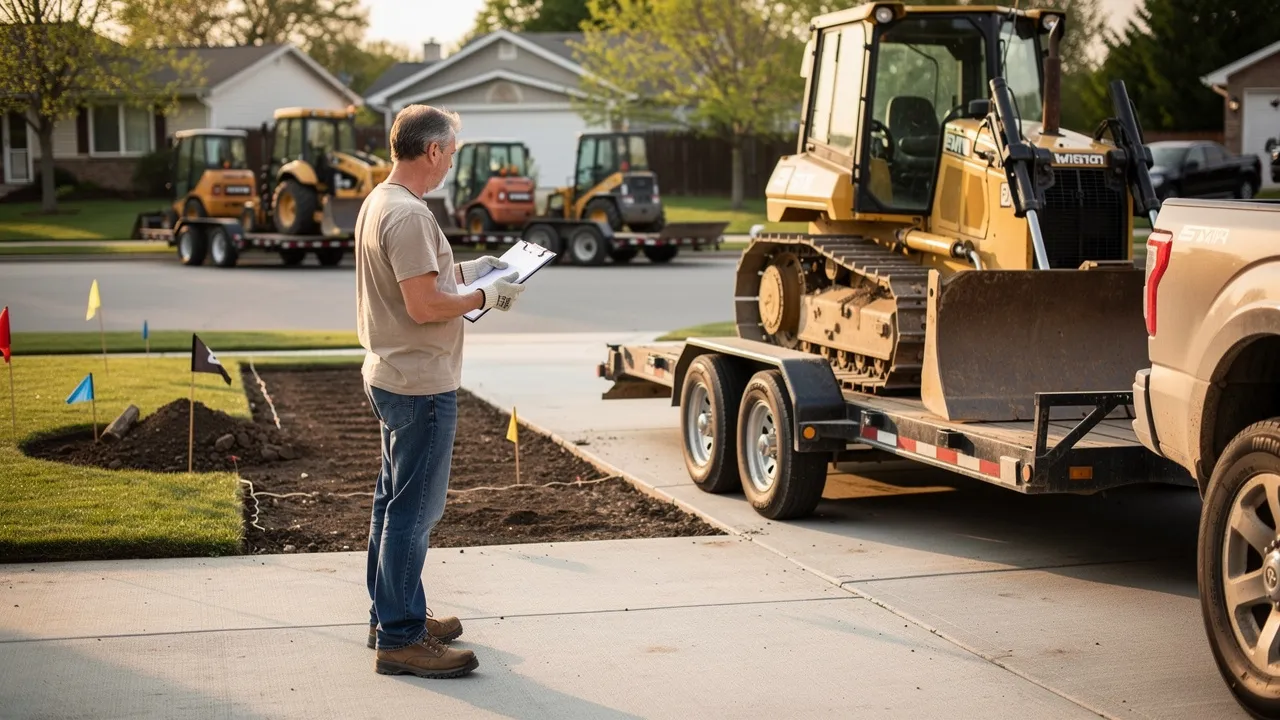
A bulldozer rental decision starts with the work your project must accomplish, not with a machine name. In Dallas-Fort Worth, dozer rentals are used for grading, clearing, and pushing material. Renting can provide access to earthmoving equipment for grading, clearing, and site preparation without requiring you to purchase a machine. Those uses can make a bulldozer inquiry reasonable, but the project still has to justify the category and the rental arrangement.
A go-or-no-go screen gives you a practical first decision:
- Go forward with an inquiry when you can describe the material or area to be cleared, graded, or pushed, identify the Irving or DFW jobsite, and estimate when the work will happen.
- Pause before requesting a specific machine when the job description is only “yard work” or “moving dirt” and you cannot yet explain the result you need.
- Keep the arrangement open when you do not know whether you need bare rental or delivery with an operator. State that question instead of assuming an answer.
A clear inquiry does not promise that a bulldozer will fit. It gives the rental conversation enough substance to address fit, timing, transport, and cost. Use this screen to separate inquiry readiness from rental readiness. Inquiry readiness means you can state the work, desired result, material, approximate scale, project city, access conditions, and timing. Rental readiness would require direct answers about the proposed category or model, availability, transport, price, billing, and operating arrangement; this article cannot establish those answers. If the first group is concrete and the second group is clearly listed as open questions, the request is ready to submit. If the first group is vague, pause before chasing a specific machine or rate. For an Irving or wider DFW project, the location and access facts frame the transport question, while the task and ground facts frame the equipment and wear discussion. Mark unknown items as questions rather than filling them with assumptions. To make the decision repeatable, sort the record into three states. Ready to inquire means the work and intended result are specific enough to describe, the project location is known, and the timing is usable even if equipment details remain open. Needs project detail means the task, material, scale, or access is too vague to support a meaningful category discussion; improve the record before asking for a specific machine. Needs provider confirmation means the project brief is usable but availability, class, transport, rate, billing, or operating arrangement is unresolved; those items belong in the inquiry rather than in your assumptions. This distinction prevents two opposite errors: submitting a bare “bulldozer near me” request with no project facts, or delaying a useful inquiry because every rental detail is not known. Review the three states separately before sending the form.
Describe the result before describing the machine
The project result should be the first line of your equipment request. Dallas-Fort Worth dozer rentals are associated with grading, clearing, and pushing material, while earthmoving equipment can also support site preparation. Use those work descriptions only when they match what you actually need to accomplish; a broad label such as “landscaping” does not tell a rental contact enough about the task.
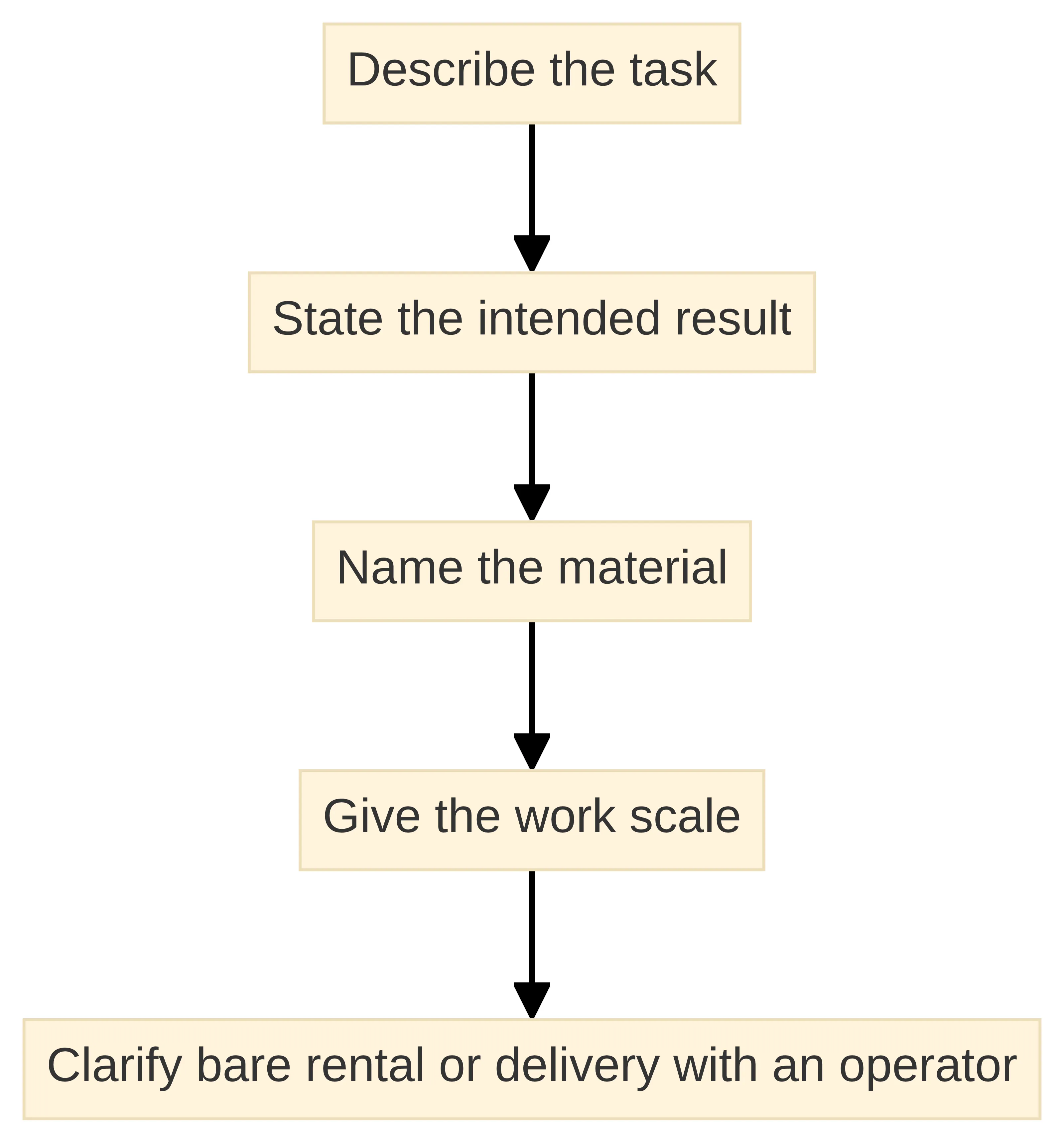
Your work description can answer four practical questions:
- What must change? Describe whether you need to grade an area, clear vegetation or debris, push material, or prepare a site.
- What is the intended result? Explain whether the goal is a more level area, a cleared work zone, a moved pile, or another defined project outcome.
- What material is involved? Name the material you expect the machine to encounter, such as soil, clay-heavy ground, vegetation, or loose material, without guessing how a particular machine will perform.
- What is the scale of the work? Give an approximate work area, pile, path, or section rather than relying on the machine category alone.
This description helps separate a genuine bulldozer question from a request that needs a different equipment conversation. It also gives the contact enough context to discuss a broad category without treating a particular model as settled.
A useful opening request names the task plainly: “I need equipment for grading a residential area in Irving,” or “I need to clear and push material at a DFW jobsite.” Add the approximate area, material, and desired result after that first sentence. When you ask for pricing, state whether you are asking about bare rental or delivery with an operator, because those are different arrangements to clarify.
Use the site record to expose fit questions
A jobsite record turns a general equipment search into a fit conversation. For a Fort Worth or DFW job, ask about machine class, operating weight, horsepower, blade, lowboy logistics, and wear or cleaning exposure, especially when the site has clay-heavy conditions. The local-fit record should also identify the project city or DFW area, intended work, timing, and site-access details.
Write down these site facts before you contact a rental business:
- Project location: Give the city, neighborhood, or DFW area. “Near Dallas” is less useful than “Irving,” “Grand Prairie,” or the specific city where the machine would work.
- Ground conditions: Describe whether the area is soil, clay-heavy ground, an existing surface, a slope, or another condition you can observe.
- Work area: Note the approximate size, shape, and limits of the area where grading, clearing, or pushing would occur.
- Access route: Describe the entrance, gate, driveway, street approach, turning space, and any narrow or restricted passage that could affect transport or maneuvering.
- Nearby constraints: Record structures, fences, landscaping, overhead obstructions, stored materials, or other features that affect the available work space.
- Transport question: State whether you are considering pickup or delivery and which part of that choice needs an answer.
These details do not decide equipment suitability by themselves. They give the supplier concrete conditions to address rather than leaving the machine category to guesswork. Keep observations, estimates, and confirmation questions separate in the record. An observation is something you can describe about the site, such as an entrance, gate, slope, nearby obstruction, or visible ground condition. An estimate is your planning approximation, such as the expected work area, pile size, usable space, or timing. A confirmation question asks the supplier to interpret those facts, such as whether the access route supports the proposed transport arrangement or whether the stated ground condition changes the wear or cleaning discussion. This separation matters because an estimate should not be presented as a machine specification, and an observed condition should not be treated as proof that a category will fit. If a detail is uncertain, label it as uncertain and explain what would need to be checked. The resulting record gives the rental contact both the information you know and the decisions that still require a response.
Clay-heavy ground deserves its own line in the request because local planning sources identify wear or cleaning exposure as a cost-variation question for Fort Worth and DFW dozer jobs. You do not need to predict the charge. State the condition and ask how it affects the proposed arrangement, cleaning expectations, or other quoted terms. Read each site field as a prompt for a different confirmation question: the project city frames local logistics, the entrance and turning space frame lowboy discussion, the ground condition frames wear or cleaning questions, and the work area and nearby obstructions frame the category and maneuvering conversation. This does not create a formula for selecting a machine. It prevents one general description, such as “residential landscaping,” from carrying several separate assumptions about access, transport, and equipment fit. If a site fact is unknown, identify it as unknown and ask what information the supplier needs to evaluate the proposed arrangement.
Treat dozer class as a question, not a conclusion
Dozer class should remain a question until the work and site have been described. Operating weight, horsepower, blade, lowboy logistics, and site wear or cleaning exposure can affect the rental conversation for a Fort Worth or DFW job. Your task is to provide the conditions that shape that conversation, not to select a class from a single online label.
A mini dozer may be a practical starting point for many landscaping projects because of its maneuverability and small profile, but that observation does not settle the fit for your property. Use it as a prompt for a more precise question: “Would a smaller dozer category suit this work area and access route?” Include the dimensions of the work area and the route to it so the specific fit can be addressed.
A class-focused request can include the following questions:
- What operating-weight range fits the stated grading, clearing, or pushing task?
- Which horsepower and blade information should be compared for the work?
- Would the site access support the proposed category and its transport arrangement?
- Does the clay-heavy condition change the wear, cleaning, or logistics discussion?
- If the project is residential landscaping, should a smaller category be considered before a larger one?
Ask for a category recommendation rather than naming a machine as though the choice has already been made. The resulting conversation can stay tied to your work, site, and transport facts.
Separate the work window from the rental window
Your work window and your rental window are related but not identical. The work window is when you expect to perform the task; the rental window is the period the agreement bills or reserves. Give the planned start date, usable work days, expected duration, and schedule flexibility so the rental contact can address the applicable period instead of estimating from a single calendar date.
Billing intervals can change how a short delay affects the request. Many rental agreements define billing as 8-hour days, 5-day or 40-hour weeks, and a 28-day month, with possible limits on prorating weekly or four-week charges after an interval is crossed. Ask how your planned duration will be billed before treating a daily figure as your total rental cost.
Put these schedule details in your project record:
- planned start date;
- number of usable work days;
- estimated total duration;
- days when the site will be accessible;
- whether weather, preparation, or another phase could move the start;
- the date by which the machine would no longer be needed.
Then ask which rental period corresponds to that schedule and what happens if the work ends earlier or runs longer. This is a request for the applicable terms, not an assumption about how the agreement will calculate time. Record schedule certainty separately from duration certainty. You may know the planned start date while still being unsure how many usable work days the project will require, or you may know the expected duration while the start date remains flexible. State which part is firm and which part may change. That distinction gives the rental contact a clearer basis for discussing a daily, weekly, or 28-day billing interval and for explaining how an early finish or extension would be handled. It also keeps a work estimate from being mistaken for a rental-period commitment. For a more useful schedule discussion, write three versions of the timing where they are relevant: the expected plan, an earlier finish, and a longer-running job. The expected plan states the date and duration you currently anticipate. The earlier-finish version helps you ask how an unused portion of the rental period would be treated. The longer-running version helps you ask what happens if the work crosses the planned end date or billing interval. You do not need to predict which scenario will occur; the purpose is to identify the schedule changes that could affect the agreement. If the start date is firm but the duration is not, say so. If both are flexible, identify the range of timing you are trying to discuss without turning that range into a promised availability window. This gives the provider a clearer set of timing questions while preserving the distinction between your project estimate and the terms that must be confirmed.
Build transport into the request
Transport belongs in the first inquiry because a bulldozer request involves more than the work area. State the site location, access route, available entry space, and whether pickup or delivery is the question you need answered. A DFW project-fit record is intended to capture site-access details and the access choice before a quote is discussed.
Lowboy logistics can affect the conversation for a Fort Worth or DFW job. Include the street address or project area, gate or driveway information, turning constraints, and any route detail you already know. Ask how the proposed machine would be transported and whether the quoted arrangement includes a separate delivery or pickup charge. Do not infer feasibility or a delivery window from the location alone.
A transport section in your request can use this short sequence:
- Give the jobsite city and address or the location details available at the inquiry stage.
- Describe the entrance, driveway, gate, street approach, and room to turn or position equipment.
- Say whether you prefer pickup, are asking about delivery, or need help determining the practical option.
- Ask whether delivery and pickup are billed separately and how the charge is calculated.
- Ask whether site access, lowboy logistics, or clay-heavy conditions change the proposed arrangement.
The provider can then address transport as part of the rental question rather than as a cost added after the equipment discussion.
EZ Equipment Rental’s stated delivery list includes Irving, Dallas, Fort Worth, Arlington, Grand Prairie, Plano, Garland, Coppell, Carrollton, and other DFW locations. That list identifies locations to raise in an inquiry; it does not establish delivery timing, price, route feasibility, or whether a bulldozer is available for your dates. Include the exact project location and ask for the applicable transport details.
Ask for the complete price picture
An indicative Dallas-Fort Worth source lists small-class bulldozers at $440–$560 a day and large-class bulldozers at $1,200–$1,500. Those figures are planning context, not a quote for your project. The same source says to confirm exact pricing when you request a quote, so do not use a range to assume availability, model, or final cost.
Heavy transport can add a separate planning question. One Fort Worth and DFW planning source lists delivery or pickup for heavy transport at $350–$1,000 or more per move and says the actual charge should be confirmed with the vendor. Another DFW source describes delivery and pickup as typically billed separately, with the amount based on distance. Treat both points as reasons to request the actual transport charge, not as a total for your job.
A useful price request separates the parts that may appear in the final arrangement:
- the equipment rate for the proposed class or model;
- the rental period and billing interval;
- delivery and pickup, if either is used;
- the fuel policy;
- the damage waiver or rental protection terms;
- the minimum rental period;
- any cleaning or wear discussion that applies to the site conditions;
- the point at which additional time or a changed schedule affects billing.
Ask for the actual pricing structure rather than multiplying an indicative daily figure by your expected days. A daily calculation may not account for delivery, pickup, billing intervals, fuel, damage waiver, or minimum-period terms. Review any response in three layers. First, check the equipment layer: proposed category or model, machine class, operating weight, horsepower, blade, applicable rate, and dates. Second, check the movement layer: pickup or delivery, lowboy logistics, separate transport charges, and any access issue that still needs an answer. Third, check the agreement layer: billing interval, fuel policy, damage waiver, minimum rental period, and relevant cleaning or wear terms. This structure makes comparisons fairer because a daily figure for one arrangement is not automatically comparable with a figure that leaves transport or contract terms unresolved. If one layer is missing, mark that item as needing clarification instead of treating the quoted figure as a complete project cost.
Billing deserves a direct question because many agreements use defined daily, weekly, and monthly intervals. Ask whether the proposed arrangement uses an 8-hour day, a 5-day or 40-hour week, or a 28-day month, and ask how the agreement treats a rental that crosses one of those intervals. This gives you a clearer comparison between the work window and the amount you may be billed.
Your request can say: “Please provide the rate for the proposed bulldozer category, the rental period that applies to my schedule, delivery and pickup charges, fuel policy, damage waiver, minimum rental period, and any relevant cleaning or wear terms.” Add the project location and site conditions so the response addresses your arrangement rather than a generic figure.
Clarify the operating arrangement
The operating arrangement should be explicit in your request. In Dallas-Fort Worth, a dozer inquiry should state whether you need bare rental or delivery with an operator. Those words describe different questions for the supplier, so do not leave the arrangement hidden inside a general request for a price.
Support can also vary by supplier and arrangement. Some rental dealers provide equipment-selection assistance and operator training, so ask the specific supplier what support is available for the proposed equipment and rental format. Keep the question open; do not assume that selection help, training, or an operator is included.
Include these lines in the operating section of your inquiry:
- “I am asking about bare rental,” or “I need to discuss delivery with an operator.”
- “Please tell me what equipment-selection assistance is available.”
- “Please tell me whether operator training is available for the proposed arrangement.”
- “Please identify any operating requirements that apply to the specific equipment and arrangement.”
That wording requests information without treating support, training, or operating conditions as settled facts. Keep the two operating arrangements separate when reviewing the response: a bare-rental question asks what equipment and terms would apply without assuming an operator, while a delivery-with-an-operator question asks the supplier to address that arrangement directly. Do not silently combine the two answers. If the supplier responds with equipment-selection help or training information but does not address whether an operator arrangement is available, continue treating the operator question as unresolved.
Keep permits and operating rules in the confirmation lane
Permit and operating questions need a separate confirmation step. The Texas Business Licenses & Permits Guide provides state-level permit information and says its content is for information purposes rather than legal advice. Use it as a starting point for state-level information, not as an answer to the requirements for your particular project or rental arrangement.
Your inquiry can ask which current resources or requirements apply to the specific arrangement, whether any operating support is available, and what information the supplier needs before discussing the equipment. Keep licensing, permits, training, and other operating rules in the question lane until the appropriate current resource or qualified professional addresses them. Do not write that a particular requirement applies unless it has been established for your situation.
Distinguish EZ Equipment Rental’s confirmed local role
EZ Equipment Rental serves industrial businesses and homeowners with equipment for various projects. EZ Equipment Rental offers a wide assortment of heavy machines for rent and sale for construction phases. Those business facts make EZ Equipment Rental a local equipment contact for a project inquiry, but they do not establish that a bulldozer is in inventory, available for your dates, or suitable for your site.
EZ Equipment Rental provides personalized recommendations based on your specific needs and budget. Give the recommendation conversation useful inputs: the work, material, work area, access route, project city, schedule, duration, transport preference, and bare-rental or operator question. A specific recommendation still needs direct confirmation of the equipment category, model, timing, price, and terms.
The practical distinction is simple:
- Established: EZ Equipment Rental serves homeowners and industrial businesses, offers heavy machines for rent and sale, and provides personalized recommendations based on needs and budget.
- Still to ask: whether a bulldozer option is available, which category or model fits, when it can be provided, how it would reach the site, what it costs, and which terms or operating conditions apply.
Keep those two groups separate in your request. That approach lets EZ Equipment Rental respond to the actual project without turning a general equipment fact into an unverified bulldozer claim.
Use DFW location details to make the request actionable
EZ Equipment Rental is located at 1307 W Airport Fwy, Irving, TX 75062. EZ Equipment Rental’s published hours are Monday through Friday from 7:30 AM to 5:30 PM, Saturday from 7:30 AM to 5:00 PM, and closed Sunday. Use the Irving location as a clear local reference when your project is in Irving or elsewhere in the DFW area.
A location-ready request can open with three facts: the DFW city where the work will occur, the planned work, and whether you are asking about pickup or delivery. Add the site address or project area, entry conditions, start date, expected duration, and your preferred operating arrangement. The Irving address and stated DFW delivery locations help frame the contact; they do not replace questions about the specific bulldozer arrangement.
Assemble the inquiry in one compact record
A compact project record gives the rental contact the facts needed to address local fit. The DFW project-fit guidance calls for the project city or DFW area, intended work, broad equipment category, timing, site-access details, and the question of pickup or delivery. Add the planned start date and duration alongside the details that explain the work and schedule, so the request can move beyond a generic “bulldozer for rent near me” search.
Use this structure for your contact-form message:
- Project location: City, address, or DFW area.
- Intended work: Grading, clearing, pushing material, site preparation, or the specific combination involved.
- Desired result: What you need the work area or material to look like after the task.
- Ground and material: Soil, clay-heavy ground, vegetation, debris, loose material, or another observable condition.
- Work area: Approximate dimensions, limits, slopes, piles, and space available for maneuvering.
- Access: Gate, driveway, street approach, turning room, route constraints, and nearby obstructions.
- Equipment question: Bulldozer category under consideration, with operating weight, horsepower, blade, or smaller-category questions left open for discussion.
- Schedule: Planned start date, usable work days, expected duration, and schedule flexibility.
- Transport: Pickup, delivery, or help deciding which access option to pursue.
- Operating arrangement: Bare rental or delivery with an operator.
- Price questions: Equipment rate, billing interval, delivery and pickup, fuel, damage waiver, minimum rental period, and relevant wear or cleaning terms.
This format keeps the request focused on the project while giving the supplier a clear list of items to address.
A sample request can read as follows:
“I am planning [grading, clearing, pushing, or site preparation] at [city and project location] in the DFW area. The work involves [material and approximate area], and the intended result is [result]. The site has [access and ground details], including [gate, driveway, route, turning, or clay-heavy conditions]. I expect to start on a date to be confirmed and need the equipment for about [duration]. Please advise whether a bulldozer category is appropriate, whether bare rental or delivery with an operator should be considered, and what pickup or delivery options apply. Please also provide the applicable rate, billing period, transport charges, fuel policy, damage waiver, minimum rental period, and any relevant operating or cleaning questions.”
Replace the brackets with your own facts. Do not fill an unknown item with a guess. The bracketed terms are prompts, not information to submit unchanged. Before sending the message, replace each prompt with a project-specific fact or state that the item needs confirmation. The finished request should ask EZ Equipment Rental to confirm the bulldozer category, availability, pricing, transport, terms, and operating arrangement rather than implying that any of those details is already settled.
Before submitting the record, read it once for missing logistics rather than adding more equipment terminology. The project city, work, timing, duration, access route, and pickup-or-delivery question should be easy to find. A concise record with concrete facts gives you a better basis for a direct response than a message that names a machine but leaves the jobsite and schedule unexplained. If the message needs to be shortened, preserve the fields that change the inquiry first: project city or area, intended work and result, ground or material condition, access, planned timing and duration, pickup or delivery question, and bare-rental or operator preference. Then retain the questions about category, availability, price, billing, transport, fuel, damage waiver, minimum rental period, and operating requirements. This priority order keeps the request usable even when every site detail cannot be described at length. It also prevents the most important unknowns from disappearing during editing: a shorter message should remove repetition, not the facts that frame equipment fit or the terms that require direct confirmation. Before submitting, check that each remaining detail is either a project fact, a planning estimate clearly identified as such, or a question for EZ Equipment Rental to answer.
State what the checklist cannot decide
A project checklist can organize your request, but it does not establish equipment availability, pricing, rental terms, delivery, or equipment suitability. Those items remain direct confirmation questions. The same boundary applies when a general bulldozer category appears to match the task: a category label is not confirmation of a particular machine or arrangement.
Leave these points open until the rental contact addresses them:
- whether a bulldozer option is available for your requested dates;
- which model or category corresponds to your work and access conditions;
- the exact equipment rate and applicable rental period;
- delivery and pickup availability, timing, and charges;
- fuel policy, damage waiver, and minimum rental period;
- billing intervals and how an early finish or schedule change is treated;
- cleaning or wear questions for the stated site conditions;
- whether the arrangement is bare rental or involves delivery with an operator;
- equipment-selection support, operator training, or other support available from the specific supplier;
- operating, permit, or other requirements that apply to your particular arrangement.
The price and logistics questions have to be answered together. A low daily figure without transport, billing, fuel, damage-waiver, or minimum-period information is not a complete project cost.
Use the checklist as a preparation tool, then ask for direct answers to the unresolved items. Do not present an indicative regional rate, a delivery-location list, or a general equipment category as a promise about your project. Keep the practical boundary clear: the request organizes the questions, while the specific rental response addresses the arrangement. When a response arrives, audit it against the same record used for the inquiry: project and work, proposed category or model, schedule, operating arrangement, transport, price, billing, fuel, damage waiver, minimum rental period, cleaning or wear terms, and operating requirements. Mark each item as answered, needing clarification, or still unresolved. If the proposed category or operating arrangement changes, revisit the transport and pricing questions rather than carrying the earlier assumptions forward. A response that confirms only a general heavy-equipment service is not the same as confirmation of a bulldozer for the stated dates and site. This review gives you a practical follow-up path without turning planning information into a suitability or availability decision.
Submit the prepared request through the contact form
A confirmation-ready bulldozer request connects the work, site, schedule, transport, operating arrangement, and cost questions in one place. EZ Equipment Rental provides personalized recommendations based on your specific needs and budget, so include those project facts rather than asking for a machine name alone. Ask for the proposed category or model, availability, timing, total rental and transport costs, billing terms, and operating requirements to be addressed directly.
For individual engineering, legal, operating, or equipment-suitability decisions, use a qualified professional who can assess your specific situation. Keep the contact message factual, identify the decisions that remain open, and avoid treating general planning information as a personal determination. Your final preparation is the completed project brief with the location, intended work, access, schedule, duration, transport preference, and operating question clearly stated.
What should you confirm before requesting a bulldozer rental?
What should I include in my bulldozer rental inquiry?
When inquiring about a bulldozer rental, include details such as the project location, intended work (like grading or clearing), material involved, approximate work area size, access route, planned start date, expected duration, and whether you prefer pickup or delivery.
How do I determine if a bulldozer is suitable for my project?
To assess bulldozer suitability, describe the specific tasks you need to accomplish, the material you will be working with, and the conditions of the job site. This information helps clarify whether a bulldozer is the right choice for your project.
What factors can affect the cost of bulldozer rental?
Factors that can influence bulldozer rental costs include the machine class (operating weight and horsepower), delivery logistics, and site conditions, particularly if the job site has clay-heavy ground.
What should I confirm regarding delivery and pickup for my bulldozer rental?
Confirm whether delivery and pickup are billed separately and ask about the fuel policy, damage waiver, and minimum rental period in your quote.
What operating arrangements should I specify when renting a bulldozer?
Specify whether you need a bare rental or delivery with an operator in your inquiry, as these arrangements involve different considerations and costs.
Where is EZ Equipment Rental located and what are their hours?
EZ Equipment Rental is located at 1307 W Airport Fwy, Irving, TX 75062. Their hours are Monday to Friday from 7:30 AM to 5:30 PM and Saturday from 7:30 AM to 5:00 PM; they are closed on Sunday.
Sources
- Bulldozer Rental Rates in Fort Worth (Daily/Weekly) — 2026 Costs — www.countbricks.com, 2026-03-11
- Rent Equipment Near Me in DFW: A Project-Fit Decision Guide — blog.ezequipmentrental.com, 2026-10-26
- Texas Business Licenses & Permits Guide — gov.texas.gov
- Do You Need a Permit to Rent a Bulldozer? | Cat Rentals℠ — rent.cat.com
- Choosing the Right Bulldozer for Your Project - H.O. Penn — www.hopenn.com
- Dozer Rental Tips for Large Earthmoving Projects | May Machinery — maymachinery.com
- Bulldozer Rental in Dallas-Fort Worth (2026 Rates) — www.rentd.com, 2026-07-08
- Contact EZ Equipment in Dallas, TX — www.ezequipmentrental.com
- About Us - EZ Equipment Rental | Dallas, TX
- Equipment & Tool Rentals in Dallas TX - EZ Equipment Rental
- EZ Equipment Rental provides industrial equipments -