
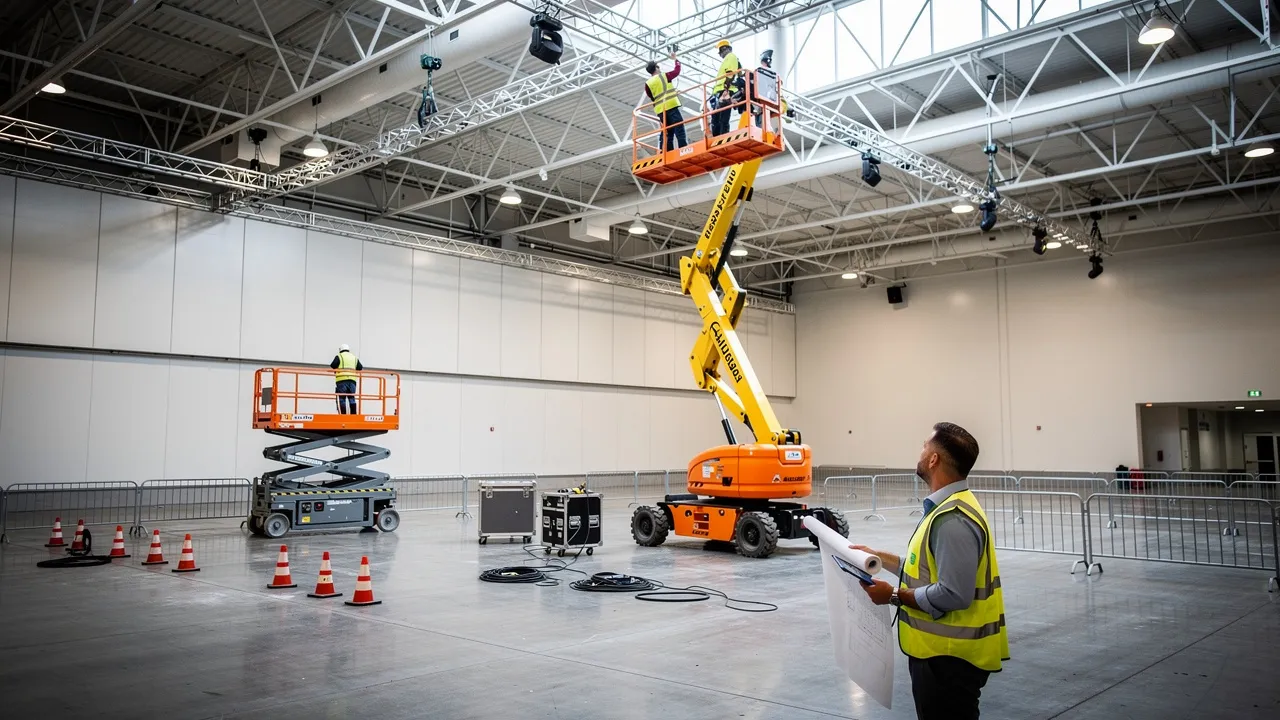
Make the reach decision before choosing a lift
Lift selection starts with the way your crew must reach the work area, not with a familiar equipment label. A boom lift reaches up and out, while a scissor lift raises a platform straight up. That difference determines whether you need to work around an obstruction, position directly below the task, carry materials on the platform, or move through a defined route. Choose the lift type based on working height, reach, terrain, and capacity requirements.
Use this first comparison to describe the job before you request a unit:
| Job condition | Scissor lift | Boom lift |
|---|---|---|
| Access path | Straight up to work directly overhead | Up, out, or over an obstacle |
| Position | Generally directly beneath the work area | Can be positioned around obstacles |
| Platform need | Wider platform for workers and materials | Narrower platform, commonly suited to one or two workers |
| Terrain starting point | Firm, level surface; rough-terrain models also exist | Some configurations suit rough, uneven, or sloping terrain |
| First inquiry question | Can the machine reach the task from directly below? | How far out, over, or around must the platform reach? |
The table is a starting screen, not a project-specific approval. Record the actual task, access route, surface, crew, materials, and hazards before you settle on a category.
Use a scissor lift for direct overhead work
A scissor lift may fit direct overhead work when you can place the machine beneath the work area and need a stable platform with room for workers and materials. That arrangement can suit ceiling work, lighting, warehouse racking, facility maintenance, or other tasks where the work face is broadly above the machine rather than beyond an obstruction. Scissor lifts provide wider platforms, while boom lifts are typically suited to one- or two-person jobs with a narrower basket. Choose a scissor lift when straight-up access and platform workspace describe the job.
A scissor-lift inquiry should answer these questions:
- Can the machine remain directly beneath the work area throughout the task?
- Does the platform provide the space needed for the planned crew, tools, and materials without exceeding the machine’s stated limits?
- Is the travel path wide enough, and can the lift reach the work without crossing holes, slopes, debris, or nearby hazards?
- Is the surface firm and level, or do you need a configuration intended for rough outdoor ground?
- Will the work take place inside an Irving warehouse, a DFW facility, or outdoors on a commercial site?
A scissor lift is not the automatic choice simply because the work is elevated. If the crew must reach over structural steel, a roof edge, stored materials, landscaping, or another obstruction, move to the boom-lift questions instead.
Scissor-lift timing also belongs in the initial inquiry. A Long Island rental guide reports that a Skyjack SJ3219 is typically reserved 2-3 weeks ahead for standard jobs, with longer lead times for commercial or facility projects requiring multiple lifts at once. That report does not establish availability in Irving or elsewhere in DFW, but it shows why you should provide the work dates and number of lifts during early planning. Ask for project-specific availability rather than treating the reported interval as a local promise.

Use a boom lift when the work must reach out or over
A boom lift may fit work that requires the platform to reach up and over an obstacle or access a difficult position. The machine can be positioned around obstacles, whereas a scissor lift generally needs to sit directly beneath the work area. That distinction matters for exterior maintenance, structural work, signage, event lighting, and facility tasks where the point of access is not directly above an open floor. A boom-lift request should state the working height, outreach, terrain, and surrounding hazards.
Boom-lift configuration should follow the shape of the reach. An articulating boom may suit work around structural steel, while a straight boom may suit long, open reach. Before you request either configuration, describe the obstruction, the distance from the setup point to the work, the required working height, and the route the machine must travel. More reach is not a substitute for checking footprint, turning space, ground conditions, and stability requirements.
Reservation timing is a planning consideration, not a DFW availability determination. A Long Island rental guide reports that boom lifts such as the JLG 450AJ are typically reserved 2-4 weeks ahead.
Boom-lift transport can be a separate planning item. One rental-cost guide reports that a flatbed truck and trailer to deliver a boom lift can cost $300-500 round trip. That range is a guide-level estimate, not a quote for your Irving, Fort Worth, Grand Prairie, or other DFW location. Ask whether delivery, pickup, route constraints, and any site access requirements are included in the project estimate.

Convert height into a working-height and terrain check
Working height is the measurement you should place in the lift inquiry. Platform height describes where the deck stops, while working height is the platform height plus roughly 2 m; select the lift by working height rather than platform height. Measure the point where the task will actually be performed, then account for the position from which the platform must approach it. Do not add a person standing on a rail or an improvised platform to create extra height.
Aerial-work-platform fit depends on more than the height number. Before selecting a unit, record:
- Ground conditions, including firm soil, pavement, slopes, holes, loose material, and changes in elevation.
- Turning space, doorway or gate dimensions, aisle width, and the route from delivery point to work area.
- Required working height, horizontal outreach, basket or platform capacity, and travel requirements.
- Nearby structures, overhead objects, power lines, communication cables, traffic, and people.
- Whether the machine must remain stationary, travel while lowered, or cross a surface that may not support its weight.
Some boom-lift configurations suit rough, uneven, or sloping terrain. Scissor lifts are best on firm, level surfaces, although rough-terrain models exist. Ask for a configuration that matches the recorded site conditions instead of choosing a larger machine merely because it offers more reach.
A useful lift request names both the target and the approach. For example, describe the working height, the distance out from the setup point, whether the platform must pass over a structure, and the surface under the wheels or outriggers. An Irving facility with a clear interior aisle raises different questions from an outdoor DFW site with uneven ground and limited turning room. Send those conditions together so the equipment discussion addresses access geometry rather than height alone.
Match the site surface and indoor environment to the configuration
Indoor and outdoor conditions can point toward different lift configurations. Electric scissor lifts may suit enclosed environments and tight aisles, while rough-terrain models are designed for outdoor uneven surfaces, mud, and slopes. Specific boom-lift configurations can also allow work on rough, uneven, or sloping terrain, while standard scissor lifts are best used on flat surfaces. Describe the surface and environment before asking which category is available.
A configuration note for a DFW rental inquiry should cover:
- Indoor or outdoor use, including an enclosed warehouse, facility, event venue, or open construction area.
- Surface type and condition, such as concrete, pavement, compacted soil, mud, slope, or uneven ground.
- Aisle, doorway, gate, turning, and overhead-clearance limits.
- Whether tires, power source, outreach, outriggers, or stabilizers need to match a particular surface or work zone.
- The distance between the delivery point and the actual work area.
Keep the site description factual. If the ground, access route, or configuration is uncertain, pause the selection and request qualified site evaluation before use.
Other equipment can create a separate scheduling dependency. A Long Island rental guide reports that track loaders are typically reserved 2-3 weeks ahead, with longer lead times for multi-week jobsite assignments. That timing does not predict DFW availability, but it is a reminder to identify every machine needed for the same work phase, not only the lift. Coordinate the requested dates for the lift and supporting equipment before the site crew is scheduled.
Map the work zone before equipment arrives
The work zone determines whether the selected lift can be placed and operated. Check the work zone for drop-offs, holes, unstable surfaces, slopes, ditches, bumps, debris, inadequate ceiling height, overhead power lines, communication cables, other overhead obstructions, hazardous atmospheres, severe weather, and people close to the work.
A practical site map should show the delivery entrance, travel route, setup area, work face, overhead clearances, restricted areas, pedestrian paths, and any place where the machine could encounter unstable ground or an obstruction. Include the intended position of workers and nearby operations. Treat overhead power lines and communication cables as energized. Stop the setup and obtain qualified direction when the map cannot establish a clear, controlled work zone.
Set the safety questions before the first lift
Overhead lines and communication cables require a firm boundary before work starts. Treat every overhead power line and communication cable as energized, stay at least 10 feet (3 meters) away, and have the power utility de-energize nearby power lines before work. Include the line location and required clearance in the site plan. If the work area cannot maintain that separation, do not position or operate the lift until the responsible utility and site-safety personnel establish the control.
Lift operating limits must be confirmed for the specific machine. Do not exceed vertical or horizontal reach limits, operate in winds above the manufacturer’s recommendations, or override hydraulic, mechanical, or electrical safety devices. Ask which instructions govern the planned configuration and how the site will monitor changing conditions. A request for more height or reach is not permission to exceed a stated limit.
Platform conduct must be settled before anyone rises. Keep access gates or openings closed, stand firmly on the platform floor, and never climb or lean over guardrails. Do not use planks, ladders, or other devices to gain height. These boundaries apply even when the remaining reach seems small or the work is taking place inside a facility.
Boom-lift fall protection has a specific connection requirement. Wear fall protection with the lanyard attached to the manufacturer’s boom or basket anchor point, not to an adjacent pole, structure, or piece of equipment. Confirm the required equipment, anchor point, and procedure with the responsible safety personnel before operation. Do not improvise a tie-off because the adjacent structure appears closer.
Operator authorization and daily checks are separate questions. Only trained and authorized personnel may operate boom lifts and scissor lifts. Test lift controls each day before use, and take any lift with a safety-affecting defect out of service until repaired. The pre-use review should cover the vehicle, controls, protective devices, hydraulic, pneumatic, fuel, and electrical systems, warnings, pins, wiring, outriggers, stabilizers, guardrails, and loose or missing parts.
Stable setup and emergency response belong in the same pre-start discussion. Set outriggers on pads or a level, solid surface, set brakes when outriggers are used, and use wheel chocks on sloped surfaces when it is safe to do so. Identify the ground-accessible emergency-lowering controls and ensure ground crews know how to use them. Before anyone goes up, complete the pre-shift inspection, establish a ground-level rescue plan, and practice emergency-lowering procedures.
Scissor-lift classification can change which requirements you need to discuss. OSHA regulates scissor lifts as mobile scaffolds under construction scaffold standards 29 CFR 1926.451 and 29 CFR 1926.452(w), rather than as aerial lifts. Ask the responsible site-safety authority which applicable rules, approvals, training records, and work practices govern your project. Do not assume that choosing a scissor lift removes the need for fall, stability, inspection, or operator controls.
Plan duration, reservation timing, and the complete cost question
Rental duration should follow the work phase rather than a guess made before the schedule is mapped. Duration often depends on project scope, weather conditions, equipment specialization, and changing construction schedules. Different project phases may need different equipment for different durations; earthmoving machinery may be needed early, while lifting equipment or compactors may be needed later. A daily term may suit a short repair, while a weekly or monthly term may suit an extended project.
Rental terms are typically structured around daily, weekly, and monthly rates, and most rental companies offer those three periods. One rental-cost guide describes the daily rate as the highest per-day cost, the weekly rate as typically 3 times the daily rate, and the monthly rate as typically 3 times the weekly rate; that guide describes a monthly period as 28-30 days. The structure is a planning example, not a quote for an Irving or DFW project. If your project will take 4+ days, the same guide says a weekly rate almost always makes more sense than paying daily.
A complete cost question separates the base rental rate from the items that can change the total. Ask about:
- Rental duration and the rate period that applies to the actual work phase.
- Delivery and pickup, including route distance, machine size, access restrictions, and whether either service is included.
- Fuel or charging responsibilities and any return condition.
- Attachments, accessories, or a different boom configuration.
- Insurance, damage-waiver, maintenance, cleaning, environmental, or other applicable charges.
- Time the machine may sit idle on site while the project waits for another trade or phase.
Delivery and pickup are often not included and can cost $150-500+ depending on distance and machine size, according to one rental-cost guide. Treat that range as general planning information, not an Irving quote. Compare complete, project-specific estimates rather than comparing daily base rates alone. Use the same assumptions when comparing estimates. Each estimate should identify the rate period, equipment configuration, delivery and pickup treatment, fuel or charging responsibility, attachments, insurance or damage-waiver treatment, expected idle time, and return condition. A lower base rate is not necessarily the lower project cost when one estimate excludes more of those items. For equipment used only occasionally, compare the rental total with ownership costs such as maintenance, repairs, storage, insurance, and depreciation. Equipment rental avoids buying, storing, and maintaining equipment for periods when it is not needed. Ask EZ Equipment Rental which assumptions apply to the project-specific estimate before choosing a rate period.
Specialty equipment may be harder to obtain on short notice and may cost more during peak demand. Book early to help have equipment ready on time and reduce the chance of work delays, especially when competition for equipment is high in spring. Early booking does not mean taking delivery before the site is ready; align the requested start date, delivery route, setup conditions, and return timing with the actual work plan.
Your inquiry should ask for a complete estimate based on the described machine, configuration, dates, location, delivery or pickup plan, fuel or charging arrangement, attachments, and other applicable charges. A clear scope helps avoid renting a machine too small to handle the work efficiently or equipment larger and more powerful than needed. Ask for the assumptions behind the estimate so you can compare options without treating an unverified price as a commitment.

Send a lift-ready inquiry from Irving or the DFW jobsite
A lift-ready inquiry gives the rental team enough context to discuss category, configuration, timing, and site questions in one exchange. Include the following details:
- Project location: city, site address, entrance, delivery restrictions, and whether the work is in Irving or another DFW community.
- Task: what must be installed, repaired, maintained, lifted, or accessed.
- Reach: required working height, horizontal outreach, approach direction, and any obstacle the platform must clear.
- Site: indoor or outdoor setting, surface, slope, ground condition, aisle or gate dimensions, turning space, and overhead hazards.
- Load and people: planned crew, tools, materials, and the platform-space requirement.
- Schedule: planned delivery timing, first use, expected duration, work phase, and return or pickup preference.
- Safety and approvals: operator authorization, applicable site rules, inspection plan, utility coordination, and questions that require qualified confirmation.
- Cost: delivery or pickup request, fuel or charging plan, attachments, insurance or other charges, and the rate period you want compared.
If a project detail is not yet known, the inquiry should identify the detail as an open question rather than guess. Unknown project details may include working height, outreach, platform load, gate width, turning space, ground condition, overhead clearance, operator status, or delivery route. EZ Equipment Rental can then identify which measurements or site checks are needed before a machine is selected. An explicit follow-up list prevents an unverified equipment category from being treated as a confirmed fit.
A clear project scope helps keep the discussion focused on equipment that is neither too small for the work nor larger than needed. Seek a rental consultation for a complex project, a tight timeline, or unfamiliar machinery, preferably during early planning so you have time to compare options and check availability. Book early, then keep the requested dates tied to the work phase rather than reserving a machine without a defined use window.
EZ Equipment Rental is located at 1307 W Airport Fwy, Irving, TX 75062. We are open Monday to Friday from 7:30 AM to 5:30 PM and Saturday from 7:30 AM to 5:00 PM, and we are closed on Sunday. Include the jobsite city and delivery or pickup preference even when you plan to work near the Irving location, because the project location affects the rental discussion.
A concise message can follow this order: “I need access equipment for [task] at [DFW location]. The work point is approximately [working height] with [outreach or obstacle]. The surface is [condition], the route is [access constraint], and the work is [indoor or outdoor]. We expect the planned crew and materials on the platform during the requested rental period. Please help identify the suitable category and list delivery, pickup, fuel or charging, attachments, insurance, and other applicable cost items.” Replace each bracket with a verified project detail before sending.
Stop when the fit or operating conditions are uncertain
Equipment use should stop when the fit or operating conditions are unclear. Do not proceed if the working height, outreach, platform capacity, ground stability, overhead clearance, weather limit, travel route, operator authorization, inspection result, or emergency plan has not been established for the specific machine and site. Do not operate a lift with a safety-affecting defect, and do not bypass a safety device to make the task possible.
Review the work area for hazards and clearances as a separate site task. A clean rental handoff does not establish that the work area is ready for this site.
Weather decisions need both the machine instructions and the work-zone conditions. Avoid using lifts in winds over 20 mph and during severe weather, and do not operate above the manufacturer’s stated wind limit. Stop when wind, ice, visibility, lightning, or another severe condition makes the manufacturer’s limit or the site control uncertain. Ask the responsible safety authority for qualified direction before restarting.
The first action for an unresolved condition is to keep the lift out of service and prevent the work from moving into the affected area. Notify the responsible site or safety person, preserve the location and hazard information, and seek qualified equipment or safety evaluation before changing the setup. If anyone is elevated during a mechanical problem, use the established ground-level rescue and emergency-lowering plan; do not improvise a rescue or continue operation.
Request a project-specific recommendation from EZ Equipment Rental
The useful next step is a project-specific discussion built from your task, working height, outreach, terrain, hazards, schedule, delivery or pickup plan, and cost questions. We provide access to high-quality boom lifts for rent in Dallas, and we offer flexible daily, weekly, and monthly rental terms tailored to project schedules and emergency repair situations. We are located at 1307 W Airport Fwy, Irving, TX 75062. A qualified equipment or safety professional must decide whether a particular machine and setup are suitable for your site, operators, and work conditions.
Before you send your inquiry, have the jobsite location, task, working height, outreach, obstacles, surface, access route, crew and material needs, dates, duration, delivery or pickup preference, operator information, and unresolved safety questions ready. That information lets the next conversation address the actual work instead of relying on a lift label or an unverified assumption.
What should you confirm before arranging a construction-site rental?
Are scissor lifts considered aerial lifts in the United States?
The terminology depends on the framework. OSHA construction rules may regulate scissor lifts under mobile-scaffold provisions, while ANSI/SAIA A92 groups scissor lifts and boom lifts as mobile elevating work platforms (MEWPs). Confirm the applicable requirements with the responsible site-safety professional or authority before use.
What should you do when a lift’s wind limit is unclear?
Do not operate the lift until you confirm the manufacturer’s stated wind limit and the site’s weather controls for that specific machine. Some guidance also recommends avoiding lift use when winds exceed 20 mph or during severe weather, but the manufacturer’s instructions and qualified site-safety direction govern the project decision.
What information helps confirm whether a lift can reach the work area safely?
Provide the required working height, horizontal outreach, approach direction, obstacles, platform load, crew and materials, ground conditions, turning space, travel route, overhead hazards, and indoor or outdoor setting. If any of these details are unknown, pause the selection and obtain qualified equipment or site-safety guidance rather than assuming a larger lift will solve the problem.
Sources
- Excavator Rental Cost How Much Does It Cost to Rent an Excavator - fivestarequipment.com
- Boom Lift vs. Scissor Lift Comparison Guide - platformbasket.ca
- Boom Lift vs. Scissor Lift: Key Differences - rent.cat.com
- Aerial Lift and Boom Lift Safety Guide (2026) - projul.com
- Scissor Lift vs. Boom Lift: Which Is Right for You? - cnsinolift.com
- Aerial Lifts FactSheet - osha.gov
- What Does It Cost to Rent Heavy Equipment | Cat Rentals℠ - rent.cat.com
- Boom Lift vs Scissor Lift: Which Aerial Lift is Right for Your Job? - zumasales.com, 2025-10-01
- How to rent industrial equipment - blog.ezequipmentrental.com, 2026-07-22
- Aerial Work Platform Guide: How to Choose the Right Working Platform and AWP Type - Leading Construction Machinery Manufacturer | Kaishun - globalfu.com
- Aerial Lift: OSHA Rules and Safe Use | SMS360 - sms360.com
- Scissor Lift vs. Boom Lift: Which One Fits Your Job? - diamondtrainingservices.com
- Boom Lift vs Scissor Lift: Choosing the Right EWP - barklyhire.com.au, 2026-11-02
- eTool : Scaffolding - Aerial Lifts | Occupational Safety and Health Administration - osha.gov
- Toolbox Talk: Aerial Lift Safety - OSHAccredited Safety Institute | Safety and Health Training - oshaccredited.com
- Equipment Rental Costs: What to Expect in 2025 - versirentals.com, 2025-06-01
- Factors That Determine Equipment Rental Lengths - synergyequip.com
- Know When To Get Guidance On Construction Equipment Rentals - Rentalex - rentalex.com
- Daily vs Weekly vs Monthly Heavy Equipment Rentals - eqsllc.com
- Heavy Equipment Rentals Guide for Construction Projects - papertownrental.com, 2026-11-20
- How Far in Advance to Rent Equipment on Long Island - jehrentals.com
- Here's How to Prepare for Your Equipment Rental - Lewisburg Equipment Rental - westbranchrental.com