
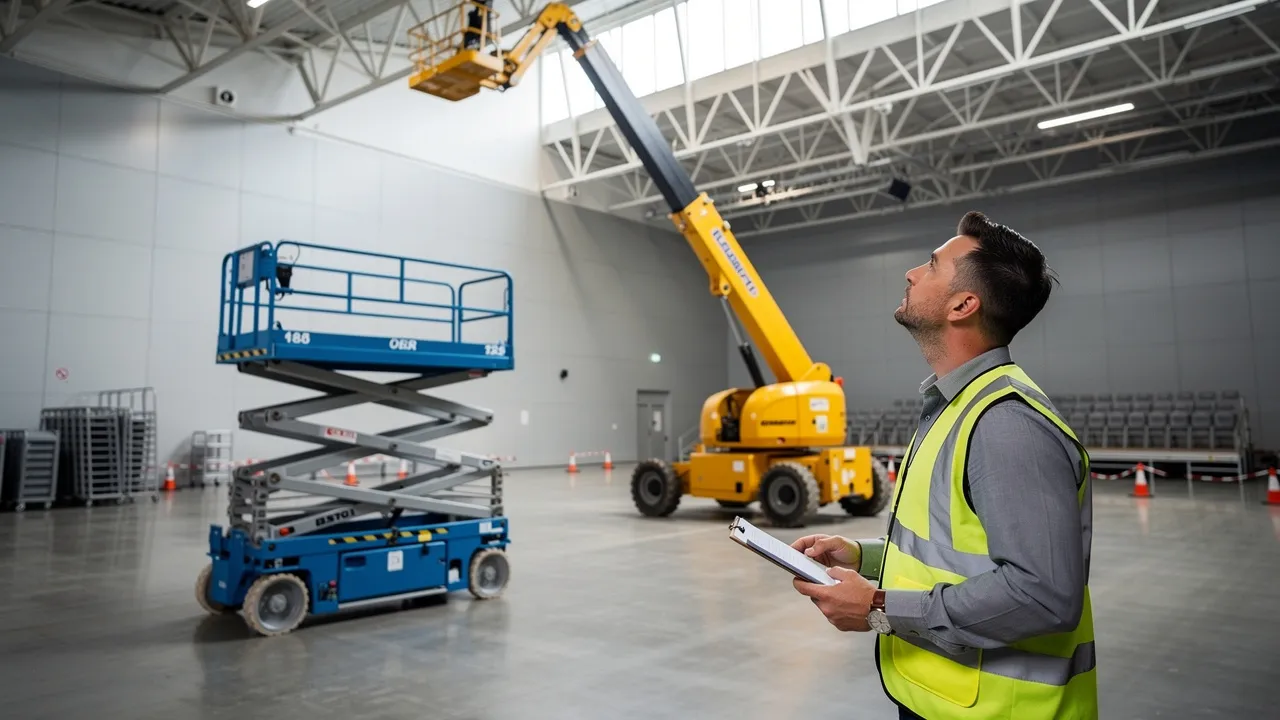
What “Contractor Lift” Means in Practice
The phrase “contractor lift” is a broad, informal way to describe aerial equipment used to help workers perform elevated tasks. It does not identify one precisely defined machine. A boom lift, scissor lift, vertical mast lift, personnel lift, or crawler lift may fit that general description, but each category creates a different work envelope.
The useful starting point is the work rather than the label. Identify where the work is located, how high and how far the platform must reach, what surface supports the machine, how much weight must be carried, and how the equipment will enter and leave the site. That record gives you a practical basis for comparing lift categories and requesting a project-specific recommendation.
Aerial equipment can differ in movement, platform arrangement, terrain suitability, power source, and access requirements. A machine that works for direct overhead maintenance inside a facility may not fit an exterior wall, a sloped work area, or a route with narrow gates. Treat the term as a starting point for classification, not as a specification to place on a rental request.
Overview
The direct answer is to identify the work envelope before choosing a lift or requesting a rental quote. Aerial lifts help workers perform elevated tasks, while different lift types are designed for different jobs. Your work envelope should include the required working height, horizontal reach, terrain, total load, access path, power source, indoor or outdoor setting, and available setup space.
Use that information to narrow the category:
- Choose a scissor-lift path when the platform can sit directly beneath the work and the surface supports the machine’s intended use.
- Choose a boom-lift path when the work is offset from the machine, must pass over an obstacle, or requires both vertical and horizontal reach.
- Investigate mast, personnel, or crawler categories when the route is narrow, the machine must be positioned manually, or ground pressure and access width make a conventional machine unsuitable.
The category is only a preliminary match. A qualified rental professional must assess the particular model, site, and operating conditions before use.
A practical screening sequence is straightforward:
- Describe the task and the exact work area.
- Record the maximum working height and any horizontal offset.
- Measure gates, doorways, aisles, overhead clearances, turning space, and the intended delivery route.
- Describe the surface, slope, grade changes, and indoor or outdoor environment.
- Add the combined weight of operators, tools, materials, and equipment that may be on the platform.
- State the rental duration and the desired delivery or pickup arrangement.
A complete record gives the rental provider usable details instead of a category name that could mean several different machines.

Key Highlights
The most useful distinctions are these:
- A scissor lift raises its platform straight up and down without lateral or outward reach.
- A boom lift provides vertical and horizontal reach, including access over obstacles or to points that are not directly above the machine base.
- A scissor lift generally requires direct placement beneath the work, while a boom lift can change the approach to an offset work point.
- Surface, access, load, power source, and site conditions can change which category fits the task.
Use these points to choose the next question, not to make a final model selection.
Published figures provide orientation rather than a quote for an Irving or DFW project. One comparison source states that scissor lifts are suitable for 6-14 meters of operation, while boom lifts can be used for 12-45 meters of operation.
Your next action is to write down the work envelope and send it with the rental request. Include the task, height, reach, surface, access route, total load, indoor or outdoor setting, duration, and delivery point. That information lets a qualified rental professional address fit and price as separate questions instead of treating the phrase “contractor lift” as a complete specification.
Use the Access Pattern to Separate Scissor Lifts from Boom Lifts
Scissor lifts and boom lifts solve different access problems. A scissor lift raises its platform straight up and down, so the machine must be positioned directly beneath the work area. A boom lift can provide vertical and horizontal reach when the target is beyond the machine base or an obstacle blocks a direct approach.
| Access question | Scissor lift | Boom lift |
|---|---|---|
| How does the platform move? | Straight up and down | Upward and outward through a boom |
| Where must the machine sit? | Directly beneath the work area | In a position that allows the boom to reach the work |
| What happens when an obstacle blocks a direct path? | The machine may not provide the needed offset | The boom may reach over or around the obstacle |
| Which boom arrangement changes the approach? | Not applicable | Articulating booms bend around obstacles; telescopic booms reach in a straight line |
This comparison narrows the category, but it does not establish whether a particular model can reach the work safely.
Typical scissor-lift heights range from 15 feet to 50 feet, and capacities range from about 500 pounds on compact models to 1,500 pounds on rough-terrain units. Those figures describe typical ranges across equipment categories, not the capacity or working height of a specific rental machine. The platform load still includes the people, tools, and equipment carried during the task.
A boom-lift approach deserves more attention when the work is above an obstruction, along an exterior wall, or away from the machine’s base. Articulating boom lifts bend around obstacles, while telescopic boom lifts reach in a straight line. For work above 12 meters, a boom lift may provide greater height than a scissor lift, but this general guidance does not replace checking the specific model and worksite.
Match the Lift to the Surface and Operating Environment
Surface conditions can eliminate a category before height becomes the deciding factor. Scissor lifts are designed for flat, level surfaces and are not suitable for rough or uneven terrain. Boom lifts can handle rougher terrain and outdoor use because they have sturdy tires, but the particular ground conditions still need a site-specific assessment.
Describe the surface in practical terms: paved floor, finished interior surface, compacted ground, uneven ground, slope, grade change, soft area, or an area with a risk of settlement. Include the route to the work point, not only the final position. A machine that can operate at the destination may still fail the access or setup check along the way.
Electric scissor lifts are relatively clean and quiet, making them suited to indoor use. That can matter for facility maintenance, warehouse work, event setup, or work near occupied areas where exhaust and engine noise affect the setting. Indoor use does not remove the need to check floor conditions, clearances, travel paths, load, and operating requirements.
Rough-terrain scissor lifts may use heavy-duty tires, four-wheel drive, traction control, or leveling outriggers for rough or sloped ground. Those features describe a category’s possible configuration, not permission to operate on any slope or surface. Ask for a configuration that matches the site assessment.
Compact electric scissor lifts can travel in elevators and reach up to about 26 feet, making some multilevel buildings workable jobsites. Confirm the elevator, doorway, floor, and route constraints for the particular machine before planning that approach.
For an Irving or wider DFW project, record whether the work is inside a facility, on a paved exterior area, or on uneven outdoor ground. Then pair that description with the access pattern. A level indoor task may point toward an electric scissor-lift discussion, while an exterior task with offset reach may point toward a boom-lift discussion; a qualified rental professional must resolve the project-specific fit.
Recognize Mast, Personnel, and Crawler Lift Categories
Vertical mast lifts are slim, one-person machines, and some models can fit through doorways or elevators. They can be relevant when the work point is indoors and the route is narrower than the route required by a larger platform. Vertical mast lifts typically range from 15 feet to 30 feet in height and from 300 pounds to 500 pounds in capacity.
Those ranges describe the category, not a guaranteed specification. Measure the route and state the number of people, tools, and materials involved before asking whether a mast lift fits.
Personnel lifts, sometimes called push-around lifts, are manually rolled into position and use stabilizing outriggers before the platform is raised. Personnel lifts typically have working heights of 20 feet to 40 feet and capacities around 300 pounds. The manually positioned design may suit a particular compact indoor task, but you still need to account for the complete route, setup area, platform load, and operating requirements.
Spider or crawler lifts are lightweight, track-mounted lifts with outriggers and are often used when ground pressure, access width, or terrain makes normal booms risky. Their presence in the broader taxonomy does not mean every rental provider offers them. Describe the constraint that led you to investigate this category and ask whether a suitable machine is available for that specific site.
Mast, personnel, and crawler categories expand the screening list; they do not replace a site assessment. Use them to explain why a narrow route, manual positioning requirement, low ground-pressure concern, or unusual terrain may need a different discussion from a standard boom or scissor lift.
Record the Work Envelope Before Choosing a Lift
A work-envelope record turns a general equipment search into a usable rental brief. Capture these fields:
- Task: State whether you are installing, maintaining, painting, cleaning, inspecting, trimming, lighting, or performing another elevated task.
- Working height: Identify the highest point that must be reached, including the effect of guardrails, obstacles, slopes, and grade changes.
- Horizontal reach: State whether the platform must extend over an obstacle or reach a point away from the machine base.
- Surface and terrain: Describe level, rough, sloped, paved, finished, soft, or uneven ground.
- Access: Record gates, doorways, aisles, overhead clearances, turning space, delivery placement, and setup space.
- Load: Add every operator, tool, material, and piece of equipment that may be onboard.
- Environment and duration: State indoor or outdoor use, power-source constraints, and the expected rental period.
Choose equipment that can reach the work without overextending, but leave the final model and operating decision to a qualified rental professional.
A boom-lift rental source says a 34- to 45-foot articulating lift is usually sufficient for residential work such as painting a two-story exterior or trimming tall trees. The same source says commercial construction, larger-structure roofing, or utility-line work may require a 60- to 135-foot telescopic lift. These examples show why the task, reach, and structure matter; they are not a model recommendation for your site.
A separate workshop-equipment source says a commercial-grade, ALI-certified two-post lift with a 10,000-pound capacity typically costs between $3,600 and $5,500 for the equipment alone, while heavy-duty 12,000- to 15,000-pound certified models generally range from $4,700 to more than $7,500. Those figures describe purchase equipment, not an aerial-lift rental quote, so they should not be used to estimate your project’s rental cost.
Duration belongs in the work-envelope record because the rental period can affect the price discussion and delivery plan. State the planned start and end window, whether the work may extend, and whether the machine must remain on site between work phases. Avoid committing to a category solely because it appears available for the desired duration; fit and safe use come first.
Check Access, Placement, and Total Platform Load
Access planning should account for gate widths, doorways, overhead clearance, turning radius, delivery placement, and setup space before you request a rental recommendation. Measure the narrowest point rather than the average route, and identify any location where the machine must turn, pass beneath an obstruction, or be positioned near another structure.
Give the measurements to the rental provider with the intended delivery point. A machine that fits the work area may still fail to reach the area if it cannot enter, turn, or be placed with the required clearance.
Maximum load capacity includes the operator and all equipment or tools onboard. Build the total from the people, tools, materials, and other items that may be carried at the same time rather than counting the operator alone.
A capacity label is not a target to exceed. Exceeding an aerial platform’s maximum load capacity can make it susceptible to tipping over and can cause injury to operators or surrounding workers. If the load is uncertain, stop the selection process and obtain a qualified equipment assessment.
Your access note should answer four practical questions: Where will the equipment arrive? How will it reach the work area? Where will it be positioned? What space will remain for workers, pedestrians, vehicles, and the equipment’s movement? Include slopes, obstacles, overhead hazards, and grade changes in the same note so the rental discussion addresses the complete route.
What Contractor Lift Rental Costs Can and Cannot Tell You
Aerial-lift rental prices vary with the machine, market, rental duration, location, and included charges.
The same guide gives a specific boom-lift example of $580 per day and $109 per day when rented monthly. The difference between that example and the broad daily range shows why you need the machine, rental period, market, and assumptions identified before using a figure for budgeting.
Rental expenses beyond the base rate might include delivery and pickup, extended rental periods, insurance coverage, operator training, site assessments, or damage-waiver fees. Pricing can also fluctuate with rental duration and location. Ask for the total cost components in the project inquiry rather than comparing a base daily rate with an all-inclusive figure.
Delivery and pickup fees can range from $150 to over $500, depending on machine size and distance. Damage waivers are often 10% to 15% of the rental price, but they may not be necessary if general liability insurance covers rented equipment. Insurance and waiver decisions depend on your coverage and agreement; obtain qualified advice for your circumstances.
Purchase prices should remain separate from rental budgeting. A workshop-equipment source says mid-rise and full-rise commercial scissor lifts generally range from $3,000 to $10,000 depending on weight capacity and whether they are flush-mounted. That figure is for purchase equipment, not a rental quote, and it does not establish the cost of a scissor-lift rental in Irving or DFW.
A useful cost request asks for:
- The specific lift category and model being priced.
- The rental period and the rate structure for daily, weekly, or monthly use.
- Delivery and pickup charges for the actual site.
- Fuel, charging, insurance, training, site-assessment, and damage-waiver charges, if applicable.
- The responsibilities for maintenance, damage, extension, and return timing.
A quote becomes more meaningful when it follows a completed fit record. Price alone cannot tell you whether the machine can reach the work or operate on the planned surface.
Prepare an Irving or DFW Rental Request
An Irving or DFW rental request should give the rental provider a concise project brief instead of only the name of a lift category. Include:
- The job location and the exact area where the equipment will work.
- The task and the highest work point.
- Required vertical height and any horizontal reach or offset.
- The surface, slope, terrain, indoor or outdoor environment, and nearby obstacles.
- Gate, doorway, aisle, overhead-clearance, turning-radius, delivery, and setup measurements.
- The combined weight of operators, tools, materials, and equipment.
- The planned rental duration and whether the schedule may extend.
- The delivery point, placement restrictions, and site contact.
- Any operator, training, access, power, or site-safety requirements already identified.
A provider can respond more precisely when the brief describes the route and work area as well as the target height.
Operators need authorization and proper training on the specific type of aerial lift they use. Include the operator and training situation in the inquiry so the rental discussion does not treat equipment delivery as permission to operate.
A complete site risk assessment identifies the task, selects an appropriate mobile elevating work platform, assesses risks, establishes controls and safe work procedures, plans rescue from height, and communicates the results. Add any completed site-assessment information to the project brief, but do not treat a written request as a substitute for the assessment itself.
For a project in Irving or elsewhere in DFW, state the municipality and delivery address rather than describing the location only as “near Dallas.” Location affects the practical delivery discussion and the project-specific quote. Include the expected rental window and the work-envelope record in the same request.
Set the Pre-Use Safety Decision Gate
The pre-use decision gate has to answer whether the site, machine, and operating plan are ready. Before using an aerial lift, assess the worksite for hazards and implement controls for fall protection, stabilization, and positioning. Safe aerial-lift use also includes equipment maintenance, following the manufacturer’s instructions, required personal protective equipment, and safe work practices.
Use this sequence:
- Identify the task and the hazards around the work area.
- Confirm that the selected equipment matches the task, reach, load, access, and surface.
- Establish controls for fall protection, stabilization, positioning, overhead hazards, and people near the work zone.
- Confirm that the operator is authorized and trained on the specific lift type.
- Inspect the equipment for damage or unsafe conditions before use.
- Follow the manufacturer’s instructions and the applicable site requirements.
If a condition cannot be resolved, do not move from planning into operation.
A boom-lift pre-use inspection framework includes 35 checkpoints across 6 systems and is performed at the start of every shift or before each use by a trained mobile elevating work platform operator. The framework covers documentation, the chassis, the boom, hydraulics, electrical controls, and safety systems. Use the equipment’s instructions and applicable requirements for the particular machine; do not treat a general checklist as a replacement for the manufacturer’s inspection process.
Inspect the aerial lift for damage or unsafe conditions before use. An aerial lift with defective components must be removed from service until a qualified person makes repairs. A missing inspection, unclear control, damaged component, or unresolved site hazard is a stop condition, not a reason to improvise.

Stop Work When Conditions or Equipment Are Unsafe
Unsafe conditions require a direct response: stop the work, keep people clear, and prevent the lift from being operated or moved until the condition is addressed. Do not use an uncertain route, reach, load, or setup as a field experiment.
Seek immediate help from a qualified equipment professional or responsible authority when an incident, instability, contact hazard, defective component, or uncertainty prevents a clear safety decision. Remove defective equipment from service until a qualified person makes repairs. Do not operate, move, overload, bridge, or improvise with a lift when its suitability or safe use is uncertain.
A completed risk assessment should identify the task, assess the hazards, establish controls, plan rescue from height, and communicate the results. If conditions change after that assessment, pause and reassess before continuing. A rental request can start a fit discussion, but it cannot clear an unsafe site for operation.
Send the Completed Project Brief for Confirmation
Your completed project brief should leave the rental discussion with five clear answers: what work you need to perform, where the work sits, how the lift must reach it, what surface and access conditions apply, and how long the equipment may remain on site. Add the total platform load, delivery point, and any operator or site requirements. That record lets you ask about a boom or scissor lift without presenting a broad category as a final equipment choice.
At EZ Equipment Rental, we provide access to boom lifts for rent in Dallas and offer flexible rental durations tailored to your project requirements. Send the Irving or DFW location, task, work envelope, access measurements, load, duration, and delivery details so we can discuss the applicable rental path.
Questions to Confirm Before Arranging a Contractor Lift
What does “contractor lift” mean, and what equipment can it describe?
“Contractor lift” is an informal umbrella term for aerial equipment used for elevated work, not one precisely defined machine. It may refer to a boom lift, scissor lift, vertical mast lift, personnel lift, or crawler lift. The appropriate category depends on the required height, reach, surface, load, access route, and work environment.
Can a scissor lift reach over an obstacle?
A scissor lift raises its platform straight up and down and must generally be positioned directly beneath the work area. It does not provide the outward reach of a boom lift. When the work is offset from the machine or requires access over or around an obstacle, investigate a boom-lift configuration and confirm the specific model with a qualified equipment professional.
How should I estimate the cost of renting a contractor lift?
Use published figures only as planning benchmarks, not as an Irving or DFW quote. One aerial-lift rental guide states typical costs of $200 - $500 per day, $800 - $2,000 per week, and $2,000 - $5,000 per month, while the same guide gives a specific boom-lift example of $580 per day and $109 per day on a monthly rental. The machine, duration, location, delivery and pickup, insurance, training, site assessment, and damage-waiver charges can change the total.
What should I include when requesting a lift rental recommendation in DFW?
Provide the exact job location, task, maximum working height, horizontal reach, surface and terrain, indoor or outdoor setting, access measurements, overhead clearances, turning and setup space, total platform load, rental duration, delivery point, and any operator or site-safety requirements. Include the combined weight of operators, tools, materials, and equipment. This gives the rental provider enough context to discuss category and model fit rather than treating a general lift name as a complete specification.
Sources
- Scissor Lift vs Boom Lift: Which suits your project? - easyrentall.com, 2023-07-21
- Boom Lift Rental Dallas TX | Aerial Lift Rentals Near You - rntr.com, 2026-06-04
- Boom Lifts? Scissor Lifts? How To Determine The Right Lift For Your Job - vandaliarental.com
- Scissor Lift vs. Boom Lift: Choosing the Right Aerial Lift for Your Job - beehiverentalandsales.com, 2026-02-09
- Boom Lift vs. Scissor Lift Comparison Guide - platformbasket.ca
- Aerial Lifts in Industrial and Construction Environments Leader's Guide - files.apsafetytraining.com
- 8 Types of Construction Lifts and Their Uses - BigRentz - bigrentz.com, 2022-05-04
- ANSI A92 STANDARDS: - dam.jlg.com
- Boom Lift Inspection Checklist | OSHA & ANSI A92.20 Guide - heavyvehicleinspection.com, 2026-07-16
- Aerial Lift Types | The Complete List - conger.com
- eTool : Scaffolding - Aerial Lifts | Occupational Safety and Health Administration - osha.gov
- Types of Construction & Man Lifts - Ritchie Bros. Blog - blog.ritchiebros.com
- What are the Different Kinds of Construction Lifts? - osha.com
- 15 Aerial Lift Safety Tips for Operators, Managers, and Pedestrians - conger.com
- What is the Safest Aerial Work Platform for Indoor Projects? - Man Lift - manliftusa.com
- Types of construction lifts you can use at your worksite - blog.hercrentals.com
- Don't Get Lifted on Price with This Workshop Car Lift Cost Breakdown - autotechsolutions.com, 2026-07-15
- The Complete Guide to Renting Aerial Lifts - pricemachinery.com
- Scissor Lift vs. Boom Lift: Which is Best for Your Construction Needs? - felici-tation.com, 2024-12-30