
Turn the site-work requirement into a machine role
Earth-moving equipment selection starts with the work the machine must perform, not with a machine name. Define whether your Irving or DFW project primarily requires digging, trenching, moving loose material, grading, or a combination of those tasks. That first distinction narrows the rental conversation before you compare access, terrain, depth, attachments, schedule, and transport.
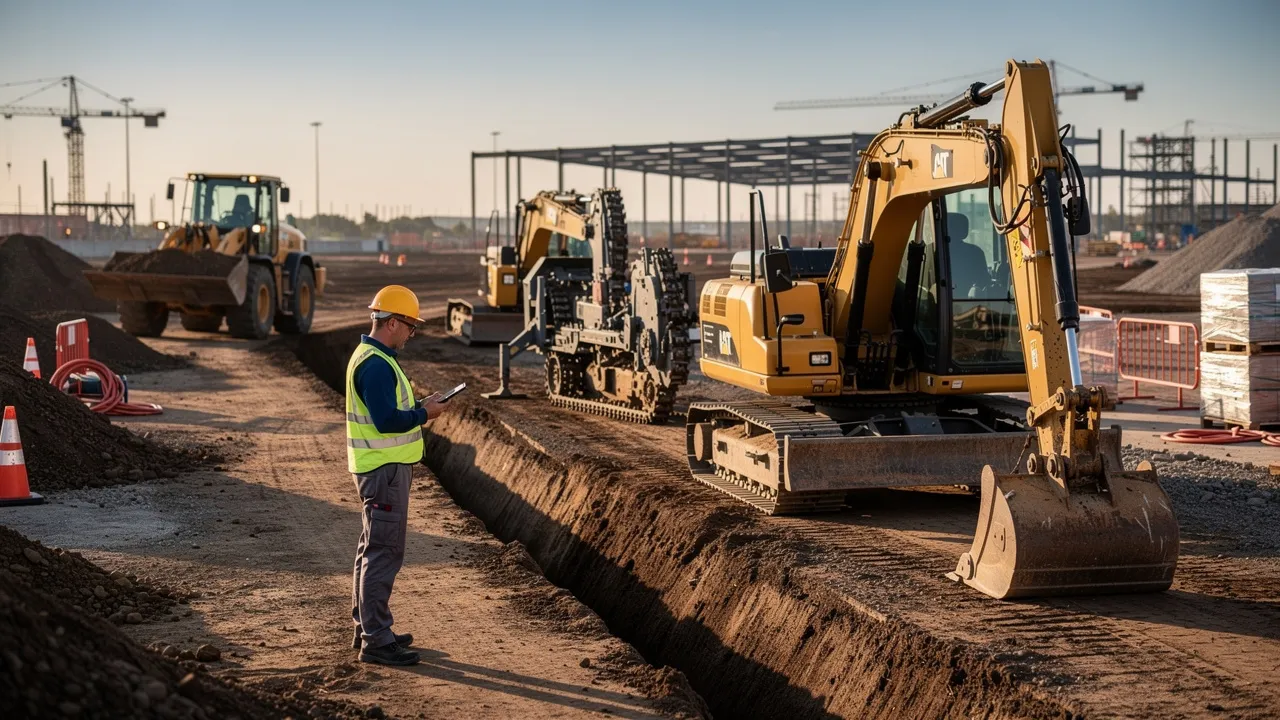
A trencher is a specialized machine for digging trenches, including trenches for cables and pipes. An excavator uses a boom and bucket for digging, trenching, demolition, rock breaking, foundations, and deep holes; larger excavators can also handle materials and other heavy work. A loader scoops loose material and deposits it elsewhere, including snow, sand, gravel, bricks, and piping, and loaders navigate well in soft soil.
Start by writing one sentence that describes the primary output:
- Dig or excavate: Remove soil, create a foundation excavation, open a hole, or reach below the existing surface. Begin with an excavator category and then describe depth, reach, access, and material.
- Cut a narrow trench: Install or expose a cable, pipe, irrigation line, or similar linear service. Begin with a trencher category and describe the required width, depth, length, soil, roots, rock, or pavement.
- Move loose material: Scoop, carry, backfill, or stockpile soil, sand, gravel, bricks, or piping. Begin with a loader or a multi-use category and describe the travel path and destination.
- Shape or level a site: Move and distribute earth across a broader area. Describe the grading stage, the amount of material to move, the desired slope or level, and the space available for the machine.
The primary role does not settle the final equipment choice. It gives you a practical starting point for a complete job brief.
Use access and terrain to narrow excavation choices
Excavation equipment fit depends on project size, terrain, space restrictions, digging depth, and the task requirements. A constrained Irving lot, a commercial site with broad working room, and a rough or unstable DFW work area can require different equipment categories even when the written task is simply excavation. Record the gate or route width, overhead or side clearance, working surface, turning room, spoil location, and the distance between the machine and the work.
Mini excavators are suited to tight spaces. Wheeled versions are best on smooth surfaces such as asphalt, while tracked versions are better on unstable or rough terrain. A mini excavator can be a reasonable category to discuss when the work requires digging or trenching in a confined area, but the final fit still depends on the required depth, reach, attachment, surface, and access route.
Skid steer loaders suit small to medium jobs in tight spaces and on hard surfaces. Their attachments can support material moving, excavation, compaction, grading, leveling, drilling, and lifting. Skid steers come in wheeled and tracked versions and can use attachments such as buckets, augers, trenchers, and grapplers for material moving, site clearing, and small-scale excavation.
Track loaders distribute weight through their tracks and can handle soft, uneven, muddy, snowy, or sloped terrain that wheeled skid steers cannot. That distinction matters when a site surface may change after weather or during earthwork. Describe the ground as it exists during the planned work, not only as it appears during a dry site visit.
Project scale changes the category discussion. Larger projects may need full-sized excavators, while smaller residential or light commercial jobs may suit mini excavators or skid steers. The same reference describes standard excavators as 13-25 tons for mass excavation and site development, with typical reference pricing of $700 - $1,500 per day. Those figures are market examples rather than EZ Equipment Rental rates; confirm the current price for the proposed configuration, duration, attachments, and jobsite.
Treat reach as a separate question from machine size. Long-reach excavators can operate efficiently in deeper or hard-to-reach areas, but that description does not establish a particular machine’s capacity or suitability for your site. Include the intended digging depth, horizontal reach, spoil placement, and any obstruction between the machine and the work in your inquiry.
Match trench work to the cut and ground
Trencher selection begins with the cut you need to make and the ground the cutting system must enter. Trenchers use a cutting wheel or chain and are available in walk-behind and ride-on configurations. Record the trench purpose, required length, width, depth, soil type, roots, rock, pavement, slope, access route, and room for spoil before you discuss a specific unit.
Walk-behind trenchers are used for narrow, shallow trenches. Ride-on trenchers are suited to hard or rocky terrain, pavement, fast trenching, and larger jobs; some have more than 100 horsepower.
These are reference ranges, not a quote from EZ Equipment Rental, and they do not replace confirmation of the proposed machine, configuration, delivery, attachments, rental period, or current price.
Cutting-system choice should follow the material and application. A wheel trencher can cut roots and rock, while a chain trencher can cut harder ground and is frequently used for deep, narrow utility trenches. For hard clay, a heavy-duty trencher or backhoe attachment may be needed; for roots or irrigation work, a chain trencher with appropriate teeth may be called for.
Use those descriptions as questions rather than automatic selections. State whether the route crosses clay, compacted soil, roots, rock, pavement, or more than one surface. If conditions change along the route, describe each segment so the rental discussion does not treat a mixed ground profile as one uniform cut.
Depending on the model and conditions, trenchers range from 10 to 100 horsepower, dig from 2 to 6 feet or more, reach up to 100 feet per minute, and create trenches from 4 to 24 inches or more.
Many trenchers offer adjustable depth control, and attachments such as augers, backhoes, and trenching buckets can expand their uses. Include the required trench depth and width, acceptable variation, and any attachment you expect to need. Do not assume that an attachment, depth-control feature, or cutting system is available with a particular rental; ask for confirmation before reserving it.
Choose machines for moving, backfilling, and mixed site work
Material movement and mixed site work call for a different comparison than a single excavation cut. Backhoe loaders can dig, break rock, backfill, move materials, and perform light demolition; larger backhoes can lift heavy objects without a crane. That range may make a backhoe category worth discussing when one project combines excavation with backfilling and material handling, but the required task, reach, load, and site conditions still need to be stated.
Skid steer loaders are compact and maneuverable for small to medium jobs in tight spaces and on hard surfaces. Attachments can support material moving, excavation, compaction, grading, leveling, drilling, and lifting. A skid steer may fit a work plan that changes between several short tasks, provided the access route, surface, attachment, load, and workspace are compatible.
Bulldozers move and grade dirt across large, open tracts, and their tracks help them traverse soft and muddy ground without sinking. That category belongs in a discussion about broad earth movement and grading rather than a narrow trench or a confined work area. A loader, skid steer, track loader, backhoe, or bulldozer should be compared against the material path and the ground conditions, not selected from the project label alone.
Use the following sequence to separate the likely roles:
- Name the material: Identify soil, sand, gravel, bricks, piping, demolition debris, or another material that must move.
- Name the movement: State whether the machine must scoop, carry, backfill, level, grade, drill, lift, or perform several of those tasks.
- Name the route: Describe the surface, slope, turning space, stockpile location, and distance between the working area and the destination.
- Name the attachment: List the bucket, auger, trencher, grappler, or other attachment under consideration without assuming that it is included.
- Name the phase: Explain whether the machine supports early site preparation, trench backfill, grading, material placement, or another defined phase.
This sequence gives you a clearer comparison between single-purpose trenching and multi-use earth-moving work.
Separate grading stages from earth-moving selection
Site grading is a sequence of planned activities, not a single machine task. A grading project may include surveying, a grading plan, required permits and approvals, clearing, excavation, compaction, drainage installation, final grading, and professional inspection. Site grading can begin with surveying and mapping existing topography, including the location and elevation of natural and man-made features.
A grading plan outlines proposed topography changes, including the location and elevation of building pads, drainage channels, and roads. Earth can then be excavated and moved to reshape a site according to that plan, using equipment such as bulldozers and excavators. Compaction and shaping soil can create a stable base for buildings and other structures.
Grading work can be described in stages so the equipment discussion stays tied to the actual phase:
- Rough grading: Rough grading shapes the site and can remove vegetation, clear debris, and level soil for a stable base.
- Cut and fill: Grading may remove soil from one area and add soil to another to achieve the desired level or slope. Cutting, filling, and compaction may all be part of the work.
- Drainage and planned features: Building pads, drainage channels, roads, retaining features, or other elements may affect the proposed topography and the movement path.
- Finished grading: Finished grading fine-tunes topography for drainage, aesthetics, and function.
- Grade check: The described grading process ends with surveyors checking the grade.
Preparing a site for grading can include removing existing structures or vegetation, such as trees. Describe those activities separately from the earth-moving requirement so clearing, excavation, hauling, grading, and compaction are not treated as one interchangeable task.

Record the site signals that change the recommendation
Equipment needs are shaped by the work, site access, season, terrain, and schedule. Your project brief should turn those signals into concrete observations instead of general descriptions such as small site or difficult ground. Include the address or service area within Irving or the DFW Metroplex, the work phase, the area to be reached, and the dates or working window under consideration.
Record these details before asking for a category recommendation:
- Work scope: Digging, trenching, clearing, grading, backfilling, material movement, demolition, or a defined combination.
- Material and ground: Soil type, clay, rock, roots, pavement, loose material, slope, softness, uneven areas, and any change along the route.
- Access and workspace: Gate or route dimensions, surface, turning room, overhead or side clearance, work area, spoil area, and distance to the stockpile.
- Depth, width, and reach: Required trench dimensions, excavation depth, horizontal reach, lifting or placement point, and acceptable working limits.
- Season and schedule: Planned start, working days, weather-sensitive activities, phase length, and any date when the equipment must be available.
- Site logistics: Haul routes, equipment staging area, material stockpile locations, other trades, and changes that could affect movement.
Long-reach excavators can operate efficiently in deeper or hard-to-reach areas, so include the reach problem rather than requesting only a larger machine. Establish haul routes, staging areas, and stockpile locations early, keep them clear, and communicate changes on an active site.
A useful first draft can fit in a short project note: location, task, material, access, terrain, dimensions, schedule, staging, and the category you want to discuss. Add photographs, a site plan, or a marked route if those materials are available to you. The purpose is to make the physical conditions visible during the rental discussion, not to replace the site decisions that belong to the responsible project team.
Plan duration as a working range
Earth-moving equipment has no single typical project timeline. Rental duration often depends on project scope, weather conditions, equipment specialization, and changing construction schedules. A smaller grading or localized site-preparation project may need machinery for a short period, while a large commercial development, highway expansion, or municipal infrastructure improvement may require extensive preparation and an extended construction period.
Project managers often evaluate the scale of excavation, material transport, or demolition before determining equipment needs. That evaluation gives you a better starting point than choosing a rental term from the calendar alone. Estimate the work in phases, then identify which machine is needed for each phase and how much schedule uncertainty could affect the handoff.
Different project phases may require different equipment for different durations. Earthmoving machinery may be needed during early development, while lifting equipment or compactors may be needed later. Excavators, bulldozers, loaders, and cranes often operate on different schedules based on their assigned tasks.
Specialized equipment may be needed only for a brief portion of a project, while general-purpose machinery may remain active for longer as construction progresses. Some machines may run continuously throughout the workday, while others operate intermittently depending on workflow requirements. Write down the expected number of working days, the likely hours or frequency of use, the task sequence, and the point when the machine can be returned or exchanged.
According to Mordor Intelligence, medium-term rentals lasting between one and twelve months represented 48.26% of the construction equipment rental market in 2025. That market figure describes the share of the construction equipment rental market represented by the stated one-to-twelve-month period; it does not predict the duration or price of your Irving or DFW job.
Use daily, weekly, or longer-term planning as questions for the rental discussion. Explain whether the machine supports one short phase, several connected phases, or recurring work across projects. If the schedule is uncertain, ask how a changed end date, an additional phase, or a different machine need would affect the rental arrangement.
Turn the range into rental questions
Rental planning should connect the job brief to reservation, delivery, pickup, configuration, price, and changing project needs. Equipment availability can affect the project schedule, so ask how far in advance the machinery must be reserved and confirm the expected delivery date. Do not treat a requested start date as confirmation that the equipment is available.
Ask for answers to these questions in the same conversation:
- Category and configuration: Which earth-moving or trencher category fits the stated task, ground, access, depth, reach, width, and attachment requirement?
- Availability: Is the proposed configuration available for the requested working window, and how far in advance should it be reserved?
- Delivery or pickup: Can the equipment be delivered to the Irving or DFW jobsite, or is pickup being considered? What site access or transport details affect that choice?
- Price basis: What is the current price for the proposed equipment, attachment, rental period, and delivery or pickup arrangement?
- Duration: Does the expected use fit a daily, weekly, monthly, or other rental arrangement, and what happens if the work ends earlier or continues longer?
- Changing needs: Could another phase need a different category, attachment, or machine size? Undersized or oversized equipment can cause inefficiencies, and needs may shift as construction progresses, so flexibility matters in rental planning.
- Ground and depth: For a trencher, how do digging depth, wheel versus rubber-track configuration, clay versus rock, and delivery distance affect the cost discussion?
The goal is a comparable answer tied to your actual project, not a generic daily rate detached from configuration and logistics.
A fair rental comparison keeps the task, equipment configuration, attachment, rental period, and delivery or pickup assumption consistent across options. Changing the task, equipment configuration, attachment, rental period, or delivery or pickup assumption can change the pricing or suitability discussion, so record the assumptions beside each response.
Mini excavator rental costs in Irving depend on operating weight, digging depth, bucket size, hydraulic attachments, and rental duration. Those factors show why a machine label alone is not enough to establish a price. Include the proposed work and configuration before comparing daily versus longer-term planning, and ask EZ Equipment Rental to confirm the current details for your job.
Assemble a quote-ready Irving or DFW inquiry
A quote-ready equipment inquiry gives EZ Equipment Rental enough project context to discuss category, configuration, availability, pricing, delivery or pickup, and rental terms. We provide earthmoving equipment, attachments, and trailers among our equipment categories, and we provide personalized equipment recommendations based on your specific needs and budget. Your request should make the jobsite conditions and intended use clear before you ask for a machine match.
Include these details in your inquiry:
- Jobsite: Give the Irving or DFW location, access instructions, delivery restrictions, and whether the site is ready for equipment arrival.
- Primary work: State whether you need digging, trenching, grading, clearing, backfilling, material movement, demolition, or a combination.
- Material and conditions: Describe soil, clay, rock, roots, pavement, soft or uneven ground, slope, drainage concerns, and any change along the work route.
- Dimensions: Provide trench width and depth, excavation depth, required reach, work area, route length, and the location where soil or material will be placed.
- Access: Explain gate or route clearance, surface, turning room, overhead restrictions, staging space, haul routes, and stockpile locations.
- Schedule and duration: Give the desired start window, expected working period, project phase, possible weather or schedule changes, and whether the equipment is for one short task or recurring work.
- Transport: State whether you need delivery or expect pickup, what the equipment must travel through, and where it will be loaded or unloaded.
- Operator and attachments: Describe the operator arrangement and list the bucket, auger, trencher, grappler, breaker, or other attachment you want to discuss without assuming it is included.
- Future use: Record the expected number of uses, likely duration, and whether future jobs will require the same transport function.
- Commercial questions: Ask for current availability, price, delivery or pickup details, reservation lead time, and rental terms for the proposed configuration.
A construction equipment decision starts with what needs to be moved, where the load will go, and how often the project will require transport. That same logic applies to excavation and trenching: describe the work destination, route, frequency, and phase rather than sending only a machine name.
Our mini excavators support digging trenches, landscaping, excavation, trenching, lifting heavy materials, demolition, and grading. We offer flexible rental terms and competitive pricing, but the appropriate term and current price depend on the project information and proposed equipment. We are located at 1307 W Airport Fwy, Irving, TX 75062, and our Irving location gives you a local point of contact for an Irving or DFW equipment discussion.
Send one complete brief rather than separate messages that omit changing site details. A complete brief lets the equipment category, attachment, schedule, delivery or pickup, and rental questions stay connected. It also gives you a clearer basis for comparing the recommendation with the actual work phase.

Pause for qualified evaluation when conditions are uncertain
Grading and excavation decisions can depend on site conditions, planned elevations, protections, permits, approvals, and the operating requirements for the work. Proposed grading work may require permits and approvals from local or state authorities. Confirm the applicable requirements for the Irving or DFW jobsite with the responsible authority before work begins.
Pause the equipment decision when the site condition, required protection, operating requirement, or machine fit is unsafe or uncertain. Do not operate earth-moving or trencher equipment without the training and authorization required for the work. Obtain qualified help for an uncertain or incident-related condition, and follow the project’s responsible safety and site procedures before selecting or using equipment.
The described grading process includes inspection by a professional engineer to certify the work. That statement applies to the described grading process; it does not establish that every Irving or DFW project requires the same inspection. Ask the responsible project professionals and authorities which evaluations, approvals, and protections apply to your work.
Request the current equipment match from EZ Equipment Rental
The right earth-moving or trencher category follows from your task, material, access, terrain, depth, reach, schedule, and rental logistics. A complete Irving or DFW job brief gives EZ Equipment Rental a practical basis to discuss the suitable category, current availability, pricing, delivery or pickup, and rental terms. We provide advice mid-project through knowledgeable team members, while a qualified professional decides whether a specific machine and operating plan suit your individual site conditions.
What should you confirm before renting an earth mover or trencher?
How do I choose earth movers for a mixed excavation and material-handling job?
Separate the work into roles first: excavation or trenching, loading and moving material, backfilling, grading, and lifting. An excavator may suit digging and deep work, while a loader, skid steer, track loader, or backhoe may better fit movement or mixed tasks. Compare each category against the material, route, surface, access, reach, attachments, and project phase rather than choosing one machine for every task automatically.
How far in advance should earth-moving equipment be reserved?
There is no fixed lead time established for every Irving or DFW project. Availability can affect the schedule, especially when a particular configuration or several machines are needed. Ask how far in advance the equipment should be reserved, confirm the expected delivery or pickup date, and allow for weather or schedule changes before committing to a start date.
When should a project team stop before operating rented earth-moving equipment?
Stop when site conditions, required protections, permits, operating requirements, or equipment fit are unsafe or uncertain. Obtain qualified help and confirm applicable requirements with the responsible project professionals and authorities before selecting or operating the equipment.
Sources
- Complete Guide to Construction Site Grading | Equipment & Contracting - equipmentandcontracting.com
- What Is A Trencher And What Size Do I Need? - centralauctiongroup.com
- Earthmoving Equipment Rental | Land Clearing | BigRentz - bigrentz.com
- 6 Questions to Ask Before Renting Heavy Equipment - couleerentalsandsales.com, 2026-10-14
- Mastering Trencher Use: A Complete Step-by-Step Guide - replacementdiggingparts.com
- Looking for Heavy Equipment Rentals in MA? Read This First! - ahearnrents.com
- 20 Types of Construction Vehicles and How They’re Used on Jobsites | EquipmentShare - equipmentshare.com
- Earth Moving Equipment Rental: 2026 Guide - sunstateequip.com
- Choosing Heavy Equipment Rental For Excavation And Site Prep - synergyequip.com
- Construction Earthwork and Excavation Guide - projul.com
- Rental FAQ | EZ Equipment Rental | Dallas TX - ezequipmentrental.com
- Factors That Determine Equipment Rental Lengths - synergyequip.com