
Start with the trench outcome before searching for a nearby rental
A trencher rental decision starts with the trench your Irving or Dallas–Fort Worth project needs, not with the closest listing or an assumed machine size. Trenching creates narrow passages for underground pipes, conduits, cables, and other utility infrastructure. That can make a trencher relevant to irrigation, a cable route, a conduit installation, drainage-related work, landscaping, or another narrow-trench task, but the machine still has to match the route and ground conditions.
For a homeowner, the practical question is not simply whether you can find a trencher near you. The question is whether powered trenching fits the project well enough to justify a rental conversation. A short garden-bed edge, pet-fence route, or cable run may belong in a manual-tool or handheld-power discussion. A one-time or occasional project may make renting a walk-behind or ride-on trencher appropriate, depending on its dimensions, terrain, access, and operating requirements.
Use this guide to prepare facts before you contact EZ Equipment Rental. Record the trench purpose, approximate length, target depth and width, soil and root conditions, route access, utility-marking status, schedule, and questions about pickup or delivery. Those details help separate a plausible equipment category from the rental details that still require direct confirmation.
A useful decision path is:
- Define what the trench must accommodate.
- Estimate its length, depth, and width.
- Describe soil, roots, slopes, and terrain.
- Measure the route from the access point to the work area.
- Complete Texas811 preparation before digging.
- Ask EZ Equipment Rental to discuss suitability and current arrangements.
The result is a prepared local inquiry rather than a promise that a particular trencher is available. Current inventory, pricing, rental duration, and delivery or pickup options remain separate questions.
Name the trench purpose before discussing equipment
The trench purpose gives the equipment discussion its starting point. Trenching creates narrow passages for pipes, conduits, cables, and other underground utility infrastructure, so describe what the passage must carry or support before you discuss a machine. In an Irving or DFW yard, that might mean an irrigation route, a cable or conduit run, a small repair, a garden-related installation, or another clearly defined narrow excavation.
Write the purpose in plain language rather than beginning with a product label. For example, record “irrigation route along the side yard” or “short conduit route from the house toward the detached structure,” then add the approximate route length and the surface it crosses. This description does not establish the required machine, but it gives a rental discussion a concrete result to evaluate.
The right trencher depends on trench dimensions, job type, terrain, and environmental concerns. Treat those as connected questions. An irrigation route through open, accessible ground presents a different discussion from a short cable route passing through a narrow gate, even if both projects involve a trench. The route, purpose, and site conditions should stay together in your notes.
Use the project purpose to screen whether powered equipment belongs in the conversation at all:
- Small garden work, pet fences, or short cable runs: Manual tools or handheld power trenchers are listed as options for these small DIY projects.
- A one-time or occasional larger task: Renting a walk-behind or ride-on trencher may be appropriate, but the equipment category still needs to match the site.
These categories are starting points, not equipment assignments. If the purpose is unclear, pause before searching by machine name. Clarify what must be placed in the trench, where the route runs, and how much ground you expect to disturb. Then carry that description into the rental inquiry.
Record the trench dimensions that define the equipment discussion
Before you contact EZ Equipment Rental, estimate three measurements: total length, target depth, and target width. You do not need a machine specification to make the first inquiry. You do need a usable description of the excavation you expect to create.
Write down:
- Length: Measure or estimate the full route, including turns and separate sections.
- Depth: State the target depth for the pipe, conduit, cable, drainage element, or other intended use. Do not substitute the machine’s possible digging depth for the project requirement.
- Width: Estimate the space the installed material and surrounding work require. A narrow cable route and a wider utility or irrigation route may lead to different equipment questions.
- Frequency: Note whether this is a one-time project or work you expect to repeat. Matching guidance identifies how many times you trench as one of the inputs for equipment selection.
Matching a trencher to a project requires the required trench depth and width, jobsite ground conditions, and how many times you trench. Keep those facts together rather than asking for a machine based only on the word “trencher.”
Published descriptions give different walk-behind ranges, so use them as context rather than as a promise about a rental unit. One source says walk-behind trencher rentals typically dig 12–48 inches deep and 3–12 inches wide, depending on the machine and chain configuration. Another describes a walk-behind trencher as potentially fitting residential trenches up to about 4–6 inches wide and 18–24 inches deep.
Those figures should not be collapsed into one universal specification. The difference reflects the fact that machine and chain configuration affect the stated range, while a particular residential application may be described more narrowly. Give EZ Equipment Rental your target dimensions and ask which available equipment, if any, can address them. Do not assume that a published range means a matching unit is stocked in Irving or available for your requested dates.
Before sending your project details, check that your notes answer these questions:
- What is the approximate total trench length?
- What depth does the planned installation require?
- What width does the trench need to provide?
- Are the measurements consistent along the route, or do sections differ?
- Does the route include turns, branches, or separate work areas?
- How many times do you expect to perform comparable trenching?
If you cannot estimate a dimension, mark it as an open question rather than inventing precision. A clear approximation and an explicit unknown give the equipment conversation a more honest starting point.
Match soil, roots, slopes, and terrain to the equipment conversation
The ground at an Irving or DFW property can change the equipment discussion even when the trench dimensions stay the same. Record whether the route crosses loose or compacted soil, clay, sand, roots, rocky material, landscaped ground, or another condition you can identify. Add slopes, grades, uneven areas, wet spots, and nearby edges to the description. The right trencher depends on terrain and environmental concerns as well as job type and dimensions.
Roots deserve their own note. A route through established landscaping may require a different conversation from a clear strip of soil. Do not treat a measured trench width as the full site description. The cutting path, surrounding ground, and space needed to position and control the equipment all matter to the suitability discussion.
If the ground is hard, the route is long, or the installation is deeper, mention those conditions explicitly. A track-drive trencher with 24-inch dig depth capacity may suit harder soil, longer runs, or deeper installations. That statement describes a possible fit, not a model recommendation or a guarantee that EZ Equipment Rental has such a unit available.
Track-drive equipment also brings rollover and terrain-stability considerations. If your route includes a slope, changing grade, soft ground, or uneven terrain, place that information near the top of your inquiry. Ask what equipment arrangement is suitable for the described site, and keep the final choice within the selected equipment’s operating instructions.
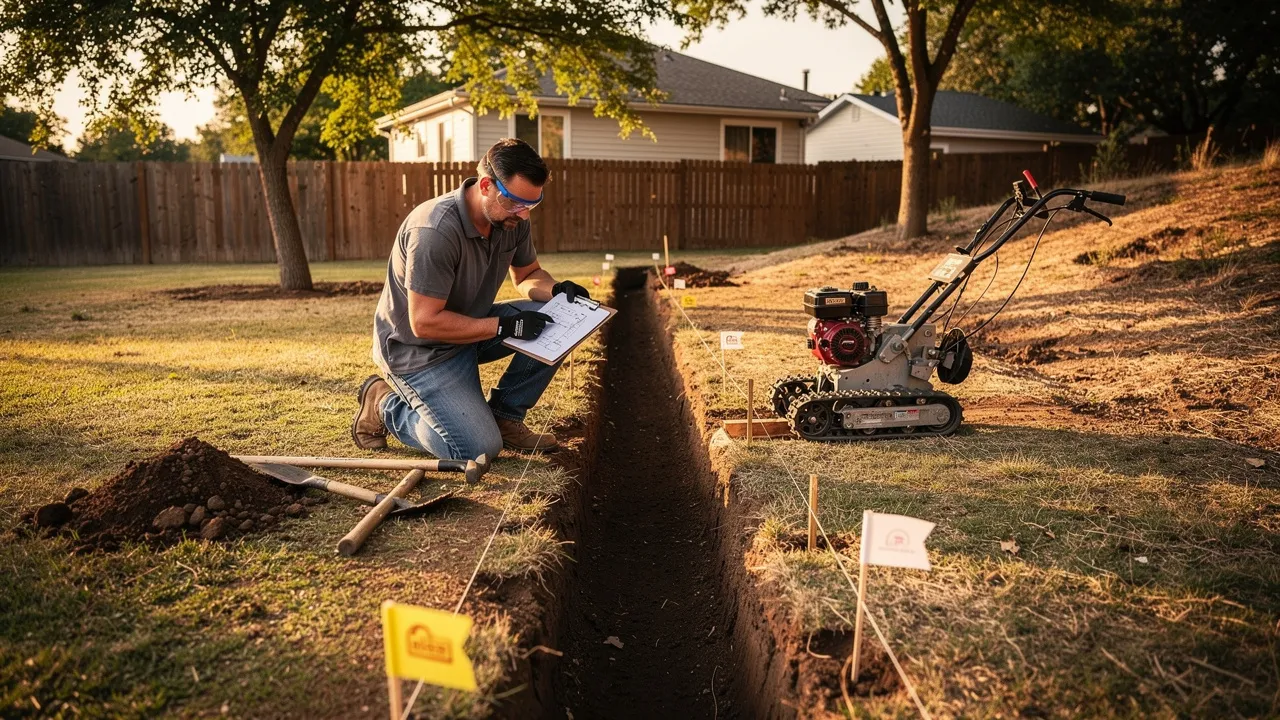
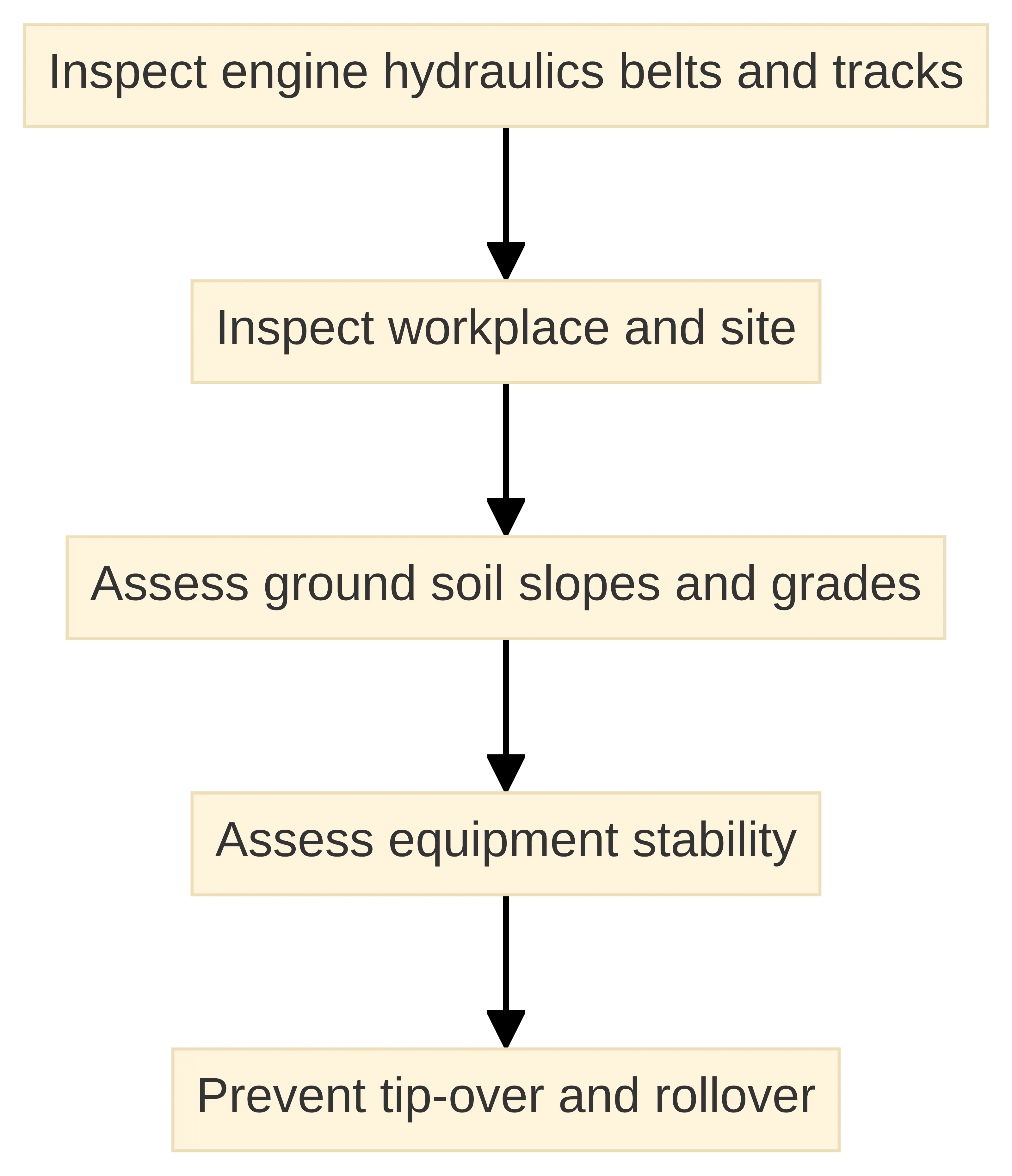
Before operation, inspect the equipment and worksite and assess soil, slopes, stability, and tip-over or rollover risks. For your site record, include:
- Soil or surface conditions along the route.
- Roots, rocks, hard-packed areas, or other visible obstructions.
- Slopes, grades, soft ground, and changes in elevation.
- Nearby structures, edges, vehicles, people, or other activity.
- The space available to position, travel, and turn the equipment.
These notes prepare a suitability conversation; they do not replace the selected equipment’s instructions or a qualified assessment of your individual site. Stop the rental decision if the route description is too vague to discuss safely.
Measure the route from the access point to the trench
Property access is an important factor when selecting a trencher. Measure the route from the likely access point to the trench rather than measuring only the trench itself. For an Irving or DFW home, record gates, narrow side yards, turns, slopes, steps, landscaping, surface changes, and any point where the machine would need to pass close to a structure or boundary.
Compact trenchers can work well in residential settings and tight access areas, but “compact” does not describe every machine or guarantee that it will pass through your property. Give the opening width, route width, turning space, slope, and surface conditions to EZ Equipment Rental. If the machine would need to cross a driveway, lawn, pavers, or another finished surface, include that fact in the inquiry without assuming the result.
Walk the access route before you request equipment and note:
- The narrowest gate or passage.
- The distance from the access point to the starting point of the trench.
- Turns, slopes, grades, and changes in surface.
- Objects that could restrict movement or visibility.
- Where people, vehicles, pets, and other activity may be present.
- Whether the planned operating area leaves room to position the equipment.
Property access is not a minor transport detail. It is part of equipment fit. A trencher that appears suitable on paper may not suit a route that cannot accommodate its movement or operating area. Ask the rental contact to discuss the access facts you recorded rather than choosing from proximity alone.
Check whether manual tools remain the better fit
A trencher is not automatically the right answer for every narrow excavation. For small DIY projects such as garden beds, pet fences, and short cable runs, manual tools or handheld power trenchers are listed as options. That gives you a practical branch to consider before arranging larger equipment, especially when the route is short, the ground is light, or access is restricted.
Use the manual-tool branch when the project is small enough to describe clearly and the work area does not require a larger trenching arrangement. Keep access in the decision: compact trenchers can work well in residential settings and tight access areas, but a restricted route may still make a smaller approach more suitable. Do not select a tool solely because it is nearby or familiar; compare the required trench dimensions and the route conditions with the work you need to complete.
A rental conversation becomes more relevant when the project is one-time or occasional and the trench is beyond a practical manual effort. Renting a walk-behind or ride-on trencher may be appropriate for that type of work, subject to the project’s dimensions, ground, terrain, and access. Use that guidance as a question for the rental discussion, not as a conclusion about your property. The same length can present different equipment needs when depth, width, soil, roots, slopes, or access change. Send the full project description so EZ Equipment Rental can discuss the available category against the actual work.
Make the branch explicit in your notes:
- Manual or handheld option: Choose this discussion when the task is a small garden bed, pet fence, short cable run, or similarly limited project.
- Walk-behind discussion: Ask about this path when the work is a medium irrigation or utility route, including a project up to 100 feet, while supplying the required dimensions and conditions.
- Larger rental discussion: Ask about the appropriate arrangement for a one-time or occasional project that exceeds a practical manual approach, without assuming a ride-on unit is suitable.
The supported action is simple: record why you are considering manual, handheld, walk-behind, or another rental category, then ask EZ Equipment Rental to discuss the unresolved fit questions.
Complete Texas811 preparation before planning the dig
Texas811 preparation belongs before the digging plan, not after equipment has been selected. In Texas, anyone planning to dig or disturb the ground must first notify a certified one-call center. That requirement applies to a homeowner planning a trench in Irving as well as to other excavation work across Texas.
Treat underground utility notification as a go-or-stop checkpoint. Do not move from a rental discussion to digging simply because the machine appears to match the project dimensions. First make the required notification, provide the planned work information, and allow the marking process to occur. Keep the utility status in your project brief so the rental conversation reflects the actual stage of preparation.
After a Texas811 request, utility locators and utility companies identify nearby underground lines and may mark them with flags or paint. The marking process gives you information about the planned work area, but it does not turn an unexamined route into an automatic approval for every excavation method. Keep the markings visible and incorporate the marked route into the site discussion.
Your notes should state whether the Texas811 request has been made, when it was made, whether markings are present, and whether the planned trench route has changed. If the route changes, treat the changed area as a new planning question rather than assuming the earlier review covers it.
Texas811 states that you must wait two working days, excluding weekends and holiday, between making the request and being able to dig. Build that stated wait period into the project schedule before you set a work date or estimate how long the rental will be needed. A request made late in the week may not produce the same usable schedule as a request made earlier, because weekends and holidays are excluded from the stated period.
Record the request date and the earliest date allowed under the Texas811 information you received. If the work plan, marked lines, or site conditions create a question, pause and seek the appropriate qualified guidance before operating equipment.
Before you ask for a final rental arrangement, confirm that your project record includes:
- The trench route and intended purpose.
- The Texas811 request status.
- The date of the request.
- The marking status, including flags or paint where present.
- Any route change after notification.
- The planned work window after the stated two-working-day wait.
This checklist organizes the utility-preparation facts you need to carry into the rental discussion. It does not provide individualized utility-locating, legal, engineering, or safety certification advice.
Set the worksite and pre-use boundaries before operation
Before the trencher touches the soil, inspect the engine, hydraulics, belts, and tracks. Pair that equipment inspection with a workplace and site inspection. The safety-training outline also identifies ground and soil conditions, slopes and grades, equipment stability, and tip-over or rollover prevention as part of the preparation.
Use a short pre-use record:
- Equipment components identified for inspection: engine, hydraulics, belts, and tracks.
- Worksite conditions: soil, slopes, grades, stability, and operating space.
- People and vehicle activity near the work area.
- Utility verification and visible markings.
- PPE and the selected equipment’s instructions.
If a condition is unclear, do not fill the gap with an assumption about the machine. Keep the question open for the appropriate qualified guidance and the selected equipment’s operating instructions.
The guide can help you prepare the site discussion, but it does not certify you to operate equipment or decide individual suitability. Use full PPE, verify utilities, inspect the machine and worksite, and assess stability before operation. Follow the selected equipment’s instructions and stop when the actual site differs materially from the description used for the rental discussion.
Build an EZ Equipment Rental inquiry from project facts
Your inquiry should give EZ Equipment Rental enough project context to discuss suitability rather than forcing the conversation to begin with a machine name. We serve industrial businesses and homeowners with equipment for various projects, and we provide personalized recommendations based on your specific needs and budget. Use that conversation to present the work facts you have already organized.
Start with the project purpose and location. State that the work is at an Irving or DFW property, identify the general type of project, and describe what the trench must accommodate. Then add the route length, target depth, target width, soil and roots, slopes, access, utility-marking status, and desired timing. A concise but complete description is more useful than a request for “a trencher” without dimensions or site conditions.
Prepare these fields before you send the inquiry:
- Project purpose: Irrigation, landscaping, yard work, a small repair, cable, conduit, pipe, or another narrow-trench task.
- Project location: City or part of the DFW area and the property type.
- Trench dimensions: Approximate total length, target depth, and target width.
- Ground conditions: Soil type you can identify, roots, rocks, hard-packed areas, wet ground, slopes, and grades.
- Access route: Gate or passage width, turns, surface changes, and the distance to the trench.
- Utility status: Texas811 request date, marking status, and any route change.
- Schedule: Preferred work window and whether weather could affect the plan.
- Rental questions: Current availability, pricing, rental duration, operating requirements, and pickup or delivery options.
Consider project scope, weather conditions, equipment specialization, and evolving schedules when estimating rental length. Give a range or explain the uncertainty instead of presenting a rental period as settled.
A plain-language inquiry can follow this structure:
I am planning a [project purpose] at a [city or DFW area] property. The planned trench is approximately [length] long, [depth] deep, and [width] wide. The route crosses [soil, roots, rocks, slope, or other conditions]. Access includes [gate width, turns, surface, and distance to the work area]. I have [completed or not completed] the Texas811 step, and the markings are [status]. I am considering a work window around [timing]. Please discuss whether a currently available trencher arrangement fits these project facts, along with the current rental duration, pricing, and pickup or delivery options.
Keep the bracketed parts as facts from your own project, not guesses about equipment. EZ Equipment Rental can use the description to provide a personalized recommendation based on your needs and budget.
Separate likely project fit from details EZ Equipment Rental must confirm
Your project record can show that a trencher discussion is reasonable without proving that a specific unit is available or suitable. The likely-fit side includes the trench purpose, approximate dimensions, ground and terrain, access route, utility preparation, and whether the work is a one-time or occasional project. The confirmation side includes the current machine or category, inventory, price, rental period, operating requirements, and delivery or pickup arrangement.
EZ Equipment Rental serves homeowners with equipment for various projects and provides personalized recommendations based on specific needs and budget. Use that local conversation to test the facts you recorded against the available arrangement. Do not convert a general walk-behind range, a project example, or a search result into a promise about a particular rental.
Keep these questions in the confirmation lane:
- Is a trencher arrangement available for the requested work window?
- Does the available equipment address the target depth and width?
- Does its configuration suit the soil, roots, slopes, and terrain described?
- Can it reach the work area through the measured access route?
- What rental duration and pricing apply to the planned schedule?
- What operating requirements accompany the selected equipment?
- Which pickup or delivery options apply to the property?
The useful boundary is direct: your notes prepare the equipment discussion; EZ Equipment Rental must confirm the current rental details. If the arrangement does not fit the facts, return to the project purpose and ask about a different supported approach rather than forcing the original machine choice.
Send the prepared project brief for local confirmation
A prepared project brief lets you ask a focused question about trencher suitability instead of relying on proximity or an assumed machine size. Include the trench purpose, dimensions, soil and terrain, access route, Texas811 status, timing, and the rental details that need confirmation. At EZ Equipment Rental, we provide personalized recommendations based on your specific needs and budget.
Our Irving location is at 1307 W Airport Fwy, Irving, TX 75062. Use the prepared facts to request that local discussion.
Before you commit to a rental, keep the distinction clear: a likely project fit is not the same as confirmed inventory, pricing, rental duration, operating requirements, or pickup and delivery arrangements. EZ Equipment Rental serves homeowners with equipment for various projects, and the next useful step is to provide the complete project brief so those current details can be addressed directly.
What should you confirm before requesting a trencher near Irving or DFW?
What factors should I consider when deciding to rent a trencher for my project?
Consider the trench purpose, dimensions (length, depth, width), ground conditions, access route, and whether the project is a one-time task or recurring. These factors will help determine if a trencher is suitable for your needs.
How do I determine the right size of trencher for my project?
To determine the right size, estimate the trench's length, depth, and width, and consider the soil type and any obstacles like roots or rocks. This information will guide your discussion with EZ Equipment Rental.
What safety precautions should I take before operating a trencher?
Before operating a trencher, use full personal protective equipment (PPE), verify the location of underground utilities, and inspect the equipment and worksite for stability and hazards.
What is the Texas811 process for utility marking before digging?
In Texas, you must notify a certified one-call center before digging.
What details should I include when contacting EZ Equipment Rental for a trencher rental?
Include the project purpose, trench dimensions, ground conditions, access route, Texas811 request status, and any specific questions about rental availability, pricing, and pickup or delivery options.
Can I use manual tools instead of a trencher for small projects?
Yes, for small DIY projects like garden beds or short cable runs, manual tools or handheld power trenchers may be more appropriate than renting a larger trencher.
What should I do if I am unsure about the trenching requirements for my project?
If unsure, clarify the trench purpose, dimensions, and site conditions before contacting EZ Equipment Rental. This will help ensure you receive the most suitable equipment recommendations.
Sources
- Factors That Determine Equipment Rental Lengths — www.google.com
- Trencher Safety Requirements: What Operators Must Know — rntr.com, 2026-06-22
- 1518 – Trencher Operator Safety Training – A.R.G. Construction, Safety and Health — argcsh.org
- 8 Trenching Tools for Your Next Project | BigRentz — www.google.com, 2026-03-16
- Trencher Rental: What Size Trencher Do I Need? | Ditch Witch West — www.ditchwitchwest.com, 2019-12-20
- How Deep Can a Trencher Dig? What to Know Before You Rent One — www.google.com, 2026-05-13
- What Trencher Do I Need for My Project? | Buddies Rentals — buddiesrentals.com
- Trenching for Utilities: What Homeowners Need to Know — www.google.com, 2026-09-11
- What is 811? — www.google.com
- Texas One-Call Law — texas811.org
- Equipment & Tool Rentals in Dallas TX - EZ Equipment Rental
- About Us - EZ Equipment Rental | Dallas, TX