
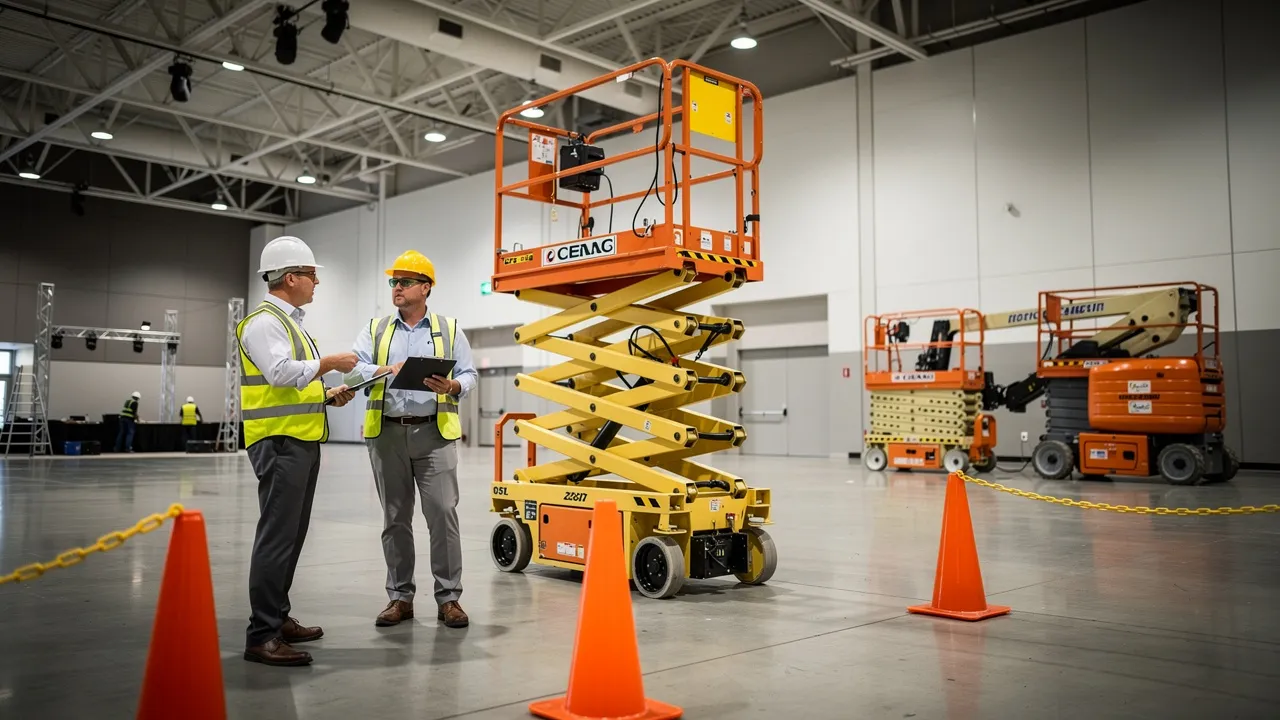
Translate the work point into the right working height
For an Irving or DFW job, identify the reach requirement before choosing a scissor-lift height label. Working height is the height a worker can comfortably reach from the platform; industry convention adds 6 feet to platform height, although some manufacturers use 6 feet 6 inches. A 19-foot lift therefore has a working height of about 25 feet, so a request for a “25-foot scissor lift” usually refers to working height rather than platform height.
That distinction gives the rental conversation a scissor-lift-specific starting point. Compare the required working height with the narrowest access opening, the platform dimensions, the total load, and the surface where the machine will operate. Depending on the model, scissor lifts can provide access to work sites 19 to 50 feet off the ground, while other equipment descriptions range from 10-foot compact electric lifts to 70-foot diesel lifts.
The work setting then narrows the equipment category. Electric scissor lifts are intended mainly for indoor work, run on batteries, and suit smooth or solid slab surfaces; some models can be used outdoors. Rough-terrain lifts can handle uneven, rough, or muddy terrain, may reach 50 feet or more, and typically have a larger work platform. These descriptions are category guidance, not a specification or availability statement for a particular Irving or DFW unit.
Use the provider inquiry to verify the exact model against the working height, access route, setting, and load rather than treating a height label as the complete match.
Translate the target area into working height
Working height is the height you can comfortably reach while standing on the platform, rather than the platform height by itself. Industry convention adds approximately 6 feet to platform height to account for the worker, although some manufacturers use 6 feet 6 inches. Use the exact machine’s specifications and manual for the final equipment decision.
A 19-foot lift has a working height of about 25 feet; people asking for a “25-foot scissor lift” usually mean working height. That wording can create a mismatch if you tell a rental desk only the number on a search result or a previous quote. Describe both measurements when you can:
- The height of the platform you expect to need.
- The height of the surface, ceiling, fixture, roofline, or work point you must reach.
- Any overhead clearance that limits the machine before it reaches the target.
- Whether the work is indoors, outdoors, or split between both settings.
Rough-terrain scissor lifts can handle uneven, rough, or muddy terrain, can reach 50 feet or more, and typically have a larger work platform than electric scissor lifts. That description does not mean every rough-terrain model reaches the same height or that its outdoor rating matches an indoor rating.
Your rental request should therefore say, for example, “The work point is approximately ___ feet above the ground, and the machine must fit through ___.” Leave the blank filled with the measured job requirement, not the machine name you found first. Ask the provider to identify the applicable platform height, working height, clearance, and outdoor limitation for the exact unit under consideration.

Match the lift to the setting and surface
Lift selection depends on the work setting, surface, emissions, noise, slope, access route, and weather exposure. The main scissor-lift types include electric, rough-terrain, and diesel models, but the exact configuration determines where you can use a unit and what limitations apply.
| Lift category | Conditions it may fit | Conditions to discuss before rental |
|---|---|---|
| Compact electric | Lightweight indoor tasks such as IT cabling or warehouse picking; compact electric models can have a maximum working height of up to 26 feet | Required load, aisle width, doorway dimensions, finished floors, and indoor clearance |
| Larger electric | Hard, level indoor surfaces; electric models offer working heights up to 45 feet and operate with zero emissions and low noise | Exact platform capacity, floor protection, slope tolerance, charging, and whether the unit will leave the building |
| Rough terrain | Outdoor work on uneven or unpaved ground; these machines use diesel or dual-fuel engines, oversized tires, and traction features for rough surfaces | Ground firmness, slope, weather, access route, outdoor working height, fuel, and any outrigger requirements |
Use an electric wheeled scissor lift only on smooth, level, hard surfaces within the manufacturer’s slope tolerance. An electric wheeled lift is not built for soft, graded, or uneven ground. A rough-terrain machine may fit outdoor conditions more closely, but its weight and dimensions can create separate access, delivery, and ground-pressure questions.
One equipment guide describes rough-terrain scissor lifts with maximum working heights of up to 53 feet and the largest weight capacity. Another description says electric scissor lifts usually measure 15 to 50 feet tall and, depending on the model, have a weight capacity of 500 to 1,000 pounds. The figures measure different source populations and should not replace the exact model’s plate or specifications.
Tell the rental provider whether the Irving or DFW site is a warehouse, finished commercial floor, paved lot, construction area, grass, gravel, dirt, or another surface. Also mention narrow aisles, noise restrictions, emissions restrictions, overhead obstructions, slopes, and any event-venue access limits before discussing a machine.

Test capacity against the model and the setting
The working-height match is only one part of the selection. Capacity is set by the model rather than by height class alone, so total the operator, tools, materials, and accessories that the lift must carry and compare that total with the exact unit’s rated capacity. Exceeding the rated capacity can compromise safety and machine stability. An extension deck may have its own lower limit.
A published equipment comparison lists electric slab lifts for indoor, smooth surfaces with a platform height range of 5.8 to 12.2 meters, or 19 to 40 feet, a capacity range of 227 to 680 kilograms, or 500 to 1,500 pounds, and maximum gradeability of 3% to 5%. The same comparison lists rough-terrain diesel lifts for outdoor four-wheel-drive use with a platform height range of 8 to 18 meters, or 26 to 60 feet, a capacity range of 680 to 900 kilograms, or 1,500 to 2,000 pounds, and maximum gradeability of up to 40%. These figures describe the comparison, not an unselected unit.
A separate equipment description says a 19-foot electric lift might weigh between 2,700 and 5,600 pounds and bear 500 to 700 pounds, depending on the model. The machine’s own capacity plate and operating manual remain the reference for the unit being considered.
Capacity also has to be checked against the setting. Wind, slope, floor strength, and platform add-ons can make a lift unsafe even when the load is below its rated capacity. Outdoor working height may be lower than indoor working height because wind affects stability; for the cited Genie GS-3232, the figures are 38 feet 1 inch indoors and 24 feet outdoors.
When comparing models, keep the load calculation, platform or extension needs, surface, slope, floor strength, weather exposure, and access dimensions together. That combination distinguishes a nominal height match from an equipment match that still needs provider confirmation.

Turn the fit check into a provider-ready request
Once the reach, capacity, and setting are defined, send the provider a compact fit description rather than only a height label. Include the intended application, required working height, narrowest access opening, platform load, and whether the ground is finished floor or dirt. Add the work setting, surface and slope, overhead or ceiling restrictions, delivery entrance, expected operator, and any accessory or training question that could change the equipment match.
Ask the provider to verify the exact unit’s platform height, working height, rated capacity, dimensions, weight, power source, platform or extension limits, and applicable outdoor or surface limits. Also request confirmation of current availability, the rental period, delivery or pickup, setup, fuel or charging, insurance or damage-waiver terms, taxes, return expectations, and any operator-related charge. A daily rental may mean 8 hours of runtime rather than 24 hours of use for some companies, so the billing period should be stated explicitly.
Rental cost depends on the model, size, jobsite location, lift height, rental duration, rental company, and added charges such as delivery, setup, insurance, taxes, or operator certifications. Rental periods may be priced by the day, week, or month. A rental pricing guide states that weekly scissor-lift rates generally fall between $500 and $1,800, depending on platform height and lift type. Published rough-terrain examples list about $154 per day, $409 per week, and $1,008 per month for a 26-foot model, and about $379 per day, $891 per week, and $2,187 per month for a 50-foot model. These are published examples for their stated equipment and locations, not an Irving price promise.
Include the requested delivery or pickup date, first work shift, expected return date, and any scheduling flexibility in the inquiry. The provider can then confirm the current fit, timing, terms, and handoff details for the actual job.
Define the rental window and build the cost question
The rental window has two separate parts: when the lift must be available and how long you expect to use it. Day, week, and month describe billing options rather than a standard Irving or DFW turnaround or rental length; confirm the delivery or pickup timing and expected rental window with the provider for the actual job. Separate confirmation of timing and duration helps prevent a billing label from becoming a scheduling assumption.
Give the provider:
- The desired delivery or pickup date.
- The first working shift and the date by which the machine should be returned or collected.
- The planned operating hours and any schedule flexibility.
- Whether the work is a single, well-defined task or part of a sequence with uncertain completion.
- Whether a delay, weather interruption, inspection issue, or site closure could extend the rental window.
A daily rental can suit a short, well-defined task, but some companies define a day as 8 hours of runtime rather than 24 hours of use. Ask which clock applies, when charges begin, how extra time is handled, and whether unused time changes the charge. Daily rates are generally higher than weekly or monthly rates, so a longer rental period may reduce the daily cost; do not choose a longer period without comparing the total charge and the project’s actual schedule.
Additional costs may include fuel, charging, attachments, and damage waivers. A rental-cost guide reports that transport is typically $75 to $200 each way when billed separately; treat that figure as a published planning example, not a DFW quote.
One pricing guide lists starting prices of $97 per day, $230 per week, or $430 per month for a 19-foot narrow electric lift; $121 per day, $338 per week, or $624 per month for a 26-foot wide electric lift; and $210 per day, $533 per week, or $1,092 per month for a 32-foot four-wheel-drive rough-terrain lift. Those starting prices apply to the cited examples and should not be presented as current EZ Equipment Rental rates.
Ask for an itemized cost question: machine, rental period, delivery or pickup, setup, fuel or charging, attachments, insurance or damage waiver, taxes, and any operator-related charge. Scheduling in advance may provide access to lower rates, and some rental companies may discount weekday or off-peak rentals, but the applicable terms remain location- and date-sensitive.
Verify the handoff before accepting the rental
The rental handoff should establish what machine is arriving, how you may operate it, which documents accompany it, and who handles unresolved problems. A quoted category is not the same as a verified equipment match.
Before accepting the unit, resolve these points:
- Exact equipment: Record the make, model, platform height, working height, capacity, dimensions, weight, power source, tire type, and any extension or accessory included in the agreement.
- Site fit: Confirm the route, doorway, floor or ground conditions, slope limits, outdoor restrictions, delivery approach, and space needed to position the machine.
- Timing: Confirm the release date, pickup or delivery window, rental-period definition, extension process, and return expectations.
- Operating requirements: Ask what training, familiarization, demonstration, operator acknowledgment, or authorization applies before the machine is released.
- Documents: For an aerial device covered by ANSI/SIA A92.2-2009, the lessor is to provide the operator’s manual and Manual of Responsibilities upon delivery, with the manuals stored on the mobile unit.
- Responsibilities: For an aerial device covered by ANSI/SIA A92.2-2009, the lessor is to explain relevant inspection, testing, maintenance, user, and operator responsibilities upon delivery and offer training or training materials initially and later on request.
- Damage and condition: Record the delivered condition, reporting process, damage responsibilities, fuel or charging expectations, attachments, and return condition.
Rental companies often require acknowledgment of basic machine operation, and some may require a demonstration or mandatory training before release. Treat that requirement as part of the schedule rather than something to solve after the machine arrives.
Follow the manufacturer’s operating manual whenever operating the lift because the manual defines the machine’s intended use and operating requirements. If the delivered machine, documents, accessories, or instructions do not match the agreed plan, pause the handoff and ask the responsible rental or site authority to resolve the difference before operation.
Use the machine and site readiness gate before operation
Treat readiness as the final part of the fit check: the exact machine, the work area, and the operator all have to be ready. Only trained, familiarized personnel should operate a scissor lift, and operators should understand its warnings, decals, and controls before moving it.
Use the manufacturer’s manual and the applicable inspection procedure to examine the machine. Check the operating and emergency controls, emergency stop, emergency lowering, guardrails, access gates, platform condition, extension slides, safety locking devices, tires, wheels, brakes, alarms, indicator lights, drive controls, fluid levels, fuel or battery charge, leaks, damaged wiring, visible structural defects, and outriggers or associated alarms when the model has them. Confirm that the operating manual and safety information are present.
Examine the work area for drop-offs, holes, uneven or sloped surfaces, soft or unstable ground, debris, cords, construction materials, overhead obstructions, electrical cables, and utilities. Treat overhead power lines and communication cables as energized. Stay at least 10 feet (3 meters) away from them. Use barriers or other work-zone controls where the site plan requires them.
Training should cover electrical, fall, and falling-object hazards; unsafe conditions; correct operation; inspections; and manufacturer requirements. During operation, stand on the platform floor, keep your body inside the guardrails, and do not use planks, ladders, or other devices as a working position.
Do not drive with the platform raised unless the manufacturer’s instructions allow it and the machine is on a firm, level surface within the permitted slope grade. High winds, rain, fog, and darkness reduce situational awareness; do not exceed the manufacturer’s wind restrictions. If the weather, ground, visibility, overhead clearance, or work zone becomes unsafe, stop and seek qualified help before continuing.
Stop rather than improvise when the plan fails
A failed inspection or unresolved operating hazard is a stop condition, not an invitation to improvise.
Stop the planned operation when:
- A control, emergency-lowering function, guardrail, tire, brake, alarm, platform, fluid system, battery, outrigger, or other inspected item does not work as expected.
- The machine does not match the agreed model, capacity, dimensions, accessories, or operating documents.
- The platform load could exceed the rated capacity, including people, tools, and materials.
- The surface has an unresolved hole, drop-off, slope, soft area, floor-strength concern, debris hazard, or obstruction.
- The route or work zone cannot maintain the required clearance from power lines, cables, utilities, vehicles, or pedestrians.
- Wind, rain, fog, darkness, or another weather condition exceeds the manufacturer’s operating restrictions.
- The intended operation would require standing on a rail, using a ladder or plank, overriding an interlock, removing a guardrail, or using the machine outside its manual.
Follow the manufacturer’s operating manual whenever the lift is operated because it defines the machine’s intended use and operating requirements. Do not substitute a general rule for the exact machine’s instructions, capacity plate, or restrictions.
For commercial work in the United States, federal OSHA workplace rules such as 29 CFR 1926.453 typically apply to employer-employee relationships and do not apply in the same way to a homeowner doing personal work. State, local, site, rental-company, and manufacturer requirements may still affect the job. Ask the responsible authority what applies to your work rather than assuming that a commercial rule or a homeowner exception settles the question.
If an incident, malfunction, or dangerous contact occurs, stop work, keep people away from the affected area, notify the supervisor or responsible site authority, and use emergency services when immediate danger or injury requires it. Do not restart the lift until the responsible qualified authority has determined that the situation is resolved.
Request qualified evaluation for unresolved hazards
Pause the job when a hazard remains unresolved; contact the responsible site authority or a qualified professional before continuing. You should pause the job when you cannot determine whether the machine matches the reach, load, surface, slope, clearance, weather, or intended operation.
Use this escalation path:
- Stop the activity. Keep the platform down when possible, remove the key if the machine has failed inspection, and keep people out of the affected work zone.
- Record the condition. Note the machine model, location, inspection result, surface or weather condition, overhead concern, load, and task that created the question.
- Notify the responsible person. Contact the supervisor, site safety lead, facility manager, rental contact, or other authority responsible for the equipment and work area.
- Bring in the right qualified help. Use a qualified equipment or safety professional for unresolved machine operation, ground, structural, electrical, fall-protection, or site-control questions. Contact the relevant utility or emergency authority when an electrical hazard, injury, fire, collapse, or immediate public danger is involved.
- Resume only after resolution. The person responsible for the work should have a clear answer tied to the exact equipment, site, and operating conditions before authorizing the next step.
A general equipment description cannot settle a site-specific engineering, electrical, structural, legal, or occupational-safety decision. Do not use a height range, capacity example, prior job, or verbal assumption as a substitute for an evaluation of the actual lift and work area.
The practical boundary is simple: if the lift, site, weather, load, operator, or intended movement is not clearly within the manufacturer’s instructions and the responsible site requirements, leave the machine out of service and escalate the question. This protects the next decision from being based on an unresolved assumption.

Send the completed inquiry to EZ Equipment Rental
Your completed project brief should give the rental team enough information to discuss a possible scissor-lift match for an Irving or DFW job. Include the work point and working height, narrowest access opening, platform load, surface and slope, indoor or outdoor setting, power and noise constraints, delivery route, intended dates, expected operating window, operator questions, accessories, and the cost items you want separated.
At EZ Equipment Rental, we offer advice mid-project through knowledgeable team members. We are located at 1307 W Airport Fwy, Irving, TX 75062. We are open Monday to Friday from 7:30 AM to 5:30 PM and Saturday from 7:30 AM to 5:00 PM; we are closed on Sunday.
Use the inquiry to describe the job rather than relying on a height label. The rental team can then address the equipment fit and current arrangements that still depend on the exact model, date, site, and rental conditions. A qualified professional decides individual suitability when the work involves unresolved engineering, legal, occupational-safety, electrical, or other site-specific questions.
Questions that finish the scissor-lift fit check
How far ahead should I book a scissor lift rental in Irving or DFW?
Availability can depend on the exact model, site, and dates. Provide the requested delivery or pickup date, first work shift, expected return date, and any weather or scheduling flexibility, then ask the rental provider to confirm availability, release timing, and delivery or pickup arrangements.
How long can I rent a scissor lift?
Rental terms may vary by provider and job. A daily period may mean 8 hours of runtime rather than 24 hours of use for some companies. Ask when charges begin, how extensions are handled, what the return deadline is, and whether a weekly or monthly term changes the total cost for your actual schedule.
What should an Irving scissor lift rental quote include?
Request an itemized quote for the exact lift, rental period, delivery and pickup, setup, fuel or charging, attachments, insurance or damage waiver, taxes, and any operator-related charge. The quote should also identify the machine’s platform height, working height, rated capacity, dimensions, weight, power source, and applicable site limitations.
What should I do if the rented lift fails its inspection or the site becomes unsafe?
Do not operate or repair a lift that fails any part of its pre-use inspection. Remove the key when appropriate, report the problem to the supervisor or responsible rental contact, and keep people away from the affected area. Stop for unresolved holes, unstable ground, excessive wind, inadequate clearance, power-line hazards, equipment damage, or other unsafe conditions, and seek qualified equipment, safety, electrical, engineering, or emergency assistance as the situation requires.
Sources
- use this checklist when renting aerial lifts - genielift.com
- How to Choose the Right Scissor Lift - hercrentals.com
- Vehicle-Mounted Elevating and Rotating Aerial Devices - webstore.ansi.org
- AERIAL LIFT PRE-USE INSPECTION CHECKLIST - ehs.wvu.edu
- How to choose the right scissor lift: Scissor Lift Capacity and Specifications Guide - Xuzhou Hengxing Jinqiao Machinery Technology Co., Ltd - everstargroup.com
- Scissor Lift Pre-Use Inspection Checklist | Crew Supply - crewsupply.ca
- How to Use a Scissor Lift: Beginner's Guide | RNTR - rntr.com, 2026-06-01
- Can I Use a Scissor Lift at Home? Safety, Sizing & Legal Guide - cnsinolift.com
- How to Choose a Scissor Lift: Power Type, Height, Terrain & Safety Standards Explained (2026) | RUNTX Machinery-RUNTX Machinery Group - runtxmachinery.com
- How to Operate a Scissor Lift Safely: 2026 Guide - forkliftacademy.com, 2026-06-14
- Scissor Lift Sizes and Heights: The Complete Chart - Airworx - airworxcorp.com
- Types Of Scissor Lifts: A Complete Guide For Job Sites - herculift.com
- Aerial Lifts FactSheet - osha.gov
- Scissor Lift Capacity: Ratings by Size, Plus Boom Lift Limits - TrueBrady Co - truebrady.com
- Electric vs. Rough Terrain Scissor Lift: Which Is Right for Your Job Site? - Everstar - everstarmachinery.com
- Safe Scissor Lift Operation Starts with the Basics - jlg.com, 2026-06-11
- How Much Does Scissor Lift Rental Cost in 2024? - bobvila.com, 2024-05-31
- Scissor Lift Rental Costs & Guide - herculift.com
- Scissor Lift Rental Cost: Daily & Weekly Rates | RNTR - rntr.com, 2026-05-30
- Scissor Lift Rental Cost (2026): Day, Week & Month - rentd.com, 2026-07-08
- Scissor Lift Rental | Rent a Scissor Lift | BigRentz - bigrentz.com
- Scissor Lift Rentals - Cincinnati, OH in Hamilton County | BigRentz - bigrentz.com