
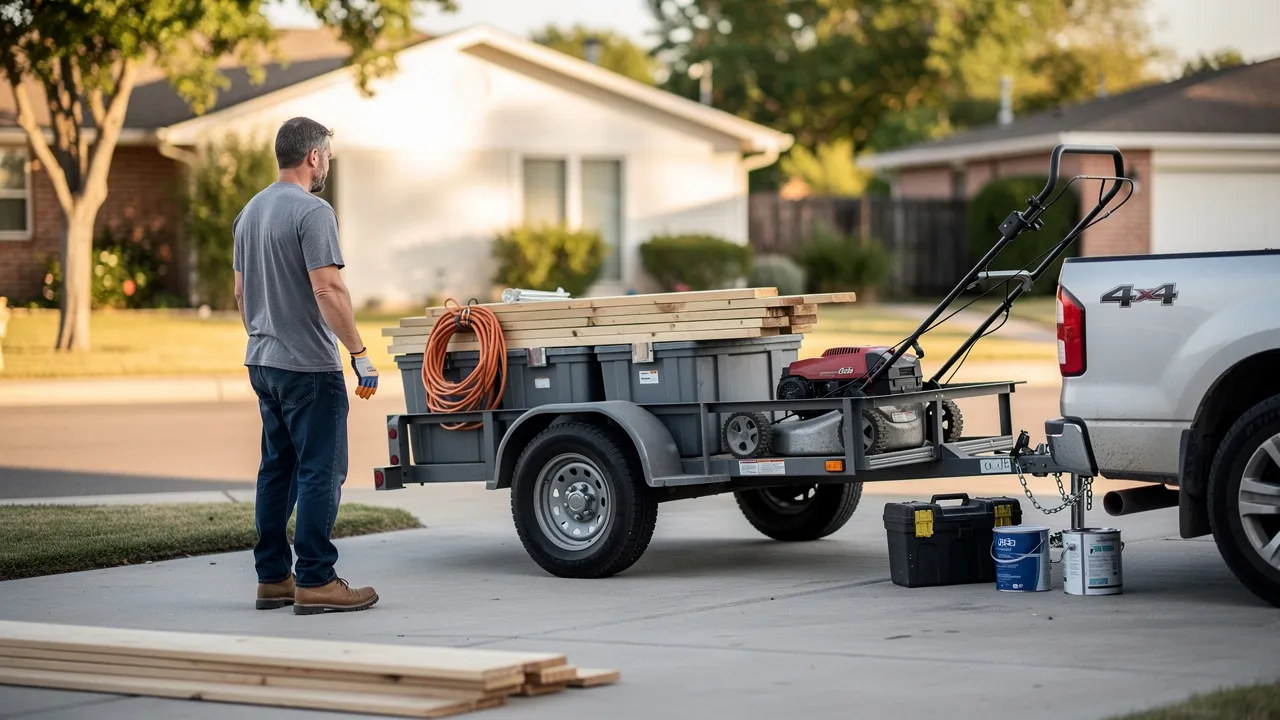
Start with the home project, not the machine name
A home project should determine the rental category, not the first machine name you find in a search. Start by writing down the work you need to complete, the material involved, the expected workload, the jobsite, and the dates you expect to work. Digging, hauling, cutting, washing, lifting, breaking, and placing materials can require different equipment, and the same task can call for different configurations when access or surface conditions change.
Before arranging a rental, understand four things:
- The job requirements, including the result you need from the equipment.
- The relevant equipment specifications and possible attachments.
- The site conditions, access limits, surfaces, overhead obstructions, and available space.
- The rental terms, timing, transport plan, and return requirements.
Record your tasks, workload, and project dates so a rental provider can help identify a suitable option. A clear description gives you a better starting point than asking for a machine by appearance or name alone.
Power requirements are another fit check: confirm what power source the equipment needs, whether that source is available at the jobsite, and whether the rental provider requires related documentation. Equipment condition should also be checked before booking, because a category match does not by itself confirm the machine is ready for the planned work.
Rental is usually a practical starting point when you need equipment for a defined project rather than repeated use throughout the year. One rental-cost guide states that buying may make more sense if you will use a machine more than 60-70% of the year; below that level, it describes rental as almost always more economical after considering purchase price, depreciation, insurance, maintenance, storage, and the opportunity cost of capital. Treat that threshold as a planning rule, not a guarantee for your project.
Ownership also brings responsibilities that do not disappear after purchase. For example, Texas First Rentals states that a third-party repair may carry an administrative charge of 10% of total repair costs, capped at $500, under its rental protection terms. That charge applies to Texas First Rentals, not automatically to every provider. For a one-time Irving or DFW home project, compare the complete rental and ownership costs before deciding.
Choose an equipment category for the task
An equipment category gives you a useful starting point for a provider conversation, but the category name does not confirm that a particular machine fits your site. Use the work you need to perform to decide which category to ask about first.
For common home projects, use the work as a starting point for the category conversation:
- Landscaping or demolition: ask about earthmoving equipment and any needed attachments.
- Flooring: ask about saws for cutting work, and describe the material and surface.
- Hauling or debris: ask about trailers.
- Concrete work: ask about concrete equipment, pumps, or saws.
- Pressure washing: ask about pressure washers.
- Moving water: ask about pumps.
- Supplying power or air: ask about generators or air compressors.
These are starting categories, not confirmed selections. Provide the material, site details, project scale, dates, vehicle information, and intended use so the provider can check capacity, configuration, attachments, transport, and operator requirements.
The category question should be phrased around the work: “I need to move this material across this route,” or “I need to cut, wash, pump, lift, or power this equipment at this location.” Include the project scale and dates in the same request. The provider can then compare the job requirements with available specifications instead of treating a broad category as a confirmed selection.
A category can also change as you describe the site. A landscaping task with a narrow gate, soft ground, overhead branches, or a long haul path may require a different configuration than the same task in an open, firm area. Ask which category and configuration should be considered, what attachments are needed, and what information would rule an option out.

Match material, site access, and project scale
Material, digging depth, lifting height, ground conditions, and available space all affect which equipment fits a project. Site access, surface conditions, overhead obstacles, and work-area restrictions matter as well. Write those details before you request a quote so the provider can evaluate the job rather than guess from a category label.
Job size, work duration, and excavation type also influence the machinery required. Larger jobs may require higher-capacity machines, while smaller or tighter-access sites may benefit from compact equipment. A narrow side yard, residential driveway, soft lawn, sloped area, low branch, or limited staging space can change the practical options even when the work itself sounds simple.
Use this short site record:
- What material will be moved, removed, cut, washed, pumped, or placed?
- What depth, height, distance, or workload must the equipment handle?
- Where will the equipment enter, turn, work, and leave?
- What are the gate widths, surface types, overhead clearances, and staging limits?
- What project dates and work duration should the provider plan around?
Send the record with photos or measurements if the provider requests them. Do not assume that a familiar-looking machine will fit the route or surface.
Mini excavator figures can illustrate why category, timing, and cost must be considered together. The Downstream Research Hub lists directional Texas figures for mini excavators: a typical cost of $3,396 per rental, a 1-day lead time, and a typical rental length of 22 days. The same source describes the lead time, cost, and rental length as directional, and the figures describe Texas data rather than a confirmed Irving quote.
Use the figures as a question prompt: ask whether a mini excavator is appropriate for your material, digging depth, ground, access, and expected duration, then request a project-specific price and availability check. A one-day planning benchmark does not promise that a machine will be available when you need it.

Compare equipment fit and attachments before booking
Equipment comparison should focus on how each possible configuration handles your actual work. A machine that is too small may slow the job, while an oversized unit can add expense or create access challenges. Availability alone is not a sufficient reason to choose one option when the machine, route, surface, or attachment does not match the project.
If several machines could perform the task, ask about their practical differences before booking. Ask the provider to compare:
- The work each configuration is intended to perform.
- The capacity, reach, depth, height, or working range relevant to your project.
- The space, surface, and access requirements for each option.
- The transport method and any vehicle or towing requirements.
- The attachments required for the material or finishing work.
Keep the comparison tied to your site. A machine that appears more capable can still be impractical if the access route, surface, clearance, or staging area rules it out.
When two configurations remain plausible, use a staged comparison rather than choosing the option that is available first. First, remove any option whose dimensions, turning space, surface needs, or clearances do not fit the access route. Next, check whether the remaining option provides the required capacity, reach, depth, height, or working range for the stated task. Then confirm that the attachment needed for the material is compatible and available for the requested dates. After fit is established, compare the complete rental total, including transport and any separate attachments or coverage, using the same rental period. Finally, compare availability, extension terms, and the process for service or breakdowns.
This sequence treats price and timing as comparison factors only after the equipment can perform the work at the site. Give the provider the same measurements and dates for each option so the comparison uses equivalent assumptions. Ask the provider to identify which constraint rules out an option when a proposed machine cannot be confirmed. Record the selected configuration, attachment, delivery plan, return time, and unresolved questions before booking. A machine’s stated capacity does not by itself confirm that the load, ground, route, or access conditions are suitable.
Attachments should be treated as a separate fit question. Check attachment compatibility and availability instead of assuming attachments are included. Ask whether the attachment works with the exact machine configuration, whether it is available for your dates, and whether it changes transport or operating requirements.
Write the attachment question into the inquiry: “Which attachment is required for this material and task, is it compatible with the proposed equipment, and is it included in the quoted rate?” Get the answer before booking. A category match without an available, compatible attachment may leave the main task unfinished.
Plan timing from a day rental to a longer arrangement
Rental rates are typically based on daily, weekly, or monthly terms, so your expected work calendar affects the quote. Short-term rentals suit quick projects, while long-term agreements provide stability; the selected long-term guidance describes those arrangements as typically lasting from a month to over a year and being maintained by the dealer. Your home project may fit a single day, a weekend, a week, or a longer period depending on preparation, weather, access, and the amount of work.
Estimate the time in two parts:
- Count the days when the equipment must physically be on site.
- Add realistic time for delivery, setup, weather interruptions, material delays, cleanup, and return or pickup.
If your project will take 4+ days, one rental guide states that a weekly rate almost always makes more sense than paying daily. That is a pricing recommendation from the guide, not a promise that every provider uses the same break point. Ask for daily, weekly, and monthly totals based on the same dates and inclusions.
Availability should be confirmed for the full period you need, and early reservation can help avoid delays during peak seasons. Delivery timing varies by equipment and provider. Downstream reports that office trailers in Texas require a typical lead time of 12 days and, in early data, stay on site for 147 days; those figures describe office trailers, not a typical small home-project rental.
The same Texas data gives three days as a useful construction-equipment planning reference, but it should not replace a provider's date confirmation. State your start date, end date, schedule flexibility, and the latest acceptable delivery date. If the project may run long, ask whether an extension is possible and how the additional time would be priced.
A pricing example can show how the rental tier changes the daily equivalent. Versi Rentals gives an example in which a machine costing $300 per day would cost roughly $900 per week and $2,700 per month. The example is not a quote for your equipment or location, and the figures should not be applied without asking for the provider's actual rate structure.
Request each term in writing with the same equipment, attachment, delivery, pickup, fuel, and coverage assumptions. That makes the daily-versus-weekly decision meaningful instead of comparing incomplete totals.

Estimate the full rental cost, not just the base rate
Texas cost benchmarks can help you prepare questions, but they are not an Irving quote. Downstream reports that construction equipment in Texas typically costs $825 per rental, with most rentals between $550 and $2,065. The figures cover Texas construction-equipment rentals and do not establish the price of a particular machine, attachment, term, delivery route, or project.
Build your budget around the complete quote rather than the benchmark alone. Ask for the equipment rate, rental period, delivery or pickup, fuel or charging, attachments, coverage, environmental fees, cleaning terms, overtime, taxes if applicable, and any deposit or other contract charge. Confirm which items are included and which are priced separately.
Standard rental rates typically include the machine, a basic orientation or walkthrough, and standard wear items. Delivery and pickup are often not included and may cost $150-500 or more depending on distance and machine size. Fuel or charging, optional damage waiver or insurance, attachments, and environmental fees are usually separate; the same guidance places optional damage waiver or insurance at typically 10-15% of the rental rate.
Return conditions can change the final amount as well. Cleaning fees may apply when equipment comes back caked in mud, fuel charges may apply when you do not refuel it, and overtime charges may apply when you keep it beyond the agreed return time. Ask these questions before signing:
- What is included in the base rate?
- What will delivery and pickup cost for my address and equipment?
- Are fuel, charging, attachments, coverage, and environmental fees separate?
- What return condition and return time apply?
- What happens if the project runs late or the equipment needs service?
Rental pricing follows daily, weekly, and monthly tiers. The daily rate is typically the highest per-day cost, the weekly rate is typically 3x the daily rate, and the monthly rate is typically 3x the weekly rate. These are stated pricing patterns, not universal terms, so compare the actual totals offered for your equipment and dates.
A full-cost worksheet can be simple: base rental, delivery, pickup, fuel or charging, attachments, coverage, environmental fees, deposit or other stated charges, and possible return charges. Use the same worksheet for every quote so a low base rate does not hide a higher project total.

Prepare the project details for a rental inquiry
A rental inquiry should give the provider enough information to evaluate the equipment category, configuration, timing, and logistics in one pass. When requesting a trailer rental from EZ Equipment Rental, include the jobsite location, material or waste being moved, intended use and required protection, vehicle information, expected start date, duration, schedule uncertainty, and whether the need is a single project or recurring transportation.
Use the same structure for other categories, adding the measurements that affect fit:
- Project: Describe the task and the result you need.
- Material: Name what will be moved, cut, washed, pumped, lifted, or removed.
- Scale: Give quantities, dimensions, distance, depth, height, or expected workload when known.
- Site: Provide the address, access route, gate or clearance limits, surface, slope, and staging area.
- Vehicle: Include the tow vehicle or transport details when a trailer or transported machine is involved.
- Timing: State the desired start date, expected duration, schedule flexibility, and latest acceptable delivery date.
- Request: Ask for a suitable category, available configuration, complete price, pickup or delivery choices, and return terms.
Office-trailer figures show why the request should identify the equipment type and duration precisely. The Downstream Research Hub reports a typical cost of $5,709, a 12-day lead time, and a directional typical rental length of 147 days for office trailers in Texas. Those figures do not describe a small residential trailer request or establish what will be available in Irving.
If your project involves a trailer, name the trailer purpose rather than writing only “trailer rental.” Explain whether you need to haul material, move waste, transport equipment, or support a longer site use. Then provide the vehicle details, jobsite, dates, and required protection so the provider can address fit and logistics.
Confirm delivery, pickup, towing, and site access
Heavy equipment often requires specialized transport, so confirm delivery arrangements before the start date. Ask whether delivery is available, then confirm the delivery cost and range in advance. Verify the address, access route, unloading area, receiving person, gates, overhead clearances, road surfaces, staging space, restricted site hours, and security procedures.
Use a delivery checklist before the machine leaves the rental yard:
- Confirm the exact jobsite address and a usable access route.
- Measure gates, overhead clearances, turns, and the unloading area.
- Confirm that the road and staging surface can accommodate the equipment and delivery vehicle.
- Identify the person who will receive the delivery and the hours when access is permitted.
- Tell the provider about security procedures, restricted hours, slopes, soft ground, or other access limits.
- Confirm pickup conditions and who is responsible for preparing the equipment for return.
A delivery date without an access plan is not a complete logistics plan.
Trailer towing requires a fit check between the trailer, the tow vehicle, the load, and the intended route. EZ Equipment Rental recommends checking car-hauling trailer fit, towing details, rental terms, availability, and pickup or delivery options. Provide the vehicle information before reserving rather than assuming that a hitch or vehicle rating is sufficient.
Operator requirements also need direct confirmation. Ask which documents, training, and operator qualifications apply to the exact equipment you plan to use.
Transport can be a material part of the quote. A flatbed truck and trailer to deliver a boom lift can easily cost $300-500 round trip, according to one rental-cost guide. That figure is a boom-lift delivery example, not a universal DFW delivery price.
Ask for delivery and pickup as separate line items when possible. If you are considering self-pickup, confirm the equipment's transport requirements, the vehicle or trailer needed, loading and unloading responsibilities, and whether your route and site can support the plan.
Use an Irving rental provider to verify the current option
EZ Equipment Rental gives you an Irving starting point for confirming a category, configuration, timing, and logistics plan.
We are located at 1307 W Airport Fwy, Irving, TX 75062. Our listed hours are Monday to Friday from 7:30 AM to 5:30 PM and Saturday from 7:30 AM to 5:00 PM; we are closed on Sunday. Use your prepared request to ask about the category, exact configuration, attachment availability, rental period, complete quote, pickup or delivery, and any vehicle or towing requirements.
A provider confirmation matters because Texas-wide planning data does not establish a current Irving rate or delivery date. The Downstream Research Hub reports that construction equipment rentals in Texas typically cost $825 per rental, with most rentals between $550 and $2,065. The Downstream Research Hub describes three days as a typical delivery reference for construction-equipment rentals, while a separate Texas rental measure indicates that half of rentals arrive within three days; these populations and descriptions are not identical.
Use those figures only to decide what to ask. Request the current equipment, availability for your dates, delivery or pickup terms, inclusions, extra charges, and return conditions for your actual project. The provider's response should resolve the gap between a statewide planning benchmark and your site-specific quote.
Stop when safe operation cannot be confirmed
Safe operation requires clear answers about coverage, training, equipment condition, maintenance support, applicable requirements, and site controls. Ask what applies to your rental and what documentation is required before the equipment arrives.
Before operation, confirm:
- The operator has the training required for the exact machine and task.
- The equipment has been inspected and maintained, and you know whom to call if it breaks down.
- The site access, surface, overhead clearance, staging area, and work restrictions have been addressed.
- The equipment meets applicable OSHA requirements, emissions standards, noise limits, dust-control requirements, and client requirements.
Stop and seek qualified help promptly when operator readiness, required coverage, equipment condition, applicable regulations, or site safety cannot be confirmed. Do not proceed by guessing about a load, clearance, surface, attachment, towing requirement, or operator qualification.
OSHA requirements, Tier 4 emissions standards, noise limits, and dust control all matter when renting equipment. Non-compliance can mean fines, delays, or shutdowns. If the provider, responsible site authority, or qualified professional cannot resolve the uncertainty, hold the rental or operation until the requirement is clear.
Move from a prepared request to a current quote
A quote-ready request connects the project task to the equipment category, site constraints, dates, transport plan, and complete-cost questions. Before sending it, make sure you can state the material or work, project scale, access conditions, expected duration, jobsite, vehicle or towing information, preferred pickup or delivery arrangement, and the questions that must be answered before booking.
Ask for the current option and confirm fit, availability, rental terms, attachments, delivery or pickup, towing requirements, and the complete price. If any safety or operator requirement remains unclear, pause rather than treating availability as approval to proceed. A qualified professional decides individual suitability where the project or equipment presents a safety concern.
What should you confirm before requesting equipment rentals near Texas?
What information should I have ready before requesting an equipment rental?
Prepare the project task, material, workload or dimensions, jobsite address, access route, gate and clearance limits, surface conditions, expected start date, rental duration, and schedule flexibility. Add vehicle and towing information for a trailer or transported machine, plus your preference for pickup or delivery. This gives the provider enough context to discuss equipment fit, attachments, availability, and the complete quote.
Are Texas equipment-rental cost figures a reliable quote for an Irving project?
No. Texas-wide figures are planning benchmarks rather than current Irving prices. One dataset reports construction-equipment rentals in Texas typically cost $825, with most rentals between $550 and $2,065, but the final amount can change with equipment type, rental term, attachments, delivery, pickup, fuel, coverage, environmental fees, and return conditions. Request a current itemized quote for the exact equipment, dates, address, and inclusions.
What should I compare when reviewing equipment-rental quotes?
Compare quotes using the same equipment configuration, attachments, rental dates, delivery or pickup plan, fuel or charging assumptions, coverage, deposit, and return conditions. Check whether the base rate includes the machine and orientation, and ask about separate delivery, pickup, attachment, environmental, cleaning, fuel, and overtime charges. Also confirm availability, service support, required documents, and the process for extending the rental if the project runs late.
Sources
- The Ultimate Checklist Before Signing for Heavy Equipment Rentals - bluegrassequipmentrental.com, 2026-11-04
- Choosing Heavy Equipment Rental For Excavation And Site Prep - synergyequip.com
- Heavy Equipment Rental Requirements: What You Need to Know - rent.cat.com
- Industrial Equipment Rental Checklist: 10 Things to Check - zoair.com
- How To Choose Rental Equipment: A Complete Guide | Jon’s Rental - jonsrental.com
- Renting Equipment for the First Time? Here's What to Have Ready - pdqequipment.com
- 10 Key Questions to Ask Before Renting Heavy Equipment - kmcequipment.com
- 11 Questions to Ask Before You Rent Heavy Equipment (and Why They Matter) - Rentstr - rentstr.com
- Safeguard Your Equipment with Texas First Rentals' Rental Protection Plan - texasfirstrentals.com
- Construction Equipment Rental in Texas | Downstream - trydownstream.com, 2026-10-12
- Guide to Long-Term Equipment Rentals: Benefits and Best Practices - rent.cat.com
- Equipment Rental Costs: What to Expect in 2025 - versirentals.com, 2025-06-01