
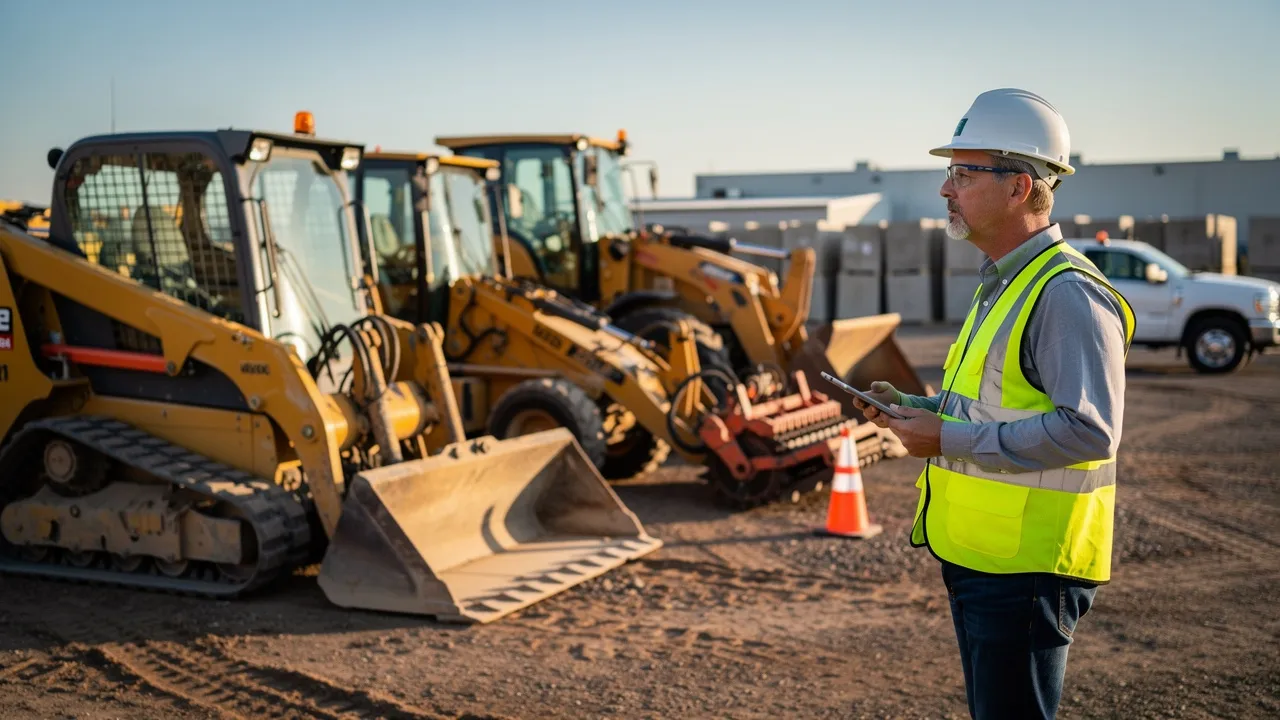
Begin with the ground work the machine must produce
An Irving or DFW earth-moving job should be described by the work output before you choose a machine category. Start by identifying whether the job involves digging, trenching, loading, grading, or moving materials. The same jobsite may need more than one capability, but the primary task gives you a useful starting point for narrowing the rental request.
Below-ground work calls for a clear depth and reach requirement. Check the required digging depth and reach before choosing equipment for excavation, then describe how much material must move, whether the machine must load another vehicle, and how far material must travel. Volume, loading requirements, and travel distances affect the equipment choice for material movement. A short trench, a changing excavation profile, and a large grading area are different production problems even when they occur on the same construction project.
A mini excavator is generally better suited for digging and excavation, while a skid steer is often better for grading, material handling, and varied attachment use. A skid steer can perform some digging tasks with the appropriate attachment, but it is not designed primarily for excavation. For digging below grade or trenching, the decision checklist recommends a mini excavator; for carrying, grading, or loading, it recommends a skid steer.
A mini excavator can reach 6 to 12+ feet deep, cut clean vertical trench walls, and rotate 360 degrees, while a skid steer with a backhoe attachment has more limited dig depth, swing, and control. Treat those figures as category guidance rather than a promise about a particular rental unit. A new standard-size excavator can cost between $200,000 and $600,000 to purchase, which helps explain why renting can be a practical way to obtain equipment for a defined project without treating ownership as the starting assumption. Write down the required output, depth, reach, material volume, and travel distance before you ask for a current equipment match.
Choose between excavators, skid steers, backhoes, and trenchers
Earth-moving and trenching categories serve different work outputs, so compare the task rather than selecting the machine that happens to be available first. Use the following map to frame the discussion with EZ Equipment Rental:
| Equipment category | Work it may fit | Boundary to confirm |
|---|---|---|
| Mini or compact excavator | Trenching, footings, landscaping, tight-access work, and excavation that needs digging depth or reach | Confirm the required depth, swing-radius clearance, ground conditions, and actual machine capability |
| Standard excavator | Mass excavation, site development, deep excavation, foundations, large trenches, and changing excavation profiles | Confirm whether the job needs the machine's size, reach, loading capability, and transport arrangement |
| Skid steer | Grading, carrying, loading, material handling, and varied attachment use | A skid steer can perform some digging with the right attachment, but it is not designed primarily for excavation |
| Skid steer trencher | Narrow, repetitive trenching for utilities, irrigation, drainage, and cables | Confirm trench depth, attachment compatibility, and whether the run is long and consistent enough for this category |
| Dedicated trencher | Long, straight runs such as irrigation lines, electrical conduit, fiber, and drainage | Confirm the required depth, ground conditions, access, and current unit configuration |
| Backhoe loader | A mixed job that combines digging, loading, grading, and travel between work areas | For dig-only work, a compact excavator may cost less and fit where a backhoe cannot |
For long, narrow, repetitive trenching, a skid steer trencher can provide continuous cutting and relatively consistent trench dimensions. An excavator is suited to deep excavation, foundations, and large trenches. For trenches, footings, post holes, drainage lines, or service runs, an excavator is often the right tool because it provides digging depth, cleaner trench lines, and reach over obstacles. Confirm the actual work profile before treating any category as the answer.
A backhoe loader digs like an excavator on one end, loads and grades like a wheel loader on the other, and drives itself between work areas at 20+ mph. That combination can suit a DFW project with several work areas and mixed duties, but the provider still needs the jobsite, material, depth, access, and schedule before confirming a configuration.
Standard excavators, 13-25 tons, take on mass excavation and site development and run roughly $700 - $1,500 per day.
Use a dedicated trencher when the output is a long, straight cut rather than a series of varied excavation tasks. Use an excavator when the job needs changing excavation profiles, greater reach, substantial digging, or material movement. Use a backhoe when the work mixes digging, loading, grading, and movement between areas. Use a skid steer when grading, carrying, loading, or attachment flexibility matters more than primary excavation. Then move to the site and rental checks in the next step.
Check site access, ground conditions, and attachments
Site access can eliminate an otherwise suitable equipment category before the rental discussion reaches price. Assess gates, structures, turning room, overhead or nearby obstacles, and the space needed for the machine to work without contacting surrounding features. Record the narrowest entrance, the available turning room, the surface between the entrance and work area, and the clearance beside walls or structures.
For a site requiring passage through a 36-to-48-inch gate or work inches from a wall, the decision checklist recommends a 1-ton mini excavator with retractable tracks and zero tail swing. That recommendation still needs confirmation against the actual machine, access route, ground conditions, and work requirements. Do not assume that a category label establishes the dimensions or operating behavior of a particular unit.
Use this access check before requesting a quote:
- Measure the narrowest gate or passage.
- Note structures, walls, parked vehicles, trees, and other obstacles.
- Record the working area and turning room.
- Identify overhead clearances and the route to the unloading area.
- Describe whether the machine will work beside a wall, along a property edge, or on a restricted path.
Give those details to the rental provider. A category recommendation is only useful when the machine can reach the work area and operate within its available space.
Ground conditions can change the equipment decision even when the work output remains the same. Include firm ground, mud, soft soil, uneven terrain, finished lawn, hard surfaces, and any area where the machine may cross or turn. Tracked machines generally spread weight better than wheeled machines, although the exact impact depends on the model and surface. The checklist says finished lawn or soft soil favors a mini excavator or a compact track loader, while hard surfaces favor a wheeled skid steer.
Before renting an excavator, establish maximum dig depth, swing-radius clearance, and ground conditions. Rubber tracks are identified for finished surfaces, while steel tracks are identified for rough ground. Treat that guidance as a point for discussion, not a substitute for confirming the actual machine and surface.
Attachments need the same level of attention. Confirm that each required attachment is compatible and available rather than assuming it is included. Not every attachment works with every machine. If lifting or loading is part of the job, check the machine's actual rated lifting or loading capabilities, working height, and intended attachments. Ask for the attachment to appear in the rental details so the equipment category, machine, and accessory are discussed as one working setup.
Walk-behind trenchers run roughly $100 - $400 per day and handle trenches to about 4 feet deep. Ride-on trenchers run $320 - $620 per day and can cut through hundreds of feet of deeper trench per hour. Typical 2026 backhoe rental rates run $350 - $700 per day depending on horsepower class. These figures are planning references, not confirmation of a DFW unit, current availability, or a complete rental total.

Overview
The right earth-moving or trencher rental for an Irving or DFW job is the category that can produce the required work output within the site's depth, access, ground, attachment, transport, schedule, and operating constraints. Start with the task: digging and changing excavation profiles point toward an excavator, long narrow trenching points toward a trencher, mixed digging and loading may point toward a backhoe, and grading or material handling may point toward a skid steer. Then test that category against the actual site rather than treating the category as a confirmed machine specification.
Daily excavator rental rates can range from $450 to more than $3,000, with the largest heavy-duty options toward the top end of the scale. That range does not establish the price of a particular DFW rental. Machine size and capabilities, rental duration, delivery or pickup, attachments, and current terms still need confirmation. Before you commit, provide the jobsite location, work output, depth, ground, access, attachments, operator plan, start date, expected duration, schedule uncertainty, and pickup or delivery preference. The result should be a focused request that lets EZ Equipment Rental confirm the current fit and rental details.
Plan the rental period and total cost
Rental cost is shaped by more than the daily rate. Earthmover rental cost depends on machine type, size, rental duration, and local market conditions; delivery and pickup fees may also affect the total. Rental duration and equipment productivity both affect total cost, so compare the cost of the rental period with the amount of work the machine is expected to produce during that period.
Rental length often depends on project scope, weather, equipment specialization, and the construction schedule. Earthmoving machinery may be needed early in a project, while lifting equipment or compactors may be needed later; aligning rental lengths with each stage can help avoid longer terms than the job demands. Excavators, bulldozers, loaders, and cranes often have different usage schedules. Specialized equipment may be needed briefly, while general-purpose machinery may remain active longer.
Rental agreements can cover hourly, daily, weekly, and monthly durations. Longer terms generally offer lower per-hour rates, but do not rent a machine longer than necessary. Ask about overtime charges, minimum rental periods, and extension rates if the job may run longer than expected or the equipment may be returned early.
Full-sized heavy equipment generally costs more to maintain and repair than compact equipment, and that difference is factored into rental rates. Exact excavator rental prices depend on size and capabilities, and daily rental rates can range from $450 to more than $3,000. The range is a broad planning reference; it is not a quote for a named unit, attachment, duration, or DFW jobsite.
Published planning ranges can help you ask a more precise cost question, provided you keep each range tied to its equipment type and conditions. Standard excavators, 13-25 tons, handle mass excavation and site development at roughly $700 - $1,500 per day, while large excavators cost more.
Ride-on machines run $320 - $620 per day and can cut hundreds of feet of deeper trench per hour. These are separate category ranges, not interchangeable prices. A trenching rate does not establish an excavator rate, and a machine's daily range does not include every possible delivery, pickup, attachment, insurance, or contract charge.
Build a like-for-like comparison by asking each provider to identify:
- The machine category, size, and relevant capability.
- The attachment or attachments included in the proposed setup.
- The rental period and the rate for that period.
- Delivery, pickup, transport, and unloading charges.
- Minimum rental periods, overtime, extension, and early-return terms.
- Insurance requirements and any coverage plan that must be accepted.
- The information needed to confirm the final total.
A lower advertised daily rate may not produce the lower project total if it covers a different machine, shorter period, different transport arrangement, or fewer services. Compare the complete setup against the work output you need.
Key Highlights
The rental decision can stay focused when you carry these points into the request:
- Start with the output. Identify digging, trenching, grading, loading, clearing, or material movement before naming a machine category.
- Check depth and access. Record the required digging depth, reach, gates, structures, turning room, and obstacles.
- Describe the ground. Include firm ground, mud, soft soil, uneven terrain, finished lawn, hard surfaces, and the route to the work area.
- Confirm attachments. Ask whether every required attachment is compatible with the proposed machine and available for the requested period.
- Plan transport early. Account for operating weight, transport arrangements, unloading access, route restrictions, and staging space before mobilization.
- Compare the full rental period. Consider productivity, delivery, pickup, overtime, minimum periods, extensions, and schedule uncertainty together.
- Give the provider a complete brief. Include the jobsite location, intended use, expected start date, duration, schedule uncertainty, and pickup or delivery preference.
These checks turn a broad search for earth-moving equipment into a practical equipment-selection conversation. Keep the details together so the requested category, current unit, terms, and handoff plan can be evaluated as one project.

Prepare a provider-ready rental request
A provider-ready rental request gives EZ Equipment Rental enough project context to discuss equipment fit instead of starting with a bare category name. Include the Irving or DFW jobsite location, intended use, expected start date, expected duration, schedule uncertainty, and whether you prefer pickup or delivery. Add the work output, maximum digging depth, required reach, material volume, loading or grading needs, and the distance material must travel.
Describe the project environment as well. State whether the work is indoors or outdoors, whether the ground is flat or a rocky hill, and whether the machine will cross finished surfaces, soft soil, mud, uneven terrain, or hard surfaces. Add the narrowest gate, turning space, nearby structures, overhead clearances, unloading area, and any restricted site hours. This context allows the rental company to discuss equipment suited to the environment rather than treating every model in a category as interchangeable.
List the attachments you expect to use and identify which task each attachment must perform. Ask the provider to confirm compatibility and availability for the proposed machine. If the job includes lifting or loading, include the required working height and the material or load description so the actual rated capabilities can be checked.
Use this request structure:
- Jobsite location and access route.
- Primary work output and secondary tasks.
- Maximum depth, reach, trench dimensions, or material movement requirement.
- Ground conditions, surface concerns, gates, turning room, and obstacles.
- Required attachments and the work each attachment must perform.
- Expected start date, duration, schedule uncertainty, and preferred pickup or delivery.
- Planned operator and any training, authorization, insurance, or site-control questions.
- Questions about current availability, rates, extension terms, transport, and return requirements.
A construction schedule should drive the rental period rather than the other way around. Medium-term rentals lasting between one and twelve months represented 48.26% of the construction equipment rental market in 2025, according to the cited Mordor Intelligence figure. That percentage describes the construction equipment rental market in 2025; it does not predict the right duration, price, or availability for your project.
Use your own schedule uncertainty as a direct question. Explain whether excavation is an early project phase, whether later work may require the machine again, and whether weather, access, permitting, or transportation could change the start or end date. Ask about extension rates before the initial term is accepted. Ask what happens if the work finishes early. A clear duration question gives the provider a basis for discussing daily, weekly, or monthly terms without assuming that a longer rental is automatically the better financial choice.
Confirm transport and site handoff requirements
Equipment delivery begins with the route and unloading plan, not with the requested arrival time alone. Before the start date, confirm the jobsite address, access route, unloading area, and person available to receive the machine. Plan around operating weight, transport arrangements, and unloading access before mobilization.
Tell the provider about gates, overhead clearances, road surfaces, staging space, restricted site hours, and security procedures before delivery. A DFW jobsite in a developed area may have narrow access or controlled entry, while another site may have a long approach, soft ground, or limited staging space.
Use a handoff checklist before the equipment leaves the provider or arrives at the site:
- Confirm the delivery address and the exact receiving contact.
- Describe the approach route, gates, overhead clearances, and road surfaces.
- Identify the unloading area and the space available for staging.
- Communicate restricted site hours, security procedures, and access instructions.
- Confirm the operating weight, transport arrangement, and unloading method.
- Ask what happens if the site cannot receive the machine at the planned time.
The provider can discuss transport arrangements, but the jobsite team must supply accurate access information. Do not treat a delivery date as a substitute for checking the route, receiving person, unloading area, and staging space.
Rental equipment documentation should be part of the handoff conversation. Before accepting rental heavy equipment, ask whether the provider certifies in writing that the equipment meets applicable OSHA standards and is safe to operate, and confirm that an operator's manual is included. Keep the manual and the provider's contact details accessible to the project team.
That request does not replace a site-specific review of hazards, operator readiness, or applicable requirements. It gives you a defined equipment-documentation question to resolve before the machine is accepted and moved into the work area.
Resolve operator, insurance, and contract details before signing
The operator plan should be identified before the rental is finalized. Identify who will operate the equipment and determine whether applicable rules or site policies require a qualified or certified operator. Heavy machinery requires appropriate training, authorization, and safe operating procedures. Only properly trained and authorized personnel should operate an excavator, bulldozer, backhoe, or other earthmover.
Ask whether the rental company provides training for the particular equipment before renting. Treat that question separately from your responsibility to establish who is authorized to operate the machine and which site procedures apply. Review applicable requirements for protective equipment, spotters, traffic control, fall protection, and exclusion zones before the equipment arrives.
Include the following operator questions in the rental brief:
- Who will operate the proposed machine?
- What training and authorization does that operator already have?
- Do applicable rules or site policies require a qualified or certified operator?
- Which protective equipment, spotter, traffic-control, fall-protection, or exclusion-zone requirements apply?
- Does the rental company provide training for this particular equipment?
- Which operator manual and equipment documentation will accompany the rental?
The answers affect whether the proposed machine can move from a rental discussion to a planned work activity. Resolve them before signing rather than treating operator readiness as an afterthought.
Insurance and contract terms should be documented with the equipment and dates. Ask whether proof of insurance is required before taking the equipment off the provider's lot. Ask what insurance is required and whether the provider's coverage plan must be accepted before taking equipment off the lot. Insurance arrangements can address financial loss connected with accidents, theft, or damage, but the specific requirement belongs to the rental agreement and your organization’s arrangements.
Before signing, document the equipment model, rental dates, rates, delivery details, insurance requirements, and return terms. Compare the written terms with the project brief so the machine, attachments, rental period, transport plan, and return expectations match the work you described.
Keep a copy of the signed terms, operator manual, provider contact details, and any written equipment or delivery arrangements with the project records. If a term is unclear, stop the contracting step and ask for clarification before accepting it.
Pause when hazards or requirements remain unclear
Unclear hazards or requirements are a reason to pause before mobilizing equipment. Survey the work area for obstacles and overhead or underground hazards, and maintain site awareness during operation. If trench requirements, underground or overhead conditions, protective systems, operator readiness, or site controls remain unclear, obtain prompt clarification from a qualified professional or the responsible authority before work begins.
Do not treat a machine rental as a substitute for a protective system, utility information, required permission, qualified evaluation, or an approved site procedure. Do not operate equipment without the required training, authorization, and safety controls.
Large machines often have limited visibility, so use a designated spotter to help guide movement and alert the operator to nearby hazards. Personnel working near earthmoving operations should wear appropriate safety gear, including hard hats, high-visibility clothing, steel-toed boots, and work gloves. Before each shift, operators should inspect the machine for visible issues or mechanical concerns to help confirm that it is in safe working condition before use.
Stop and seek qualified help when any of these conditions applies:
- The required trench protection or local requirement is unclear.
- Underground or overhead hazards have not been identified or controlled.
- The planned operator lacks the required training or authorization.
- The machine, attachment, access route, or site control does not match the project brief.
- The equipment arrives with a condition or document that has not been resolved.
- The work area cannot support the planned traffic control, spotter, exclusion zone, or other applicable control.
Mini and compact excavators typically run $150 - $400 per day, but price does not decide whether a machine is appropriate for a hazardous or unclear work area. Confirm the required depth, reach, access, ground, attachment, operator plan, and site controls first. If any of those conditions remain unresolved, pause the rental or mobilization discussion until the appropriate qualified professional or responsible authority provides direction.
Send the completed project brief for current confirmation
A completed project brief gives you a practical next step: send the task, depth, access, ground, attachments, transport, schedule, operator, insurance, and contract questions together so the proposed rental can be checked against the actual Irving or DFW jobsite. A qualified professional or responsible authority should decide individual site, engineering, excavation, regulatory, and operating requirements when those requirements are unclear.
We provide earthmoving equipment, attachments, and trailers. Our fleet includes heavy earthmoving machinery. We offer daily, weekly, and monthly rental terms. We are located at 1307 W Airport Fwy, Irving, TX 75062. Our team provides guidance, maintenance, and prompt support during the rental period.
Include a request for confirmation of the current equipment fit, attachment compatibility, availability, rental terms, and pickup or delivery options. Do not commit to a category, price, duration, or transport arrangement until those project-specific details have been confirmed.
What should you confirm before renting earth-moving equipment?
What does it typically cost to rent earth moving equipment?
Published planning ranges vary by category and size: mini and compact excavators typically run $150 - $400 per day, standard excavators roughly $700 - $1,500 per day, walk-behind trenchers roughly $100 - $400 per day, and ride-on trenchers $320 - $620 per day. These figures are not DFW quotes; delivery, pickup, attachments, insurance, rental duration, contract terms, and current availability can change the total. Confirm the current machine, rate, and complete charges with EZ Equipment Rental before committing.
What information should I include when requesting an earthmoving rental?
Provide the Irving or DFW jobsite location, primary and secondary tasks, required depth and reach, material volume, ground conditions, narrowest access point, turning room, obstacles, required attachments, expected start date, duration, schedule uncertainty, and pickup or delivery preference. Also identify the planned operator and include any questions about training, authorization, insurance, transport, extension terms, and return requirements. This gives the rental provider enough context to discuss a suitable current configuration rather than a category name alone.
What should I confirm if the project schedule changes after booking?
Ask before signing how overtime, minimum rental periods, extensions, and early returns are handled. Rental length can be affected by project scope, weather, equipment specialization, access, transportation, and changing construction phases. Confirm whether daily, weekly, or monthly terms are available for the proposed equipment and document the applicable rate and notice requirements in the agreement.
What must be ready before an earthmoving machine arrives at a DFW jobsite?
Confirm the delivery address, access route, gates, overhead clearances, road surfaces, unloading area, staging space, restricted hours, security procedures, and receiving contact. The operator should be trained and authorized, and applicable requirements for protective equipment, spotters, traffic control, exclusion zones, and trench protection should be resolved before mobilization. If hazards, underground conditions, local requirements, or equipment fit remain unclear, pause and seek direction from a qualified professional or responsible authority.
Sources
- Skid Steer vs. Mini Excavator: Which Is Better for Your Job? | Avanza Equipment - avanzaequipment.com
- HEAVY EQUIPTMENT OPERATOR TRAINING & QUALIFICATION ... - blm.gov
- Skid Steer Trencher vs. Excavator: Which Is Better for Trenching? - skidpro.com
- The Ultimate Checklist Before Signing for Heavy Equipment Rentals - bluegrassequipmentrental.com, 2026-11-04
- Heavy Equipment Rental Requirements Explained - rent.cat.com
- What To Know Before Renting Equipment | MacAllister Rentals - macallisterrentals.com
- Mini Excavator vs Skid Steer: Which Machine to Pick - stm.com.au
- Excavator vs Skid Steer: Which One Do You Need? - sinkfarmequipment.com
- Excavator vs Skid Steer: Which One Fits? - Small Hire - smallhire.com.au
- Factors That Determine Equipment Rental Lengths - synergyequip.com
- Earthmoving Equipment Rental | Land Clearing | BigRentz - bigrentz.com
- A Guide to Heavy Equipment Rental Costs | Warren CAT - warrencat.com
- What Does It Cost to Rent Heavy Equipment | Cat Rentals℠ - rent.cat.com
- Earth Moving Equipment Rental: 2026 Guide - sunstateequip.com