
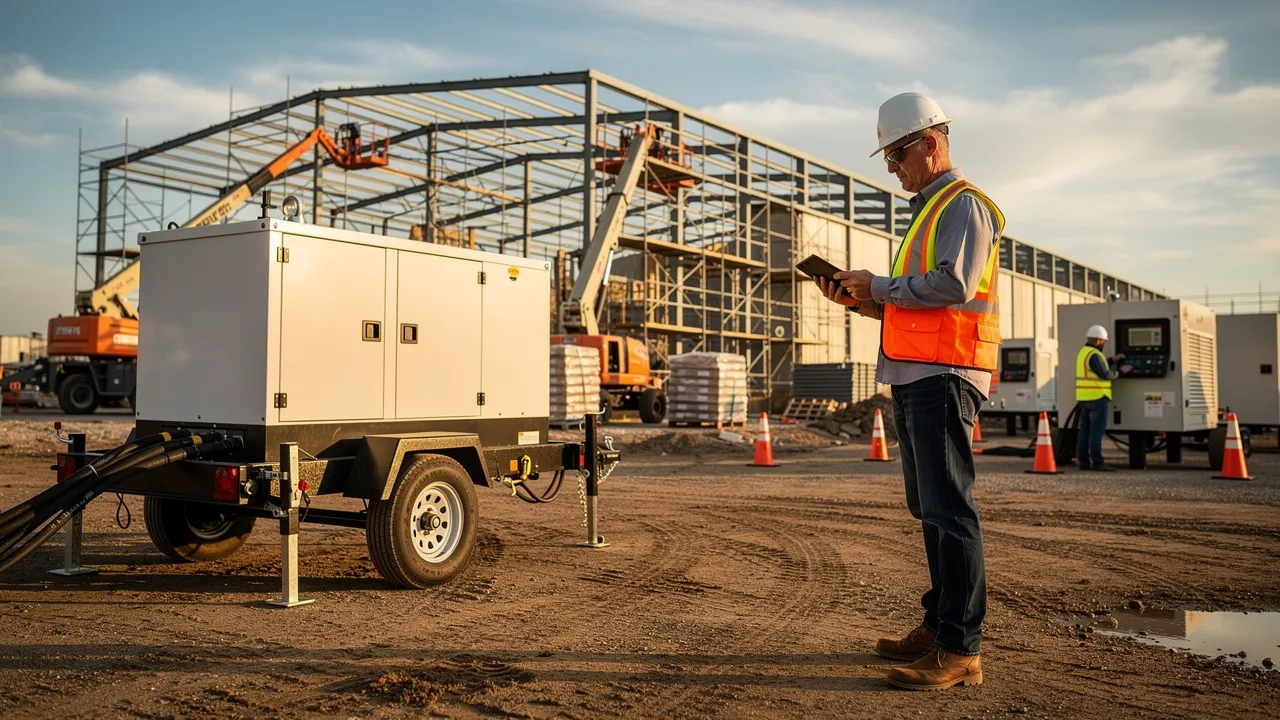
Start with the jobsite’s actual temporary-power requirement
A DFW construction project needs a generator rental plan built around the power requirement at the jobsite, not simply the project name or a rough guess about equipment size. Temporary power can help keep work moving when a grid connection is unavailable, insufficient, or compromised. The useful starting point is a written description of what must operate, when it must operate, where the equipment will sit, and who will handle the practical responsibilities around it.
For a project in Irving, Dallas, Fort Worth, Grand Prairie, Garland, Plano, or another DFW location, prepare the facts before asking about a particular unit. Your request should explain the work phase, the equipment that needs power, the expected operating period, the site access conditions, and any known connection requirements. That information gives the rental conversation a defined purpose without turning an unverified assumption into a generator selection.
Use this guide to move through the decision in order:
- Identify the loads that must operate.
- Separate normal demand from startup demand.
- Record voltage, phase, connection, and distribution questions.
- Define the operating period and fuel responsibilities.
- Check delivery, placement, access, service, and safety conditions.
- Turn the completed record into a focused request to EZ Equipment Rental.
Keep two ideas separate as you prepare: whether the generator arrangement fits the project and which party will perform or pay for each rental-related task. The result is not a final electrical design. It is a provider-ready project brief that helps you ask the right questions and keeps equipment fit, site readiness, and rental responsibilities separate.
Overview
Generator suitability depends on several connected facts: required output, critical loads, starting loads, voltage and phase, fuel, runtime, site access, distribution, and the responsibilities assigned for setup and support. Treat each fact as a confirmation point rather than as a reason to choose a unit from a label such as “small commercial project” or “construction backup.”
A documented power assessment gives you a more useful starting point than a quick estimate based only on square footage or service-entrance size. The assessment identifies essential equipment, records electrical requirements, and establishes which systems need backup power. For a larger site, the supporting setup may include temporary distribution panels, transformers, switchgear, or other equipment in addition to the generator.
Your rental request should answer five practical questions:
- What equipment must operate, and what can remain off?
- What happens when motors, pumps, compressors, or other loads start?
- What voltage, phase, connection, and distribution details apply?
- How long will the equipment operate, and who handles fuel planning?
- Can the DFW jobsite receive, place, connect, service, and support the equipment?
Use those answers as decision gates. If the essential loads are not identified, pause before discussing capacity. If startup conditions are unknown, mark them for technical review. If the connection path or site access is unclear, keep the request open rather than treating an apparent output match as a complete solution. If responsibilities are unassigned, include them as agreement questions.
The rental agreement may assign delivery, setup, maintenance, monitoring, emergency support, and fuel management in different ways, so those responsibilities need direct confirmation for the specific project and rental period.
Record the loads that must operate
The jobsite load record should identify every system that must receive temporary power and the conditions under which it will run. Start with the work sequence, because a generator serving a concrete placement phase may face a different demand pattern from one supporting lighting, pumps, tools, or temporary facilities during another phase.
List the equipment and systems in three groups:
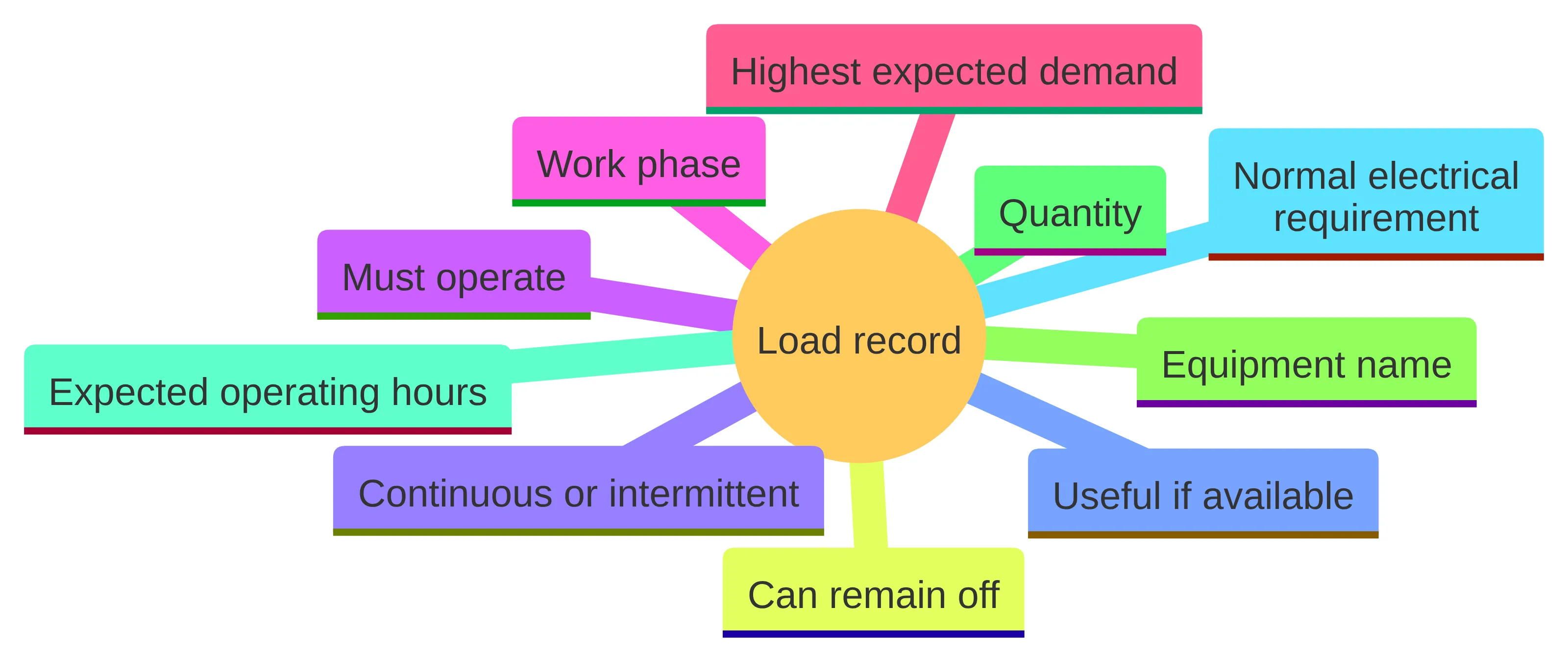
- Must operate: Equipment or services that cannot be interrupted during the defined work period.
- Useful if available: Loads that support productivity but can be delayed, reduced, or operated at different times.
- Can remain off: Equipment that does not need power during the rental period or can be supplied another way.
For each item, record the equipment name, quantity, expected operating hours, normal electrical requirement if known, and whether it operates continuously or intermittently. Include temporary lighting, pumps, compressors, charging equipment, controls, job trailers, and other connected loads when they are part of the plan. Do not replace an unknown electrical requirement with a guess based on the equipment’s appearance or the size of the building.
A documented assessment should measure or otherwise establish the electrical requirements of the essential equipment and identify the systems that need backup power. That approach is more useful than relying on square footage or service-entrance size alone. If the project has several work areas, note which area each load serves and whether multiple areas may operate at the same time.
Create a separate list for each major work phase when the load mix will change. For example, record the equipment used during excavation, concrete work, interior finishing, or temporary-facility operation separately instead of combining every possible load into one undifferentiated total. Note which phase creates the highest expected demand, but leave the capacity decision to the technical review of the actual electrical requirements.
Your load sheet can use this format:
| Load or system | Quantity | Normal operating pattern | Must operate? | Electrical information to confirm |
|---|---|---|---|---|
| Primary work equipment | Continuous or intermittent | Yes or no | ||
| Pumps, compressors, or motors | Startup and running periods | Yes or no | ||
| Lighting or temporary facilities | Scheduled operating period | Yes or no | ||
| Tools and auxiliary equipment | Simultaneous or staggered use | Yes or no |
Send the completed list with your inquiry. It gives EZ Equipment Rental a project description to review instead of asking the rental team to infer the requirement from a single equipment name. If you cannot document a requirement, label it as unknown and make it a question rather than filling the gap with an estimate.
Account for startup demand separately from normal operation
Startup demand is a separate generator-selection question because motors, pumps, compressors, and similar equipment can require more power when they start than they require during normal operation. A load list that records only steady operation can therefore leave out a condition that affects the requested generator category or supporting equipment.
Mark every load that starts rather than assuming that all equipment draws power in the same way. Your record should distinguish between equipment that runs continuously, equipment that cycles on and off, and equipment that may start while another load is already operating. Note whether several motors, pumps, or compressors could start together during the same work step.
Use this short startup review:
- Identify each motor, pump, compressor, or other load with a startup event.
- Record the normal operating requirement and any available startup information separately.
- Note the order in which the loads are expected to start.
- Identify simultaneous starts that could occur during the work sequence.
- Ask how the startup conditions affect the proposed generator and distribution plan.
Startup information can change with the work phase. A pump that starts only when a particular area needs drainage creates a different operating pattern from a compressor that cycles throughout the shift. Record those conditions, including whether the equipment may restart after an interruption, so the request describes the way the loads will actually be used.
Do not turn this checklist into a self-directed sizing calculation when the necessary electrical information is missing. Instead, give the rental team the equipment documentation, nameplate information, or project assessment available to you and ask which details still need confirmation. A pre-delivery power assessment can review load requirements and peak demand periods as part of confirming the unit size.
A useful inquiry might say: “The site will operate two pumps and one compressor during this phase. The pumps may start while lighting and temporary facilities are running. Here are the available equipment requirements and the expected sequence. Which additional information is needed to assess the generator and distribution arrangement?” That question communicates the operating situation without asserting that a particular capacity will work.
Keep startup demand visible in the project brief even when the work appears small. The point is not to make the request more complicated; it is to prevent a normal-running estimate from standing in for the full operating condition.
Confirm the electrical interface before discussing a unit
The electrical interface determines how the generator connects to the equipment it will power, so voltage and phase must be confirmed before you discuss whether a particular unit fits. The generator must be compatible with the powered equipment’s voltage and phase requirements. A project brief should therefore describe the intended connection path rather than stopping at the total load.
Record the following interface questions:
- What equipment or panel will receive the temporary power?
- What voltage and phase requirements apply to each essential load?
- Will the loads use one distribution point or several work areas?
- Is a transfer switch, temporary distribution panel, transformer, switchgear, or another item part of the connection plan?
- Where are the proposed tie-in points?
- Who will assess or complete the connection?
Ask the rental team which information it needs before delivery and which portions of the connection plan remain the responsibility of the project team.
Assemble the interface information in a small packet rather than scattering it across messages. Include available equipment nameplates, panel information, a load schedule, the proposed tie-in locations, and a simple site plan if those documents exist. Mark each item as confirmed, estimated, or unknown. That distinction helps prevent a preliminary figure from being treated as a completed electrical requirement.
NFPA 110 addresses performance requirements for emergency and standby power systems used when normal power fails. That standard’s scope is relevant when a project involves an emergency or standby power system, but a general rental article cannot determine how a particular installation should be configured. Describe the proposed interface accurately, provide the applicable project documentation, and keep the final connection decision with the people responsible for the project’s electrical design and compliance.
Do not describe a generator as compatible merely because its advertised output appears large enough. Compatibility includes the electrical requirements of the powered equipment and the connection path between the generator and those loads.
State the operating period and plan for fuel responsibilities
The operating period defines how the generator will be used and what support questions belong in the rental discussion. State the project dates or work phase, the expected hours of operation, whether use will be continuous or intermittent, and whether the schedule could extend beyond the initial period. You do not need to promise an exact duration when the construction schedule is still changing; identify the planned period and the source of uncertainty.
For longer operating periods, plan for appropriate fuel storage and refueling. The fuel plan should identify who supplies fuel, who monitors the level, how refueling is coordinated, and what happens if the work period extends. Fuel management may be handled by the rental provider, the site team, or another arrangement depending on the agreement, so do not assume that it is included with the equipment.
Separate the planned operating period from the rental period. The equipment may be needed before the first active shift for delivery, setup, or connection review, and it may need to remain available if a work phase changes. Ask how the planned schedule, extension possibility, and return timing relate to the rental agreement rather than assuming that the first and last work dates answer every term question.
Ask these questions before committing:
- What rental period matches the planned work phase?
- How are additional days or an extended schedule handled?
- Who supplies and manages the required fuel?
- Who checks fuel levels during operation?
- What arrangements apply if the generator must run outside the planned schedule?
- What maintenance or service timing applies during a longer rental?
The rental agreement may also allocate setup, maintenance, monitoring, and emergency technical support differently. Record the answer to each responsibility beside the operating-period information so you can see whether the plan depends on an action that no party has accepted.
Harsh or dusty environments may require more frequent maintenance, and the equipment manufacturer’s maintenance instructions govern the appropriate maintenance approach. A DFW jobsite with active cutting, excavation, demolition, or material handling should describe the surrounding work conditions so the maintenance conversation is based on the actual environment rather than a generic schedule. Ask which maintenance instructions apply to the specific equipment and rental period.
Check whether the DFW jobsite can receive and support the generator
The DFW jobsite needs enough room and suitable access for delivery, placement, cabling, and servicing before a generator can become a workable part of the project plan. Site readiness is not limited to finding an open patch of ground. The proposed location must also work with the connection path, service access, work sequence, and any restrictions imposed by the property or jobsite plan.
Create a site record that covers:
- Jobsite city and complete delivery location.
- Entry route, gate dimensions, turning areas, and access restrictions.
- Proposed placement area and its distance from the loads or tie-in points.
- Space required for cabling, distribution equipment, inspection, and servicing.
- Surface, grade, clearance, and nearby work activities that may affect placement.
- Site contact, delivery window, and coordination requirements.
- Storage or security arrangements for the rental period.
A pre-delivery assessment can review the site’s load requirements, peak demand periods, and tie-in points. Your site record should help that conversation by identifying where the equipment could go and how the power would reach the work areas. If several placement areas are possible, describe the advantages and restrictions of each instead of selecting a placement area without checking the connection and service implications.
Add a simple access sequence to the request: where the equipment would enter, where it could be placed, how cabling would reach the intended loads, and how technicians could reach it for servicing. This sequence exposes conflicts between an apparently open placement area and the actual route needed for delivery, connection, inspection, or maintenance.
Ask directly whether delivery, positioning, cabling, setup, and servicing are included, available, or assigned to the project team. Rental agreements may distribute these responsibilities differently. Do not imply that EZ Equipment Rental has confirmed a delivery route, placement arrangement, or delivery term until the details have been discussed for the specific DFW jobsite.
An Irving site and a project in Fort Worth may present different access arrangements even when the power requirement is similar. Give the exact location and practical site conditions in your request so the conversation can address the actual jobsite rather than a general DFW assumption.
Separate generator fit from rental responsibilities
Generator fit and rental responsibility are two different decisions, and your project record should keep them separate. A generator may appear to match the load description while the plan remains incomplete because delivery, setup, monitoring, maintenance, emergency support, or fuel management has not been assigned.
Use a responsibility matrix during the rental conversation:
| Project question | What you need to identify | Responsibility to confirm |
|---|---|---|
| Delivery | Who transports the equipment and coordinates the arrival? | Rental agreement or project team |
| Placement | Who positions the generator at the approved location? | Rental agreement or project team |
| Setup | Who handles the agreed setup and connection work? | Rental agreement or qualified project personnel |
| Distribution | Are panels, transformers, switchgear, or cabling included or separate? | Rental agreement and project design |
| Monitoring | Who checks operation and responds to an issue? | Rental agreement or site team |
| Maintenance | Who schedules and performs required maintenance? | Rental agreement and manufacturer instructions |
| Fuel | Who supplies, stores, monitors, and replenishes fuel? | Rental agreement or site team |
| Emergency support | What support pathway applies if the unit stops or conditions change? | Rental agreement |
The rental agreement determines how these duties are allocated for the specific equipment and period. Rental services can include some combination of delivery, setup, maintenance, monitoring, and technical support, but those services should not be assumed from the existence of a rental listing. Ask for each responsibility in plain language and write down the answer.
This distinction also improves cost review without assuming that rental is cheaper than ownership. Compare the full arrangement you need: equipment period, delivery, setup, distribution, fuel, maintenance, monitoring, and any extension or return conditions that apply. The purpose is to understand the commitment before you proceed, not to promise a saving.
Use the matrix to identify the next action for each row. If the load and interface are clear but fuel management is not, ask that question before committing. If delivery is possible but placement or cabling remains unassigned, resolve that boundary before treating the generator as ready for the jobsite. If technical responsibility is unclear, keep the connection decision with the qualified project personnel responsible for it.
Keep unresolved items visible. A blank responsibility row is a question for the rental conversation, not permission to fill in a favorable assumption.
Apply official safety guidance without making project-specific electrical decisions
Official safety guidance should shape the questions in your rental brief without becoming a project-specific electrical decision. OSHA guidance recommends using appropriately rated cords and not using tools or appliances with frayed cords, missing grounding prongs, or damaged housings. Treat those points as pre-use checks for the equipment and connection materials that will actually be used at the jobsite.
Your safety section can include these confirmation points:
- Are the cords and connection materials appropriately rated for the intended use?
- Are cords, grounding prongs, housings, tools, and appliances free from the listed damage conditions?
- What equipment documentation applies to operation, maintenance, and inspection?
- Which project personnel are responsible for the connection, inspection, and operating decisions?
- What requirements apply to the proposed connection method?
For generators connected through transfer switches, grounding requirements are addressed by Article 250 of the National Electrical Code. This guidance identifies an area for careful project review; it does not allow you to select a connection method from a general article.
Maintain an emergency power supply system according to the manufacturer’s instructions and applicable requirements. Harsh or dusty operating environments may require more frequent maintenance, so include the site conditions in the equipment and service discussion. The applicable equipment documentation remains part of the operating plan.
The OSHA portable-generator fact sheet is informational and does not impose new compliance requirements. Use applicable OSHA standards, regulations, project requirements, and equipment documentation for compliance questions. Keep your request factual: describe the equipment, loads, connection plan, and site conditions, then ask what technical review is required before operation.
Do not use a general safety checklist as a substitute for the project’s electrical review. Use it to identify documentation and responsibility questions, then provide the completed information to the qualified personnel responsible for the connection, inspection, and operating decisions.
Turn the assessment into a provider-ready rental inquiry
A provider-ready generator inquiry gives us enough project context to discuss a suitable rental path without asking the team to guess at your requirements. We offer generators as part of our rental equipment and provide personalized recommendations based on your specific needs and budget. Your role is to supply the project facts that make those needs clear.
Organize the request in this order:
- Project location: Give the DFW city, complete jobsite address, site contact, and access restrictions.
- Work phase: Explain what the temporary power will support and when the work is expected to occur.
- Essential loads: List each required load, quantity, normal operating pattern, and available electrical information.
- Startup conditions: Identify motors, pumps, compressors, or other equipment that may require more power at startup.
- Interface information: Include known voltage, phase, tie-in, distribution, and transfer-switch details without guessing at unknown values.
- Operating period: State planned dates, expected hours, continuous or intermittent use, and schedule uncertainty.
- Site conditions: Describe delivery access, placement space, cabling route, service access, and nearby work.
- Responsibility questions: Ask who handles delivery, placement, setup, distribution, monitoring, maintenance, emergency support, and fuel management.
- Documents: Attach or reference equipment nameplates, load schedules, electrical assessments, site plans, and applicable project requirements.
Before sending the inquiry, mark each major item as confirmed, available for review, or still unknown. This makes it easier to distinguish a project fact from a question for the rental conversation. It also keeps a preliminary load estimate, an unconfirmed delivery assumption, or an incomplete fuel plan from appearing to be a settled rental condition.
End with direct questions rather than a vague request for “a generator.” For example: “Which generator rental options should we discuss for these loads and operating conditions? What information is still needed to assess compatibility, distribution, site access, fuel, and support responsibilities? Which items would be included in the rental agreement?”
Avoid inserting unverified specifications, pricing, fees, availability, delivery promises, or operating rules into the request. Ask for those details for the specific equipment and rental period. A precise inquiry does not guarantee a match; it creates a clear basis for the next confirmation step.
Request a project-specific generator recommendation from EZ Equipment Rental
We offer generators as part of our rental equipment. We provide equipment rental services in Dallas and are located in Irving, Texas; our listed location is 1307 W Airport Fwy, Irving, TX 75062. Our DFW service context makes the exact jobsite location, access route, and site contact useful parts of your request.
Before you send the project details, separate what you know from what must be confirmed for the specific equipment and rental period. A qualified professional should decide individual electrical suitability and project-specific compliance. Once those boundaries are clear, your completed brief can support a focused discussion about the appropriate rental path, required supporting equipment, and agreement responsibilities.
A clear project record gives the rental conversation a practical starting point and keeps the final equipment, connection, operating, and service decisions tied to the actual DFW jobsite.
What should you confirm before committing to a generator rental?
What factors should I consider when determining generator suitability for my project?
Consider required output, critical loads, starting loads, voltage and phase requirements, fuel availability, runtime, site access, and distribution needs.
How can I prepare a rental request for a generator?
Prepare a request by detailing the project location, work phase, essential loads, startup conditions, interface information, operating period, site conditions, and any responsibility questions.
What should I confirm about the jobsite before renting a generator?
Ensure the jobsite has enough room and suitable access for delivery, placement, cabling, and servicing of the generator.
What are the responsibilities related to generator rental that I need to clarify?
Clarify who handles delivery, placement, setup, monitoring, maintenance, emergency support, and fuel management in the rental agreement.
How do I assess the startup demand for equipment when renting a generator?
Identify each load that starts, record its normal operating requirement, and note the order and conditions under which loads are expected to start.
What safety guidelines should I follow when renting a generator?
Follow OSHA guidelines by ensuring cords and connection materials are appropriately rated and free from damage, and consult applicable standards for grounding and connection methods.
How can I contact EZ Equipment Rental for a generator rental?
You can contact EZ Equipment Rental directly through their website or visit their location at 1307 W Airport Fwy, Irving, TX 75062.
Sources
- How to Rent a Generator: Complete Guide | Alayan — alayanrentals.com
- Emergency Power Generator Rental: A Guide to Temporary Backup Power — www.curtispowersolutions.com
- Generator Rental for Construction Sites: 2026 US Guide — datacenterfuels.com
- Overview of Emergency Power Supply Systems — www.nfpa.org, 2024-06-14
- Grounding Requirements for Portable Generators — www.osha.gov
- An Overview of NFPA 110 — www.nfpa.org, 2023-01-23
- How to Size a Generator for a Commercial Building — www.ptpnw.com, 2026-08-17
- About Us - EZ Equipment Rental | Dallas, TX — www.ezequipmentrental.com
- 40 Tips to Successful Generator Rentals — www.rermag.com, 2017-09-28
- EZ Equipment Rental provides industrial equipments -
- Equipment & Tool Rentals in Dallas TX - EZ Equipment Rental