
Translate “lift event” into an event equipment plan
The phrase “lift event” can have more than one meaning, so this guide uses it in the event-equipment sense: planning elevated access for temporary setup, lighting, maintenance, or related work at an event or facility in Irving or the wider DFW area. Start with the task rather than the machine name. You need to know what must be reached, where the equipment will stand, how people and materials will move, and how long the work window will remain open.
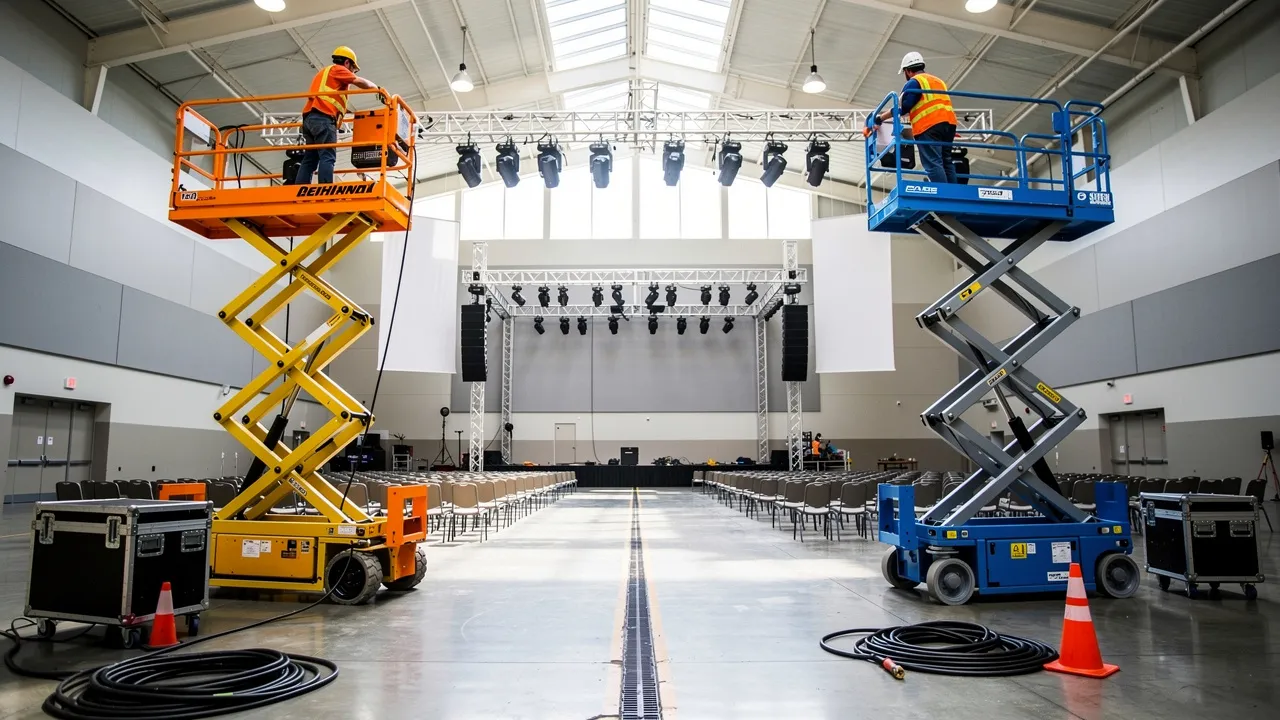
Aerial lifts elevate personnel above ground; examples include scissor lifts and telescopic boom lifts. For an event, that may mean raising authorized workers to install or maintain temporary lighting, complete overhead venue work, or reach an exterior feature during setup and breakdown. The equipment choice follows the work envelope: height, direction of reach, operating surface, available space, and the load of workers, tools, and materials.
Cost belongs in the initial plan because the rental window and lift class can change the budget. Published figures for around 19-foot electric scissor lifts listed observed costs of about $95 - $290 per day and $222 - $710 per week. Around 26-foot electric scissor lifts listed observed costs of about $121 - $380 per day and $338 - $950 per week. Around 40-foot electric scissor lifts listed observed costs of about $245 - $699 per day and $549 - $1,653 per week, while published longer-term costs for that class were about $1,150 - $3,979 per month; one 4-week example was $1,169.
A useful event plan therefore has four parts: define the work, compare the access pattern, record the site, and coordinate the rental window. If any of those parts remains uncertain, pause the selection instead of treating a familiar lift name as proof that the equipment fits.
Start with the event task and access point
The event task determines whether you need elevated personnel access, a platform for people and materials, directional reach, or a different category of equipment. Write the work as a short description before comparing rentals: install lights above a stage, inspect an exterior wall, maintain ceiling fixtures, position materials for a temporary build, or reach a point beyond a fixed obstacle. A clear task description gives a rental specialist something more useful than “I need a lift.”
Scissor lifts can suit fit-out, maintenance, installation, warehouse, painting, and ceiling tasks when vertical access and a stable working area are needed. That makes them a possible fit for overhead venue work where the target is directly above the machine and the platform needs to support people, tools, or materials. The event still needs a model-specific check for height, capacity, surface, and access.
Boom lifts can suit work requiring directional reach, including access over obstacles, exterior walls, facades, and structural work. A boom lift raises a person in a small bucket or compact platform; if the work goes beyond the 40- or 50-foot maximum height of most scissor lifts, you will probably need a boom lift. Describe the target point and the obstacle between the machine and that point before asking for a recommendation.
Use this first decision split:
- Choose the vertical-access path when the work is directly above the base and a spacious platform is useful.
- Explore the directional-reach path when the platform must extend outward, over an obstacle, or toward a location that the base cannot sit beneath.
- Describe another equipment need separately when the main task is ground-level movement, power, air, or lighting rather than raising personnel.
The action is simple: write the task, target point, and obstruction pattern before selecting a lift.

Choose vertical access or offset reach
Scissor lifts provide primarily vertical access and do not provide horizontal outreach. Boom lifts provide vertical and horizontal reach and can extend over obstacles or into hard-to-access positions. Choose the lift type based on working height, reach, terrain, and capacity requirements rather than choosing by the word “lift” alone.
| Event question | Scissor lift direction | Boom lift direction |
|---|---|---|
| Where is the target? | Directly above the machine base | Above, beyond, or around an obstacle |
| What access pattern is needed? | Primarily vertical access | Vertical and horizontal reach |
| What work area is useful? | A stable, spacious platform | A compact platform or bucket at a directed position |
| What configuration may matter? | A platform selected for the required height and load | An articulating boom for bending around obstacles or a telescopic boom for farther straight-line reach |
| What must be checked? | Working height, surface, capacity, and travel path | Working height, horizontal reach, surface, capacity, and maneuvering space |
Articulating boom lifts bend around obstacles, while telescopic boom lifts reach farther in a straight line. When maximum height is the prerequisite, a comparison guide describes boom lifts as a better choice: telescopic boom lifts can reach heights of up to 200 feet, while scissor lifts generally reach around a maximum of 60 feet. Treat those figures as comparison guidance, not as a substitute for the specifications of the model proposed for your event.
A listed 46-foot electric scissor lift has a platform height of 45 feet 9 inches and a platform capacity of 770 pounds. The figures describe that listed machine, not every scissor lift. Match the planned workers, tools, and materials to the applicable model's capacity, and distinguish platform height from the working height you need.
Historical safety data also explains why the access decision cannot rest on height alone: CDC/NIOSH reports 1,380 worker injuries and 87 fatalities involving aerial lifts or scissor lifts between 2011 and 2014. Those figures describe that 2011-2014 period, not the risk of a particular DFW event. Use them as a reason to require the right equipment, trained operators, and a site-specific operating plan.

Test height, platform, and venue access
Working height is the measurement that matters for the target, but platform height and working height are different measurements. Record the height of the work point, then ask for the manufacturer's working-height specification instead of estimating reach from a platform label. Include the height of fixtures, signs, trusses, walls, or ceiling features that must actually be reached.
Venue access can eliminate an otherwise suitable machine. Some electric scissor lifts can fit through standard doorways and narrow passages when completely folded, while boom lifts need larger transport and maneuvering space than scissor lifts. Measure doorways, gates, corridors, loading areas, turning points, ramps, and the route from unloading space to the work zone. Include the folded dimensions and travel requirements of the proposed model in the discussion.
Operating surface is another selection filter. Choose the lift based on working height, operating surface, and whether you need to reach over or around obstacles. A venue floor, paved parking area, landscaped ground, temporary surface, or uneven outdoor area can lead to different equipment questions, so describe the actual surface rather than calling it simply “indoors” or “outdoors.”
As an early budget benchmark, daily man-lift rental costs typically range from $150 to $650, depending on lift type, working height, and local market. The range is not a quote for an Irving or DFW event. Use the exact work height, access route, surface, expected duration, and intended load to narrow the equipment conversation.
Record the site conditions before requesting equipment
The site record should describe the conditions that affect stability, travel, clearance, and load. Before requesting equipment, record:
- The planned work height and the point that must be reached.
- The surface, slope, soft areas, underground voids, and any temporary flooring.
- Holes, drop-offs, curb edges, bumps, debris, and obstructions along the travel path.
- Overhead beams, pipes, ceiling structures, signs, trees, and power lines.
- The combined weight of authorized personnel, tools, and materials.
- The available unloading, setup, turning, and evacuation space.
This record gives the rental discussion a site-specific starting point.
Ground support deserves a direct check. Verify that the ground can support the lift's weight plus its rated load, including checks for underground voids and soft soil. Check the site for uneven surfaces, drop-offs, holes, bumps, floor obstructions, debris, and overhead hazards, and do not park the lift on a slope exceeding the operator manual's specifications. Mark hazards in the travel path so the operating team can see them before movement begins.
Survey for overhead obstructions such as beams, pipes, and ceiling structures at the planned work height. The cited job-safety analysis says to maintain a minimum clearance of 10 feet from power lines under 50kV; verify the requirements applicable to the site and equipment rather than treating that figure as a universal answer for every electrical situation. Keep the planned travel and work envelope clear of contact and collision hazards.
Slope and load limits are model-specific. The cited job-safety analysis says most lifts are rated for a 0-5° maximum slope, while the applicable lift's specifications must be checked. Do not exceed the lift's maximum capacity or the manufacturer's specified boom and platform load limits, including the combined weight of workers, tools, and materials. If the ground, slope, clearance, or load cannot be documented, stop the selection process and obtain a qualified assessment.

Coordinate venue access, timing, and rental duration
The event schedule should account for more than the hours spent at the elevated work point. Build time for access approval, arrival, unloading, movement to the setup area, inspection, venue coordination, the work itself, and removal. Ask the venue which entrances, loading windows, floor protections, barricades, noise limits, and overhead restrictions apply. A venue's event schedule and a machine's required setup space must work together.
Rental duration is project-dependent. A short lighting adjustment may need a daily window, while a multi-day setup, maintenance sequence, or extended temporary installation may require a longer period. We offer flexible rental durations tailored to project requirements, including flexible daily, weekly, and monthly rental terms for variable project schedules and unexpected emergency repair situations.
Our Irving location is at 1307 W Airport Fwy, Irving, TX 75062. For an event in Irving or elsewhere in DFW, include the venue address, access route, unloading point, setup area, and requested rental window when discussing the equipment plan. Ask how the proposed transport arrangement fits the venue's loading rules instead of assuming that the nearest entrance or parking area is usable.
Use this coordination sequence:
- Ask the venue for access, surface, overhead, weather, and operating requirements.
- Give the rental contact the event date, work window, location, task, height, reach, load, and route details.
- Match the rental period to the complete setup and work sequence, not only the time at elevation.
- Recheck the plan if the venue changes the work area, access time, surface, or event layout.
The direct action is to create one shared site and schedule brief before equipment is arranged.
Build a realistic lift-event cost question
Published rental figures are benchmarks, not an Irving or DFW quote. Typical man-lift rental costs are cited at about $150 - $650 per day, depending on lift type, working height, and local market. Weekly man-lift rentals are generally cited at about $550 - $2,200, and a full-week rental typically saves 30% - 50% compared with booking five separate days. The comparison is between a full-week rental and five separate daily bookings.
DOZR reports a marketplace average scissor-lift rental cost of $190 per day, $480 per week, and $1,018 per month. Those figures measure a marketplace average rather than a particular machine or DFW quote, and public listings vary considerably by size and market. Treat the daily, weekly, and monthly amounts as separate rental-period benchmarks.
Observed scissor-lift costs vary by class. Around 19-foot electric lifts are listed at about $95 - $290 per day and $222 - $710 per week. Around 40-foot electric lifts are listed at about $245 - $699 per day and $549 - $1,653 per week. Published longer-term costs for around 40-foot electric scissor lifts were about $1,150 - $3,979 per month, and one current 4-week example was $1,169. These figures describe observed listings for the stated classes and periods.
Rough-terrain scissor-lift pricing depends largely on location, availability, and desired vertical height. Cited examples range from a 26-foot model at about $154 per day, $409 per week, and $1,008 per month to a 50-foot model at about $379 per day, $891 per week, and $2,187 per month. The two examples differ in height and equipment type, so they should not be treated as a single standard rate.
Other published examples separate indoor and directional-access equipment: a compact push-around electric lift for indoor use runs around $150 - $250 per day, while a 40-foot boom lift or articulating lift can run $300 - $550 per day. Ask which equipment class, working height, reach, terrain capability, rental period, and local-market assumptions produce the figure you receive. Also ask what the quoted amount includes for transport, setup, and venue logistics.
A complete cost question sounds like this: “For this event location and access route, what lift type matches the work height, reach, surface, and load; what is the daily, weekly, or monthly rate; what rental period applies; and which transport or event-logistics charges are separate?” That wording keeps the conversation tied to the actual site instead of a broad online range.

Set operating requirements before the event begins
Only trained and authorized people should operate an aerial lift, and training must cover the specific type of machine. A person trained on a scissor lift should not be assumed to have the training needed for a boom lift. Assign the operating responsibility before the event and keep untrained event staff, guests, vendors, and bystanders outside the operating area.
Training should cover electrical, fall, and falling-object hazards, hazard avoidance, operation and load capacity, inspections, and manufacturer requirements. Those subjects belong in the event's operating plan because the venue may contain guests, temporary structures, lighting, signs, cables, and other work-area changes that are not present on a normal jobsite.
Conduct a documented pre-use inspection and use a safe-use program that begins with a risk assessment and includes daily safety observation and trained personnel. Complete the assessment before the first lift, then repeat the observation when the work area, weather, access route, crew, or equipment changes. Keep the inspection and operating information available to the responsible supervisor or site lead.
Install guardrails and close access gates or openings before raising the platform. Do not exceed the manufacturer's load limits, including the combined weight of workers, tools, and materials. Do not sit or climb on guardrails or use planks, ladders, or other devices on the work platform. These are operating boundaries, not adjustments to make when the work point seems just out of reach.
Protect bystanders with barricades, a person keeping them at a safe distance, or other suitable means. Watch the direction of travel and maintain awareness of clearances above, below, and on all sides. For a public event, coordinate the exclusion area with venue management before guests, performers, exhibitors, or other crews enter the work zone.
Stop for unsafe weather, equipment, or operations
Weather can change the event plan after equipment arrives. Wet ground can affect stability and poor visibility can make elevated work harder to manage; do not operate aerial equipment during lightning or when weather or ground conditions make work unsafe. Build a weather decision into the schedule rather than relying on the event start time as permission to continue.
If lift conditions or operations feel unsafe, ground the lift and cease operations. Stop for unstable or changing ground, unexpected movement, damaged equipment, loss of clearance, an unplanned person entering the work zone, or any condition that conflicts with the operating plan. Do not solve an unsafe reach or access problem by improvising with the platform, a ladder, a plank, or an altered travel route.
The cited emergency plan says never to operate a mobile elevating work platform without a spotter or ground attendant. Follow the site's emergency plan if an operator becomes unable to continue or controls fail. For a failure of platform controls while elevated, the cited plan directs a spotter to use ground controls to lower the platform to ground level. Do not attempt an improvised elevated rescue; involve the designated site or emergency response personnel according to the plan.
The first response is to stop, keep people clear, communicate the condition, and follow the written site procedure. If the procedure, equipment status, or qualified response is not available, keep the lift grounded and obtain immediate qualified help before restarting.
Seek qualified evaluation when the plan cannot be verified
The work area can contain uneven, soft, or sloped ground, overhead power lines, and overhead structures that create tip-over, contact, or collision hazards. A venue diagram or general equipment category cannot resolve those conditions by itself. The unresolved condition needs a site-specific answer before the equipment is selected or operated.
Pause the plan and route it to the venue safety lead, supervisor, or qualified equipment contact when you cannot verify:
- Ground support, slope, underground conditions, or the travel path.
- Working height, horizontal reach, platform capacity, or machine configuration.
- Clearance from power lines, structures, guests, vehicles, or other event equipment.
- The inspection status, operator authorization, weather decision, or emergency procedure.
Do not book around an unresolved hazard or ask an operator to make the missing engineering, site, or authority decision while the platform is in use.
A clear boundary protects the event schedule: if the site cannot support the proposed equipment, the route cannot be controlled, or the operating requirements cannot be confirmed, keep the lift out of service until the responsible qualified person resolves the question. That pause is the next action, not a delay to work around.
Send EZ Equipment Rental the event details
A complete event brief should state the Irving or DFW location, work task, target height, required reach, access route, unloading and setup space, surface and ground conditions, overhead hazards, intended load, venue requirements, operating schedule, rental duration, and any weather-sensitive timing. Include photographs, measurements, or a site sketch when they clarify the route or work point.
We offer a fleet of well-maintained, top-of-the-line boom lifts. We provide generators, lighting, air compressors, earthmoving equipment, attachments, and trailers, among other equipment. We also offer advice mid-project through knowledgeable team members, so the equipment discussion can include the surrounding event setup when the lift is only one part of the plan.
Use the brief to separate what you know from what still needs confirmation: the task and access point should be clear, while the final model, operating limits, schedule, and site suitability should be addressed for the specific event. A qualified professional should decide individual suitability when the site or operating conditions affect that decision. The completed details give the next rental discussion a practical basis.
Questions to answer before requesting a lift-event rental
What does “lift event” mean in an event-planning context?
The phrase can have more than one meaning. In an event-equipment context, it refers to planning elevated access for temporary setup, lighting, maintenance, or related work at a venue or facility. The plan may involve an aerial lift, another equipment category, or no lift if the work remains at ground level.
How long does a lift event rental usually last?
There is no universal event duration. The rental window depends on the work scope, setup and breakdown sequence, venue access hours, inspection time, weather, and whether the equipment is needed for one day or several days. EZ Equipment Rental offers daily, weekly, and monthly rental terms, subject to project details and confirmation.
What information should I provide when arranging event equipment in Irving or DFW?
Provide the venue address, work task, target and working height, required reach, surface and ground conditions, slope, overhead obstructions or power lines, travel route, unloading and setup space, combined worker-and-material load, operating schedule, rental duration, and venue rules. Measurements, photographs, or a site sketch can help clarify access and setup requirements.
What should happen if weather, access, or equipment conditions become unsafe?
Stop the operation, keep people clear, and follow the site’s written emergency procedure. Do not operate during lightning or when wind, rain, visibility, ground conditions, damaged equipment, or blocked clearances make the work unsafe. Only trained and authorized people should operate the specific lift type; obtain qualified assistance before restarting if the condition cannot be verified.
What does lift-event equipment typically cost in the DFW area?
Published benchmarks - not an Irving or DFW quote - put typical man-lift rental at about $150 - $650 per day and $550 - $2,200 per week. Marketplace and observed scissor-lift listings vary by class, with examples from about $95 - $699 per day. The final price depends on lift type, working height, reach, terrain capability, rental period, availability, location, delivery, and other site or venue requirements.
Sources
- Scissor Lift vs. Boom Lift: Choosing the Right Aerial Lift for Your Job - beehiverentalandsales.com, 2026-02-09
- Scissor Lifts vs. Boom Lifts: A Comparative Analysis - atlanticforkliftservices.com
- Mobile Elevating Work Platform (Aerial Lift) Emergency Rescue Plan - Supervisors, Operators, and Spotters - safety.umbc.edu
- 1. Purpose 2. Scope 3. Definitions 4. Responsibilities 5. Procedures Aerial Lift Safety Program - campus.kennesaw.edu
- Aerial Lift Safety - rmu.edu
- Boom Lift vs. Scissor Lift Comparison Guide - platformbasket.ca
- Choose the Right Aerial Lift for Oahu Job Sites - equipmentoahu.com, 2026-10-12
- Aerial Lift JSA Template & Example - JSABuilder - jsabuilder.com, 2026-04-03
- Safely Operate Scissor & Boom Lifts in 5 Simple Steps - runyonrental.wordpress.com
- Weekly Safety Meeting - Aerial Lift Safety - Safety Matters Weekly - safetymattersweekly.com
- Working at Height? 5 Questions to Ask Before Renting an Aerial Lift - kmcequipment.com
- Scaffolds MIOSHA CS Part 32: Aerial Work Platforms ANSI/SAIA A92.22 - michsafetyconference.org
- OSHA aerial lift requirements → what 1926.453 says | Texas Lift Rental - texasliftrental.com, 2026-08-09
- Scissor Lift Rentals - Irving, TX in Dallas County | BigRentz - bigrentz.com
- Man Lift Rental Cost: Daily & Weekly Rates | RNTR - rntr.com, 2026-06-01
- Best Software for Boom Lift and Scissor Lift Rentals - prexa365.com
- Rent 46' Electric Scissor Lift - Tall Indoor Access - texasfirstrentals.com
- Scissor Lift Rental Cost: 2026 Price Guide | Avanza Equipment - avanzaequipment.com