
Start with the job, not the equipment name
Equipment selection for an Irving or Dallas-Fort Worth project starts with the job requirement, not a machine name. A request such as “I need a lift” or “I need a generator” leaves out the details that determine whether a category can support the work. Begin with the result you need, the material or equipment involved, the place where the work will happen, and the time window for completing it.
Equipment rental selection involves matching the equipment type, capacity, attachments, and technical specifications to the job requirement. That match gives you a useful starting point without treating a category label as a final selection. The actual model still depends on the work envelope, site access, operating conditions, and rental terms.
A job-first brief should answer these questions before you request a recommendation:
- What task must the equipment perform, and what must it reach, move, power, cut, compact, illuminate, or support?
- What material, people, tools, or connected equipment will be involved?
- What height, horizontal reach, load, power demand, clearance, or workspace does the task require?
- Where will the equipment operate in Irving, Dallas, Fort Worth, or another DFW location?
- What access route, entrance, surface, overhead clearance, and available workspace will affect setup?
- When must the equipment arrive, how long will it be needed, and could the schedule change?
Accurate information about load requirements and the work environment helps identify appropriate equipment. If a detail is uncertain, label it as uncertain instead of filling the gap with a guess. That gives the rental conversation a clear question to resolve.
Build the event and facility operating record
An event or facility equipment plan starts with a record of the work area and its demands. Note the activity, working height, reach, overhead clearance, ground conditions, load, access route, and available workspace before asking about a model. For scissor-lift work, selection should account for the application, overhead clearance, ground conditions, and weight requirements. Working height means platform height plus approximately six feet (6') to account for workers, so record the target work point rather than only the platform height.
Then connect the work point to the site's physical limits. Boom lifts can position their bases farther from an elevated work zone while still reaching it, whereas scissor lifts move strictly upward and may be limited when an obstacle blocks direct placement. For a restricted entrance, either lift category may be suitable depending on the model; check actual dimensions and operating clearance. On uneven or challenging ground, verify model suitability against the manufacturer’s requirements. For multiple workers and tools, compare the model-specific rated capacity and platform workspace.
A scissor lift’s weight requirements are a firm selection boundary for safety and stability. The request should include the combined weight of workers, tools, materials, and any other platform load, along with a question about the proposed model’s rated capacity.
A requirements-first rental record can use two passes. The first pass should identify the limiting requirement: maximum working point, required horizontal reach, combined platform load, entrance dimensions, overhead clearance, ground condition, or electrical demand. The second pass should identify negotiable details, such as whether the work window can change or whether delivery and pickup should be compared. The limiting requirement should drive the initial category question, while negotiable details should remain in the current rental discussion. A scissor-lift request should identify model-specific capacity and workspace because a category name does not establish those values. A boom-lift request should identify required base position and horizontal outreach because a lift that reaches the required height may still fail an offset-access requirement. A generator request should identify connected equipment and intended distribution arrangement because kW alone does not describe the full electrical fit.
A generator request needs both the connected load and the electrical limits. A generator has separate kW and kVA limits: the engine sets the kW limit, the alternator sets the kVA limit, and the load must clear both. Treat those figures as specifications for the stated set, not as a substitute for matching your actual load.
For an event or facility power plan, pair the connected load with the generator’s electrical limits. Record the equipment that will draw power, then compare both limits: the engine sets kW, the alternator sets kVA, and the load must clear both. Use the connected-load record to frame the availability and pricing question. Confirm the proposed model against the actual event or facility load before discussing current pricing and rental duration with EZ Equipment Rental.
Map event and facility equipment dependencies
Event and facility work often combines several equipment dependencies. Map the activity first, then separate the request into the functions that must be supported: elevated access, material handling, temporary power, lighting, compressed air, earthmoving, concrete work, or transport. Attach the relevant work point, load, access route, ground condition, and operating window to each function.
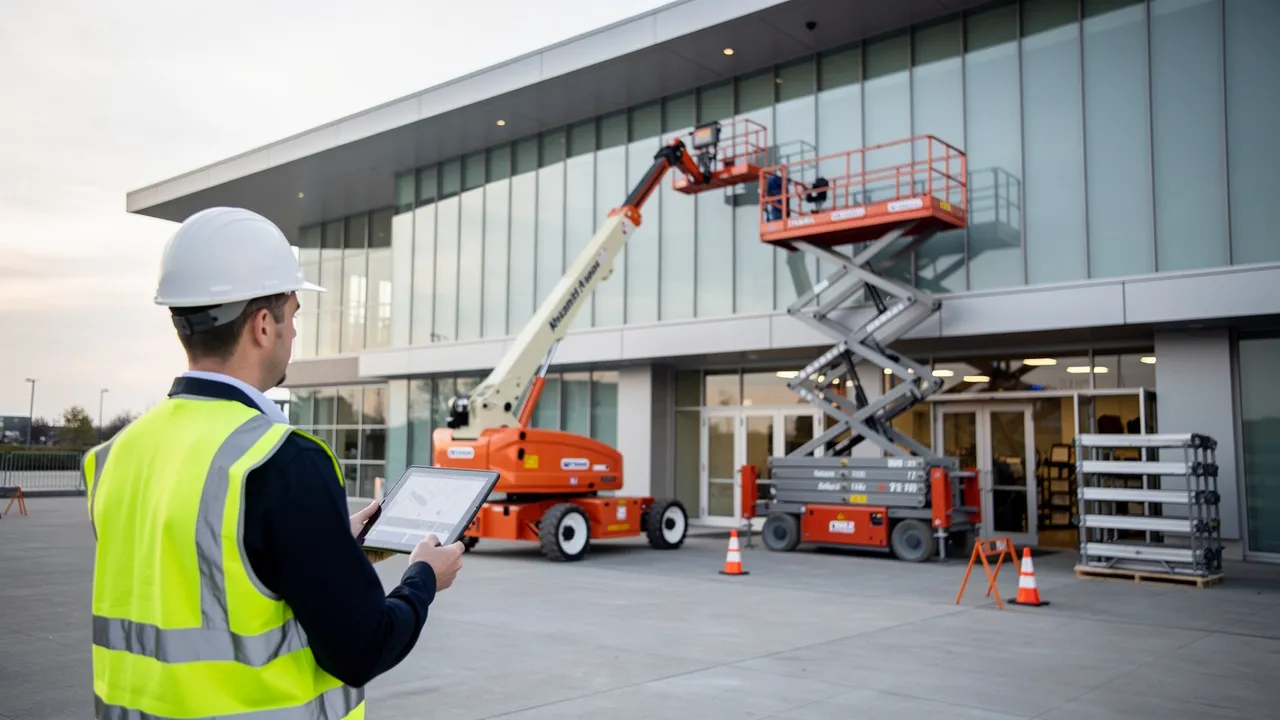
- Aerial access: A scissor lift primarily raises its platform vertically, while a boom lift can provide vertical elevation and horizontal outreach. Scissor lifts are often useful when you need a larger platform and direct access above the machine. Boom lifts may be more appropriate when the work area is offset or you need to reach over or around an obstacle.
- Material handling: We offer industrial forklift rentals for warehouse operations, construction projects, and heavy-duty lifting. State the material, load requirement, travel path, surface, and working height so the forklift question reflects the actual handling task.
- Power and site support: We provide generators, lighting, air compressors, earthmoving equipment, concrete equipment, and trailers. Separate temporary power, after-dark illumination, compressed air, material movement, concrete work, and transport needs when describing the site.
For an event or facility, keep lighting, power, access, and material-handling needs as separate lines in the request. Carry each line into the equipment, availability, pricing, terms, and delivery discussion.
A category decision path should preserve the reason behind each choice. Match the lift type to the job's working height, reach, terrain, and capacity requirements. If the work is offset or blocked by an obstacle, start with the boom-lift category and provide the required outreach, height, base position, access route, and ground information. If the task involves warehouse or construction loads, start with the forklift category and describe the load and travel conditions. If the task supports an event or facility, separate power, lighting, air, and access needs instead of putting every requirement under “specialty equipment.”
This routing method helps you ask a precise question without claiming that the category alone is suitable. The final equipment discussion still needs the model’s specifications and the conditions at your Irving or DFW site.
Translate event and facility power needs into a usable brief
Event and facility power planning starts with an inventory of every connected device and every area that needs light. List audio equipment, catering equipment, climate-control equipment, temporary lighting, tools, chargers, displays, and other loads, then separate continuous draw from peak draw. Calculating continuous and peak draw helps prevent circuit overloads when sizing event power. A generator has separate kW and kVA limits, so include the available electrical information rather than providing only a rough description such as “power for an event.”
Portable generators can supply electricity from 6 to 2,000 kW for tools, lighting, and climate-control equipment. Sound-attenuated generator models reduce noise in residential areas and at special events. LED light towers, metal halide systems, and solar-powered units can illuminate work areas after dark. Your brief should identify whether the need is event power, facility work, temporary lighting, or a combination of those functions.
Generator placement and outlet distribution belong in the site brief, not as an afterthought. Position generator exhaust away from canopies and organize outlet distribution to keep walkways clear and protect guests from carbon monoxide. Include the canopy or building arrangement, outlet locations, cable or distribution needs, guest or worker paths, and any noise-sensitive area in the discussion.
When the event schedule and equipment list are known, consider distribution panels and dedicated circuits for high-draw event equipment. Separate high-draw lighting, sound, and climate-control needs in your inventory so the rental question can address how the equipment will be distributed. If the equipment list or event schedule is still changing, identify the largest expected load and the uncertainty plainly; do not present an unconfirmed load as final.
Assemble the provider-ready information
A provider-ready rental request gives the rental team enough project context to discuss equipment fit rather than guessing from a category name. Start rental coordination by sharing your project timeline, site conditions, and equipment requirements. Accurate information about your load requirements and work environment helps identify the appropriate equipment.
Prepare these details:
- Jobsite: Give the Irving or DFW address, site contact, delivery entrance, access hours, and any route or parking restriction that affects arrival.
- Task: Describe the intended use, work point, material or equipment involved, and the result the equipment must support.
- Specifications: State working height, horizontal reach, load or power demand, platform workspace, clearance, ground conditions, and any attachment or connection requirement you already know.
- Schedule: Provide the expected start date, required duration, work hours, and the amount of schedule uncertainty.
- Transport: Include vehicle information when relevant, especially when a trailer or recurring transportation need is involved. State whether the request concerns a single project or recurring transportation.
- Handoff: Explain whether you expect delivery, plan to arrange pickup, or need to discuss both options.
A complete request can still contain unknowns. Marking an unknown tells the rental provider which question needs an answer before the arrangement moves forward.
Delivery and pickup planning should follow the site’s actual access window and local traffic patterns. Schedule equipment delivery and pickup around site access hours and local traffic patterns to help minimize disruptions. For an Irving facility, event venue, warehouse, or construction site, include loading times, gate procedures, contact availability, and any period when the site cannot receive equipment.
The schedule should also distinguish the date equipment is needed from the date the work is expected to finish. That distinction helps you discuss a rental window that can accommodate a changing event, maintenance task, or construction-support schedule without assuming that the original plan will remain fixed.
Turn the brief into a current rental question
A current rental question asks for confirmation rather than treating a general category, old estimate, or search result as a booking. Equipment availability can change frequently because of maintenance, transport time, and existing bookings. Rental pricing can vary with rental duration, delivery distance, operator requirements, and current demand.
Ask EZ Equipment Rental to address these points for the proposed equipment:
- Is the requested category and specification available for the required dates?
- What is the current rental price, and which charges relate to duration, delivery distance, operator requirements, load capacity, or additional fees?
- Does the proposed rental period use a daily, weekly, or monthly definition that matches the work schedule?
- What delivery distance, pickup arrangement, access condition, and transport requirement apply?
- What operating-hour limits, fuel or battery requirements, and maintenance responsibilities apply?
- What rental terms and requirements must be resolved before the equipment is released?
Ask about delivery and pickup, operating-hour limits, fuel or battery requirements, maintenance responsibilities, and rental terms. Rental duration, equipment type, load capacity, and additional fees can affect rental costs.
A rental-response comparison record should place each current option on the same basis rather than compare headline prices alone. The rental-response comparison record should show the equipment category, proposed model specifications, rental dates, included operating hours, delivery or pickup charges, fuel or battery responsibility, maintenance responsibility, operator requirements, coverage or damage-waiver terms, and extension or return conditions. Daily, weekly, and monthly prices should not be treated as equivalent when included shifts or additional charges differ. The renter should confirm the current arrangement’s included hours and return timing for the proposed equipment and dates. An unanswered field should become a follow-up question rather than an assumption about availability, cost, or suitability.
Rental duration needs a shared definition because a calendar label does not always describe the included operating shifts. A one-day rental period is one 8-hour shift over a 24-hour period. The listed one-week rental period is five 8-hour shifts over seven days. The listed one-month rental period is twenty 8-hour shifts over 28 days.
Use those definitions as questions for the current arrangement, not as a promise about every rental. Ask which hours, dates, extensions, return timing, and additional charges apply to the equipment you are considering. Availability, pricing, and terms still require confirmation for the proposed job and dates.

Coordinate the event or facility handoff
Equipment handoff should include the information needed to recognize the machine and its operating requirements. Upon delivery, equipment familiarization may include reviewing controls, model-specific safety devices, manuals, and daily operator maintenance requirements. Ask when that review will occur, who will receive it, and what documentation will remain with the equipment.
A handoff plan should also match the delivery time to the site’s access hours and local traffic patterns. Record the delivery contact, receiving area, access route, equipment location, return timing, and maintenance responsibility. If a site condition or operating question remains unresolved at handoff, pause the decision and obtain the appropriate qualified direction before use.
Pause when the site or operation cannot be verified
A rental decision should pause when the site, equipment limits, or operating conditions cannot be verified. Stop the selection process and seek qualified help when electrical hazards, overhead lines, unstable ground, uncertain capacity, changing weather, lifting exposure, or unfamiliar operation prevents a reliable decision.
Boom lifts’ greater maneuverability also increases the risk of accidental contact with hazards, especially electrical lines. Boom lifts are more susceptible to spring-action movements that can eject personnel from platforms when wind, potholes, or hoisted materials create kinetic energy. Those conditions require more than a category label; they require a site-specific decision about the equipment, operating limits, and qualified personnel.
Use the applicable requirements, manufacturer instructions, and qualified personnel for decisions about aerial-lift operation.
Surface and access conditions create a direct boundary for lift selection. Boom lifts can typically tolerate uneven surfaces of up to 5° of tilt, whereas scissor lifts handle up to 2.5°. Those figures do not establish that a particular model fits your site; manufacturer requirements govern whether a model is suitable for uneven or challenging ground.
Do not proceed from a guessed capacity, clearance, ground condition, electrical separation, or operator qualification. Record the unresolved condition, keep people away from the affected operation, and obtain qualified help before selecting, setting up, or operating the equipment.
Send the completed request to EZ Equipment Rental
A completed rental brief gives us the facts needed to discuss equipment fit, current availability, pricing, rental duration, delivery or pickup, operating limits, and applicable terms. Include the jobsite, task, load or power demand, height or reach, access route, ground conditions, schedule, delivery timing, and any unresolved site or operator question. We can then focus the conversation on the equipment category and specifications that still need confirmation rather than on an incomplete equipment name.
Individual suitability, permitting, compliance, and operation decisions belong with the applicable authorities, manufacturer instructions, and qualified personnel. Use the prepared project details to begin the rental discussion, while keeping current availability, pricing, terms, and delivery or pickup subject to confirmation.
What should you confirm before requesting an equipment rental?
How are daily, weekly, and monthly equipment rental periods usually defined?
The listed periods are one 8-hour shift within 24 hours for one day, five 8-hour shifts within seven days for one week, and twenty 8-hour shifts within 28 days for one month. Confirm the current arrangement’s included hours, return deadline, extension terms, and additional charges before committing.
What information is needed to size a generator for an event or facility job?
Provide a list of every connected load, including lighting, audio, catering, climate-control equipment, tools, chargers, and displays. Separate continuous from peak draw and provide available voltage and power-factor information when known, because a generator must meet both its kW and kVA limits. Also describe the site layout, outlet distribution, exhaust location, walkways, canopies, and any noise-sensitive areas.
Does rental insurance cover equipment damage, theft, and liability?
Rental insurance commonly addresses equipment damage, theft, and third-party liability, but coverage depends on the policy and rental agreement. Check whether your existing business policy covers short-term rentals or whether coverage can be added. Confirm the required coverage, damage waiver terms, and responsibility for loss before the equipment is released.
Can equipment delivery require special transport or permits?
Yes, equipment delivery requires specialized transport and may require permits for oversized loads. Confirm the delivery route, site access, receiving hours, loading area, transport responsibility, and any applicable permit or documentation requirements for the specific equipment and DFW jobsite.
Sources
- Construction and industrial equipment rentals - hercrentals.com
- Power Planning For Tent Events: Generators, Outlets, And Load Limits | Superior Tent Rentals - superiortentrentals.com
- Build heavy equipment rental app: complete marketplace guide - sharetribe.com, 2026-02-22
- How to Choose the Right Scissor Lift - hercrentals.com
- Comprehensive Jobsite Equipment Guide for Irving Construction Projects - irvingscissorliftrental.com
- Forklift Rental for Warehouse Near Me | EZ Equipment Rental - news.ezequipmentrental.com
- Safety | Herc Rentals - hercrentals.com
- Sully's Tool & Party Rental - Boom Lift vs. Scissor Lift: What’s Safer for Outdoor Projects? - sullysrental.com
- Outdoor Show Power & Generator Sizing - TSE Entertainment - tseentertainment.com
- Boom Lift vs. Scissor Lift Comparison Guide - platformbasket.ca
- Scissor Lift vs Boom Lift: Key Differences Explained - avanzaequipment.com
- Scissor Lifts vs. Boom Lifts: A Comparative Analysis - atlanticforkliftservices.com
- Scissor Lift vs. Boom Lift: Choosing the Right Aerial Lift for Your Job - beehiverentalandsales.com, 2026-02-09
- Electric Pallet Jack Rental Dallas for Efficient Handling - news.ezequipmentrental.com
- Construction Equipment Rental in Rochester, NY | BigRentz - bigrentz.com